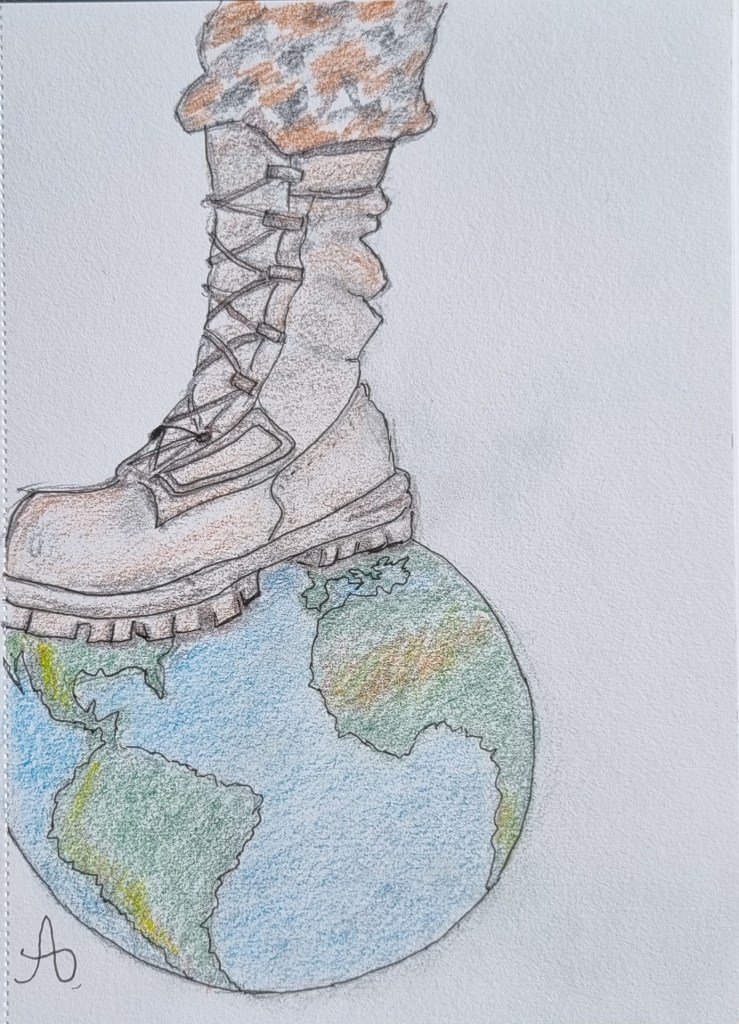
Let’s get out from under the carbon military boot print

Irrespective of what stance you take on the war in Ukraine, or anywhere else, in March last year, US author Meehan Crist wrote the following in the London Review of Books, “One of the worst outcomes of the war in Ukraine would be an increasingly militarised response to climate breakdown, in which Western armies, their budgets ballooning in the name of “national security” seek to control not only the outcome of conflicts but the flow of energy, water, food, key minerals and other natural resources. One does not have to work particularly hard to imagine how barbarous that future would be”.

Crist’s point is simply to describe the world we already have, but a bit more so; and her prediction is exactly what is happening.

  • The US has raised military spending to $858 billion this year; up from $778 billion in 2020.
  • France has announced an increase from a projected E295 billion to E413 billion in the next seven years (an average of E59 billion a year).
  • German spending is rising sharply, from E53 billion in 2021 to E100 billion in 2022 and is set to go further.
  • Japan aims to double its military spending by 2028 and is also debating whether to start deploying nuclear weapons.
  • In the UK, the government’s aim to increase military spending from 2.1% of GDP to 2.5% by 2030 comes on the back of what is already among the highest per capita military spends in the world.
  • NATO, the core alliance of the Global North, already accounted for 55.8% of global military spending in 2021 before any of these increases.
  • Other direct US allies – with a mutual defence pact – accounted for another 6.3%.
  • So, the direct US centred military alliances account for three fifths of global military spending and yet they are now raising it further at unprecedented rates. These are the world’s dominant imperial powers, acting in concert to sustain a “rules based international order” in which the rules are written in, and to suit, the Global North in general and Washington in particular.

The carbon boot print of these militaries is not measured under the Paris Agreement. It is, nevertheless, huge and growing; and we can’t pretend it isn’t. At the moment, the carbon boot print of the US military alone is the same as that of the entire nation of France. This is incompatible with stopping climate breakdown; both in the direct impact of production and deployment, the diversion of funds which are urgently needed to invest in the transition, and the potential impact of their use – which could kill us all very quickly; particularly if nuclear weapons are used. John Bellamy Foster’s Notes on Exterminism for the Twenty First Century Ecology and Peace Movements should be required reading for both movements.

Because this military is not sitting idle. The first phase of the Wars for the New American Century – in the form of the War on Terror since 2001 – have been calculated by Browns University at 4.5 million people; three quarters of them civilians killed by indirect impacts of US and allied military interventions. The scale of this is because doctrines like “shock and awe” are not simply an impressive displays of explosive power, but specifically designed to smash energy and water systems, both clean water supply and sewage treatment, within the first twenty four hours of an intervention to reduce surviving civilian populations to a state of numbed misery and demoralisation. “Why do they hate us?” I wonder. 4.5 million people is about half the population of Greater London, or three quarters of the population of Denmark and twenty two times as many as have died in the Ukraine war so far (assuming total casualties of 200,000, most of them military on both sides). It’s a lot of people. *

Their deployment and use more widely against opponents that are more resilient than Iraq, Afghanistan or Libya- which this escalation of expenditure and increased integration of alliances makes possible – would, even if it did not go nuclear, be catastrophic both in its direct loss of lives but also in the disruption of global supply chains leading to widespread economic unravelling. According to the Australian Strategic Policy Institute, a war in the South China Sea that closed down shipping lanes would have a rapid impact regionally – “Taiwan’s economy would contract by a third, while Singapore’s economy would fall by 22%, according to the baseline estimate. Hong Kong, Vietnam, the Philippines and Malaysia would suffer falls of between 10% and 15%” – but would have a knock on effect everywhere else affecting 92% of global trade. The attempt in the Global North to set up “secure supply chains” – defining economic policy increasingly around military imperatives (“securonomics”) is not to avert such a conflict, but to make it economically manageable, and therefore more likely.

This scale of military expenditure also dwarfs their domestic investment in combatting climate change, urgently needed because the wealthiest countries put the heaviest weight of emissions on the rest of the world, both historically and through their per capita footprints now: let alone helping Global South countries develop without reliance on fossil fuels. This has a wider implication, with the UN Sustainable Development Solutions Network reporting that progress towards the UN Sustainable Development goals has been static for three years.

Pledged to commit $100 billion a year to help the transition in the Global South, more than ten years ago, they have never been able to eke out this money, have never hit the target, have tried to use loans (debt trap) instead of transfers, sought to apply conditions and control. The US contribution to that is now aiming for just over $11 billion by 2024. This is now reckoned to be a tenth of what’s needed. This is despite 66% of their populations agreeing that this support should go in, and only 11% against. The contrast with the $77 billion they have stumped up to fight the Ukraine war with no trouble at all in the last year is quite startling. News that Finland is planning to cut development aid to countries in Africa that don’t line up behind the Western line on Ukraine is an ominous sign of how far backwards this could begin to go; with any attempt at global governance through structures like the UN abandoned and notions of international obligation and mutual humanity giving way to even more overtly colonial attitudes and practices than we already have. Although the notion that the Global North can “build a wall” and keep the human consequences of climate breakdown out is a fantasy – as the climate is breaking down behind the wall too – it probably won’t stop them trying.

The USA and its allies pose themselves as “Global Leaders”. They could and should be, as they are the countries with the greatest concentrations of wealth, power and technical know how, communications and education, but they are falling horribly short; because they see leadership as the same thing as dominance – and subordinate everything else to that.

In fact, in 2022, China – usually presented in our media as a negative force on climate – invested 70% more in renewable energy generation than the USA and EU combined, just under half the global total on its own. Next year, according to the International Energy Agency, China will account for 70% of new offshore wind, 60% of new onshore wind, and 50% on new solar PV installations. So, the “international leaders” have a lot of catching up to do.
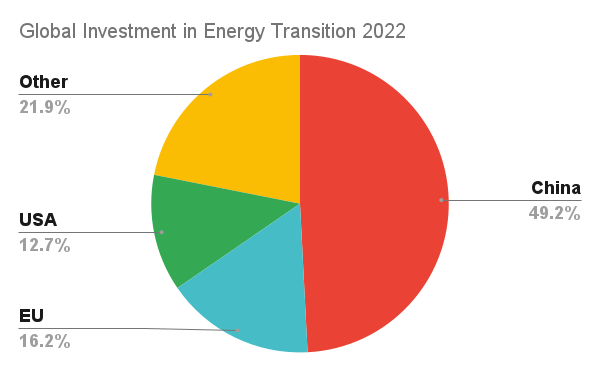
The US and EU are some way behind, and nowhere near where they need to be. Instead of investing on the scale needed to hold the global temperature increase below 1.5C, they are tooling themselves up militarily to try to deal with the consequences of failing to do so; in an effort to sustain their global dominance. If they are leading us anywhere, its to Armageddon.

A report from the US military in 2019 sums up the paradox. Reflecting that, if climate breakdown continues at its present rate, countries that are already water stressed will be getting beyond crisis point within two decades and that this will lead to “disorder”. Their conclusion was that this means that

1. they will be intervening in these crises, and

2. will therefore need to build themselves in a secure supply chain of water so that the troops who are dealing with people in crisis because their environment has run out of it, will have enough to keep them going in the field!

Reflecting further, that on our current trajectory, climate impacts within the United States itself would lead to infrastructure breaking down, followed by the social order breaking down, followed by the military itself breaking down; as it faced overstretch trying to maintain order as civil society failed. Nevertheless, they also note that the rapidly increasing melt of the Arctic ice shelves and permafrost means that new sources of the fossil fuels that are causing the crisis in the first place to be available for exploitation and that a key task for them would be to make sure that the US gets the lion’s share of them. As a study in self defeating thinking, it can’t be beat.

To repeat the point at the beginning, regardless of anyone’s stance on any given war taking place now, and who should “win” it, its this drive and acceleration of military spending that the climate and peace movements should be combining to hold back – both to avert the growing risk of conflict, because arms races tend to end in wars on the momentum of their own dynamic (which requires a lot of demonisation and conflictual stances to fuel and justify it) and to allow saved funds to be used to avert the climate crisis itself. A bottom line demand is that the military carbon boot print must be accounted for in the Paris Process and a mechanism agreed for reductions to a common per capita level, combined with common measures and investments for increased global cooperation in lock step with it.

*Casualty figures in Ukraine are easy to come by but hard to trust. 200,000 assumes a parity between the Ukrainian and Russian militaries; whereas figures from Mossad, among others, indicate significantly lower Russian losses (at perhaps a fifth to a third of the Ukrainian level) so 200,000 may be a high estimate. One notable feature of this war is that civilian casualties have been a fraction of the military losses – the opposite of the trend from the mid twentieth century onwards; during which “there has been an increase in civilian fatalities from 5% at the turn of the 19th century to 15% during World War I (WW I), 65% by the end of World War II (WW II), and to more than 90% in the wars during 1990’s, affecting more children than soldiers”. From https://www.frontiersin.org/articles/10.3389/fpubh.2021.765261/full#B12

The Balloon Goes Up!

Is it a bird? Is it a plane?

Amid all the fuss about the Chinese balloon floating over Montana – we should not forget that the US has 339 military surveillance satellites operating around the world; watching everyone and everything all the time.

They launched four of them in 2020 and, as Space Magazine reported at the time “It’s unclear exactly what the spacecraft will be doing up there.” Though I think we can work it out.

If every other country reacted to that like the US has to this balloon, no future summit would ever be able to take place.

Paranoia about Chinese technology is becoming another theme being pushed hard in the Western Press and on right wing sites. Here’s a headline from one of them. China finds SHOCKING WAY to spy on you – and they’re already in your KITCHEN! (their caps) Of course, if there’s someone from Chinese intelligence who wants to sit in your fridge to note the contents, he or she would have to nudge Jeff Bezos, Mark Zuckerberg and Eric Schmidt out of the way first. “Alexa! note down everything I’m saying”.

The US has also been developing balloon surveillance capacity of its own. Last May Politico reported that

Over the past two years, the Pentagon has spent about $3.8 million on balloon projects, and plans to spend $27.1 million in fiscal year 2023 to continue work on multiple efforts, according to budget documents.

And that

For years, DoD has conducted tests using high-altitude balloons and solar-powered drones to collect data, provide ground forces with communication and mitigate satellite problems. The Pentagon is quietly transitioning the balloon projects to the military services to collect data and transmit information to aircraft, POLITICO discovered in DoD budget justification documents.

Projecting just a little perhaps?

Where Paul Mason goes wrong…

By Farcaster – http://heymancenter.org/files/events/milanovic.pdf, CC BY-SA 4.0, https://commons.wikimedia.org/w/index.php?curid=49781915

Paul Mason’s 2018 article What kind of capitalism is it possible for the left to build? while dated in its optimistic presumption that left governments were on the cards in the UK, USA, France and Spain in short order, is, as he puts it “brutally honest” in its rejection of any notion that the working class in the richer countries has any obligations towards, or prospects of an alliance with, the working classes and oppressed of the developing world.

As he puts it in his conclusion,

“Is this strategy designed to allow the populations of the developed world to capture more of the growth projected over the next 5-15 years, if necessary at the cost of China, India and Brazil having to find new ways to break out of the middle income trap? Would it, in other words, flatten out and reverse the trends captured in Branko Milanovic’s famous “elephant graph” over the next two decades?

For me the answer is yes. This is a programme to save democracy, democratic institutions and values in the developed world by reversing the 30-year policy of enriching the bottom 60% and the top 1% of the world’s population.

It is a programme to deliver growth and prosperity in Wigan, Newport and Kirkcaldy – if necessary at the price of not delivering them to Shenzhen, Bombay and Dubai.

Lets examine this more closely. Delivering growth and prosperity to “Wigan, Newport and Kirkaldy” – if necessary at the price of not delivering them to Shenzen, Bombay (sic – its been called Mumbai for years) and Dubai” might be more simply summarised as “Britain First”, despite Mason’s insistence that he is against “ethno-nationalism”.

Letting Shenzen and Mumbai go hang alongside Dubai means that he is not solely concerned with the “Global South elite” – a term that appears in his Tweets quite a lot as a way to imply that the Global South is so much more full of elites than the Global North – but with the labouring masses of the entire Global South; the overwhelming majority of humanity. For Mason, if they stay poor as the price of “prosperity to Wigan”, so be it. But, in reality, the “bottom 60%” are far from being “enriched”. They are barely getting by. Under the impact of Covid and now the Ukraine war, they are being impoverished very quickly.

Presumably Mason thinks that’s ok because they’re used to it, and should find “other ways” to get better off; and its their problem to do it, nothing to do with us. These are, after all, far away countries of which we know little.

In this sentence is the abandonment of any basic solidarity between working people in the wealthy countries and those who are far worse of than we are – probably because they are far worse of than we are.

The “elephant graph is misleading in some respects in that, while it notes increases in wealth, it does not take into account the starting points for those increases, and gives the impression that the working class in the developed/advanced/imperialist countries (delete according to ideological preference, but we all know who we’re talking about) are relatively hard done by compared with those in the Global South. This graphic from Visual Capitalist (!) shows what the actual distribution of global wealth is – and points to rather different conclusions from Mason’s.

The full article from Visual Capitalist can be seen here.

The “logic” of Mason’s position is that working class people in the Global North, most of whom are in the 32.8% above earning between $10,000 and $100,000 a year and hold 11.1% of the world’s wealth, should be fighting simultaneously with the top 11% – those earning over $100,000 a year holding 85% of the world’s wealth – and the bottom 55% – those earning less than $10,000 a year owning just 1.3% of the world’s wealth.

In his failure to recognise the necessity of an alliance between workers in the Global North with those in the Global South – the majority of humanity – Mason’s position can’t help but collapse into the “ethno-nationalism” he claims to be seeking to avoid.

The logic of “ethno-nationalism” is for workers in the wealthier countries to bloc with the top 11% – who are overwhelmingly concentrated in the Global North – against the Global South. “Send them back!” Build that wall!” This is most extremely expressed by Fascists. But Fascists, in emphasising white racial solidarity as their motivating drive, create division and run the risk of civil war in multi ethnic Global North countries. So, at the moment, this is usually expressed more “inclusively” in terms of “national unity” or “Western Values” or “democracy in our continent” (Keir Starmer, my emphasis).

And, looking at this more closely, Mason avoids a key point. Part of the Global South has found another way forward, but not one that Mason likes.

If you look at the link to the elephant graph in the quote above, it has a very revealing caption. The sharp differentiation between the working class in the developed countries and the top 1% is very clear. The growth in income and well being in the Global South is helpfully qualified to point out that most of this has happened in China.

And so it has. From an average per capita income of around $300 a year in 1980 to over $10,000 a year now. This has been described in a Labour Foreign Policy Group document that is primarily hostile to China as “perhaps the most significant contribution to human wellbeing in world history”.

You might think that such a development might merit a positive engagement from someone who describes himself as a Socialist; given that the elimination of extreme poverty in China and the lifting up of 850 million people to relatively decent living standards has taken place under the government of a Communist Party with 90 million members in a country that sees itself as building “Socialism with Chinese characteristics”.

But not a bit of it. Mason counterposes this to “prosperity in Wigan etc”. His “30 year policy” remark implies that the growth and development in China – which is of a different order and different scale to any part of the Global South still labouring under the Washington consensus – is part of the same process that has led to extreme income differentiation in the Global North, not, as it is, part of a challenge to it.

He therefore gets his alliances all wrong. While he posits the possibility of taking on both the bottom 60% and the top 1%, the logic of his position is a Global North class bloc against the Global South in general, and those countries within it that see themselves as Socialist in particular.

His title spells this out. “What kind of capitalism is it possible for the left to build?” This is the Left in the developed countries. Ourselves alone. Which he presumes can take on our own ruling classes – not only without global allies but actively repudiating them – while leaving the 1% he is supposedly targeting in control of their own system; hoping that – under challenge -they will stay within the bounds of “democratic institutions”; despite all our historical experience of what they do whenever their interests are threatened.

This is both wrong and impossible.

And the proof of this pudding has already been in the eating. Since he wrote his article in 2018, the vehicles for such a prospect have been seriously smashed up by the ruling class. No one now expects the Sanders current in the US, the sort of left Social Democracy represented by Corbynism in the UK, or La France Insoumise to get into government. At all. The scale of defeat varies, but the bottom line is that no variant of left social democracy is going to be let anywhere near government in any country in the Global North that has any heft; so Mason’s nostrums are a dead letter before they start. In the UK, the Starmer project flirts overtly with and encourages exactly the sort of ethno-nationalism Mason claims he opposes.

We live in the best democracies money can buy. The “democratic institutions” in our countries are the facade through which the rule of the 1% is mediated. This operates on a whole series of sophisticated levels which, under the impact of economic and political crises are becoming more evident. The attacks on “democracy, democratic institutions and values in the developed world” – from naked gerrymandering to voter suppression to racist notions that citizenship in wealthy countries is a privilege that carries a price tag of political loyalty- are all home grown. These “democratic institutions” are not a natural part of Global North society but a space to organise won in struggle that is now under increasing attack with – paradoxically – the slogans of a Cold War between “Democracy” and “authoritarianism” as part of the cover for it.

Economic Nationalism and Nuclear Energy

The problem with drinking patriotic Kool Aid is that it can’t help but lead to hallucinations. And it doesn’t matter if the beverage concerned is traditional true blue vintage or a home brew knock off tribute version.

Surreal is not usually a word I would associate with the General, Municipal and Boilermakers Union, but their comment on the government decision to try to cut out Chinese involvement in UK Nuclear power plant construction – that this is a huge opportunity to regain the UK’s position as the world leader in new nuclear (1) – is bizarre for a number of reasons.

  • The UK has not been a world leader in new nuclear since about 1957.
  • In 2019 the countries installing the most new nuclear power plants were China and Russia. (2)
  • Since 1990, Japan and France have dominated global nuclear R&D, with 64% of expenditure between them. (3)

The UKs proposed £250 million investment in developing Small Modular Reactors as part of the government’s 10 point Plan is such a tiny fraction of this that it might be more accurately categorised as a token gesture.

Nevertheless, SMR plants, based on a souped up version of Rolls Royce’s nuclear motors for submarines – will – if they go ahead – produce electricity that is a third more expensive even than that produced by large reactors at the moment; in a context in which the costs of renewables are constantly falling. Why the industry projects that these expensive baby white elephants would create a viable export industry is a mystery – especially after somewhat larger funding to kick start a similar project in the USA was pulled in 2017 (4).

Promises of a nuclear new dawn larded down with bunting are hardy perennials. In 2015, George Osborne promised that that at least £250m would be spent by 2020 on an “ambitious” programme to “position the UK as a global leader in innovative nuclear technologies”.(5) Same old figure. Same old patriotic bluster. Welcome to the new announcement. Same as the old announcement.

Plans for 6 new large power stations have now been cut to 3. Cost overruns and delays are built in, as is a high price for the electricity eventually generated. The price for electricity generated by Hinckley C is £92.50 per megawatt hour; twice the wholesale price. This plant, being constructed by EDF, was supposed to be built by 2017, but is now not expected until 2026. It will cost £23bn, not the original £16bn in the contract. Sizewell C is projected to cost another £20 billion, with the costs falling on bill payers even before its up and running.

There are many reasons not to go down the nuclear route. Chinese involvement is not one of them.

Workers at Fukushima showing how safe nuclear power is.  IAEA Imagebank is licensed under CC BY-SA 2.0

The argument to break the contract with China’s “state owned nuclear energy company”, as the GMB puts it, is on “security” grounds. This is only an issue if the government is projecting a future of increasing hostility. This is not something being generated by the Chinese. We are sending an aircraft carrier to their backyard. They are not sending one to ours. The whole labour movement should see this new Cold War atmosphere as a threat, not dress it up as an opportunity.

  1. Chinese nuclear block ‘staggering U-turn’ from Conservatives | GMB

2. Nuclear Power – Analysis – IEA

3. Energy Subsidies – World Nuclear Association (world-nuclear.org)

4. UK: Power from SMRs 30% more expensive than large reactors | Wise International

5. UK government to release funding for mini nuclear power stations | Energy industry | The Guardian