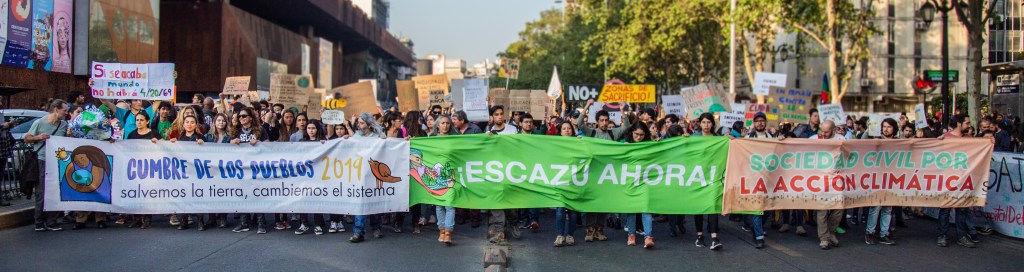
Photo by Constanza.dougnac – Own work, CC BY-SA 4.0,
This is, approximately, the text of a speech I gave at the Climate, Class and Crisis meeting at Goldsmiths College on 6th June. The full meeting can be viewed here **with some very interesting contributions from Claire Fuller, one of the founders of XR, who is still very much involved, Damian Gayle, Environment correspondent for the Guardian and Matt Huber author of Climate Change as Class War and a Professor in the Geography and Environment Department at Syracuse University New York and chaired by Feyzi Ismail of Goldsmiths Media Studies Dept.***
I’m going to be speaking in a personal capacity so I can be more heretical, which tends to get more of an interesting discussion. The whole question climate breakdown is a class struggle and it’s a global one; and the working class movement has to step up and lead it because the ruling class is failing to do so.
Globally, I think we have to get a handle on what’s needed and who’s doing what.
There was a very interesting article recently by Adam Tooze which identified that in order to actually make the energy transition we need to be investing $4 trillion a year.
According to the International Energy Agency, last year 1.7 trillion was invested in renewables ( though, as they are including nuclear in that, that’s a little optimistic.
But one trillion was still invested in fossil fuels.
So you’ve got $1.7 trillion going more or less in the right direction, but one trillion going the other way.
So overall, a move of $0.7 trillion in the right direction, but we need to be doing more than four times as much.
So, that’s the scale of what we need to be doing.
Tooze also notes that, of that renewable investment, 49.7% of it was by China; which was 70% more in total than the United States and the EU combined.
We don’t hear about that a lot. We usually get China as the villain of the piece because of its coal fired power stations…
So, that’s the scale of the investment; and those three big continental economies make up more than 75% of the time.
And those figures are confirmed by the IEA for the next year. Their projection is that China is going to account for 55% of new renewable capacity in 2024.
So, whatever your view of China, Tooze ‘s comment that it’s the only country in the world investing on the scale required poses a question for all of us in the Global North/West. Why aren’t our much richer societies/ economies/ polities, matching that, or doing more?
Some of it is that climate breakdown, as well as representing an existential challenge for the survival of humanity, in a more immediate limited sense represents an existential challenge for the ruling class as a class.
Oxfam did an analysis that showed that the top 10% – which is basically anyone or more than about £80,000 a year – will take us beyond 1.5 degrees on their own; which underlines the point that for most of us 80,000 quid is a lot of money, but for people like Boris Johnson, you know that this is a fraction of the “chicken feed” that he said he was being paid to write for the Daily Telegraph, which I think was a quarter of a million a year. So for people like him, a very, very, very high standard of living is is really roughing it: the other phrase he used for this was “hairshirtery”. And, for him and people like him, it would be.
And there’s also very worrying thing at the moment, which is the misdirection of investment into military spending. In the US debt ceiling negotiations last week they agreed to cut welfare but increase the military budget to $850 billion a year.
And that’s going on throughout the Global North. Japan, Germany, are doubling expenditure; Britain’s going up to 2.5% of GDP; and the implication of that is that the Global North, rather than invest in actually combating climate change, is tooling itself up to defend itself against the consequences of failing to do so.
So what do we do, given that it’s the top 10% that run the show, control capital, the markets, buy politicians and set the media agenda?
This isn’t about protest.
It’s not about getting the people in charge to notice in the hope they’ll do the right thing.
They know; and prioritize other things.
The fossil fuel companies put money into climate denial and and confusion in the same way that the tobacco and asbestos companies did about the links between their products and cancer.
The private sector won’t lead.
There’s only 5% of big companies have “gold standard” transition plans. And that’s this government’s gold standard, so that’s probably going to be fairly generous to them.
For small companies, it’s not really on their agenda.
One of the big U.S. Investment banks that withdrew from Mark Carney’s Climate Finance initiative last year did so because they said putting climate concerns ahead of profits for shareholders was “immoral.”
So all of this now requires a kind of massive cognitive dissonance – not simply on their part but across the whole of society; to keep us all thinking in a strange kind of way, with an emotional disconnection from what’s actually going on – and the promotion of all that via the media across society.
That ranges from outright denial, people like the Global Warming Policy Foundation, through a kind of Technical Micawberism; you know, something wonderful and technological will turn up and save us all at the last minute…and with one mighty bound we’ll be free! Just illusion and ideological delusion.
I remember Nadim Zahawi at the launch of the DFE net zero strategy at the Natural History Museum last year saying very, ebulliently “We are going to be saved by the British entrepreneurial spirit!”
Yeah…
OK, so you get denial in various forms.
And it ranges from Sunak, who says it’s “economically illiterate” to block New North Sea oil and gas.
To people like Gary Smith from the GMB, who says it’s “naïve” to block New North Sea oil and gas.
So the first thing is we have a fight in the labour movement.
And we need to organize to have it, and I’ve got a bit of a checklist, which is a bit obvious, you know, grandmother sucking eggs situation.
But we need
- a network of Climate activists in each union that’s organized.
- Sound policy passed in each union; and on the wider issues, not simply the sectoral concerns, but the overall issues. Because we’ve got to think strategically. We’ve got to think hegemonically. We’ve got to think that our movement has got to lead this fight. It’s not about defending our members from it. It’s about getting ahead of it. Of course, there’s different challenges in different unions.
- Taking that policy up to the TUC.
- Get the Union apparatus partly organizing around the issue. In the NEU for instance what used to be health and safety is now health, safety and environment and we’re doing things like getting out heat guidance – which never used to be an issue, but it is now. And we’re having our first ever green bargaining reps training at the beginning of July. So that sort of thing is happening. The UCU is way ahead of us btw. They’ve been doing it for about five years longer than we have.
- To organize across unions in the same sector. We put a united front together of all of the unions in the education sector, whether they’ve got network or not, around the DFE Net Zero Strategy producing a joint critique of it, and we’re continuing to liaise.
- The activists to coordinate across the whole movement. And you’ve got lots of formations for that. You’ve got Climate Justice Coalition, Campaign Against Climate Change, Greener Jobs Alliance.
- To take this politically and by politically I mean in a very narrow sense, in slightly Parliamentary sense at this point. Obviously it’s got to be taken up much more broadly in terms of the kind of mobilization Claire was talking about. But in terms of government, because it’s what states do that’s going to make the immediate difference, there’s the whole question of what Labour’s going to do. Because we’re very likely going to have a Labour government and it’s going to be a Starmer led Labour government not a Corbyn led government: so it’s a rather different kettle of fish and the current discussion on North Sea oil and gas and the £28 billion investment, whether they’re going to do it or not, is absolutely the frontline of the argument at the moment. And we’ve got to fight that one through. So, for example, the just transition demands that UNITE says it wants to promote -they should be very clear about what those are, to coordinate that with other people in the movement, and fight that through the Just Transition body that Labour actually has; which UNITE is part of. It’s not a matter of saying ohh we want a just transition but not actually putting it forward. We got to make sure they put it forward. I haven’t seen it yet. I’m sure they will come up with something, but it’s it’s a matter of urgency that they do it.
- It’s wider as well, because we’ve got to look at local authorities. Can we get local authorities to set up Just Transition bodies to plan for things like insulation, the expansion of the workforce that we need, training those new workers in the FE colleges, including a climate awareness module so that they know what they’re doing and why they’re doing it? So they’re on a mission. Not just doing a job. They’re on a mission and they believe in that mission. It’s about social transformation and linked to community campaigns for local energy generation and things like onshore wind.
Do you know how many onshore wind turbines were put up in this country last year?
2! Both at Keele University. Just staggering.
Just a few points on protest.
I think we’ve got to try to avoid public antagonism.
I don’t think it helps having people, you know, really hacked off – people going about their ordinary business really hacked off – but to target ruling class over consumption, so that you’re actually connecting with all the resentment that people feel about the inequality that we’re going through at the moment – and it’s being put on the right targets; all these people flying about in private jets, why aren’t we targeting that?
And to undercut all this bullshit that you get in the media – that the climate movement is all posh people inconveniencing “ordinary folk”, in the words of Andrew Neil. So you get this stuff from Farage, who says “Just Stop Oil is all posh girls called Imogen and India”, right?
This is from a stockbroker from Sevenoaks who went to Dulwich College and his name is Nigel. Man of the people?
So we have to undercut that narrative.
We’re also going to have to target the media in my view, because it is really poisonous. We are absolutely flooded by denial and drivel; I mean, how many more articles on Phillip Schofield can you take?
And we also need to coordinate the mass actions. I think the turn of XR to mass organization is the right move. The Big One was terrific. It was like a four day outdoor teach in. Everybody was learning from everybody else and it it was brilliant. We need more of that. But I think we need to coordinate it, organise it with other currents; and organise it at key points like the COP. You know, there’s been some students occupying universities recently. Would it be possible to organize a mass wave of that in November? Don’t know… throwing it out there.
Last thing, I think we also need to highlight demands that cut costs and accelerate the transition. Insulation is the obvious one, but what about a demand for free travel cards for every worker, paid for by the employer to facilitate the transition to public transport and away from cars?
To sum up, however we do it, let’s not mourn, let’s organise.*
*I didn’t actually say this bit, but thought about it afterwards as the conclusion I should have used…instead of “er, that’s it” so, to that extent, this text is backdated.
**If you watch the video and look at the machine generated transliteration that runs alongside, it provides hilarious food for thought for anyone who believes that the activity of reading is solely phonetic. The same thing can be seen if you ever watch the transliteration of the News that runs in a strip along the bottom on the BBC 24 hour channel a few seconds after the speaker.
What the machine is doing is taking the sounds it picks up and putting them into words that sound like the sounds. This is the theory of synthetic phonics in action, in an almost pure form, because the awkward middle stage of recognising and attributing a sound to the graphemes (letters) is cut out.
Because there is no reference to syntax, and the meaning of the sentence up to that point, the results are a bit hit and miss. Sometimes accurate. Sometimes gibberish.
Which underlines the point that in actual reading – done by people – the meaning of the text read so far helps guide what you think is coming next; so the recognition of letters and sounds is in a dialectic with that.
Children learning to read do this quite slowly – and you can see them doing it; sometimes reading on a bit before noticing that what they are saying doesn’t match what they are seeing, so going back to have another go. Adults and proficient readers do that too, but at such a terrific pace that its below conscious attention.
***In Feyzi’s intro she says that I was the founder of Thurrock Friends of the Earth in 1971, one of the first local FOE groups. I was actually one of several people, including Angela Monck, Bob Moorman and others, all of us school students; and at that point we had no inkling of climate change, but were worried about nature depletion – all the local elm trees were dying of Dutch Elm disease – and a wasteful use of resources. At one point we picketed the local Tescos about overpackaging and got in the local paper looking purposeful and frighteningly young.
 Urban ramblings