The time’s out of joint episode 3. We the people?

The real divisions in a society in crisis are often obscured by the form of the apparent political rift. When Polly Toynbee (Guardian 26/3/19) argues from opinion poll results that the divide between leavers and remainers is now more strongly felt than prior allegiance to political party she underlines a disjunct between a passing sense of identity and a longer term set of alliances based on material interests that are more fundamental.

These interests cross borders. A paradox of globalisation is that the ethno-nationalist reaction against it is being encouraged, assisted and funded by the policy of the Trump administration in the United States, and some of the right wing  media outfits associated with him. Some US businesses are doing this directly – looking forward to serious pickings as big polities are broken up into weaker fragments. They are working on the EU. They would like to do it to China.

The most fundamental  division in Britain is between those who have wealth and power and those who do not – however they voted in June 2016. It is in the interests of the former to coral as many of the latter as possible behind them and the most potent way to do so has always been “patriotism” – the assumption that being born in a place should put you at the front of the queue for whatever is going and – that your particular “identity” somehow makes you both better than other people and gives you a wider significance- as a compensation for your very real subordination and obscurity in everyday life. In countries that are no longer as powerful and influential as they were, this often becomes toxic.

A division within the wealthy – in which one faction breaks with the established way of doing things- leads to all sorts of weird developments in which all that is solid turns into air – old Etonians claim to be anti-elitist, a leadership contender for the Conservative Party says “Fuck business”, the Daily Express, Sun and Mail denounce the House of Lords and the judiciary; and hedge fund managers short sell UK stocks and bonds to cash in on the economic consequences of their “patriotic” campaign – in which the lower orders are urged to “believe in the country” – taking as their motto an inversion of JFK – “ask not what you can do for your country” – ask only what your country can do for you.” and go laughing all the way to the tax haven.  Because the country is set up for their benefit and only functions in order to do so, they wrap themselves in the Union flag while deftly stashing their assets in Dublin or Belize or Singapore, and preparing to burn “traitors” on bonfires made of red tape, as a distraction from the grand opening of

  • Free Trade Ports and Enterprise zones (in which they and their friends will be bribed and subsidised to invest, while paying no tax back)
  • the take over of the Health Service by US insurance firms (and probably Virgin) -so check the wallet before the pulse
  • and the spread of chlorinated fried chicken stands- finger lickin cheap and nasty.

disguising their venality in the name of “The People.”

So, who are “The People”?

When Michael Howard went on the radio on Sunday (24 March) to argue for the hardest available Brexit, he talked about honouring the wishes of the 17.4 million people who vote to leave in the referendum, without troubling himself to question whether his own preference was indeed what they were voting for. He had a point as far as it went. 17.4 million is a lot of people and their views have to be taken into account. But, beyond the 17.4 million, what about the rest of us?

In a country with over 66 million people, that’s just under 50 million who’s views – in Howard’s world – are simply to be excluded from having any say or influence in the future direction of the country.

One of his Conservative colleagues commented today that “the British people” had “voted overwhelmingly” to leave the EU. Thinking that a ratio of 52:48 of those voting is “overwhelming”is sufficiently odd to require some investigation as to who he thinks “the British people” are.

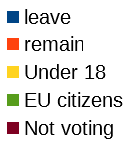
Of a population of 65.5 million in 2016:

17.4 million voted leave.

16 million voted remain.

13 million were under 18 and ineligible to vote.

3 million were EU citizens not entitled to vote despite working and contributing.

16 million didn’t vote at all.

As a graph, this looks like this.

imageunnamed

For this Conservative MP, the bloc represented in dark blue is an “overwhelming majority.” For Michael Howard these are “the people”, or at least the people that count – in whose image the nation must be recast. This is also about the control of the 17.4 million. Their views were and are far more diverse than they have been presented, but for people like Howard they are a useful statistic forever frozen in 2016 – the time of The One True Vote.

This sets us up for continuing crisis and polarisation. A political project that seeks to slash and burn regulations and protections for workers rights and the environment, that favours the replacement of the civil service with ad hoc committees of businessmen, that is prepared to see social security, farming and manufacturing go to the wall by slashing tariffs, and the re-ignition of the Irish troubles over a reimposed border, cannot afford to have a consensual approach. The sheep must be separated from the goats and the goats must be slaughtered. The cultural revolution style shrillness of the headlines – CRUSH THE SABOTEURS – ENEMIES OF THE PEOPLE –  matches the disruptive scale of the project and also the impossibility of it being carried through without a breakdown in an agreed political framework in which differences can be resolved without violence. It is in this context that a reviving UKIP is seeking to build an effective  street fighting movement led by Tommy Robinson, pulling firms of football hooligans into some very large and aggressive mobilisations which have attacked trade unionists and the police.

If Brexit is averted the crisis will continue because everything that then goes wrong will be attributed to “the great betrayal” – in the same way that Germany was only defeated in World War 1 because the army was “stabbed in the back.” Untrue myths are often the most potent – because they cannot be tested. The scale of this remains to be seen, but anyone who thinks that just remaining in the EU as it currently is will solve all our problems has not noticed the economic stagnation of the euro zone, the impasse of Macron, the backsliding of Germany on its climate change commitments and the continent wide spread of US backed ethno-nationalist currents likely to make the next European parliament the most right wing in its history.

If Brexit is not averted – especially if we get a hard version – the grim realities are likely to turbo charge a hunt for further “saboteurs” and “enemies if the people”.

Although the weariness at all this is often expressed in the infantile injunction to “just get on with it” – as if “it” was something that you could “just get on with” – most people want to be able to get on with their lives without massive upheaval and disruption. Remaining, or the softest possible Brexit, like Labour’s deal or Norway plus, offers the best chance of relative stability in which “The People” can realign around more fundamental questions.


The old order is dying, the new struggles to be born*.

It was the contrast that did it.

The old

On March 15th at 11:20 in the morning there were two groups of secondary school students standing outside the National Gallery on a trip. They looked as though they would do what they were told, accept what they were given; or – if given the chance – resist it in secret underhand ways, damaging to all concerned.

Bedecked in black (always black) Academy blazers, they were lined up, orderly, standing still with barely a twitch, silent, a bit resigned but tense and sullen looking; as though having had to be socialised by psychological defeat. They were collectively individualised; isolated from one another all together: sameness one at a time.

They were staring blankly, incuriously seemingly at nothing, eyes mostly unfocussed and inward, as though the centre of London were no more interesting than a dentist’s waiting room; passive enough to be ready for a future holding little promise of security, a home to live in or worthwhile, well paid work to do.

The established faith – an untruth universally acknowledged –  that education is the way up and out – that if you work hard and get your grades you’ll get on, that each of us is pitted against each other in a battle for a big car and a big house, status, standing or celebrity and that social mobility “up” to a lifestyle that burns its way through the planet’s resources in a desperate search for something to fill the holes in our souls is a real or worthwhile enough dream for everyone to buy into – hanging over them like a preordained defeat; with the occasional Pygmalian escapee only serving to mock those left behind.

No doubt their school would get a “good” or “outstanding” from OFSTED for successful socialisation of the next generation; shaving off the edges of their square pegs the better to fit compliantly into the corporate round holes of a world in which their dulled, test drilled uniformity is the human equivalent of the crash of species – from rain forests and insects to amphibians, big cats and primates; and their replacement by mono-cultural plantations, 5 billion factory farmed cows and 20 billion chickens poisoning water courses in a mountain of manure.

Their teacher stood in front, half looking away, aware but glazed, with the slight smile of a man whose behavior management systems were beyond having to make exceptional personal efforts; but who was nevertheless avoiding eye contact.

A new hope

Five minutes later and a stone’s throw away, spread across the whole of Whitehall, moving fast and tumultuously, laying siege to Downing Street and bouncing up and down on the walls of ministries, thousands upon thousands of their contemporaries came pouring up the road in a torrent of banners, chants, singing, slogans and conversations; calling for their elders to wake up to the threat of runaway climate change.

The Horses on guard at Horse Guards Parade bucked and cantered in a sort of solidarity as their breast plated riders struggled to retain control and blank expressions.

The creative energy was palpable. The intention serious. The mood a mixture of exuberance at taking action, earnest seriousness and a sense of responsibility in getting their message across, defiance in breaking bounds, fueled by an exasperated rage and fear at the cloth eared mulishness of a society so wedded to its old ways of doing things that it is sleep walking into a disaster that is clearly seen yet downplayed to invisibility – in the school curriculum even more than the news.

“I am no longer accepting the things I cannot change. I am changing the things I cannot accept” read one of the banners – a welcome echo of the 68 slogan “Be realistic – demand the impossible” because if what seems impossible is what is necessary for us to survive as a civilisation, we have to face up to it.

In the 1960s some people were sufficiently scared of nuclear war to take direct action to try to shock wider society into opening its eyes to the threat. People sat in the road to block traffic. The students did the same. Sitting in the road and chanting “turn your engines OFF!” as a direct comment on how everyday habits of getting around are helping set us up for disaster. The difference now is that nuclear war is an event that could or could not happen whereas climate change is an event that is happening. Every year it gets more apparent and the urgency of dealing with it gets through to more and more people, despite the millions poured into poo pooing it by fossil fuel companies; exhibiting the same profit defending criminal irresponsibility shown by their counterparts in tobacco and asbestos but on an apocalyptic scale.

These students were unsupervised, running things themselves; improvising a route with lively elan and running rings round the police. They broke through the limits of official dialogue and behavior in a self disciplined orderly disorder. Adults with them were supportive participants with no need to exercise control because the students were dedicated to a higher purpose and were controlling themselves.

In finding the voice that their generation needs, they have overflowed the bounds of business as usual. Their understanding, initiative, creativity, formidable organising skills, capacity for coherent and constructive argument, wit, research skills, courage and humour; have developed a sense of agency, mission, solidarity and empowerment that makes them the leaders in society and education today.

Those Ministers and Head teachers who think it enough to mouth platitudes about missed education and threatening detentions – to try to derail this movement and dampen their students down into the same subordinated, depressed  state as the poor souls outside the National Gallery – are failing to grasp the opportunity for social and educational change that their students are serving up to them on a plate; and of course a staggering lack of any sense of proportion. Many of these students have already stepped into a world beyond one in which the old ways have any meaning or resonance.

They have opened a breach in the old order. Time for the rest of us to pour in behind them.


*Quote from Antonio Gramsci.


Weirder than Takoma Park

On my daily morning fitness and shopping run down to Sainsburys – a good route that I can manage  without stopping because its downhill all the way – I pass through a labyrinth of alleyways on the Springfield estate that zig zag down the hill like a mountain terrace.

There is usually a small pile of discarded beer tins and cigarette packets cluttering up along the fences – the suburban detritus of bored youth or demoralised old age – but this morning, rising above all that and neatly duct taped in a line along one of the creosoted fences were three tulips in full bloom. Having been there overnight they were bowing their bright red heads in an elegant silent swoon, like imprisoned princesses awaiting their fate – or a random art installation with no cultural agenda.

It must have been a significant act for someone for them to buy that number of tulips – or, more menacingly, cut them from someone’s garden – bring them to that spot and tape them up in a line – carefully equidistant – just there. An odd place for a romantic gesture; or a shrine; or a ritual: or a warning.

Down at Wembley Asda  – the stadium looming in the near distance like a newly arrived space craft –  there are people collecting money. It’s not very clear what for. One elderly woman – who looks like she is begging because she has no charity sign, but is turned out too smartly and has far too posh a voice has made herself up all over in lime green face paint, so she looks like a very thin version of Fungus the Bogeyman wearing a shimmery raincoat. As she approaches, a small child riding in a supermarket trolley cowers in terror, her safe world suddenly threatened.

The time’s out of joint. Episode 1. “I cannae hold it Captain, she’s going to blow…”

On September the 19th 2014 I found myself walking towards Hendon tube station unsure about which country I was in. The Scottish independence referendum had been the previous day and I hadn’t heard the result.

It was like being suspended between possibilities. Schrodinger’s country – alive and not alive at the same time. The early morning street bathed in pale sunlight, and all the people going about their business, would have been the same, and just as solid, but which state we were in, and where we might be heading, seemed fluid, full of possibilities, most of them bleak.

Were we still in the Britain we had grown up in, surviving a little while longer with its familiar outlines, dusty old emblems and narcissistic nostalgia; or had Scotland broken away into a brave new dawn on the back of the enthusiastic support of barely half its people, having to lug along the bewildered resentment of the rest like Braveheart with a limp; leaving behind a wounded greater England (or lesser UK) – with Wales and the North of Ireland as awkward appendages cued up to eye the exit – the long slumber of continuity broken by edgy debates about who – after all – we think we are – or, for that matter, were?

Uncertain speculation was resolved prosaically by the front page of the Metro in the Hendon Central entrance. Return to normal. No terrible beauty born. Continuity had won out, allowing the old order to drive on for a few more miles as though nothing had changed – rather like the Duke of Edinburgh in his 4×4 on a country lane on a darkening evening with poor visibility –  but in reality just as a  chrysalis – a thin papery wrapper with deeper, darker stirrings within it – English nationalism – in its stubborn, bloody minded, “I’ll cut my nose off to spite my face if I want to,  because its my bloody nose; and don’t you come over here telling me not to – its none of your bloody business” mode – probably the worst of them.

Had the SNP won in 2014 they, like the Catalan nationalists more recently, would have faced the problem not only of how and how far to disengage with deep structures of economic, political, cultural, personal and emotional love hate relationship that had been taken for granted for years and years and years, but also how to manage a people polarised – just over half wanting to press ahead with a new identity, with the other half no longer feeling completely at home because they had lost something essential to their sense of themselves – which I suspect would have felt like an amputation to a lot of people; still feeling the sensation in ghost limbs, as an awful reminder that they weren’t there any more

At least, in their case, the nationalism was an inclusive one. Anyone who lived in Scotland would be considered Scots, regardless of their origin or anything else. An adjustment would have been difficult, but there was some sort of forward looking prospectus for it. Continuing to co-exist within the wider framework provided by the EU – setting common ground for the tension with the bilateral relationship with England- would have set relatively limits to the poison and polarisation generated by any divorce – just as it had allowed peaceful co-existence between the “two traditions” in the North of Ireland; pending a long term demographic shift towards a united Ireland. Love (or making it) conquering all in the end.

A loosening of absolute identities, allowing people with a differing sense of identity to share a space to live in, is at the heart of belonging in most countries that are going well, looking forward and outwards. Identities are not simple. They are multiple. Every society is to a greater or lesser extent multicultural, multi ethnic, multi faith, multi lingual and divided by class; and every individual’s sense of belonging is a unique combination of these big things and lots of little ones (illustrated rather graphically by the case of the former Jihadist who abandoned ISIS and wanted to come home because he missed his mum, pasties and Dr Who). To loosen things further, all these aspects of identity also overlap with people in other countries; which creates international identities that can be a challenge to the notion of absolute allegiance that all states seek to foster because they want people to die for them. “I vow to thee my country…”

That means that it is possible, outside of periods of crisis, and unless a state defines itself in absolute nationalist terms as belonging to ONE people, defined by blood, for people to co-exist peacefully; even while imagining the country they live in in completely different ways and as a very different place. A metaphor for this is China Mieville’s The City and the City – where the very different cities of Beszel and Ul Qoma occupy the same space operating on different rules and perceived at different ends of the colour spectrum – while their citizens see each other – and the other city – only as a glimpse on the edge of perception.

It’s at moments of crisis – when the economy no longer holds out a future of promise, when people begin to struggle to make ends meet in the here and now, that mutually exclusive visions become more forceful and frenetic, discourse becomes coarse, the centre falls apart – because the arguments really matter – and implicit aspects of identity become explicit and visible and fundamental. When this occurs there is the shock of a rift and the beginning of a prolonged crisis.

To be continued…


John Brown’s body

About twenty years ago, in quieter less delirious times, we were visiting Harper’s ferry in West Virginia and took part in a history walk. The town was full of tour guides dressed in period costume and uniforms and talking in character. A soldier in union blue told us that the town was under military occupation, full of Confederate sympathisers, and under continual threat from Confederate raiders like John Singleton Mosby; and he was keeping a close eye on the market stall in front of him to keep control of smuggling.

A lively young woman in a bonnet, who’d told us the story of John Brown’s raid and attempted slave rebellion in 1859 – in which Brown’s aim to seize the arsenal in the town, then march south along the Appalachians raiding plantations and raising an army of freed slaves came to grief when he was defeated by a company of marines commanded by Robert E Lee, arrested and hung- also set us up for the debate on secession that began the civil war two years later… in which John Brown’s soul went marching on and he achieved posthumous revenge.

Having set out the issues – among which were the divergent pull of loyalty to Virginia combined with significant slave owning in rural areas, pulling against urban employment being heavily boosted by federal contracts for the Armoury (1) – she asked us, when we got to the next stop on the walk, to divide according to how we would have voted – secede and join the Confederacy to one side – or remain with the Union on the other.

Until that point everyone had seemed, and probably perceived each other, to be a common body of (mostly) modern, well off, middle class white Americans with broadly shared assumptions. But when the crowd physically divided there was a slight majority for the Confederacy. The two sides stared at each other across a physical gap that was far smaller than the fracture between their visions of the country they thought they were living in.  I found myself weighing them up in case it came to blows.

The cockahoop smirks on their side and the odd smartass comment- “They’re only votin’ that way to keep their jobs” (2) – and the affronted looks of shock and betrayal on ours – turned a piece of historical play acting into a sign of dangerous times; in which this old fracture in the framework of the nation might again render it incapable of containing the incompatible visions within it.

1 “By 1860 the use of slave labor in West Virginia was about 48% in agriculture, 16% in commerce, 21% in industry and 15% in mixed occupations”. https://en.wikipedia.org/wiki/History_of_slavery_in_West_Virginia

2. The young woman in the bonnet had explained that the town’s largest employers had been very strongly against the Confederacy.

Tree of Lights

If, in early evening, you head down the hill towards Ladbroke Grove from Westbourne Park tube station, when you reach the bottom, at either end of a square just large enough to hold a pair of tapas bars spilling light, music and customers onto pavement tables stand two trees with bright, white lights strewn across their branches, interspersed with wire and paper stars. The effect is quite magical and, for a while, it is enough to perch on a bollard and stare up at it taking in the peace. If you are waiting for the love of your life – as I was – there is something transcendent about it.

At one time there was a bench underneath – which would have made it even more romantic had it not also been the place where the local smack heads would gather, so their surroundings somehow reflected their internal high – which meant that everyone else called it the “heroin bench” and avoided it.

So, the council, sadly, took it away.

In 1979 the same streets looked like a very different place. The same bone structure – magnificent Georgian terraces – but before they’d had face lifts and scrub ups – when they were still coal blackened, crumbling and run down, heavily squatted; with some derelict. In preparation for an overland trip to India I was in search of a publication called the BIT guide. This was a travel guide written for travelers by travelers. A sort of rough guide before these became commercial standardised products.

People who went on the hippy trail east would write down information about where to go to get buses, which hotels were cheap but decent, inspiring places to see, what the exchange rates for currencies were (three years previously) where the bazaars were, where to get drugs and how to avoid them, which hotels were busted regularly in Quetta; and to be wary of the border official at the Lahore to Amritsar crossing who seemed to enjoy frisking people a little too much. These reports from the trail were typed up and duplicated and stapled together to make a fat blue paper covered booklet.

This was wonderfully idiosyncratic, quirky, completely unregulated, massively out of date in detail; no one was “on the same page” or used a “house style”, no one was paid for it, no one was advertising or spinning, nor would anyone expect to be sued for inaccuracy because everyone was stating their own point of view, which you could either take or leave at your own risk. As a labour of love it was remarkably accurate and I’d have been completely lost without it.

Finding it wasn’t easy though. The address I’d been given was a huge old edifice with wide crumbling steps and a heavy front door that was wedged half open. No one seemed to be in. Either that or they were in the process of moving out. Inside there was no sign of people living there. Corridors and stair cases were bare. Piles of junk strewn rubble lay in odd corners. A tall, thin, silent guy with a huge beard – who looked as though he’d fallen asleep at the Isle of Wight festival in 1970 and only just woken up – seemed bemused by me asking him for a BIT guide – as though the time for that had been and gone – but led me to a room in which there was a small pile of them laying about casually on top of another heap of rubble. He didn’t bother with the 50p it was supposed to cost. I suspect that I was the last person ever to get hold of one of the final ever editions.

Intimations of mortality

Going to the doctors with a cough and discovering blood pressure high enough to require medication is one thing – being told that the medication is permanent is another. Apart from never being able to eat grapefruit for the rest of my life, the impact is primarily psychological.

Having had an almost survivalist attitude – that going to the doctors is best avoided because the immune system would only be weakened by taking tablets – that it was me and my body against all comers; a suburban Robinson Crusoe complex that implies a life under siege- it is something like being welcomed into a communion to surrender to the permanent embrace of the massive support network that is the National Health Service. Welcome home.

The local pharmacy is quite a social centre – with music (usually soft classics), the rolling news on a silent TV with those comically mangled sub titles translated instantly from speech by a machine trained in phonics but not syntax or meaning; which sometimes create a weird parallel reality – regulars who drop in (regularly) and the chief pharmacist presiding; as warm and conversational as the best sort of pub landlord. People put the world to rights while waiting for their Anusol ointment. If they had loyalty cards there my family would definitely qualify and apply – get enough points and you get a complimentary bottle of Ibuprofen. Accepting a dependence upon others is far more socially liberating than I’d expected.

Getting ready for retirement; sitting and watching the rugby on a Friday afternoon with the sound off and Mahler’s first symphony on the radio. Life on the edge.


On a glorious early summer’s day in February…

The kind of day that people are default dressed for the season they expect and are sweating in bright sunshine in padded jackets and woolly hats.

The papers report that swallows have been seen in the South West and Wales.

Outside Parliament people are enjoying global heating while they can.

With calls of “TEACH THE TRUTH!”, outside the Department for Education a polite but determined lobby of over 100 teachers, academics, students, parents and children (mostly girls) gather in the light to call for the blinkers currently preventing our education system from properly acknowledging the urgency of climate breakdown to be thrown away- so we can teach comprehensively about it with no punches pulled – and generate the skills and values needed to stop it.  The way that our institutions press on regardless with business as usual in the face of the biggest existential threat human civilisation has ever faced is generating this bewildered determination to save our own future.

Speeches follow from a Professor at the Open University and Secondary teacher thoughtfully saying what they know and expressing their frustration at how little they can officially say in classes, Exec members of the UCU (lecturers) and NEU (teachers) unions beginning to turn their unions firmly into this struggle and calling for the government to realise its legal obligations under article 12 of the Paris Agreement to shift their education systems so they are part of the solution, fiercely articulate student strikers – one of them only 14, but with a maturity well beyond her years – excited by their sudden significance, sense of agency and solidarity; and scared by the reason they feel they have to break rules and previous bounds; and an American guy dressed in a rather Santa like red robe who seems to be there to prove that movements like this need a strong dose of eccentricity to keep them sane; who nevertheless speaks a lot of common sense.

After the speeches, a lesson. An average size class of about 30 students, but varying in age from 2 or 3 right up to 6 form – most of whom look like illustrations from a Shirley Hughes book -sits right in front of the speakers platform, mostly on little chairs made of cardboard boxes with the XR symbol painted on the backs, with extraordinary patience and better behavior than any class I have ever been in – either as a pupil or a teacher – as one teacher tries to cover climate change issues, while his Head of Department constantly cuts him off, asserts all the soul crushing routinism of exam targets that are geared to the needs of a mode of society whose time has gone; that had teachers and students laughing aloud in uncomfortable recognition.

At the doors of the DFE the security people seem equally bewildered about what all this is about. They look quite threatened by this gathering of very peaceful people. At one point a boy of about 10 volunteers to take copies of the lobby letter, calling for climate change to be treated as the emergency it is and overprinted with children’s hands in poster paint, in to Minister Damien Hinds; and the bouncers – who have formed a line across the door – won’t let him in or take the letters saying that the Minister isn’t at work in the building. A few surprised calls of “where is he?”, “keep it for him” and “put them in his pigeon hole” persuade them to take the letters off his hands.

Walking away afterwards and Parliament Square is extraordinarily quiet. Hundreds of black cabs – several of them pink – are arrayed all round the square and a way up Whitehall in each direction in a protest against the clean air zone. Save our exhaust fumes. With nothing except pedestrians and bikes able to move – they just prove how peaceful, clam and pleasant the streets are when their vehicles aren’t moving through them.

Early Spring Omnibus

Waiting as the only other customer in the barbers in the mini mall by the bus stop (£6 for an all over number 2, usually with minimum fuss and conversation – a moment of silent reprieve) flicking through yesterday’s Metro, while the old guy in the chair is having a spirited conversation with the usually taciturn barber, in what sounds like Urdu. I recognise a few words breaking through the music of talk that’s like a duet by a pair of masters in its warm interplay of tones and tempos – sentences half completed by one, taken up and flourished by the other – hums of agreement and half laughs of recognition. My turn in the chair and find out that the language was actually Gujerati and he’d been talking about the custom his mother had, when he was growing up in East Africa, that every time she cooked chapatis she would give the first one to the cows – who would queue up every day lowing for their fix – the second to the crows and the third to the dogs – and only then would the family eat.

On the bus to Sainsbury’s opposite the Temple and a bloke who looks like a sadhu gets on. A tall, powerfully built man with a slightly anguished face and staring eyes – he is wearing a singlet, leather trousers, enormous boots, festooned with necklaces and beaded dreadlocks – faded tattoos – stars, tear drops, Chinese letters patterned across bulging muscles – and carrying several canvas and plastic bags; and two pointed sticks of different design and function as though they are staffs of office. He walks past the driver, plonking his bags on the side and starts rummaging in them muttering “bus pass” as a sort of talisman. Not finding it and giving up he stands opposite me muttering about “evil spiders and snakes”. I give him a friendly nod. The driver pretends that he isn’t there. Different rules for Holy Men.

There is something exhilarating about being semi retired and using a free bus pass on a day that would have been a work day until now; even on a wet and wind swept Wembley High Street- even if it is only checking out a different branch of a supermarket instead of the habitual one and noticing the subtle differences between the goods they stock as the cultural composition of the local population changes. Freedom Pass is well named.

By the old clothing charity bins, a man walking a foxhound. Perhaps someone is starting a hunt for urban foxes.


Maigret and arbitrary shelving

One of the many good things about my local library is the way that books are sometimes shelved in unexpected sections; so that people who might be stuck in their ways and reading habits might pick up something refreshingly different by mistake.

This afternoon the three Maigret novellas that I picked up from the crime section just before Xmas – and read one after the other as an immersion in another time and place -had been replaced by a discerning librarian on the “classics” shelf – a smaller and slightly stuffier enclave populated – this being England – largely by Dickens, Hardy and Elliot – with token spaces for mighty Russians like Tolstoy and – this being Brent – rebellious black voices like James Baldwin and Jean Rhys.

The three slim Simenon volumes looked like cheeky interlopers, with their CRI sticker with revolver logo clearly branding them as a lesser breed of text to be rubbing shoulders with these portly Victorian gentlemen and socially significant voices. And yet…

If the definition of “classic” literature is that it takes the reader into another time and place in their imagination and challenges them to think and feel on a deeper level and that this still works regardless of how long ago the work was written, I don’t think these books were mis shelved.

As a child, the 1960-63 Maigret BBC TV series was my first inkling that France existed as somewhere specific and apart. Chiefly the accordion heavy tango of a theme tune (by Ron Grainer – who also composed Dr Who and The Prisoner) accompanying Rupert Davies as Maigret in stylish mac and fedora striking a match on a wall to light his pipe; served as a meme for all things French in 1961 that weren’t actually General de Gaulle. That a Tango should be considered evocatively French is probably a tribute to English insularity. Paris, Buenos Aires …what’s the difference ? All sort of Latin and across the channel somewhere; and its an accordion for goodness sake.

As a detective hero, Maigret has got to be the least sexual of any detective other than Hammet’s Continental Op. A middle aged, married man in a childless marriage of unreconstructed patriarchy and affectionate bovine routine; in which he goes home for lunch whenever possible and Mme Maigret anticipates his arrival sufficiently to open the door before he gets to it.

There is a much sharper edge of social critique than I expected. Ian Rankin has argued that his Rebus series has been the best vehicle he could devise for running a series of stories about what’s happening in Scottish society. Andrea Camilleri would probably say the same about Montalbano. Reading Simenon is like that but also locked into a time and place that has gone. In 1950s Paris, if the Chief Inspector of the police Judiciare couldn’t commandeer the one car attached to the station, he would take the bus. I like that. He also spends most of the day having discreet and civilised nips of calvados or glasses of beer while ruminating in Bistros or cafes (putting away quite a bit but with no sense that he’d ever end up passed out on an armchair instead of in bed like Rebus does more often than not) which would now have him up on report.

There is an explicit statement in one story that the purpose of the police and the law is the upholding of power in the first instance, the rights of property in the second while the rights of people, especially those without wealth or power come a very poor third; and plenty of references to higher up judicial indifference to crimes affecting the lower orders, especially if they were ethnic minority.

This is a more effective look at themes of alienation, and the anxiety that human intuition, skill and empathy was being replaced with machines and systems, that ran through a lot of popular culture at the time. Comedy films like Jaques Tati’s Mon Oncle (1958) Spike  Milligan’s Postman’s Knock (1961) or Norman Wisdom’s Early Bird (1965) – the last of which I recall queuing round the block for at the State cinema in Grays with hundreds of other school kids for the Saturday matinee (stall tickets 3d) – were built around this, with a backward looking nostalgia for small business as an embodiment of human quirkiness in the process of being buried by huge conglomerates with standardised systems.

Attempts by Maigret to use his weight to humanise the impact of the legal machine by turning a blind eye are a all part of the empathy he uses to solve problems of motive and method – most of which are bound up with human relationships. He does the job – when it comes to the crunch – because he finds the people involved interesting in a ruefully accepting kind of way. There is no Manichean sense of good and evil, though no sympathy for the corrupt and powerful. Wrong doing is seen as a social activity – one way of surviving and fitting in. No one is inherently a bad ‘un. This is quite refreshing after reading too much Harry Bosch – because if you look long into the abyss, the abyss also looks into you.

Simenon’s motto was to seek to understand without judging – something anyone concerned with the increasing impact on our personal and collective mental health of systems that judge without understanding will find quite contemporary.