A Mask and a Bowl of Mince

In the 1990s, there were just two curry houses in our local drag of shops. The one nearest the park was a rather dusty, sleepy place called Lahoria that had had the same decor since it opened at some point in the seventies; and almost certainly the same menu. It was run by a plump, tired old bloke, with a rumpled face and rumpled tank top, who presided over the small groupings of tables from the sanctuary of a hatch; beyond which lay the mysteries of the kitchen. The food was similarly tired. It was usually empty. We went there occasionally because life can sometimes be too exciting, and we liked the old bloke; who was always friendly and a bit wistful. At the other end of the strip was the Lahore Kebab House of East London. A strange title for a restaurant in NW9. Part of a very small chain of two. This place was hopping. Spiced up to the pain threshold, sizzling on baltis, crowded out with the first generation of Asians who didn’t feel they’d be better off making it at home for nothing. It was a gold mine at the time.

As the Millennium turned, unviable small businesses – a plumbers emporium, a newsagent, an old established hairdressers (Lord Andre) that all seemed a bit like time capsules – gave up the ghost and were replaced by Lahore Kebab House clones. Lahore Spice busy and bustling on the corner, Sheikhan overextended and smart minimalist, stretching across two shop fronts in the middle, affecting an upmarket style but padding their dishes with chick peas quite a bit we thought. Lahoria was bought up by a bloke who renamed it Chili Masala, tore out the partition, set up outside tables, plugged in an ice cream fridge and sold it from the pavement outside; opened late, late, put in a big screen showing Bollywood films and ran lots of promotions to get bums on seats at the formica tables. Even the big old white pub opposite the Green, with its air of lonely desolation, was reborn as one of those upmarket places with fake marble floors and big screen TVs showing the football, or films with the sound down; and a Shisha bar for the smart young set at one end (migraine inducing milkshakes and strobe lights a speciality).

Lahore Kebab House was suddenly empty. About ten years ago, just before he sold it, we had a chat with the owner. He was managing to get by, but talked sadly about how he’d lost a huge part of the money he’d made by investing in a flat that hadn’t been built yet in Dubai. The sky was the limit. But, along came the 2008 crash and the company building the block went bust, taking the money he’d already paid with it.

Last night, after sunset but before it got properly dark, venturing out to get a take out on a Friday night I walked down the hill into into the delusions of the “post pandemic”, in which everyone seems to think that if they act like its all over, it will be all over; and the strip is as lively as it ever gets. What looks like a hen do queuing at the cash point. A steady trickle of shoppers in and out of Costcutter. Vans parking on mysterious business. Cars accelerating a little too urgently. A jumble of people at the bus stop. Passing buses are crowded. The passengers seem edgily lively in the orange light. Few masks. I venture into Lahore Spice for a variation on our usuals – if it has paneer in it, we’ll eat it – and I am the only person with a mask. I get looks. I feel like an unwelcome reminder that is probably bad for business.

As the restaurant is built on the side of a steep hill, what’s ground level at the front quite quickly becomes cellar like at the back. The kitchen is crowded with burly men in their forties, busily manhandling steaming woks and sizzling kebabs over hellish grills and flames, all clattering metal and hissing steam on one side and deftly and industriously wrapping food containers for the take outs with kitchen foil on the other. The skinny young lad who waits table and is definitely at the bottom of the pecking order, manoeuvres elegantly, if nervously, around them. He is the only one watching where he is going. The others move like they are in their own world and it is everyone else’s job to get out of their way. Beyond the kitchen there is a set of prolapsed stairs climbing up to a narrow nether region out the back lined with doors to unmentionable places. A worker carefully comes down them carrying a large plastic bowl of raw mince; which makes me very grateful to be a vegetarian.
Laundrie van, and other psychic shocks

On the way down the hill, a small white transit van of the sort driven by Brian Laundrie heads past, giving rise to a small shudder of false recognition and slight fight or flight response. Its obviously not that van, as the FBI has impounded it and will be going over it with minute forensic attention, but its identical appearance gives rise to a shudder. It must be disconcerting to have to drive it. It would be hard to feel affectionate to a van like like now, sweet and dinky looking though it is. A bit like the way that actors who play characters who do abusive things being treated with caution; as if it were them really doing it.

The pavements outside the library are being roped off and sawed up again. Blokes in hard hats and high viz jackets stand, shake their heads, rub their chins and suck their teeth. They have a plan, but seem to be making it up as they go along. An elderly Gujerati gentleman stands looking on with his hands behind his back and an air of lugubrious despair – as though he is dying to say “I suppose you know you’re doing that all wrong”, but can’t summon up the energy.

Outside Aldi, a four or five year old girl is perched atop one of the new stone benches with the local history notes built in. The Aldi, which used to be a Sainsburys was originally an Odeon cinema. She is playing at reading the newspaper*. Perhaps she can read the headlines, big enough print, short enough words, if not the text. She gives the pages a shake, then turns them carefully over and smooths them down, a pitch perfect imitation of her elderly relatives who still read newspapers. That’s the way to do it.

I see that Nadine Dorries, our new “Culture Secretary”, has accused the “snowflake left” of, among other things, “dumbing down panto”. I’m not sure how that might be possible – it would be like dumbing down the Metro – so all I can say is “OH NO THEY’RE NOT!”

*It’s the Metro, so that’s a loose description.

Paddington and bigotry by rail

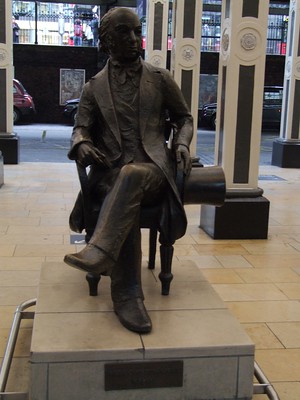
At Paddington Station I take my hat off to Isambard Kingdom Brunel’s statue in a show of respect to a man that could design a palace to steam like that without recourse to hallucinogenic drugs. He has taken off his own, far more impressive, hat too; and sits smiling amidst the wonders he has made.

“01042010 – 250 Paddington Station – Isambard Kingdom Brunel statue” by failing_angel is licensed under CC BY-NC-SA 2.0

The statue of Paddington Bear on the opposite side is light and shiny on the nose, crown and brim of his hat where the kids have touched him.

Reading town centre has a noisy, slightly manic quality, generally quite smartly turned out people making a sharp contrast with some striking looking serious drunks. One stares out blearily from under a hoody, with a red and weather beaten face that makes him look like Aragorn grown old as Strider. Another tall, stringy looking man walks along with an ID tag around his neck showing he is functional at least some of the time, while talking to himself and taking rather wide steps that waver tentatively before making a commitment to coming down. Every pace an adventure.

The train to Reading is named after a community activist who fixed things for his neighbours and played music in the streets, which may be the future. The train back is named after a GWR employee who won the VC in the First World War. Three other employees who died in it are commemorated along the body of the locomotive with brief biographical notes and photos of lugubrious looking men with walrus mustaches; who are definitely the past.

As was the frustrated football fan on the Euston to Watford line who looked like a bitter and twisted version of Andy Parsons and decided that the carriage would benefit from his slightly inebriated rant against woke this and anti- British that; partly directed at his mates; but using them as a backdrop and back up to talk to everyone who couldn’t avoid hearing. At one point, he looked directly at me, perhaps because I was wearing a pink shirt and was therefore a living rebuke to all things masculine. His most ironic line was that if Britain hadn’t defeated Hitler, no one would have the nerve to pull down statues. Which I guess means that Hitler was on his side in that. No one rose to his bait. He was, of course, not wearing a mask.

Autumn

Outside Hendon Magistrates Court the ornamental Fuschia hedge has grown through the railings in a riot of drooping magenta flowers. Getting ready for an Autumnal return to normal, a young worker with a hedge trimmer is squaring it off as a metaphor for a legal system with a limited imagination. He is wearing ear protectors. Less than a metre away from him, the old lady, young couple and small child lined up by the bus stop, are not. Confused bees waver around the cauterised bristling twigs where the flowers used to be. The young worker sweeps them up from the floor. Tidiness before life.

Beside Chili Masala, the small patch of waste ground has some fitful grass bravely trying to compete with a jumble of liberally discarded plastic bottles and beer cans, like a miniature replica of that field at the Reading Festival left full of single use tents. A sole cabbage White butterfly flutters gamely around it showing what life could be about instead.

Outside our flat, bees are weaving in and out of the flowers in the hedge. One blunders into one of the many webs strung across it with a huge tiger striped spider hanging motionless in the middle. Immediately the spider, twice the size of the bee, is on it and wrapping it up in a silk coffin with busy legs moving quickly up and down like a sewing machine. The bee is quickly reduced to future packed lunch in a silk sarcophagus in about ten seconds, and the spider lowers it down out of sight for later, before climbing back up to wait.

Looking down from the top deck of the 83 from the bridge over the wide stretch of tube lines by Wembley Park. A pair of Jubilee line trains snaking slowly round the curve towards the station, framing a line that dives steeply down to an opaque rectangular maw of a tunnel that looks like a portal to somewhere grim.

At the bottom of the hill, the first crane fly of the season. It half flies, is half blown hither and thither, long spindly legs wavering around and small wings whirring frantically. It seems far more alone than it should do.

Afghanistan – Xinjiang.

The mainstream coverage of the Afghanistan collapse has played down both the direct impact of the US/NATO invasion on Afghans and drawn a veil over where all the money went. Instead, we have had a narrative that resurrects the image of “the West” as the defenders of Afghan women and children, as a cover for maintaining an over the horizon military capacity through drone strikes and an aid and financial freeze that puts their lives even more at risk.

This is not a claim that stands up to much scrutiny. As Tariq Ali noted in New Left Review (1)

As for the status of women, nothing much has changed. There has been little social progress outside the NGO-infested Green Zone. One of the country’s leading feminists in exile remarked that Afghan women had three enemies: the Western occupation, the Taliban and the Northern Alliance. With the departure of the United States, she said, they will have two. (At the time of writing this can perhaps be amended to one, as the Taliban’s advances in the north saw off key factions of the Alliance before Kabul was captured.) Despite repeated requests from journalists and campaigners, no reliable figures have been released on the sex-work industry that grew to service the occupying armies. Nor are there credible rape statistics – although US soldiers frequently used sexual violence against ‘terror suspects’, raped Afghan civilians and green-lighted child abuse by allied militias. During the Yugoslav civil war, prostitution multiplied and the region became a centre for sex trafficking. UN involvement in this profitable business was well-documented. In Afghanistan, the full details are yet to emerge.”

And an article published at www.german-foreign-policy.com points out that,

“US drone attacks…. caused numerous civilian victims. The Bureau of Investigative Journalism…. lists more than 13,000 of these attacks in Afghanistan. The number of victims has been calculated at between 4,100 and over 10,000, the number of proven civilian victims at between 300 and 900. According to research by the online platform The Intercept, this would be an under-estimation. Already in October 2015, the Intercept had reported – citing documents furnished by a whistleblower – that from January 2012 to February 2013, only 35 of the more than 200 victims of the US drone campaign in northeastern Afghanistan had been listed as US targets. In the course of five months, the portion of unintentional drone victims was nearly 90 percent.”

So, nine out of ten victims were collateral damage. This pattern has continued with the drone attack last week supposedly targeting a “suicide bomber” managed to kill 10 civilians including 6 children. The chilling effect of the drone threat extends beyond Afghanistan’s borders. Zubair Rehman, a 13 year old student from the Pakistan borders said in 2013

“Now I prefer cloudy days when the drones don’t fly. When the sky brightens and becomes blue, the drones return and so does the fear. Children don’t play so often now, and have stopped going to school. Education isn’t possible as long as the drones circle overhead.” (2)

This assessment from the Socialist Economic bulletin reveals that

  1. Afghan GDP has plateaued since 2011.
  2. GDP per head has barely risen since the invasion in 2001, and is running well below that of Pakistan and Nepal.
  3. Unemployment has remained at just under 12% throughout the period of the invasion, three times the level in Pakistan and Nepal.
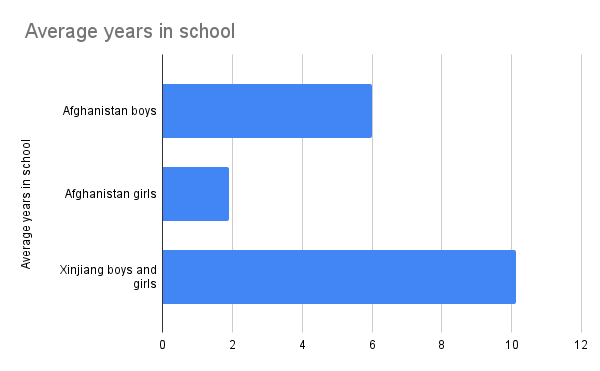
  4. The actual level of schooling for Afghan girls is just 1.9 years, compared with 6 years for boys and around four years in Pakistan and Nepal.
  5. So, where did the money go? “If highly regarded economists place the cost of the war in the trillions of US Dollars, and yet…the Afghan economy has been shrinking to a level below $20 billion annually, then funding must have left the country. In effect, the taxpayers of the US and elsewhere were not funding nation building in Afghanistan, they were funding US defence contractors, the Pentagon war machine, and a whole raft of ancillary suppliers, of everything from ‘security personnel’ to beer and burgers. That is where the huge bonanza of public money went”. 

Its very strange how the currents – on the right and the left – that are most vocal about the Western defeat at the hands of the Taliban (and often support Islamophobic Laïcité in France) are also the currents that give most credence to Jihadist separatists in Xinjiang.

The standard trope in the Western media is to present the Western intervention in Afghanistan as developmentally positive – while the picture painted of Xinjiang is done in the bleakest hues. The claims of Western Intelligence assets and jihadist separatists about Xinjiang that are taken as such an article of faith in the UK, from the Alliance for Workers Liberty, through the Labour front bench all the way to Ian Duncan Smith and beyond, also don’t stand up to much scrutiny; which is why they are never given any in the mainstream press. This measured assessment by UK Academics provides a more balanced view and is worth a thoughtful read.

A comparison with Afghanistan after 20 years of Western intervention and tutelage is also something of a corrective to the notion that a “genocide” is taking place.

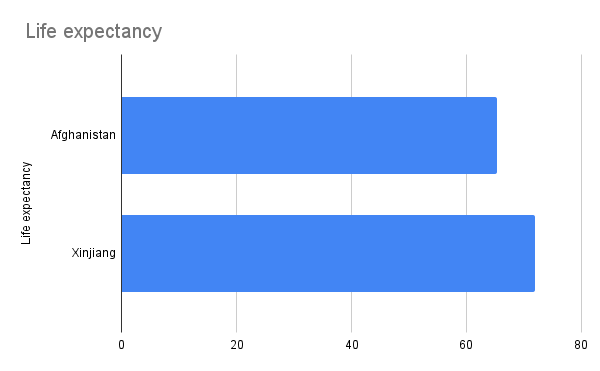
Xinjiang is one of China’s poorest regions. Along with Tibet, it was only in the last year that extreme poverty has been overcome for all citizens. Nevertheless, although life expectancy in Xinjiang has not yet caught up with the Chinese average of 77 years; at 72 it is a full 7 years more than in Afghanistan. It should be noted also that Afghanistan has suffered 7,101 deaths from Covid. The total figure for Xinjiang is 3 (out of a total population of over 25 million). A comparable death rate for the UK would be less than 10, rather than than the 150,000 plus we have actually suffered under our definitely non genocidal government.

When it comes to girls education, boys and girls in Xinjiang have equal access; and almost twice as many years in school as Afghan boys, and more than five times as long as Afghan girls. (3)

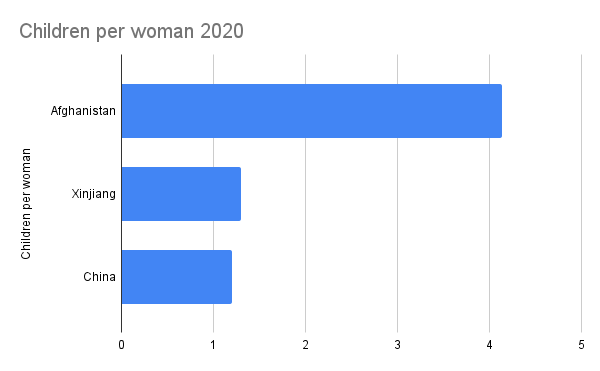
Large families in developing countries tend to be a marker of poverty and underdevelopment. Keeping birth rates low has been an aspect of China’s poverty reduction policies for years, with the one child policy only recently reversed. It should be noted that ethnic minorities were exempt from that policy and until the wider availability of contraception in the last decade, families in Xinjiang tended to be large, which kept women in the home and out of employment. The number of children per woman in Xinjiang is now low (at 1.3 children) but not quite as low as the Chinese average (1.2).

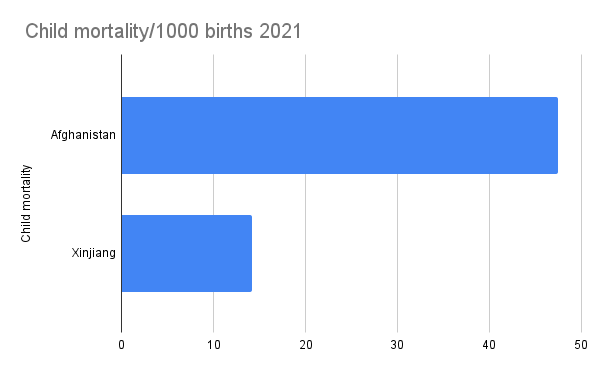
Similarly, accusations that China is committing “genocide” against the Uighurs sit oddly with figures for child mortality which are not only significantly lower than those for Afghanistan, but half that of India (29/thousand).

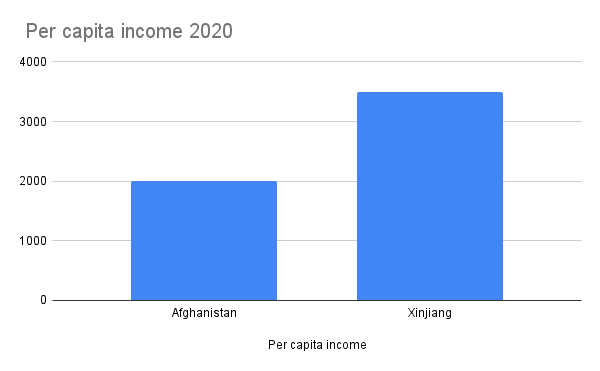
Average income in Xinjiang is almost twice that of Afghanistan and the trend is for an ongoing rapid increase, with an annual average growth of over 8% between 2014 and 2019. (4)

If the strategy of the West is to squeeze Afghanistan economically – as a punishment for defeat – the only prospect for Afghan development is through integration into the Belt and Road initiative via Pakistan. The impact of such development on Afghan society – if this course is followed – can’t help but be more positive than the last twenty years of intervention and war.

  1. NLR Sidecar. Debacle in Afghanistan.
  2. Cited in Like ordering Pizza. Thomas Meany on the war in Afghanistan London Review of Books 9/9/21
  3. http://toronto.chineseconsulate.org/eng/news/t1884310.htm
  4. https://disputedline.com/employment-labour-rights-xinjiang-2017/

Street Wedding Music

At closing time outside the NatWest Bank by Kingsbury Circle, a line of young men lean against the wall, whip smart in black suits and bow ties; like a team of rather slender bouncers, or a small gathering of the Nation of Islam waiting for Malcolm X to speak on a street corner in Harlem in 1961. Either the Nat West has suddenly enforced a seriously enhanced dress code and all its male staff are lining up as a public display of it, or there’s a wedding in prospect. The latter possibility is confirmed by the presence of one young man in a bright gold Shalwar standing slightly in front of the others like a commanding officer.

Soon enough, they all climb into a jostling queue of cars sounding their horns. One guy in the lead car stands up so he is out through the sun roof filming backwards. Two others – in a display of insouciant bravado -sit sideways out of passenger seat windows as the cars, all of them shiny, some of them seriously sleek and expensive, head off towards Northwick Park and points West in a convoy of overpowered metal. The horn blasts are loud, but somehow harmless, happy and harmonic; like a piece of minimalist music. Sonata for car horn and car horn. Even the people complaining and holding their hands over their ears at the bus stop are laughing.

A builders van parked opposite advertises the prospect of work on basements, decoration and refurbishment, with a company name that is hopefully not an onomatopoeic prediction of what happens to their work; KRK.

Intimations of Mortality

We seem to have a new sort of spider web this year. A sort of formless gauzy mist that drifts across corners and appears overnight. No tightly defined geometric structures. As though the spiders know that God is dead and isn’t checking on the quality of their work.

After the brains, two slugs the size of battlecrusiers ooze inexorably from one hedgerow on the path outside our flat to the happier hunting grounds under the other.

We have a strange intrusive ticking, that sounds both mechanical and urgent, coming from inaccessible places in our water pipes at times. It feels like a countdown.

The intense playful and urgent quality of the playing in this year’s Proms exudes a sense that live music cannot be taken for granted forever; that each performance is precious and has to be fully savoured. Live music in more ways than one.

The government has decided to “live with” the virus. Which means that they are content that people should continue to die from it. Forever and ever. Amen.

Economic Nationalism and Nuclear Energy

The problem with drinking patriotic Kool Aid is that it can’t help but lead to hallucinations. And it doesn’t matter if the beverage concerned is traditional true blue vintage or a home brew knock off tribute version.

Surreal is not usually a word I would associate with the General, Municipal and Boilermakers Union, but their comment on the government decision to try to cut out Chinese involvement in UK Nuclear power plant construction – that this is a huge opportunity to regain the UK’s position as the world leader in new nuclear (1) – is bizarre for a number of reasons.

  • The UK has not been a world leader in new nuclear since about 1957.
  • In 2019 the countries installing the most new nuclear power plants were China and Russia. (2)
  • Since 1990, Japan and France have dominated global nuclear R&D, with 64% of expenditure between them. (3)

The UKs proposed £250 million investment in developing Small Modular Reactors as part of the government’s 10 point Plan is such a tiny fraction of this that it might be more accurately categorised as a token gesture.

Nevertheless, SMR plants, based on a souped up version of Rolls Royce’s nuclear motors for submarines – will – if they go ahead – produce electricity that is a third more expensive even than that produced by large reactors at the moment; in a context in which the costs of renewables are constantly falling. Why the industry projects that these expensive baby white elephants would create a viable export industry is a mystery – especially after somewhat larger funding to kick start a similar project in the USA was pulled in 2017 (4).

Promises of a nuclear new dawn larded down with bunting are hardy perennials. In 2015, George Osborne promised that that at least £250m would be spent by 2020 on an “ambitious” programme to “position the UK as a global leader in innovative nuclear technologies”.(5) Same old figure. Same old patriotic bluster. Welcome to the new announcement. Same as the old announcement.

Plans for 6 new large power stations have now been cut to 3. Cost overruns and delays are built in, as is a high price for the electricity eventually generated. The price for electricity generated by Hinckley C is £92.50 per megawatt hour; twice the wholesale price. This plant, being constructed by EDF, was supposed to be built by 2017, but is now not expected until 2026. It will cost £23bn, not the original £16bn in the contract. Sizewell C is projected to cost another £20 billion, with the costs falling on bill payers even before its up and running.

There are many reasons not to go down the nuclear route. Chinese involvement is not one of them.

Workers at Fukushima showing how safe nuclear power is.  IAEA Imagebank is licensed under CC BY-SA 2.0

The argument to break the contract with China’s “state owned nuclear energy company”, as the GMB puts it, is on “security” grounds. This is only an issue if the government is projecting a future of increasing hostility. This is not something being generated by the Chinese. We are sending an aircraft carrier to their backyard. They are not sending one to ours. The whole labour movement should see this new Cold War atmosphere as a threat, not dress it up as an opportunity.

  1. Chinese nuclear block ‘staggering U-turn’ from Conservatives | GMB

2. Nuclear Power – Analysis – IEA

3. Energy Subsidies – World Nuclear Association (world-nuclear.org)

4. UK: Power from SMRs 30% more expensive than large reactors | Wise International

5. UK government to release funding for mini nuclear power stations | Energy industry | The Guardian

If you want to point a finger, make sure you have a leg to stand on.

A narrative in the media today that seeks to pre-emptively point the finger of blame at four of the G20 countries – Brazil, China, Russia and Australia – for a global failure to meet carbon reduction targets is coming from countries that have no leg to stand on.

While all countries need to sharply increase their commitments, and actions, they are not all starting from the same place.

People in China and Brazil might feel aggrieved to be lectured by the UK, which has a worse per capita emissions figure than them; and even the Australians might feel a bit piqued if criticised by the USA.

It should be noted that these are carbon emissions by domestic production. Countries like the UK which have offshored a significant slice of manufacturing have a significantly higher global impact. In 2016, only 54% of the UK’s carbon footprint was domestically sourced with the remaining 46% coming from emissions released overseas to satisfy UK consumption. Ministers tend to be very quiet about that. While China, which has a lot of manufacturing, has a lower footprint through consumption.

Traffic, thank you hats and Mussolini on a lamp post.

At the bottom of Buck Lane, as the steep slope inclines ever steeper, one of the many motoring dickheads who express their social distancing frustrations by driving too fast and revving their engines, making a lot of noise and not caring who hears it, explodes up the hill in a cacophony of straining motor without a backward look, leaving a dense blueish cloud of exhaust behind for a heavily built and wheezing mother to laboriously wheel her heavily laden push chair through. The small child in front in the seat sits bolt upright and looks offended; as well he might.

Down by the shops, the traffic has built up in recent weeks, and a driver honks his horn in frustration at the car in front, which has stopped, waiting for another driver to vacate a parking space and causing an instant tail back. The horn, meant to be used in emergencies not as a sign of minor irritation, is loud and nerve jangling, obliterating all other sounds while it blasts and putting everyone else almost as on edge as the driver. Sharing is caring. A hefty sort of guy walking in front of me stares across at the driver, whose window is open, makes eye contact and calls “calm down”. In doing that, he is speaking for many of us, but gets the inevitable reaction of someone who is already angry and has just made a status gesture in front of his family – all gathered around and overheated in his car – and can’t afford to take a rebuke without losing face; so he escalates, leans out of his window all red faced and shouts back, honking his horn again. This is repeated ritualistically – and slightly comically now we are used to it -as the traffic queue slowly edges forward again, roughly at walking pace; so the argument keeps pace all the way down to the station.

In some ways I’m sorry for drivers. On the way down to the shops I get to walk through the Park. Nothing like walking to get your thoughts in order. And this time of year we have the wildflowers that the council has put in to encourage the bees. Right now there is an exhilarating flash of scarlet poppies. Its like an Impressionist painting but better, because its what would have inspired an impressionist painting. Manet live. Or, like stodgy old Wordsworth, your heart can’t help but “leap up”. People driving past miss all that. How much do you lose with the freedom of the not so open road? Invest in a shopping trolley and you get a walk in the Park, time to think and a bit of exercise too.

In the deep shade of a spreading Oak tree, the Roe Green Park Moot is meeting. A dozen or so elderly Gujerati guys – who now seem to be in permanent session -sitting in a circle, several on little camp stools brought for the occasion, two propping up black iron bicycles like props from a Satyajit Ray film, several of them talking at once and waving their hands. Further on, the open air exercise class is back. Mostly legs in the air like they are practicing for the synchronised swimming at the Olympics.

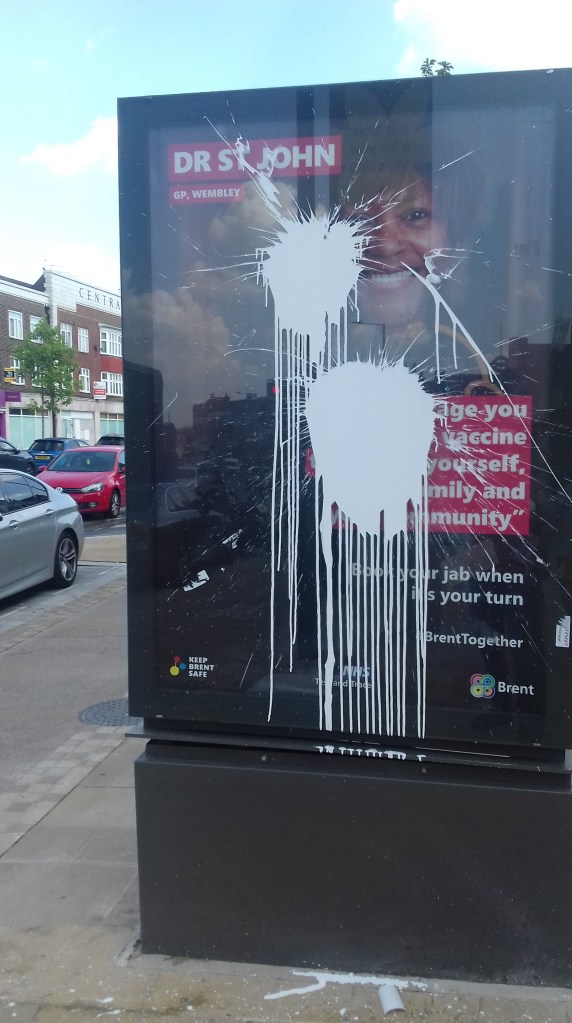
A little bit of implied violence from the sort of people who think that a high level of COVID infections is the same thing as being “free”. All the council posters urging people to have vaccines and take care have had pots of paint thrown at them.

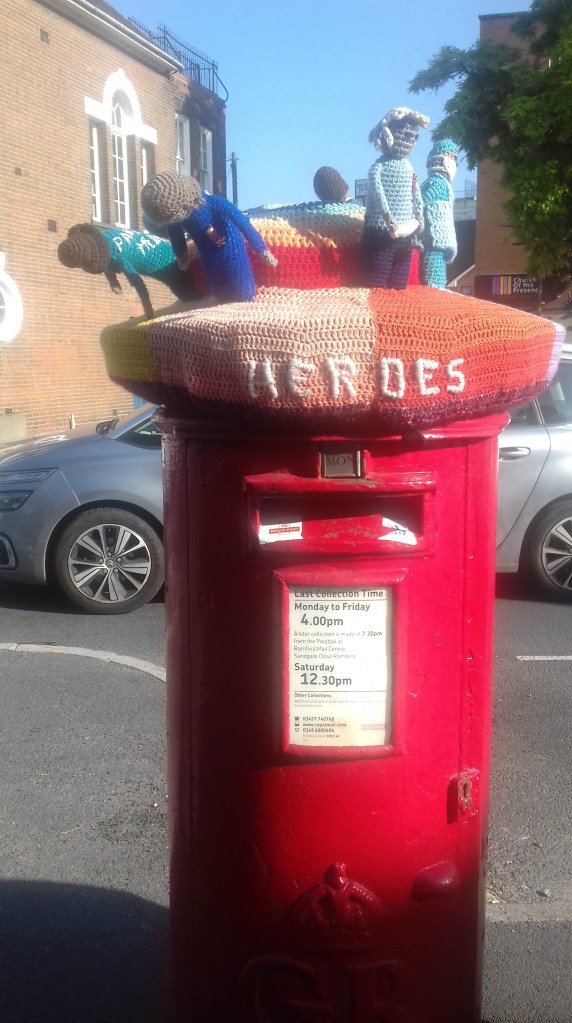
By contrast, down in Grays at the weekend, someone has crocheted a thank you hat for the NHS to put on top of the post box outside the library.

As the NHS comes under pressure from the rise in cases, it is perhaps appropriate that some of these figures show they have been pushed a bit beyond their limits.

On the way up Cromwell road, just opposite Mumford and Sons (the former fish and chip shop and Covid victim now being gutted, windows black and gaping like a corpse whose eyes have been eaten by crows) two youths walking past me. The smaller, meaner looking one tweaks the chest of the taller – who looks a bit like a browner version of Sideshow Bob – saying “I’ll flick your nipples if you keep chatting shit”. On the way back down in search of chips – having developed a habit of smiling at passers by during the pandemic as a sort of mutual affirmation (we’re still here then) – I pass a couple sweating their way up the hill and smile at them. A few steps on and behind my back I hear the bloke mutter “Fucking smiling! Ooo’s e fink he’s fucking smiling at?” and I realise that I’d almost forgotten that old reflex of keeping safe by keeping neutral. Like the safety advice on the New York Subway. “Avoid eye contact with anyone over three years old”. The motto of every Council in South Essex should probably be Qui tibi vultus (oo, you lookin at?)

One of the butchers in Orsett Road is now Halal and offers “real goat”. Makes you wonder what the unreal goat is and who sells it.

When I hang out my laundry on the whirly drier in the backyard, the sight of my trousers hanging upside down to dry is reminiscent of Mussolini suspended from that lamp post by the Partisans after they shot him in Mezzagra in 1945.

Out of the window

  • a young guy on an electric scooter swishes past; like the ghost of a future that we might already be too late to build. You can’t help noting that the police in London have confiscated 500 of these in the last couple of months – pending the Highway Code updating itself to cope with them – while the gas guzzlers that poison our air and are helping overheat our planet rev happily along with complete impunity.
  • a sound of hooves and a glass carriage pulled by two horses with huge pink plumes driven by men in top hats and full of tiny Asian girls in fluffy pink dresses appropriate for princesses but looking a bit bored and apprehensive trots by up past the castle flats; their parents driving behind in a nervous convoy, leaning forward over their steering wheels.