The West vs Russia – was it all inevitable?

This look at Mike Phipp’s review of Gilbert Achar’s The New Cold War- The United States, Russia and China from Kosovo to Ukraine, is because it represents an archetype of the thinking among sections of the Left that have fallen into becoming cheerleaders for NATO; despite their recognition that, as the author approvingly quotes Achar it continues to push, global relations in the worst possible direction, (my emphasis) at a time when the world should be focused on fighting the greatest threats that humanity has ever faced short of a nuclear Armageddon—climate change and pandemics—as well as the socioeconomic consequences of global economic crises related to these same threats.” So should we all.

The title of the review is a belated acknowledgement by the author that this is not a war between Russia and Ukraine, but a war between Russia and “the West”. “The West” can be described in many ways. “Global North” is another label for it. The most developed, advanced, dominant countries in the world, united militarily in NATO with the United States at its core is another. And it is, indeed, pushing global relations in the worst possible direction. The tragedy of the position taken by the author is that the logic of it provides them with left cover to do so.

With the collapse of the Soviet Union in the early 1990, the way that pushing global relations in the worst possible direction manifested itself was a drive by the United States to “dominate the post Soviet space”. This is thoroughly documented, but the author ignores it because it is such a blatant move by the dominant global imperial power to extend its dominion eastwards; with the ultimate aim of control of Russia itself, “a gas station masquerading as a country” as Senator Lindsay Graham put it. Understanding this makes supporting NATO’s war aims under the guise of supporting Ukraine’s national self determination an unsustainable posture; therefore the only possible position is disavowal. Look right at it, and not see. Or try to talk it away…

So, let’s look and see.

Dominating the post Soviet space meant not only moving to absorb Eastern European members of the former Warsaw Pact into the USA’s political, military and economic orbit, but also breaking the USSR down into its constituent republics, and seeking to control the leadership in Russia while this took place.

By 1992, precursors to the neo cons, often with direct fossil fuel interests like Dick Cheney, argued for partitioning Russia into smaller parts immediately, the better to dominate it and, “get the gas”. This is now back on the agenda, both in Ukraine and the US. The more cautious heads, who won out in 1991, felt that this would lead to uncontrollable political and economic chaos that would be more trouble than it was worth, particularly with several thousand nuclear weapons in the mix. They went for holding the country together under the control of a biddable President (Yeltsin) while shock therapy shattered its economy and reduced it to its knees as a competitive power.

Politically, in Eastern Europe, this also meant disinterring old nationalist identities from the shadows that, in their rejection of a common Soviet past, celebrated collaborators with the Nazis as national heroes, particularly in Ukraine and the Baltic States.

Economically, as the author puts it, “The IMF-blessed economic reforms plundered the former USSR, wrecking the economy and impoverishing the mass of people” throughout the nineties. GDP declined 3% in 1990, 5% in 1991, 14.5% in 1992, 8.7% in 1993 and 12.7% in 1994 and didn’t recover sustained growth until 1999. Between 1988 to 1999 per capita income in Russia dropped from $3,777 pa to just $1,331 pa.

This also involved overt anti democratic action, backed by “the West”. Again, as the author puts it ” when the Russian parliament became a centre of opposition to the policy, the then President Boris Yeltsin dissolved it and ordered the military to shell the building in 1993″ killing 147 people and wounding 437, according to Yeltsin’s own officials. The anniversary of this event on October 4th passes in silence in the West every year. Hardly surprising as the US at the time praised Yeltsin’s “superb handling” of the situation.

It is evident that Western shock therapy could not be carried through without repression. The author puts this mildly. “There’s no doubt that the economic policies imposed on Russia by the West contributed significantly to this process.” Indeed.

But he then makes an arbitrary detachment of the military dimension of US policy “It’s less evident, in my view, that US-led military policies played the same role”, on the basis that “they did not impact on the life of ordinary people in Russia in anything like the same way as the economic destruction.” As if the military, economic and political dimensions of a single policy can be divided from each other. As if the economic destruction could have been guaranteed without the military threat of the US in the full flush of its unipolar moment. This serves a purpose because, if NATO expansion is conceded to be a real, and very widely understood, threat in Russia, the whole house of cards resting on the oft repeated phrase “unprovoked invasion” collapses.

Instead, the author spins his argument around speculation about how the rise of Vladimir Putin – as an embodiment of nationalist self assertion – might have been avoided. This implies that – far from being inherently locked into a push for its own dominance, the US could have applied a different policy, one that built up and integrated Russian into a “common European home” perhaps and, instead of shock therapy, applied a Marshal Plan to the “post Soviet space”. The implication of this is that he shares Gorbachev’s delusions about the nature of US imperialism. That it is possible that it could genuinely lead the world in the interests of anything other than its venal ruling class. As though the Marshal Plan itself were an act of selfless generosity, rather than a hard nosed intervention by the US to prevent Europe going Communist – reviving flattened European competitors to revive as the price paid – allowing Western European Social Democracy half a century of delusion that its welfare states were a tribute to its own strength and wisdom rather than the temporary price paid to stave off the red threat.

This gets quite surreal when discussing Putin’s proposal to join NATO in 2001. Nowhere does the author consider why the US turned this down. The clue is in Putin’s own statement, that Europe (my emphasis) will reinforce its reputation of a strong and truly independent centre of world politics soundly and for a long time if it succeeds in bringing together its own potential and that of Russia, including its human, territorial and natural resources and its economic, cultural and defence potential.” A strengthened European pole inside NATO with Russia as a hefty and unshiftably consolidated component part is the last thing the US wanted then, and now, as it would put its own hegemony in Europe at risk.

But, not letting the Russians in, and continuing to expand NATO at the same time, while fomenting or taking advantage of political crises in Russia’s “near abroad” in Georgia and Ukraine particularly meant that Russia, with the 20 million dead from World War 2 seared into living memory, was bound to feel under threat. Because it was, in fact, threatened. It takes an extraordinary level of dulled empathy to ignore this; or treat it as some sort of irrational paranoia on their part – or attribute it to a personality defect on the part of President Putin – all of which have become articles of faith among these currents.

In presenting the “colour revolutions” in Georgia and Ukraine as “attempts to break free” the author swallows the US narrative whole. Becoming imperial junior partners of the United States is not the same thing as to “break free”.

His argument that local actors have agency – which they do – is presented as in itself a sufficient refutation of any notion that these movements were “Western orchestrated” or “designed to encircle Russia militarily”; as if all three can’t be true at the same time.

This is odd, because the author comes close to acknowledging the point when he states, “Equally, from the standpoint of the opportunities available to self-interested Western capitalism, any military or diplomatic arrangement with Russia which left the latter’s hegemony over these states intact would be less than satisfactory, especially given the exploitable, mineral-rich nature of some of them. If opportunities for a grand US-Russia rapprochement were missed, it was not accidental. (my emphasis)”. Quite so.

There is reckoned to be $12 trillion worth of rare earths and related minerals, most of it in the rebellious region of the Donbass; which “self interested Western capitalism” would like under its control, regardless of the rights or views of the people who live there.

The Maidan movement in Ukraine had popular support in Western Ukraine. The hegemonic political current within this is passed over without comment, the better not to acknowledge the strength of the far right. To do so is embarrassing, so best not. The US and EU were also active participants in the process, and the aim to pull Ukraine decisively into the Western orbit economically and politically, and to begin to pull it in militarily, had been part of the agenda since 1991. Not to acknowledge this is disavowal again.

What is even stranger about this is that the argument is completely inverted when it comes to Eastern Ukraine and Crimea. When people there rebelled against the overthrow of a government they had, for the most part, voted for, their “local agency” is dismissed by the author’s camp as completely invalid, and reduced to them being simply Russian agents.

This is where the author’s central argument, that “for socialists, the central starting point is the human and social rights of the peoples in the states involved, which could not be sacrificed to great power bloc considerations” exposes itself as utter tosh. The human and social rights of the people of the Donbass, who rebelled against Kyiv in 2014 and have been shelled and bombed by the UAF daily ever since, and mobilised in tens of thousands into the Donbass militia, are ignored completely, of no account, dismissed, written out of history. Some people, it seems, are more equal than others.

Its also evident that Ukraine itself is part of the “post Soviet space” that the US and its allies were, and are, seeking to dominate. The impact since separation in 1991 has also been to wreck the economy. As Renfrey Clarke has noted “World Bank figures show that in constant dollars, Ukraine’s 2021 Gross Domestic Product was down from the 1990 level by 38 per cent. If we use the most charitable measure, per capita GDP at Purchasing Price Parity, the decline was still 21 per cent. That last figure compares with a corresponding increase for the world as a whole of 75 per cent.”

Even before the war, Ukraine had the worst death rate in Europe and was losing 600,000 young people to emigration every year. The country has been asset stripped at an increasing pace, especially since 2014, with Western agri-businesses buying up land, and the post war reconstruction deal aimed to be run by Blackrock seeking to recoup the debts Ukraine has run up to the West by acting as its henchman/military frontier state/ willing sacrificial victim. This is grotesque any way you want to look at it, and will be crippling, whatever the residual assets and territory controlled by Kyiv.

Self determination, it won’t be.
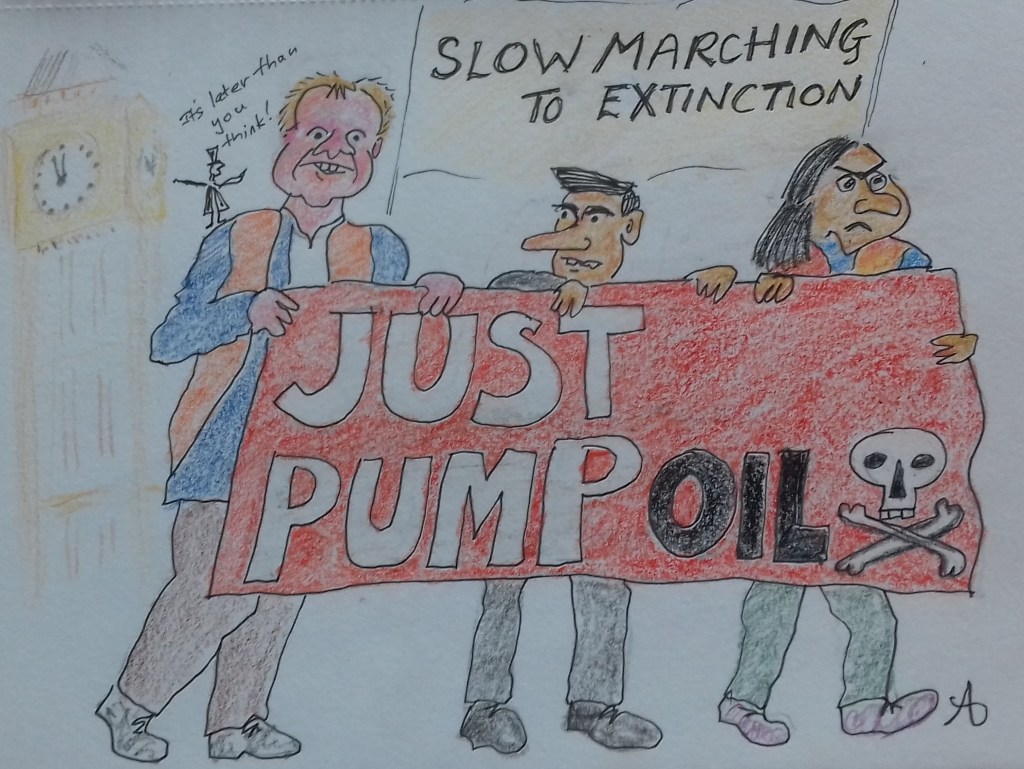
Writing to the Blacktops

Writing about the Greenpeace activists who scaled Rishi Sunak’s mansion in North Yorkshire to drape it with black cloth, the Daily Mail headline was:

HOW ON EARTH COULD THIS BE ALLOWED TO HAPPEN?

As eco protestors scale the roof of the Prime Minister’s family home, which is a humiliating symbol of our supine tolerance of a tiny self obsessed bunch of zealots who disrupt everyday life with impunity.’

So I wrote them the following:

With fires, floods and famines already devastating our planet, the real “tiny, self obsessed bunch of zealots” who will make “everyday life” not just disrupted but unsustainable within the lifetimes of children currently in our schools, are the owners of fossil fuel companies; and the think tanks, politicians and newspapers that they buy to defend their profits. People who went on holiday to Rhodes this year will have had their “everyday life” disrupted violently by the impact of climate breakdown. Its time to end the impunity of the tiny minority who are causing it.

And the Daily Express, with characteristic understatement, HEADS MUST ROLL! JUST HOW DID THIS HAPPEN?

So I wrote them this.

Given the increasingly frenzied tone of your articles and headlines on anything related to climate breakdown, and people trying to alert us to the severity of it, I must confess to wondering if your “Heads must roll!” headline was intended to be solely metaphoric.

May I suggest that a suitable set of people who’s head should roll is anyone in government, business or media who downplays the seriousness of the crisis – just ask anyone who went on holiday to Rhodes this year – or slows down the pace of the measures needed to tackle it, putting our children’s futures at risk for short term financial or political gain?

The Express article went on to quote an unnamed Tory MP as saying “I’d say shoot them!” which indicates a state of mind that is a long way from sweet reason.

I remember this when it was all fields… What kind of housing and where?

Recent contrasting visions of housing development from Michael Gove and Lisa Nandy pose some questions about what kind of homes we want to live in, where we build them, in what kind of communities, with what level of facilities, what standards they are built to (in terms of carbon emissions/sustainability size/dimensions and quality) who builds them and how (and what their motivation is) who owns them and is responsible for upkeep?

There is a consensus between both major Parties that “home ownership” is an aspiration and a good thing in itself. This presumes

  • an atomised pattern of housing that is presumed to be for individuals or families acting as consumers first, members of a community second*.
  • that those individuals or families are in a position to afford to buy and them maintain them: which is increasingly not the case. Go for a walk around an average suburb and you find a lot of houses in a bad state of repair, with owners unable even to “keep up appearances”.

A market not simply determined by demand exceeding supply – but also massively distorted by the intervention of finance capital seeking assets, and doing so by bumping up land prices to an astronomical extent – requires house prices to stay high, but mortgages to be sufficiently affordable not to cause a crisis. What happened in new developments like Chafford Hundred in Essex during the property crisis in the early 90s, when a slump in prices combined with increases in interest rates and half the properties in the area were repossessed, is a stark warning of what can happen when the market fails – as it must when prices get overheated, as they now are. The attempt by the Bank of England to cut inflation by raising interest rates, thereby paradoxically raising the price of staying in your house if you have a mortgage, is heading in that direction.

This points to a paradox. With a growing population unable to find somewhere affordable to live, with two thirds of childless single adults aged between 20 and 34 still living with their parents, a trend that rose by a third between 2010 and 2020, its generally agreed that the UK is 4.3 million homes short. Hence the pressure on both potential governments to have a plan to build a lot more of them. But, if a lot more of them are built, there is a downward pressure on prices. And a lot of property investment relies on them staying high.

This is putting the market above people’s needs and wants.

Ask almost anyone what they want and its a place to live that’s affordable, spacious enough to spread out in without feeling squeezed, solidly built so there are not a lot of costs in maintaining it, well insulated so energy bills can be kept low, with access to green spaces (if not a garden, then a local park, grass verges and street trees, maybe allotments) and amenities within walking distance and decent transport links. If construction is determined by the market and the demands of developers, the homes that meet and exceed these standards will be for the people who can afford them the most; places like the Welborne development in Hampshire. Homes for the rest of us, for sale or rent, will be poky, crammed together, built with corners cut and materials skimped on.

Gove’s announcement, counterposing dense brownfield urban development to “concreting over the green belt” aims to hit two targets at once.

  • Defuse the nimby reaction in leafy Tory rural seats that put paid to previous Tory housing growth targets after they lost the Chesham and Amersham by election to the Liberal Democrats in 2021.
  • Allow population growth to be housed by keeping it urban; so that existing city facilities don’t have to be replicated in new developments, thereby cutting costs.

If done properly, this should implement 15/20 minute neighbourhoods, which is easier to do in cities; and this should be a cross Party consensus. A dense local population provides demand for shops and services and keeps them viable. There are so many cafes and bakeries in Paris because there are seven storeys of apartments built above them full of people who will be popping in and out for a baguette or expresso. This also, however, has to be combined with integrated town planning that takes account of transport needs – ensuring public transport links and pedestrian/cyclist priority to inhibit space gobbling cars – and green spaces; so the dense population has air to breath and space to share and regenerate its soul.

Gove’s approach is a bit more Wild West and desperate than that.

Part of it is a “make do and mend” set of proposals on buildings conversion that relax the criteria for permitted development rights. As this would be market led and carried out in the interests of developers and landlords, it is likely to see a rash of glorified living cupboards being shoved into old office developments by inserting ticky tacky partition walls. This would be a triumph for the same entrepreneurial spirit that has already led to people living in partly converted garages and family homes carved up into tiny flatlets, but with more of an official nod and a wink.

This could be a further step towards shanty towns, or new suburban slums, accelerating the downward slide we are already seeing in many areas. The absence of space and proper cooking facilities in Homes in Multiple Occupation is a boon for fast food outlets; but also leads to a tsunami of litter and infestations of rats and foxes happy to fatten up on the half eaten chicken wings that alienated people dump in the streets.

We should also bear in mind, when listening to Gove wax lyrical about beautiful architecture uplifting the human spirit, that Conservative MPs voted down Labour proposals that private rented homes should be “fit for human habitation”. Presumably they think that people who can’t afford to live anywhere other than an unventilated room with a bed and Belling in it should just see the black mould on their walls as a motivation to make better lifestyle choices; or, perhaps, that anyone living in places unfit for human habitation do not deserve to be classified as human.

This was not received well.

The Local Government Association noted that “expanding permitted development rights risks creating poor quality residential environments that negatively impact people’s health and wellbeing, as well as a lack of affordable housing or suitable infrastructure.”

Shelter said that “Converting takeaways and shops into homes and restricting building to city centres won’t help. It could risk creating poor quality, unsafe homes that cause more harm than good” and instead the government “should put its money where its mouth is and get on with building a new generation of social homes.”

Moreover, property consultancy Knight Frank’s said the plans are “unlikely to have meaningful impact on housing supply”.

The exception to an insistence on city brownfield sites is “Garden Villages”. Gove rhapsodises about Welborne as an example of these. Semi rural middle class enclaves which look as though they are designed to cement a population of Conservative voters into Blue Wall seats.

Welborne, is a 6,000 home development between Southampton and Portsmouth, that will be built over 30 years with a £2billion price tag. It has self consciously retro architecture, with a limited range of design styles that is almost regimental. Look at the images of how they imagine it on their website and there’s something eery about it. A replica of an imagined past; with the same monstrous quality as if a contemporary composer were to write in exactly the same style as Haydn. No matter how good it was, it would still sound wrong; out of time and out of place. About half of the houses have chimneys as a motif (hopefully not for wood burners, which would be worse) and there is no sign of solar panels. It looks like a Homes fit for Heroes Council estate but with more generous proportions, steeper roofs and semi bowed windows – for that Georgian gentrification look – and wider grass verges; each house defended from the others by a dense wall of privet. It presents itself as a place for people who are so nostalgic for the past that they want to live in a replica of it, but with lots of mod cons. Presumably it will be possible to twitch the curtains by remote control.

Needless to say the proportion of homes that will be classified as “affordable” will start out at 10% (rising to “up to 30%”, which seems unlikely). So, 90% of the homes will be unaffordable for people on average incomes, which will define the sociology of the place and determine its character from the off. They might as well have a sign reading “No Riff Raff” on the approach roads.

And it will be roads. Connections to anywhere else will be via a new Junction on the M27 that is a confirmed part of the development. The possibility of a rail link is at a more exploratory stage, though essential if a vision of green streets designed to facilitate walking and cycling internally is not to be fatally undermined by a need to have a car to get anywhere else. The images on the site have nice mature tree lined streets with relatively few parking bays. How this would stand up to the pressure of frustrated, and well heeled, car owners demanding a place to park can only be imagined.

This is at conception stage. Garden villages that have actually been built have been described as “Amazon deserts”. Sparsely served with amenities, so nowhere to go or meet people locally, socially isolating, dependent on cars to get anywhere that has anything worth getting or doing. Places to store people when they are not working, or while they are, if doing so remotely. Exactly the opposite of what we need.

Lisa Nandy, for Labour, proposes to

  • Restore centrally determined local housing targets and make it mandatory for LAs to have housing plans.
  • Organise new construction through Local Development Corporations.
  • Build on the green belt -and make it easier to reclassify agricultural land to build on it.
  • Shift balance in renting so social housing is more common than private renting.
  • make house building central to Labour’s investment plans.

This poses a number of questions.

What standards will these homes be built to?

Building anything now that is not zero carbon emissions is storing up an expensive retrofit job for the future. If these homes are not part of the proposed £28 billion annual green transition investment they become part of the problem. Apply proper standards and they are part of the solution.

  • Will they have solar panels and heat pumps fitted as standard?
  • Will they be designed to be properly insulated to keep cool in summer and warm in winter without too much use of energy?
  • What specification will there be for design(s) to minimise construction waste and recycle unused material from one site to another?
  • What specification will there be for minimum spaces/facilities per person, so that total numbers are not inflated by building lots of small units.
  • Will any sophisticated control technology be designed to be as simple as possible to operate?

Will they be built in communities?

  • What local commercial, social and community facilities will be required to make any development viable on the 15 minute model?
  • Will the transport infrastructure require affordable, regular and reliable public transport links to larger centres with streets designed around people not parking spaces?
  • Will there be car clubs so the flexibility of occasional car use does not require the – personal and social -burden of owning one?

How will they be built and who will build them?

  • If Councils have the responsibility to develop the local housing plans to meet the local housing targets, will there be a mandated target that most of them will be social housing at the highest standards (as above) at genuinely affordable rents? The imperative to squeeze out the deplorably neglectful and chaotic private rented sector clashes here with Nandy and Starmer’s obsession with the “dream of home ownership”. The notion that inequality is best dealt with by means of “aspirational social mobility” up a structure that remains increasingly unequal, rather than actually reducing inequality was never viable, but in the Anthropocene is an absurdity. Building a massive new wave of Council Housing at genuinely affordable rents would be the best solution to meet people’s needs. This is crucial, alongside scrapping “right to buy” because housing associations have become developers rather than social landlords and council estates contain a mix of tenures because of it. Many of the houses or flats where tenants have exercised the right to buy are now owned by developers or large-scale private landlords who invariably charge much higher rents than councils. This will only stop when renting socially is restored as a good thing in itself, and no longer denigrated as just safety net for people who can’t afford to buy. Affordable social renting also allows geographical mobility. There are streets, even towns, where people are stuck with deteriorating properties and no work to pay for improving them, unable to afford to go anywhere else or to sell house that as no-one wants. To deal with a similar situation in the 1970s Housing Improvement Areas were introduced and the local state stepped in, took over these streets through Compulsory Purchase Orders, improved them and then rented them.
  • This relates to who will build these homes. The best way to do it would be Local Authority Direct Labour Organisations, with a unionised workforce on decent terms and conditions, proper training through FE College hubs (including a climate module to develop a sense of mission) and an option for workers building new Council Homes to take up a tenancy after working for six months. When this was done in New Towns like Stevenage, it had a knock on effect of greater civic engagement after it was built. This is in contrast to the sense of resentment that comes off luxury housing construction sites; where workers are putting up places to live (or invest in as an absentee owner) that are so far beyond their wages that it can’t help generate a profound alienation. If this work is contracted out to developers, as it is at the moment, their imperative to maximise profit will determine everything else; and all other goals will be subordinated. Developers prioritise the latter. they are building profits first and homes a long way second.
  • Which relates to the question of who will be on the Local Development Corporations and who will have the whip hand? Will there be community and trade union representation or will it primarily give developers quasi state powers? It has to be said that Gove aims to develop outer East London using an LDC to override the powers of the London Mayor and any local accountability at all, building Docklands 2 down through Thamesmead, a linear riverside development (on a flood plain) that when first envisaged in the late 80s was referred to as Heselgrad.
  • There is an additional problem with leaving developers in the driving seat, which is that if the private housing market begins to collapse, as it is now, developers will stall developments as they fear they won’t be able to sell; then any ‘affordable’ social rented property that is part of it will also be stalled because they are tied together.
  • We should note that the current definition of ‘affordable’ requires a minimum income of about £80,000, especially if through shared ownership, more than double the average UK income of £38,000 pa. Council rents, are the only level that is genuinely ‘affordable’.

What parts of the green belt will be built on; and is it necessary?

  • Nandy usually refers to brownfield sites within the green belt, disused garages and so on, but by making it easier to reclassify agricultural land, its clear enough that a wider range of places is envisaged. So this poses all the questions above about standards, community facilities and public transport links.
  • However, there are over 35,000 empty properties just in London and 100,000 around the country that could be CPO’d by local authorities, and this could limit the extent of any need to build on the Green Belt. In London in particular, many of the luxury flat developments built in the last decade or so along the Thames are empty because they are bought by finance capital as investments. In Kensington and Chelsea one in eight homes is long term unoccupied and one in three in the City of London. It is scandalous that they are lying empty when it takes hundreds of thousands of pounds and 80 tonnes of CO2 to construct a new house. So, CPO first, new build second would save time, money and resources; in the case of London about a year’s worth of new builds.

Will Labour stand up to the developers?

  • Developers will want new build first, subsidies, the minimum of demands and the maximum profit.
  • In recent years, they have pushed back hard against net zero standards on grounds of cost – and the Cameron government caved in to them. They are now campaigning hard against a demand from Natural England that they take into account the impact of new developments on water tables, and look like they are going to get away that too.
  • They will do so again. Building homes to the standards we need will cut into their bottom line, or cost more. They will argue that targets can only be met if standards are relaxed. In the same way that Harold Macmillan built a record number of houses in the late 50s by relaxing the standard size expectation for each unit. Architectural shrinkflation.

The signs in this are not good. Labour’s overall approach to business was summarised by an unnamed executive in a long report in the Evening Standard (25/7/23) as “the plan is clearly ‘don’t force us into loads of new rules by your behaviour. Sort it out yourselves, make some money, then we’ll take the tax to pay health and education’.”

In building its a starting point that there will have to be “loads of new rules” if we don’t want to replicate what we’ve had up to now.

*With 36% of households being single individuals in Scotland and 30% in England and Wales the scope for the exploration of more shared accommodation to cut costs (all round) and loneliness should be much more on the agenda than it is.

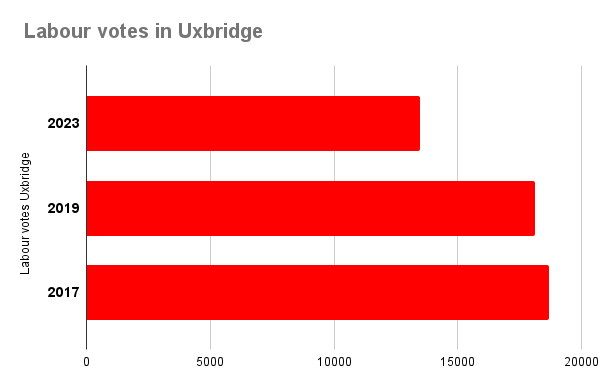
Labour Votes in Uxbridge, Selby and Ainsty down on 2017

Before anyone gets any impression that the Selby by election represents a mass move endorsement of Labour’s current attempt to drift into office on the back of Conservative unpopularity, all of the by elections on July 20th should provide food for thought.

Selby has been presented as the clearest evidence of a potential landslide, and much made of the swing from Tory to Labour. When you look at actual voters, however, its clear that there is no massive surge of Labour support, with a slight increase on the votes achieved in the bleak midwinter of 2019, but a drop from the high watermark of Corbynism in 2017. This indicates that Labour was able to mobilise some of its core vote in this constituency, but not all of it.

The swing is accounted for by the collapse of the Tory vote, from 33,995 in 2019 to 12,295 this week. A drop of almost two thirds.

A further indication that it is antipathy to the Tories that is driving these results rather than positive support for Labour is show by the votes in Somerset and Frome, where the Conservative vote also plummeted by two thirds, from 33,231 to 10,179.

Its quite clear that most of Labour’s previous voters in this constituency voted for the Lib Dems, whose 13,325 voters in 2017 were barely 3% ahead of Labour’s 10,998. The Labour vote is now less than a tenth of what it was then and is now a quarter of the vote achieved by the Greens, whose vote doubled.

In Uxbridge, the Labour vote was down about a quarter on both 2017 and 2019 from over 18,000 in both years to 13,470.

The Conservative vote, however, dropped by a “only” a half from 25,351 to 13,965. If this is the straw of comfort that the Conservatives are grasping at, it shows how desperate their situation is.

The notion, now being energetically pushed by the Labour leadership, that the Uxbridge result shows the need to back off from any policy that might scare off current Conservative voters is belied by the utter failure to motivate and mobilise Labour’s potential vote in these constituencies. The stances taken on issues like the two child cap on child benefit, that led to the moniker “Sir Kid Starver” circulating all across social media, will hardly have driven our people to the polls with any enthusiasm.

And, as for the ULEZ, this post from Open Democracy indicates that it was the failure to fight for it that was one of the factors that kept potential Labour supporters at home, the opposite of the conclusion that the Party leadership is so eager to draw. As they put it.

…Russell Warfield, a campaigner with the environmental group Possible says – is that there is a “hardened rump” of Conservative, anti-ULEZ, pro-car voters in the outer-London boroughs. And we already knew that: polling shows that, while a majority of Londoners back ULEZ expansion, most Tories oppose it.

Specific polling in a group of London boroughs where councils are taking legal action against Sadiq Khan over the scheme – including Hillingdon, which overlaps with Uxbridge and South Ruislip – found a majority of people in these areas who are deeply concerned about air pollution. (My emphasis)

Just as there is a block of anti-ULEZ people capable of being mobilised by the Tories, there is a group of pro-ULEZ people that Labour could have mobilised had they tried. But instead, the party’s candidate came out against the scheme, Starmer sat on the fence, and the potential Labour voters sat at home.

Ukraine, Ecocide and Complicity – or, why the climate movement should not allow itself to become a fig leaf for NATO.

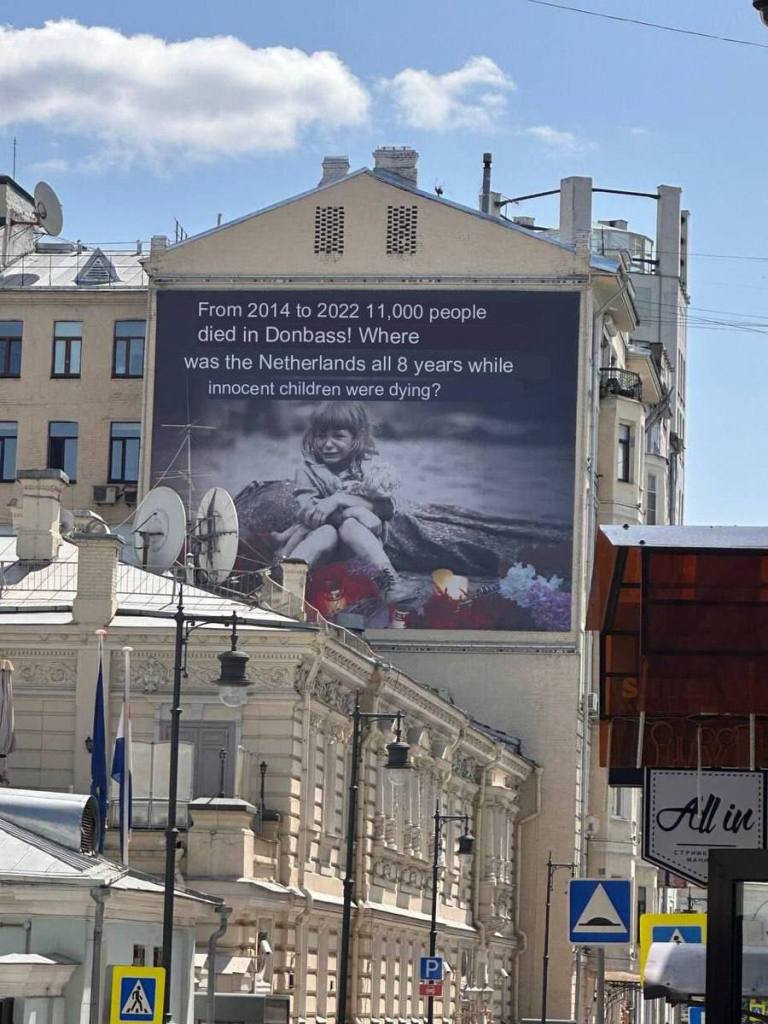
This poster is displayed on the side of the Dutch Embassy in Moscow and shows the number of people killed in the Donbass between 2014 and 2022. If you walk down the Arbat in the same city you will see hundreds of poster sized billboards memorialising the children killed by Ukrainian shelling into the Donbass in that time. If you go to Donetsk City, you will see a memorial garden for these children. That shelling continues daily even now.

Framing an argument to bury the truth

There is a manipulative form of polemic that starts with a particular image, or emotive incident, that is guaranteed to mobilise an empathetic emotional response from a viewer or reader. If you watch BBC News reports on Ukraine, and think about what they are doing as well as what they are saying (and not saying) you will see this in an almost perfect form. Everything is geared to eliciting an emotional, sympathetic response on the calculation that – because emotion always trumps reason – this will then blot out questions about why these events are taking place; because it will be taken for granted who is to blame.

You might argue that that’s what I’ve done here, but images like that above will never appear on the BBC, or in the Guardian, because its the wrong sort of emotional response. The wrong dead children. The wrong sympathy. None of these kids will have Fergal Keane deployed, with sad backing music and beautifully filmed mordant images of grieving parents, your heart strings will not be expertly plucked to resonate with theirs. But they are just as dead. And the imposition of an ideological no fly zone, through the current banning of RT and policing of social media, means that you are very unlikely to see them anywhere else either. But they are just as real. So, this is just a small challenging counter image to stick onto the gigantic montage of images that have created the one sided picture that you’ve been exposed to already.

And if the deaths of those poor people in the pizza restaurant in Kramatorsk this week is to be taken as justification and fuel for sacrificing even more people to pursue this war with an enhanced sense of moral indignation; is that not equally true for the people in Donetsk?

Because in narrative framing, anything that is out of sight is out of mind. In the case of wars, some people’s deaths are framed as their just deserts because they have the misfortune to belong to a people or state targeted by ours. As the infamous Sun headline crowing over Croatia’s ethnic cleansing of the Krajina in the Yugoslav wars put it, “Serbs you right”.

The Climate Movement and truth

There is now a move to align the climate movement in the Global North/West with the war aims of NATO. A press conference in Kyiv at the end of June, with President Zelensky, Mary Robinson and Greta Thunberg, announced a European body to evaluate “the environmental damage resulting from the war, formulating mechanisms to hold Russia accountable and undertaking efforts to restore Ukraine’s ecology”.

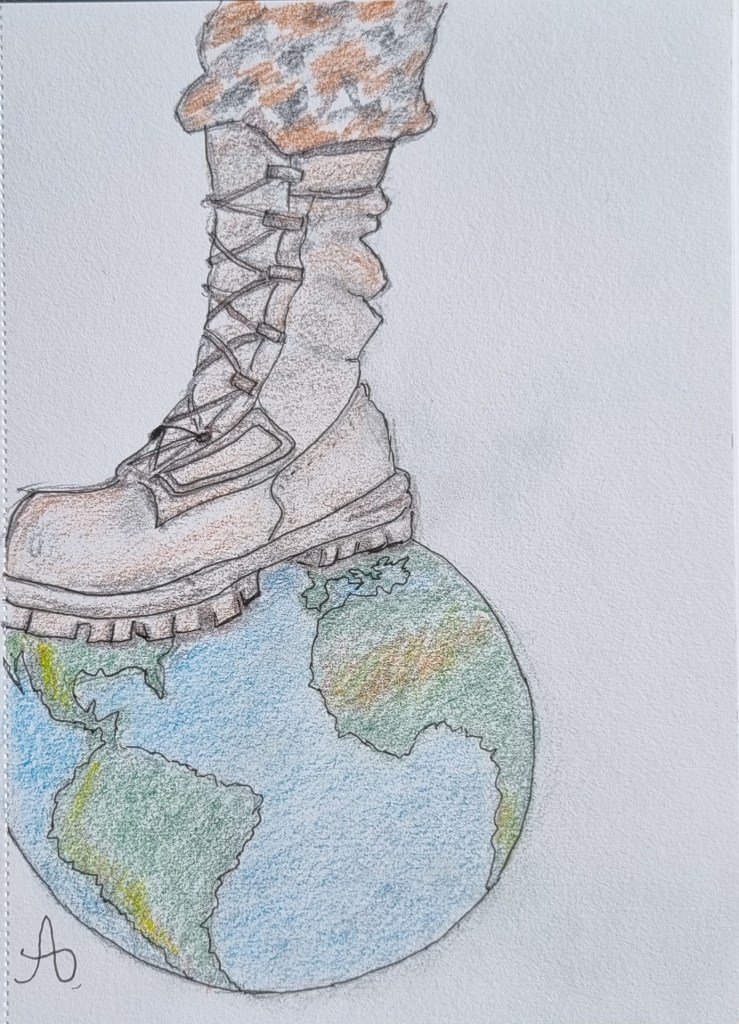
A Commission to examine the ecological damage done by the war as such is, however, not what this Commission is. Such a Commission would have to recognise that the way to stop the ecological damage is to end the war. NATO does not, yet, want to do that, so this Commission is structured to attribute all the blame to one side. Participants in this Commission from the climate movement, whatever their intentions, will find themselves providing a moral fuel to continue the war with single minded righteousness: thereby providing a thin green fig leaf for the most destructive militaries in the world. These are now rapidly expanding and increasing their carbon boot print to an unprecedented degree; and intend to use it. This Commission’s effect will be to prolong the war; thereby generating ever greater ecological damage and human loss.

A frame that aims to “hold Russia”… and only Russia…“accountable” means that ecological damage committed by Ukraine or NATO are either outside their purview, or considered not to exist.

Shells and missiles fired by the Ukrainian armed forces are no more ecologically benign than those fired by the Russians. In the case of the depleted uranium shells supplied for British Conqueror tanks, they can be worse. Ignoring this requires a level of cognitive dissonance that can only be sustained by an act of intense will; or generated by a red mist of moral indignation – generated by the the narrative framing above – sufficient to enable people to look straight at it, and not see it.

Anyone arguing that any ecological damage is ultimately the Russians’ fault “because they invaded” should not forget that this war started in 2014; when the Ukrainian Air Force bombed Donetsk city, opting for a military solution to a political crisis. Does anyone doubt that this would have led the Kyiv government being universally denounced in the West as a regime that “bombs its own people” had they been US opponents?

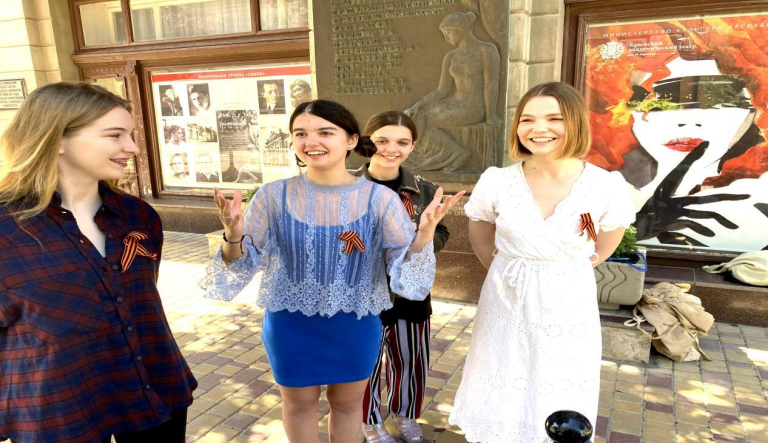
If you think that the road to peace runs through a Ukrainian victory, have another look at the picture of that girl in the ruins in Donetsk, and the picture of the Crimean Theatre students below, and reflect on the fact that the full realisation of Ukrainian/NATO war aims will involve the ethnic cleansing of their whole region; and that Kyiv has been completely explicit about that.

Theatre students in Simferopol Crimea wearing orange and black ribbons and singing songs on Victory Day May 6th 2023. Photo Dan Kovalic. For a view of how Crimea broke from Ukraine in 2014 and what it is like now see Dan’s article with Rick Sterling here.

President Zelensky was quite blunt that this Commission will be “support for Ukraine”, in the context in of him rejecting any prospect of a ceasefire and frozen conflict and promising to continue the war regardless of the cost. That cost will be measured in escalating environmental damage and human lives and the devastation of his country. The remark of the US officer in Vietnam who remarked that “in order to save the village, it was necessary to destroy it” haunts his speeches.

Collusion in confusion

Participation in a Commission on partisan lines will by definition require collusion with an a priori propagandist interpretation of any event. Four extreme examples of this that pass for conventional wisdom in the West so far.

  • The oft repeated narrative that the Russians were shelling the Zaporozhe nuclear power plant, when it was occupied by their own troops. Even after the Ukrainians admitted they were doing it, the media here still tried to muddy the waters. Ukraine being not only willing to shell a nuclear power station but having actually done it is not something they want us to dwell on. Especially now. The statement from President Zelensky at that press conference with Thunberg and Robinson alleging a Russian plan to blow up the Zaporozhe power station in the coming weeks is particularly alarming in this context; because it might be a cover to resume the shelling – with the blame preemptively allocated -as a pivot for global outrage and mobilisation, as argued by Dmitriy Kovalevich here.*
  • The bizarre accusation that the Russians blew up their own Nordstream gas pipelines releasing up to 350,000 tonnes of methane, doing an enormous amount of environmental damage. It has been a US aim to cut Europe off from Russian gas supplies for over a decade; well before the war. Blocking the certification of Nordstream 2 in February 2022 was a big victory for them. But only a provisional one, because the Russians remained in control of the pipelines and any peace settlement would see them turned back on. Blowing them up rules that out and stops the Russians having that option. It takes peculiar mental gymnastics to imagine that the Russians would destroy their own infrastructure to hand a geopolitical advantage to the United States. Articles by Seymour Hersch detailing US involvement have been largely suppressed in the media here.
  • The case of the ammonia pipeline blown up in Kharkiv is similar, in that the flow of ammonia from Russia to the West had been shut down by the Russians weeks previously as a tit for tat for the West not fulfilling its obligations under the Russia- Ukraine grain/fertilizer deal; so blowing it up would only make sense for a force trying to cut all potential trade between Russia and the West.
  • Claims from the UK Ministry of Defence that the depleted uranium shells they have supplied with their Conqueror tanks are really nothing to worry about, repeated in the media with a straight face. The use of these munitions in Iraq has had horrific impacts. For example The Falluja Hospital’s birth defects Facebook page, where medical staff catalogue cases, reveals the striking diversity and quantity of congenital anomalies. Babies in Falluja are born with hydrocephaly, cleft palates, tumors, elongated heads, overgrown limbs, short limbs and malformed ears, noses and spines. The use of these shells will poison wherever they are used in Ukraine for years after the guns fall silent, while the British politicians who supplied them have roads named after them in Kyiv.

A further example and exemplar of the approach that we are likely to see more of in the framework of this Commission is a recent article on Open Democracy Khakhovska dam destruction is part of the climate emergency. This makes the valid point that the dam’s collapse is environmentally disastrous, but then rests the gigantic accusation of “ecocide” on a conditional presumption, that the destruction of the dam is likely to have been the work of Russian forces”. “Likely”. Not definitely. Not even probably.

“Likely”. So, how likely? If your brief is that all ecocide is carried out by the Russians, it becomes necessary not even to ask this question; allowing carte blanche to the Ukrainian/NATO side to do their worst and just attribute the consequences to the other side. “Likely” is a small word, easily passed on from when reading at speed, but it is an admission that everything that follows by way of emotional mobilisation could very well be applied against the cause the author supports if readers allow themselves to think and question a bit.

Because its a matter of public record that the Ukrainian armed forces have been shelling and firing HIMARS missiles at this dam for months.

Their military and political leaders hastened to delete posts bragging about doing so as soon as it was breached, but many of them have been recorded and are in the public domain.

Taking a step back, there are three possibilities for how this dam was destroyed. Longer analyses of this can be read here and here, but in a brief summary these are the theories.

  1. The Russians blew up the dam to enable them to withdraw troops from the riverside to redeploy them against the main expected thrust of the Ukrainian army offensive further east; even though this would deplete water supplies to the Crimea. Resecuring this supply after Ukraine cut it off has been one of their main military objectives, and remains one. So, it would be an oddly self destructive to imperil it. It has also been reported, from Ukrainian sources, that Russian troops dug in on the east bank of the Dnieper were taken by surprise by the inundation; which would not be likely if their command were responsible for blowing the dam. More to the point, the Russians were in control of the dam. All they had to do to create a flood would be to open the sluice gates. No need to blow it up, so, why do so?
  2. The Ukrainians blew it up to wash away Russian minefields and defensive positions on the lower lying eastern bank of the river. Their earlier attempts to do so, to cut off the Russian forces on the West Bank before their withdrawal last Autumn, are well publicised. So, whatever the case in this instance, it was something they were prepared to do, it was well within their moral compass, with all the consequences that flow from that. They also appear to have been releasing water from dams higher up the Dnieper in order to keep the flood going; which is odd behaviour by anyone trying to minimise damage.
  3. The dam had been so weakened by the long term effects of the shelling and missile attacks on it that a build up of pressure from a greater volume of water building up behind it in the run up to the breach was too much for it; and both the Russians and Ukrainians have had to improvise a response.

Its hard to see the first option as anything other than the least “likely”, but judge it for yourself.

The media narrative in the UK, however, is not characterised by rational analysis or balanced judgement. The sort of spluttering rage you get from Simon Tisdall in the Observer is more characteristic;. “Of course the Russians did it…Only this malevolent Kremlin regime would wilfully inflict human and environmental havoc on so vast a scale…That’s what they do, these mobsters.” The sound of a man shouting down his own doubts because, as he admits “It’s impossible to prove at this point.” Obviously also a man with no memory of the 4.5 million people killed by the “War on Terror”, nor the far greater environmental destruction in Iraq inflicted by us and our US allies nor, more recently Yemen, thanks partly to the expert training provided by the RAF and RN to their Saudi counterparts; not to mention the after sales service provided by BAE systems making sure that their missiles were accurately targeted.

That’s why the argument on Open Democracy that “it is not enough to just lobby against fossil fuel extraction; we must recognise that the end of Russian imperialism is key to the struggle for climate justice” is so disoriented. It lets the the US and its allies, the world’s dominant imperialism, with the biggest military carbon boot print, completely off the hook to such a degree that it lines up behind its war aims. Anyone who thinks that the route away from the environmental damage caused by this war is via a Ukrainian/NATO victory has lost touch with reality; both in the concrete practical terms of the enormous human and environmental damage that would be required to secure one, and the horrendous consequences for the world of a triumphant retooled US alliance seeking to partition the Russian Federation, take charge of its fossil fuel reserves, really get stuck into oil and gas extraction in the Arctic, and get ready for the war in the South China Sea they’ve been pushing for; with Taiwan as the same sort of sacrificial victim that Ukraine has been.

Taking this stance would also sever links with movements and governments in the Global South; where people who have been on the receiving end of the US imperial system for decades see through its pretensions and fear its ambitions. It would be a disastrous course for the climate movement in the Global North to take. This is particularly in the context of governments like the UK cutting its commitment to global climate finance citing, among other things, “the costs of including help for Ukraine being included in the aid budget.”

Instead of becoming partisans of either side in this war, or any other, whatever our individual views, the climate movement here should stand for an end to the war, oppose militarisation, and campaign to get the global military boot print fully included in the Paris process, with a target to measure, monitor and cut it as fast as possible.

Post script. * The International Atomic Energy Agency has now confirmed that there are no Russian explosives set on the power station.

Let’s get out from under the carbon military boot print

Irrespective of what stance you take on the war in Ukraine, or anywhere else, in March last year, US author Meehan Crist wrote the following in the London Review of Books, “One of the worst outcomes of the war in Ukraine would be an increasingly militarised response to climate breakdown, in which Western armies, their budgets ballooning in the name of “national security” seek to control not only the outcome of conflicts but the flow of energy, water, food, key minerals and other natural resources. One does not have to work particularly hard to imagine how barbarous that future would be”.

Crist’s point is simply to describe the world we already have, but a bit more so; and her prediction is exactly what is happening.

  • The US has raised military spending to $858 billion this year; up from $778 billion in 2020.
  • France has announced an increase from a projected E295 billion to E413 billion in the next seven years (an average of E59 billion a year).
  • German spending is rising sharply, from E53 billion in 2021 to E100 billion in 2022 and is set to go further.
  • Japan aims to double its military spending by 2028 and is also debating whether to start deploying nuclear weapons.
  • In the UK, the government’s aim to increase military spending from 2.1% of GDP to 2.5% by 2030 comes on the back of what is already among the highest per capita military spends in the world.
  • NATO, the core alliance of the Global North, already accounted for 55.8% of global military spending in 2021 before any of these increases.
  • Other direct US allies – with a mutual defence pact – accounted for another 6.3%.
  • So, the direct US centred military alliances account for three fifths of global military spending and yet they are now raising it further at unprecedented rates. These are the world’s dominant imperial powers, acting in concert to sustain a “rules based international order” in which the rules are written in, and to suit, the Global North in general and Washington in particular.

The carbon boot print of these militaries is not measured under the Paris Agreement. It is, nevertheless, huge and growing; and we can’t pretend it isn’t. At the moment, the carbon boot print of the US military alone is the same as that of the entire nation of France. This is incompatible with stopping climate breakdown; both in the direct impact of production and deployment, the diversion of funds which are urgently needed to invest in the transition, and the potential impact of their use – which could kill us all very quickly; particularly if nuclear weapons are used. John Bellamy Foster’s Notes on Exterminism for the Twenty First Century Ecology and Peace Movements should be required reading for both movements.

Because this military is not sitting idle. The first phase of the Wars for the New American Century – in the form of the War on Terror since 2001 – have been calculated by Browns University at 4.5 million people; three quarters of them civilians killed by indirect impacts of US and allied military interventions. The scale of this is because doctrines like “shock and awe” are not simply an impressive displays of explosive power, but specifically designed to smash energy and water systems, both clean water supply and sewage treatment, within the first twenty four hours of an intervention to reduce surviving civilian populations to a state of numbed misery and demoralisation. “Why do they hate us?” I wonder. 4.5 million people is about half the population of Greater London, or three quarters of the population of Denmark and twenty two times as many as have died in the Ukraine war so far (assuming total casualties of 200,000, most of them military on both sides). It’s a lot of people. *

Their deployment and use more widely against opponents that are more resilient than Iraq, Afghanistan or Libya- which this escalation of expenditure and increased integration of alliances makes possible – would, even if it did not go nuclear, be catastrophic both in its direct loss of lives but also in the disruption of global supply chains leading to widespread economic unravelling. According to the Australian Strategic Policy Institute, a war in the South China Sea that closed down shipping lanes would have a rapid impact regionally – “Taiwan’s economy would contract by a third, while Singapore’s economy would fall by 22%, according to the baseline estimate. Hong Kong, Vietnam, the Philippines and Malaysia would suffer falls of between 10% and 15%” – but would have a knock on effect everywhere else affecting 92% of global trade. The attempt in the Global North to set up “secure supply chains” – defining economic policy increasingly around military imperatives (“securonomics”) is not to avert such a conflict, but to make it economically manageable, and therefore more likely.

This scale of military expenditure also dwarfs their domestic investment in combatting climate change, urgently needed because the wealthiest countries put the heaviest weight of emissions on the rest of the world, both historically and through their per capita footprints now: let alone helping Global South countries develop without reliance on fossil fuels. This has a wider implication, with the UN Sustainable Development Solutions Network reporting that progress towards the UN Sustainable Development goals has been static for three years.

Pledged to commit $100 billion a year to help the transition in the Global South, more than ten years ago, they have never been able to eke out this money, have never hit the target, have tried to use loans (debt trap) instead of transfers, sought to apply conditions and control. The US contribution to that is now aiming for just over $11 billion by 2024. This is now reckoned to be a tenth of what’s needed. This is despite 66% of their populations agreeing that this support should go in, and only 11% against. The contrast with the $77 billion they have stumped up to fight the Ukraine war with no trouble at all in the last year is quite startling. News that Finland is planning to cut development aid to countries in Africa that don’t line up behind the Western line on Ukraine is an ominous sign of how far backwards this could begin to go; with any attempt at global governance through structures like the UN abandoned and notions of international obligation and mutual humanity giving way to even more overtly colonial attitudes and practices than we already have. Although the notion that the Global North can “build a wall” and keep the human consequences of climate breakdown out is a fantasy – as the climate is breaking down behind the wall too – it probably won’t stop them trying.

The USA and its allies pose themselves as “Global Leaders”. They could and should be, as they are the countries with the greatest concentrations of wealth, power and technical know how, communications and education, but they are falling horribly short; because they see leadership as the same thing as dominance – and subordinate everything else to that.

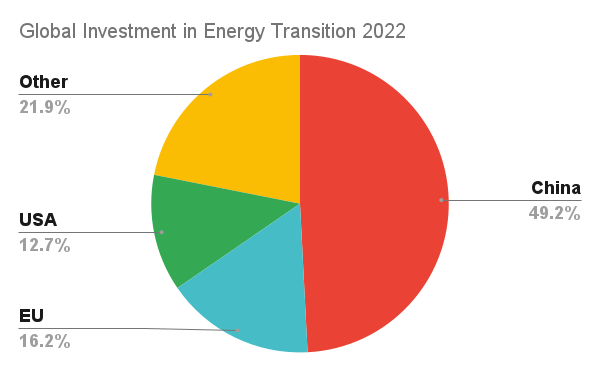
In fact, in 2022, China – usually presented in our media as a negative force on climate – invested 70% more in renewable energy generation than the USA and EU combined, just under half the global total on its own. Next year, according to the International Energy Agency, China will account for 70% of new offshore wind, 60% of new onshore wind, and 50% on new solar PV installations. So, the “international leaders” have a lot of catching up to do.

The US and EU are some way behind, and nowhere near where they need to be. Instead of investing on the scale needed to hold the global temperature increase below 1.5C, they are tooling themselves up militarily to try to deal with the consequences of failing to do so; in an effort to sustain their global dominance. If they are leading us anywhere, its to Armageddon.

A report from the US military in 2019 sums up the paradox. Reflecting that, if climate breakdown continues at its present rate, countries that are already water stressed will be getting beyond crisis point within two decades and that this will lead to “disorder”. Their conclusion was that this means that

1. they will be intervening in these crises, and

2. will therefore need to build themselves in a secure supply chain of water so that the troops who are dealing with people in crisis because their environment has run out of it, will have enough to keep them going in the field!

Reflecting further, that on our current trajectory, climate impacts within the United States itself would lead to infrastructure breaking down, followed by the social order breaking down, followed by the military itself breaking down; as it faced overstretch trying to maintain order as civil society failed. Nevertheless, they also note that the rapidly increasing melt of the Arctic ice shelves and permafrost means that new sources of the fossil fuels that are causing the crisis in the first place to be available for exploitation and that a key task for them would be to make sure that the US gets the lion’s share of them. As a study in self defeating thinking, it can’t be beat.

To repeat the point at the beginning, regardless of anyone’s stance on any given war taking place now, and who should “win” it, its this drive and acceleration of military spending that the climate and peace movements should be combining to hold back – both to avert the growing risk of conflict, because arms races tend to end in wars on the momentum of their own dynamic (which requires a lot of demonisation and conflictual stances to fuel and justify it) and to allow saved funds to be used to avert the climate crisis itself. A bottom line demand is that the military carbon boot print must be accounted for in the Paris Process and a mechanism agreed for reductions to a common per capita level, combined with common measures and investments for increased global cooperation in lock step with it.

*Casualty figures in Ukraine are easy to come by but hard to trust. 200,000 assumes a parity between the Ukrainian and Russian militaries; whereas figures from Mossad, among others, indicate significantly lower Russian losses (at perhaps a fifth to a third of the Ukrainian level) so 200,000 may be a high estimate. One notable feature of this war is that civilian casualties have been a fraction of the military losses – the opposite of the trend from the mid twentieth century onwards; during which “there has been an increase in civilian fatalities from 5% at the turn of the 19th century to 15% during World War I (WW I), 65% by the end of World War II (WW II), and to more than 90% in the wars during 1990’s, affecting more children than soldiers”. From https://www.frontiersin.org/articles/10.3389/fpubh.2021.765261/full#B12

An argument with the BBC on climate coverage and a debate in the Metro letters column.

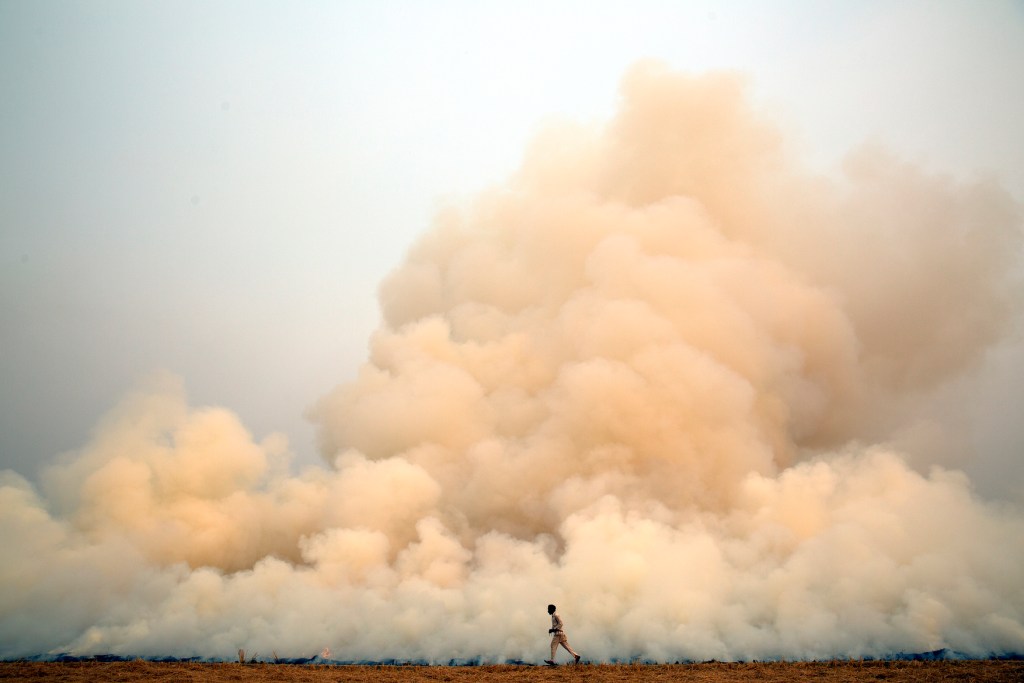
Crop burning in Northern India. By the end of the decade almost half the Indian population will be trying to live in an average temperature of 29C. Photo: Ishan Tankha / Climate Visuals Countdown

Coverage of the climate crisis in the media is usually pushed to the margins and framed to deflect serious attention to it. The BBC seems to be on a mission to normalise it, to make it background. The tabloids mix oh goody, we’re going to be “Hotter than Morocco” front pages with shrieking calls for the “Eco Mob” to be banged up so we can enjoy the snooker (or whatever) and weird articles in rightist broadsheets like the Telegraph that spread misinformation – their latest that solar panels becoming less efficient at above 25C is a fatal flaw, not the marginal problem that it actually is – in that peculiarly gloating tone always used by people trying to take refuge from a changing reality in a timeless common sense that has actually long past its expiry date.

In the face of all this, its worth having a go at times, so…

My complaint to the BBC (The World Tonight).

You reported on Antonio Gutierez’s warning that the world is heading for a 2.8C average temperature increase, with all that follows from that, without seriously addressing it – and then didn’t seriously address it. There was no follow up. No comment from anyone else. It was then not referred to again during the summary of the news in the middle and end of the programme.

On any objective judgement, this was overwhelmingly the most significant item on the news and should have been treated as such. None of the other issues threatens the whole of human civilisation within the lifetime of children living now. Simply reporting the warning then treating it as somewhat less significant than the well merited demise of Boris Johnson, or the sad death of Glenda Jackson, is part of the process whereby a fundamental crisis in our civilisation becomes wallpaper, as if it is “something we have to get used to”, as one of your anchors put in in a previous programme, as if we are going to be able to, as if the crisis we are at now is going to stop there.

A warning like that should be stopping the clocks and making us sit up to deal with it, not passing quickly on to all the displacement activity we are busy with while we wait for things to fall apart around us. Could you please, please live up to your mission as broadcasters and treat this with the seriousness it deserves? Thank you

Their reply; which reads like stalling…

Thank you for contacting us and for sharing your concerns about The World Tonight, broadcast on June 15.

However, we’re not able to reply to your complaint without more information. If you could provide us with the specific time at which the relevant news item was heard, we may then be able to address your complaint.

If you’d like to listen back, we’ve provided a link to the programme below…

My response

You asked for details of when the item occurred in the programme. Its 5 minutes 50 seconds in. As the essence of what I was saying was that Antonio Gutierrez’s warning is something that should be taken seriously and be given far more extensive coverage – instead of being mentioned once then passed over in silence for the rest of the programme – the fact that you couldn’t find the clip rather illustrates my point. By contrast, diverting though it is, Boris Johnson’s latest shenanigans will barely be a footnote if there is anyone left to write History in 2100. I honestly despair of your coverage sometimes; like the way that Labour’s pledge to stop new oil and gas exploration on PM on Monday (about half way through) wasn’t debated in the framework of this being imperative but very difficult – leading on to a serious examination of what would need to be done to do it and what changes would need to be made – but a sneery and fatalistic dismissal from Evan Davies and his guest that it could be done at all. Perish the thought that this country might be able to rise to a serious challenge. Not your finest minutes.

The Metro Letters Page is full of letters that their authors think are “gotcha!” challenges, which are actually deflections from having to think through an issue that, if they took it seriously, would scare them shitless. Here’s one I responded to earlier.

Tuesday 6th June

Kate Taylor (Metro Talk Mon) says that demonstrators from Just Stop Oil are neither “moronic” nor “cowardly” . People cause greenhouse gases and the UK population today is 67 million and will be 77 million by 2050. World population today is 8 billion, up from 2 billion 100 years ago.

Will Kate Taylor and members of eco-groups pledge to have no more than one child, never to travel in a petrol/diesel vehicle, turn off their gas supply, take no foreign holidays, eat less meat, use no mobile phones nor electrical goods and never attend music festivals or sporting events? Eco talk is cheap.

Clark Cross, Linlithgow

Thursday 8th

Clark Cross (Metro Talk Tuesday) says “eco talk is cheap”. What he’s missing is that failure to act on the breakdown of our climate will be very costly in all respects, and sooner than we think.

On our current trajectory 2 billion people will be trying to live in an average temperature of 29C by 2030; including half the population of India.

So, while it’s a bit late for me just to have one child, I have to admit that I’m extremely grateful not to have any grandchildren (much though I’d love them) because the world we are heading for unless we make drastic changes will be a nightmare by the time they are adults.

So, whatever we can do we must do, as individuals and as a society.

Paul Atkin, London 

Friday 9th

Paul Atkin (Metro Talk, Thurs) says “we must do all we can as individuals and a society” to fight climate change. The oil, gas and coal-rich countries are still exploiting their reserves, while China, India and others have agreed only to “phase down” not “phase out” coal. What would Paul suggest the UK, with one per cent of global emissions, can do to penalise these countries before we all fry?

Clark Cross, Linlithgow

This was my reply that they didn’t print, perhaps because it poses questions outside any framework acceptable to them.

Clark Cross (Metro Talk Friday) suggests that the UK should “penalise” China and India before doing anything serious to avert climate breakdown on its own behalf. 

Leaving aside the suicidal quality of this, and awkward facts that India’s per person carbon footprint is a third that of the UK, and that China is the only country in the world investing in renewable energy on the scale needed – half the global total last year and 70% greater than the USA and EU combined – we are still left with historic responsibility.

This country became wealthy partly through burning vast quantities of coal. Our contribution to the greenhouse gases currently over heating the world is about 7% of the global total. Seven times our fair share. So, we have a responsibility to fulfil there; and we need to cooperate with the rest of the world to do it, not look for conflicts. Time is frighteningly short.

Paul Atkin, London

9 questions for Rachel Reeves and Keir Starmer.

In the week that

  • the sky all along the North American Atlantic seaboard turned orange from wildfires in Quebec,
  • and the two year drought in Northern Italy was broken by six months worth of rain in 36 hours,
  • and on the first day of “Big Green Week”,

Rachel Reeves announced that Labour’s modest plan to bring the UK up to the European average by investing £28 billion a year into green transition would be subject to “fiscal rules” that meant they would have to “ramp up” to get there.

Despite these brave words from Ed Miliband, “Some people don’t want Britain to borrow to invest in the green economy. They want us to back down. But Keir, Rachel and I will never let that happen. Britain needs this £28bn a year plan and that is what we are committed to”; the way that Reeves framed her argument implied that the “ramp” is likely to be be long and shallow, and the chances of getting to then end of it slight.

This poses a number of questions.

  1. Are we in a climate emergency or not?
  2. Outside the wilder reaches of the Tory back benches and the cluster of delusionary think tanks clustered around Tufton Street and the Spectator, it is generally agreed that we are; so does this not require emergency measures?
  3. As the breakdown of the conditions for human civilisation to survive is a greater existential threat than any we face apart from nuclear war, and certainly more overwhelming than the Second World War: do you think anyone in 1940 would have said, “we are committed to fighting the Nazis, but we have to be fiscally responsible about it and make sure the books are balanced as we do it?”
  4. Given that a failure to invest on this scale will mean that the UK will be unable to match levels of subsidy and support going in from the EU and the USA, does this not imply a collapse in any prospect of “investing in the industries of the future” and therefore the prospect that, as the industries of the past are outmoded and superseded, the UK becomes a deindustrialised backwater – as the private sector investment you want to attract is drawn elsewhere?
  5. As you have previously calculated that £6 billion a year will be needed to meet your pledge on insulating homes, is this an irreducible bottom line, or are you also abandoning your pledge to cut energy bills for everyone “for good”?
  6. As unnamed Shadow Ministers have been quoted in the press arguing that some investment in, for example, housing and transport will be needed that are not part of “the net zero agenda”, how will you make sure that any investment that could contribute to net zero does; as any investment that is not part of the solution is part of the problem?*
  7. If your plan is to “ramp up”, at what point will you start, with how much investment in what projects; and how do you calibrate the return on the investment?
  8. If your problem is a lack of government income, why are you not planning to tax the energy producing companies on every penny of their windfall profits, which would pay for the £28 billion a year several times over?
  9. If these fiscal rules are sacrosanct, will they also apply to military spending and, when there is a choice between military escalation and saving our society, which will take precedence?

*An example that links the two is what kind of housing development Labour will push. There is a world of difference between

  • the current paradigm of cookie cutter, ticky-tacky houses with poor insulation, with the maximum number of units squeezed in so developers can get the biggest possible profits, built in the green belt in car dependent “amazon deserts”  (like an American suburb but meaner)
  • and 15 minute neighbourhoods built as communities with all necessary facilities within walking distance, good public transport links to larger centres; and made up of homes built at zero carbon standard with very low energy use and bills.

Being in support of “the builders not the blockers” without legislating the latter as standard will mean that the next generation of mass house building will follow the line of least resistance – with developers cutting corners, skimping on materials, maximising units and profitability; and dumping the ensuing problems on a future that is getting shorter and more threatening all the time.

Climate breakdown. Don’t mourn – organise!

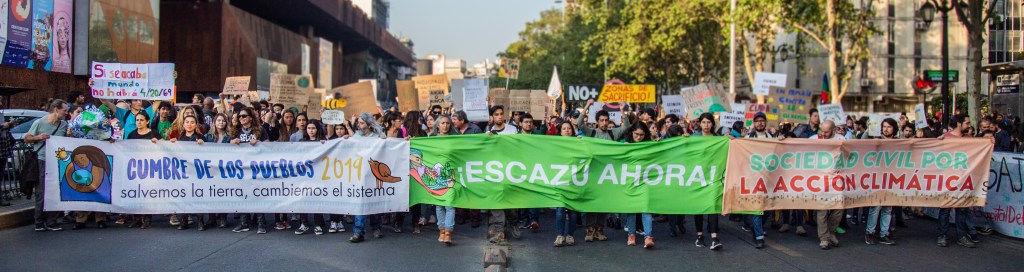
Photo by Constanza.dougnac – Own work, CC BY-SA 4.0,

This is, approximately, the text of a speech I gave at the Climate, Class and Crisis meeting at Goldsmiths College on 6th June. The full meeting can be viewed here **with some very interesting contributions from Claire Fuller, one of the founders of XR, who is still very much involved, Damian Gayle, Environment correspondent for the Guardian and Matt Huber author of Climate Change as Class War and a Professor in the Geography and Environment Department at Syracuse University New York and chaired by Feyzi Ismail of Goldsmiths Media Studies Dept.***

I’m going to be speaking in a personal capacity so I can be more heretical, which tends to get more of an interesting discussion. The whole question climate breakdown is a class struggle and it’s a global one; and the working class movement has to step up and lead it because the ruling class is failing to do so.

Globally, I think we have to get a handle on what’s needed and who’s doing what.

There was a very interesting article recently by Adam Tooze which identified that in order to actually make the energy transition we need to be investing $4 trillion a year.

According to the International Energy Agency, last year 1.7 trillion was invested in renewables ( though, as they are including nuclear in that, that’s a little optimistic.

But one trillion was still invested in fossil fuels.

So you’ve got $1.7 trillion going more or less in the right direction, but one trillion going the other way.

So overall, a move of $0.7 trillion in the right direction, but we need to be doing more than four times as much.

So, that’s the scale of what we need to be doing.

Tooze also notes that, of that renewable investment, 49.7% of it was by China; which was 70% more in total than the United States and the EU combined.

We don’t hear about that a lot. We usually get China as the villain of the piece because of its coal fired power stations…

So, that’s the scale of the investment; and those three big continental economies make up more than 75% of the time.

And those figures are confirmed by the IEA for the next year. Their projection is that China is going to account for 55% of new renewable capacity in 2024.

So, whatever your view of China, Tooze ‘s comment that it’s the only country in the world investing on the scale required poses a question for all of us in the Global North/West. Why aren’t our much richer societies/ economies/ polities, matching that, or doing more?

Some of it is that climate breakdown, as well as representing an existential challenge for the survival of humanity, in a more immediate limited sense represents an existential challenge for the ruling class as a class.

Oxfam did an analysis that showed that the top 10% – which is basically anyone or more than about £80,000 a year – will take us beyond 1.5 degrees on their own; which underlines the point that for most of us 80,000 quid is a lot of money, but for people like Boris Johnson, you know that this is a fraction of the “chicken feed” that he said he was being paid to write for the Daily Telegraph, which I think was a quarter of a million a year. So for people like him, a very, very, very high standard of living is is really roughing it: the other phrase he used for this was “hairshirtery”. And, for him and people like him, it would be.

And there’s also very worrying thing at the moment, which is the misdirection of investment into military spending. In the US debt ceiling negotiations last week they agreed to cut welfare but increase the military budget to $850 billion a year.

And that’s going on throughout the Global North. Japan, Germany, are doubling expenditure; Britain’s going up to 2.5% of GDP; and the implication of that is that the Global North, rather than invest in actually combating climate change, is tooling itself up to defend itself against the consequences of failing to do so.

So what do we do, given that it’s the top 10% that run the show, control capital, the markets, buy politicians and set the media agenda?

This isn’t about protest.

It’s not about getting the people in charge to notice in the hope they’ll do the right thing.

They know; and prioritize other things.

The fossil fuel companies put money into climate denial and and confusion in the same way that the tobacco and asbestos companies did about the links between their products and cancer.

The private sector won’t lead.

There’s only 5% of big companies have “gold standard” transition plans. And that’s this government’s gold standard, so that’s probably going to be fairly generous to them.

For small companies, it’s not really on their agenda.

One of the big U.S. Investment banks that withdrew from Mark Carney’s Climate Finance initiative last year did so because they said putting climate concerns ahead of profits for shareholders was “immoral.”

So all of this now requires a kind of massive cognitive dissonance – not simply on their part but across the whole of society; to keep us all thinking in a strange kind of way, with an emotional disconnection from what’s actually going on – and the promotion of all that via the media across society.

That ranges from outright denial, people like the Global Warming Policy Foundation, through a kind of Technical Micawberism; you know, something wonderful and technological will turn up and save us all at the last minute…and with one mighty bound we’ll be free! Just illusion and ideological delusion.

I remember Nadim Zahawi at the launch of the DFE net zero strategy at the Natural History Museum last year saying very, ebulliently “We are going to be saved by the British entrepreneurial spirit!”

Yeah…

OK, so you get denial in various forms.

And it ranges from Sunak, who says it’s “economically illiterate” to block New North Sea oil and gas.

To people like Gary Smith from the GMB, who says it’s “naïve” to block New North Sea oil and gas.

So the first thing is we have a fight in the labour movement.

And we need to organize to have it, and I’ve got a bit of a checklist, which is a bit obvious, you know, grandmother sucking eggs situation.

But we need

  • a network of Climate activists in each union that’s organized.
  • Sound policy passed in each union; and on the wider issues, not simply the sectoral concerns, but the overall issues. Because we’ve got to think strategically. We’ve got to think hegemonically. We’ve got to think that our movement has got to lead this fight. It’s not about defending our members from it. It’s about getting ahead of it. Of course, there’s different challenges in different unions.
  • Taking that policy up to the TUC.
  • Get the Union apparatus partly organizing around the issue. In the NEU for instance what used to be health and safety is now health, safety and environment and we’re doing things like getting out heat guidance – which never used to be an issue, but it is now. And we’re having our first ever green bargaining reps training at the beginning of July. So that sort of thing is happening. The UCU is way ahead of us btw. They’ve been doing it for about five years longer than we have.
  • To organize across unions in the same sector. We put a united front together of all of the unions in the education sector, whether they’ve got network or not, around the DFE Net Zero Strategy producing a joint critique of it, and we’re continuing to liaise.
  • The activists to coordinate across the whole movement. And you’ve got lots of formations for that. You’ve got Climate Justice Coalition, Campaign Against Climate Change, Greener Jobs Alliance.
  • To take this politically and by politically I mean in a very narrow sense, in slightly Parliamentary sense at this point. Obviously it’s got to be taken up much more broadly in terms of the kind of mobilization Claire was talking about. But in terms of government, because it’s what states do that’s going to make the immediate difference, there’s the whole question of what Labour’s going to do. Because we’re very likely going to have a Labour government and it’s going to be a Starmer led Labour government not a Corbyn led government: so it’s a rather different kettle of fish and the current discussion on North Sea oil and gas and the £28 billion investment, whether they’re going to do it or not, is absolutely the frontline of the argument at the moment. And we’ve got to fight that one through. So, for example, the just transition demands that UNITE says it wants to promote -they should be very clear about what those are, to coordinate that with other people in the movement, and fight that through the Just Transition body that Labour actually has; which UNITE is part of. It’s not a matter of saying ohh we want a just transition but not actually putting it forward. We got to make sure they put it forward. I haven’t seen it yet. I’m sure they will come up with something, but it’s it’s a matter of urgency that they do it.
  • It’s wider as well, because we’ve got to look at local authorities. Can we get local authorities to set up Just Transition bodies to plan for things like insulation, the expansion of the workforce that we need, training those new workers in the FE colleges, including a climate awareness module so that they know what they’re doing and why they’re doing it? So they’re on a mission. Not just doing a job. They’re on a mission and they believe in that mission. It’s about social transformation and linked to community campaigns for local energy generation and things like onshore wind.

Do you know how many onshore wind turbines were put up in this country last year?

2! Both at Keele University. Just staggering.

Just a few points on protest.

I think we’ve got to try to avoid public antagonism.

I don’t think it helps having people, you know, really hacked off – people going about their ordinary business really hacked off – but to target ruling class over consumption, so that you’re actually connecting with all the resentment that people feel about the inequality that we’re going through at the moment – and it’s being put on the right targets; all these people flying about in private jets, why aren’t we targeting that?

And to undercut all this bullshit that you get in the media – that the climate movement is all posh people inconveniencing “ordinary folk”, in the words of Andrew Neil. So you get this stuff from Farage, who says “Just Stop Oil is all posh girls called Imogen and India”, right?

This is from a stockbroker from Sevenoaks who went to Dulwich College and his name is Nigel. Man of the people?

So we have to undercut that narrative.

We’re also going to have to target the media in my view, because it is really poisonous. We are absolutely flooded by denial and drivel; I mean, how many more articles on Phillip Schofield can you take?

And we also need to coordinate the mass actions. I think the turn of XR to mass organization is the right move. The Big One was terrific. It was like a four day outdoor teach in. Everybody was learning from everybody else and it it was brilliant. We need more of that. But I think we need to coordinate it, organise it with other currents; and organise it at key points like the COP. You know, there’s been some students occupying universities recently. Would it be possible to organize a mass wave of that in November? Don’t know… throwing it out there.

Last thing, I think we also need to highlight demands that cut costs and accelerate the transition. Insulation is the obvious one, but what about a demand for free travel cards for every worker, paid for by the employer to facilitate the transition to public transport and away from cars?

To sum up, however we do it, let’s not mourn, let’s organise.*

*I didn’t actually say this bit, but thought about it afterwards as the conclusion I should have used…instead of “er, that’s it” so, to that extent, this text is backdated.

**If you watch the video and look at the machine generated transliteration that runs alongside, it provides hilarious food for thought for anyone who believes that the activity of reading is solely phonetic. The same thing can be seen if you ever watch the transliteration of the News that runs in a strip along the bottom on the BBC 24 hour channel a few seconds after the speaker.

What the machine is doing is taking the sounds it picks up and putting them into words that sound like the sounds. This is the theory of synthetic phonics in action, in an almost pure form, because the awkward middle stage of recognising and attributing a sound to the graphemes (letters) is cut out.

Because there is no reference to syntax, and the meaning of the sentence up to that point, the results are a bit hit and miss. Sometimes accurate. Sometimes gibberish.

Which underlines the point that in actual reading – done by people – the meaning of the text read so far helps guide what you think is coming next; so the recognition of letters and sounds is in a dialectic with that.

Children learning to read do this quite slowly – and you can see them doing it; sometimes reading on a bit before noticing that what they are saying doesn’t match what they are seeing, so going back to have another go. Adults and proficient readers do that too, but at such a terrific pace that its below conscious attention.

***In Feyzi’s intro she says that I was the founder of Thurrock Friends of the Earth in 1971, one of the first local FOE groups. I was actually one of several people, including Angela Monck, Bob Moorman and others, all of us school students; and at that point we had no inkling of climate change, but were worried about nature depletion – all the local elm trees were dying of Dutch Elm disease – and a wasteful use of resources. At one point we picketed the local Tescos about overpackaging and got in the local paper looking purposeful and frighteningly young.

Ukraine Chief of Intelligence drops the mask on forcible reoccupation of Crimea and partition of Russia

The 26th May is the ninth anniversary of the beginning of the shelling of Donetsk by Ukrainian forces in 2014. For the Donbass Ukrainians that opposed the new Maidan regime this event marked the point of no return. It followed the burning alive of the anti-maidan protestors in Odessa on May 2nd 2014 and Ukrainian forces trying to storm Mariupol that same week. The shelling has continued daily ever since, including today, killing several people. Yet, listen to the news here and there is silence about that. The casualties caused by a Russian missile strike in Dnipro were reported however, and President Zelensky’s comment that this showed the Russians to be “fighters against everything humane and honest” was not put in the context of what his own forces are doing. An enemy of the United States would be accused of “shelling his own people”.

Nevertheless, most people who support the Ukraine Solidarity Campaign, or call for a Russian military withdrawal and restoration of the pre 2014 borders, sincerely assume that this would be a liberation for the people who live in the Donbass and Crimea; and that this is where the war would stop.

This interview with Kyrylo Budanov – the head of Ukraine’s military intelligence (the GRU) – by a journalist who has been making a film supporting the Ukrainian war effort released last week, shows that the Ukrainian high command (and journalists) have no such delusions.

Budanov says a number of interesting things in this interview, some of them revealing, some quite far fetched. He is, after all, an intelligence officer, so he has access to a lot of information; but, as an intelligence officer, a large part of his job is to spin false but instrumentally useful narratives. He is also a firm believer in the notion that if you will something hard enough, it will come to pass and that Ukraine will “win”, despite their succession of grinding defeats since the new year and the terrible cost in lives that is the price of carrying on.

At the same time, he is secure enough in the presumed support of his audience to describe what the sort of victory he wants would look like. In the same way that the Guardian is now so sure of the allegiance of its readers to Ukrainian nationalism that they can reveal that, when collaborating with the Nazis in WW2, they killed around 100,000 Poles, a massacre described as “genocide” by the Polish government as recently as 2016.

In the interview’s final section, about what would happen in Crimea if Ukraine’s war aims were achieved (starting 36:57 minutes in) he is quite blunt that “victory” in the sense of military reoccupation would only be the start of a “difficult” “multi year process” of “reintegrating” territories with a population that is actually hostile and does not want to be reoccupied. Three million people with, as he puts it “a completely different view of the world”*. The interviewer uses the euphemism “three million not very devoted people” and Budanov states that those people with an “altered psyche” who can be “re educated” should be – without specifying what should be done with those that can’t, though “physical elimination” is a phrase he uses elsewhere. This will have to be done with a carrot and a stick, as the two only work together; and with a “firm hand”. This will be “hard work” he says.

Many words can be used to describe this scenario. “Liberation” for those 3 million people is not one of them. If you believe in self determination, you can’t support this.

His comments at the end section about “a new security architecture in the world” are put in context by a section “About the Future of Russia” a little before this (at 32.45 minutes in). In this, the interviewer pulls across a map of the Russian Federation – “your famous map” with the partition borders – that Dick Cheney and Zbigniew Brzezinski originally proposed back in 1991 as a way to manage the “Post Soviet space” most amenably for the US – drawn in in thick blue felt tip lines; remarking that “its been shown a lot”. Not in the media here it hasn’t. It might make people wonder a bit.

This isn’t Budanov’s map, but is similar. If you google US aim to partition Russia and click on images, you get a number of variations.

Budanov uses a number of euphemisms about “unanimous transformation” of Russia and the prospective partition being “conceptual”, and speculates that the more defeats the RF suffers the more it will break up, starting with the Caucasus. His confirmation, when discussing the prospect that “new states” will be imposed on the wreck of the RF that, “Russians are well aware of this” gives a tacit recognition that the Russian security concerns raised in the run up to February 24th were real and existential.

His statement “we don’t need Russia in the form that it exists now”, underlines this and, given where the partition plan originated, cannot be defined as defensive.

*If you want an insight into why the people in Donbass might have a “completely different view of the world” – which Budanov suggests is a result of “propaganda” – consider these personal accounts from the day the Ukrainian army started shelling Donetsk city on May 26th 2014. These are from the Donetsk Anti Fascist site.

Marina Kharkova: “May 25 was the last day of peace in Donetsk, as the family celebrated the birthday of my father, a miner. The mood was anxious, restless and tense because of the general situation, but nothing yet seemed to portend tragedy. On the morning of 26, on my way to work, I heard the sounds of flying planes and distant explosions. Everyone had gathered in the largest office and was listening to an employee who lived near the railway station. She cried and told how Ukrainian planes and helicopters had bombed from the air, how their nine-storey building on Privokzalnoye had been shaking, how women killed by shells were lying directly on the pavement bleeding, how the minibus she was travelling in had hurtled away from the danger zone. She sat in silence, clutching her heads, trying to comprehend. Tanya was given water and sedatives – she was so sick. Then, by inertia, they tried to get on with their business. The rumble outside the window increased, though the office was far away from the airport. Ambulances and cars with militia were whizzing down the street. After three in the afternoon everyone decided to stop their pointless attempts to pretend to be busy and drove home. The understanding of what was happening came at once, although the consciousness was still trying to cling to yesterday’s peaceful day. The 26th of May was the point at which “it will never be the same again”.

EIena Hovhannisyan, a biology teacher: “At that time we kept up with the news from Sloviansk and Kramatorsk. We already knew how people had been martyred in Odessa, Mariupol and Krasnoarmeisk. I had forebodings of near disaster. It was already hovering over us, but we did not think how tragic, long, brutal, hopeless the events would be. Sometimes it seemed that it was just a bad dream, that I would wake up and everything would be like before. But no. It is an illusion that the war will not touch you. It will touch everyone, sooner or later. We were simply the first to be in the epicentre. And May 26th I will always remember. The warm, sunny weather and the roar of planes in the sky. From the balcony on the side of the airport black smoke could be seen, you could hear explosions constantly. The first shelling, deaths, destruction, grief and pain. Since that day, there would be no peace in Donetsk for another nine years. But we didn’t know it then. And that day was endless, filled with horror and pain. The phones were literally ringing off the hook – everyone was trying to find out what happened to their loved ones, whether they were alive or not. In the evening my son arrived from work; his office was a couple of blocks from the station. He told about the horror in the city, about the dead woman vendor from the station market, about the very young guy who worked as a valet. He was killed by shrapnel from a missile fired by a Ukrainian helicopter. People were falling, screaming, crying, calling for help. Passers-by tried to save the wounded, car alarms howled. The railway station area in any city is the most crowded place. In Donetsk on Privokzalnoye there are markets, shops, banks, the area was teeming with life. They say helicopters flew so low that you could see the pilots in the cockpit. And these pilots also saw that they hit peaceful people. This was not done by some Hitlerites, but by Ukrainians, with whom we lived in the same country. May 26 was the day that turned everything upside down. There is no and will not be our forgiveness for Ukraine. And there will be no return.

From the diary of a Donetsk woman who wanted to remain anonymous: 26 May 2014, from the balcony, I saw planes firing missiles. My husband, coming home from work, told me about the dead in the station square. At the same time as the airport was being bombed, the fighting moved into the city, on Kievsky Avenue linking the city and the airport. People who had lost their jobs or shelter, relatives or loved ones, went to volunteer for the militia. And every day there were more and more of them, including my acquaintances, as the war gradually touched everyone.

It is difficult to describe the sensations of trying to sleep to the sound of shelling outside your windows. The deafening and resounding explosions are somewhere close by. Your heart sinks each time, because no one knows where the next shell will land. But when you see the dawn, you realize that another night is behind you, all your loved ones are alive today.

In addition to the fighting at the airport and the aerial bombardment with unguided shells, Ukrainian snipers shelled the Putilovsky Bridge. This road was then called the “road of death”: civilian cars with people were burnt and shot, and in the Putilovsky Grove there lay the bodies of both civilians unluckily caught up in the active fighting and the militiamen trying to save people. For several days, the bodies were decomposing in the terrible heat: there was no opportunity to pick them up and bury them.

An ambulance was also shot up on the road to Donetsk airport. Its crew, Artem Kovalevsky, the ambulance driver, paramedic Sergei Kozhukharov and doctor Vladimir Vasilievich, miraculously survived and managed to get out of hell.

They told reporters from the local branch of Komsomolka in Donetsk how they managed to survive when Ukrainian snipers shot even those who had managed to run into the wooded area.

Victoria Sergeyevna, neurologist: I was on duty that day, the hospital was far away from the airport, but we all knew what was going on. In the evening, many people of different ages with strokes or suspected strokes were brought to our department. People’s chronic illnesses were exacerbated by the stress. The statistics of deaths from heart attacks and strokes during the war has increased dramatically compared to the peacetime. And these are also our victims of the war, just as innocent as the victims who died under shelling”.