Of trenches, barbers and betting shops

Running through the park and someone has dug out a series of slightly curved strips of soil, covering about half of the grass area by the children’s playground where the kids usually play football. These are about half a metre wide and several metres long and don’t appear to have any function. Their uniformity implies that they were dug by a machine; the number of them that they were done with some purpose – presumably a municipal one. This might be an attempt to put in flowers to support insect life and add a splash of colour – to supplement the meadowing of the top half of the park – which leaves the long slope down towards the tennis courts swishy with long grass in the high summer. I hope so. As I pass a small group of little girls in hijabs are playing football across them anyway and arguing – as you do – where the imaginary goal post is.

Just by Aldi there is a betting shop. It is the only shop in the street that has hand rails to support infirm people to stagger up the slope a few steps the better to lose their money. Considerate.

In our local straggle of shops and restaurants a new micro hairdressers stands out like a black tooth in a Colgate smile. The window is covered in a deaths head figure holding scissors and a set of menacing playing cards. Below, a range of clippers are laid out like implements of torture. The decor inside is an intense black and white vertical stripe. Its name is something like The Final Cut, or The Close Shave and it looks like a barbers for sado-masochists, or people who confuse a hair cut with living on the edge.

Dopplegangers

Where I live there are a lot of lookalikes.

I have recently seen Robert Mugabe getting on a bus with his shopping; looking thoughtful, Lenin stacking shelves in Sainsburys; looking relaxed, gone ginger and having put on weight.

Down the hill is an elderly man who is the spit of the late Emperor Franz Josef of Austria Hungary – who, although he has laid down the burden of absolute power in favour of erecting a trellis, continues to drive two Mercedes cars – one silver, one blue. Presumably one for Austria and one for Hungary.

A tale of two supermarkets.

It was the best of shops, it was the worst of shops…

Thurrock  Thurrock voted Leave in the EU referendum by 72% on a 72% turnout. The second highest Leave vote in the country. 

If you go to the Morrison’s in Grays Thurrock, the walls by the tills are dominated by  gigantic black and white photographs of the past. In pride of place is one of Tilbury “A” Power Station from the 1950’s or 60’s. It overlooks the shoppers, solid and dependable –  fueled by vast quantities of coal dug out from under “native soil” and hauled in on the river – just as those of us old enough to remember it can recall it in those corners of the mind in which the past seems solid enough to walk through – its tall slender chimneys pouring out its carbon emissions like a banner. Warming our homes, powering our industry, over heating our planet. Power before we knew the full extent of the damage.

It creates a perverse sort of elegiac pride in nostalgia. Coal, cement, the Docks, heavy industry, hard graft, breathing in the smoky air. This is who we where when we knew who we were. Who are we now? Who are we becoming?

This speaks unequally to the shoppers. There are other old photos of people who are – I think without exception – white. The shoppers in the aisles are now much more mixed than that. Seeking to define a place only by its past threatens to keep it there.

A contrasting set of photographs could lift eyes and hopes.

Alongside the old black and white coal fired station – a similar sized photo in full colour of the London array – the 175 turbine 630 MW offshore wind farm just down the Estuary, in all its elegant enormity – not quite so local but almost, and the second largest offshore wind farm on Earth – something to give some pride in the present and hope for the future.

This is what we used to do. This is what we do now.

Alongside the picture of people in the late 40’s sunbathing by the riverfront at the Wharf pub – all baggy shorts and summer frocks – a full colour picture of people as they are now playing on the beach playground, running on the galleon, climbing the rope pyramid, digging in the sand, drinking tea and eating chips – as you do.

This is who we were. This is who we are.

A montage of self portraits of children from local schools.

This is who we are becoming.

Kingsbury

Brent voted 60% to Remain in the EU referendum on a 65% turn out.

Being a German owned supermarket, the Aldi in Kingbury has a Union Jack the size of a Shankill Road gable end overlooking and dominating the tills. The queues are as diverse as any in the country. Go along any one and you will find several home languages.

You will also find the same lined, hard working faces as you do in Thurrock.

Brent has the largest Romanian population in the country. Evangelicals outside the Tube station often have texts entirely in Eastern European languages. None of these people had the right to vote in 2016, despite working here and paying more into the system than they take out. They have no right to vote for national government either, whatever deal is come to on their rights to remain.

The message of the flag – that someone thought it a good idea to put it up – and to put it up on such a huge scale – seems to be that our future is sufficiently uncertain that overt and in your face expressions of loyalty to traditional symbols is needed to prevent our future becoming more than our past.

The news that, on the day of the EU summit that kicked the UK’s prospective exit six months down the road, some five Brexit supporters swathed in Union Jacks blockaded the Aldi distribution centre in Cheshire by parking camper vans across the road – while shouting “We don’t want German” and “This is Brexit at its best” – might make the company’s attempt to brand itself as a local shop for local people more understandable – but also underlines the self defeating futility of it.  The blockade included several continental made vehicles. One of them German. Sometimes the news reads like satire.

Who want to be stuck with who they are the whole time?

Nick Hornby’s comment in Fever Pitch about the dangerous excitement of being seen as a teenage football hooligan on Saturday afternoons, when the rest of the week he lived a well behaved and humdrum life, strikes a chord with anyone who writes – or reads.

There is an American children’s book called Harold’s Magic Crayon in which a toddler draws lines that become reality. The crayon is – of course – purple.

Authors writing fiction as omniscient narrators are the gods of their own worlds – which often become stranger and more various in the process of writing. Few start with a plan or a story frame beyond the basics of a character and a dilemma which sets a puzzle to be solved – or at least explored. Having a worked out beginning, middle and end before starting – like Michael Heseltine’s life plan – would be to set limits before the start. Life, as Heseltine found out – isn’t like that. The point is the exploration; not the target.

Authors writing in the first person are trying out different identities – which are different possible versions of themselves – or an attempt to get beyond themselves – to try to inhabit a different skin in a different life in a different place.

When we write, we are more thought out and considered than when we speak. A more literate, well referenced version of ourselves. All the insights we pick up then think through, can be backdated as though they were spontaneous. “You – only better” as the American plastic surgery adverts used to put it.

This capacity to live as though we were someone else through fiction is given an additional spin by the existence of alternative online universes wherein people can “live” as souped up avatars. In its simplest form this can be as one character in a series of scenarios combining problem solving with fighting in an endless series of encounters in which you – as your character – are in permanent peril, but with an eternal capacity to be reborn after death and start again. “Life” in these contexts as a series of rehearsals for getting it right one day – Groundhog Day with a mouse – before moving on up to the next level to be “the best that you can be” – within the confines of a game designer’s universe.

The question we might want to think about is to what extent the pay offs that we get from these games – or engagement with social media as such – becomes a more exciting substitute for the messy humdrum realities of real lived sensuous experience – especially if we feel the need to live through an avatar – possible as an on screen Ninja, but not when pulling a shopping trolley to Asda on a rainy Tuesday.

The extent to which the players of the game identify with their character as the way they would like the world to see them spills over into online communication when there is no direct contact. Dating profiles are an obvious form of this.

Loneliness – and a sense the the person you are is not someone anyone else would want – can lead to catfishing – another attempt to explore possibilities and get genuine feedback as a fictionalised version of yourself – or as someone you’d like to be. The paradox of this is that the genuine emotions behind this can connect beneath the subterfuge.

The phenomena of the online political troll is another. President Bolsonaro of Brazil was elected last October on a tidal wave of online disinformation about his opponent co-ordinated by allies of Steve Bannon. His rapidly collapsing popularity indicates that a quickly inflated bubble of bullshit doesn’t necessarily last, but is all it takes in the short term and, in an election, that’s all it takes. In any forthcoming election, be prepared for online broadsides of dead cats.

The slew of stories about Russian intelligence having a big online operation and intervening in political debates in other countries – as though this is the kind of contemptible thing that only the Russians would do –  has had a quieter counterpoint in admissions that all intelligence agencies are at it. One intelligence operator sitting in an office in Moscow, or GCHQ, or the NSA HQ, can be running up to a dozen assumed identities at one time. They will not simply be intervening overseas, but also at home.  They are almost certainly very busy people.

The revelation that at least ten profiles of people posting anti-semitic abuse while claiming to be supporters of Jeremy Corbyn were completely fake – fake names, fake photos – poses a serious question. Who would have an interest in providing false evidence of “far left anti-semitism” while hyping up the tensions inside a party that the powers that be in this country are desperate to keep out of office? This is adopting a caricature persona – a virtual straw man for others to knock over – as a job.

While it is only natural that debates about important issues spark strong emotions – the mutual hostility generated by abusive posts is an end in itself for those who want to sew the seeds of rancor. No one engaged in debate forums should assume that anyone unknown is necessarily a real person. Reflecting that the aim of trolls is to hype up debate so that responses are irrational or abusive underlines the importance of being polite – not rising to provocation – and using facts.

Such debates can become very absorbing – even obsessive – as the desire to find coherent narratives is how we create meaning for ourselves. I argue, therefore I am.

The dominance of social media in our lives now – and the highly manipulative Apps that drive us when we are on it – gives rise to the disturbing thought that real life is becoming relegated to the things that we do to sustain us while we are waiting to get ourselves connected in this extraordinarily alienated way.


Death to Rat Runs…

When Waltham Forest Council proposed to bar through traffic between the shops in Walthamstow village there was a vocal and lively resistance. Believing that preventing cars driving through would finish the shops off, over 100 people demonstrated, complete with a coffin symbolising the death of the shops.

The effect was the opposite. The absence of cars made the space between the shops quieter, safer, more peaceful , more pleasant. It even made the air fresher. As the street was now a more attractive place, more people came to it. The shops are thriving. None are boarded up. Opposition seems to have dwindled to one irate antique dealer. At the end of the shops, a side road has been bollarded off and a small park enlarged to make a public square run by the local residents association as a social space, and people play petanque on it, among other things. A small corner of North East London that will be forever Paris.

The attempt to reclaim our streets from the car is beginning to flower. Waltham Forest has 6 mini-Holland schemes in place, with several more in preparation. Every week there are delegations from other local authorities coming to have a look to see how it works.

Essentially the idea is to keep through traffic confined to main roads – by cutting off through routes on side roads with bollards at one end. These block cars, but allow walkers and cyclists through. That means that local residents with cars can get in and out, but their streets will no longer be rat runs. This dramatically cuts the volume of traffic and the speed it goes at; because any traffic is local and part of the community, not racing through in an edgy quest to get somewhere else as quickly as possible. It makes the areas concerned calmer, quieter, more peaceful. An elderly pedestrian carrying his shopping at a slow shuffle illustrated the importance of this. In most streets the presumption is that we all have to skip or jog out of the way of an oncoming car just as an act of self preservation. This man couldn’t do that if he wanted to and now he didn’t need to. None of us should have to.

With safer roads, more people – and children – are walking or cycling. The council has put in 250 lockable bike hangars with space for 6 bikes. These take up the parking space of one car. At a rent of £25 a year per bike, 3 000 people are on a waiting list; providing a demand for an additional 500 hangars. There has been a measured improvement in physical activity and health which is self generating once the framework is in place.

Subtle changes to street furniture are also taming the traffic. Extending double yellow lines further from corners improves visibility. Making the corners on junctions sharper forces vehicles to slow down to take a bend; so the emphasis is put on pedestrian safety rather than the speed of traffic flow. Mixed use paving at junctions makes drivers think of the primacy of walkers when they cross from a main road to a residential area. All this seems quite small, but the cumulative effect is civilising. One local resident commented that before this scheme was introduced he used to have several near misses with vehicles every week when he was out on his bike. Now its down to about one a month. The children pouring out of schools at 3:30 stroll confidently and socially down empty roads previously dominated by speeding cars.

The barriers to traffic are sometimes in the form of trees or planters, further greening the area. Maintenance of the planters is run by local residents, and several residents associations have been formed to keep them up; thereby bringing people together and creating more of a community with a sense of ownership and neighbourliness. Residents of one social housing block – seeing the example – independently crowd funded so they could plant trees and flowers along the end of an otherwise bare patch of green lawn.

One of the first things that people noticed when a railway bridge that had previously been a rat run was bollarded off was the bird song. In a space that no one would previously hang around in, someone has thoughtfully fixed a little notice at infant child’s height with the time of trains on it; so they can stand and watch as they go by.

So far, so civilising. All of these developments are south of the great circle of smog that is the North Circular, where there is a greater density of tube stations and tighter bus routes facilitating alternatives to cars even among the well heeled; who nevertheless keep cars and mostly park them up during the week but retain them for weekend escapes. The North Circular is also the border for the first phase of the ultra Low emissions Zone – leaving the outer suburbs as a zone left behind in an earlier car based phase of urban development.

But the problem in these wider, sparser unreconstructed ‘burbs is not just an infrastructural one, but a matter of politics. The MP for this area is that godfather of all things backward, Ian Duncan Smith – or “Ian Duncan Smith Nurrrgh” as he is known in the House of Commons – the groan of despair that greets his name every time he is called by the speaker making it habitually triple barreled. That’s the Ian Duncan Smith who turned up at Chequers recently in an open topped sports car like a depressive version of Mr Toad – an instant meme for a mid life crisis – and clearly “the motorists friend.” The Conservatives are digging in against the expansion of the ULEZ and will make it a theme of their 2020 Mayoral election campaign; so the prospect of successful mini- Hollands between the North and South Circulars and the M25 becomes something of an imperative. What they will be seeking is a response like the initial reaction in Walthamstow Village, but one that has no chance to learn from experience that there is a better way to live.

Post script – a personal encounter with IDS.

What I wrote above may seem a little unkind – though not as much as one of the fit for work assessments brought on by Mr Duncan Smith when he was at the Department for Work and Pensions. It is partly driven by an odd sixth sense experience while I was accompanying a visit to the House of Commons by our School Council. While Emily Thornberry was showing them the Terrace overlooking the river I was standing just inside and felt a sudden chill behind me. It was a bit like the moment in Star Wars when Obi Wan Kenobi says “I felt a great disturbance in the force – as as if millions of voices suddenly cried out in terror and were suddenly silenced.” I turned, and there, looming up from the restaurants below, staring blankly ahead, was the former leader of the Conservative Party, although wreathed in all the bready, buttery aromas of what passes for a good lunch in the home counties- carrying with him such an air of misery and gloom that I’d have felt sorry for him had he not been so intent on pulling the rest of us down with him.

The time’s out of joint. Episode 2. Two tribes?

The two cities superimposed on each other – as though East and West Berlin occupied the same physical space – in China Mieville’s the City and the City is not too far from the reality of the unexpressed conflicting visions in people’s minds. Two people can walk down the same street and be aware that they are in the same country, but imagine that that country is a  different place from the way the other imagines it. Each person will think that the  view of the other is far more like her own than it is – until there is a political crisis that brings a simplified and caricatured version of those visions out of their heads and onto billboards and screaming headlines.

The EU referendum was one of these crises. Two very different visions of the country – both almost equal in size – were set up to stare aghast at each other in mutual incomprehension.

On the defeated remain side – the  48% of the voters who had complacently assumed that their future was everyone’s-  shocked big cities looked down their noses in horror. Sam Johnson’s Eighteenth Century view that “anyone who lives in the provinces is fit to do so” becoming a common theme among better off, self consciously well educated people in the capital. A furious sense of betrayal among many younger people, who no longer dance to the old “patriotic” tunes with the fervour of their elders, whose sense of identity as “Europeans” was bigger than just “British”, felt the result as an abrupt closing in of horizons – that a terrible ugliness had been born.

The leave vote – 52% of voters, 38% of the electorate – grew from anger especially among older, whiter, maler voters in small towns and old industrial areas at being left behind by the slick, faceless, soulless, distant and unaccountable “Brussels bureaucracy” steamrollering ahead in the interests of big money. This was coupled with provincial resentment at the continuing concentration of wealth in cosmopolitan, metropolitan London and other big cities and spiced up with resentment at comer-inners from overseas. This was expressed very forcibly online by one correspondent who wrote “we should build a wall around London.” Although this rallied around a vision of the country that drew hard on the myths that have sustained its self image in an increasingly compensatory way long after the realities on which those myths were based had gone, many of these people would also seek to defend their health service, the prospect of decent jobs and a bit of self respect.

The extent to which the political debate generated by the economic and environmental impasse of neo liberal capital – with the future feeling like a threat and the present a squeeze – with even life expectancy beginning to decline – has been channeled into two false choices – leave the EU and we’ll be back to being a great independent trading nation with good old blue passports, imperial measures and maybe even thru’penny bits – or stay with the EU and everything will be modern and fine and we can keep eating croissants for breakfast-  is an attempt to limit political options to two dead ends.

The deliberate hyping up of that debate, using pejorative terms designed to create knee jerk reactions and deepen tribal affinities; “traitors”, “remoaners”, “racists”, “metropolitan elites”, “rednecks” – is an attempt to make allegiance to these dead ends the most deeply felt identification in politics. The logic of this is to break and recast the current political parties into a remain coalition – from the Labour right to the likes of Heseltine and Soubry – and a rump Tory/UKIP greater English nationalist party – thereby marginalising Corbyn and the Labour left.

Neither side in an argument posed in these terms is capable of “uniting the country,” because neither is capable of refounding it on a new basis; and each will leave the other resentful and angry and preparing for trouble. Each is led by competing fractions of capital – one relatively integrated into the EU, happy to settle into a north European spiesseburger democracy; the other seeking a more piratical modus operandi as a smaller, meaner version of the United States; or perhaps a version of Jersey with nuclear weapons and a hinterland of slums.

Because neither of these is a way forward, the task we face is to generate a new hegemonic politics out of this debate that goes beyond both the nostalgic delusions of going it alone – including its left variation (which might be called “Social Democracy in one country”) – and the comparable delusion that trying to unite Europe on the basis of a Hayekian minimal state with as little accountability to its peoples as possible is going to be enough to contain the tensions that its failures have generated.

The focusing of an emerging left alternative in the form of a Corbyn government preparing from a Green new deal and a quantum shift in economic strategy and international alignments – which has echoes across the continent and in the United States – concentrates the minds of all those trying to maintain the old broken framework. It makes the current risky polarisation into Brexit tribes an imperative, even when it creates paralysis, because there is an alternative on the horizon and there is palpable fear that it might win an election.


The time’s out of joint episode 3. We the people?

The real divisions in a society in crisis are often obscured by the form of the apparent political rift. When Polly Toynbee (Guardian 26/3/19) argues from opinion poll results that the divide between leavers and remainers is now more strongly felt than prior allegiance to political party she underlines a disjunct between a passing sense of identity and a longer term set of alliances based on material interests that are more fundamental.

These interests cross borders. A paradox of globalisation is that the ethno-nationalist reaction against it is being encouraged, assisted and funded by the policy of the Trump administration in the United States, and some of the right wing  media outfits associated with him. Some US businesses are doing this directly – looking forward to serious pickings as big polities are broken up into weaker fragments. They are working on the EU. They would like to do it to China.

The most fundamental  division in Britain is between those who have wealth and power and those who do not – however they voted in June 2016. It is in the interests of the former to coral as many of the latter as possible behind them and the most potent way to do so has always been “patriotism” – the assumption that being born in a place should put you at the front of the queue for whatever is going and – that your particular “identity” somehow makes you both better than other people and gives you a wider significance- as a compensation for your very real subordination and obscurity in everyday life. In countries that are no longer as powerful and influential as they were, this often becomes toxic.

A division within the wealthy – in which one faction breaks with the established way of doing things- leads to all sorts of weird developments in which all that is solid turns into air – old Etonians claim to be anti-elitist, a leadership contender for the Conservative Party says “Fuck business”, the Daily Express, Sun and Mail denounce the House of Lords and the judiciary; and hedge fund managers short sell UK stocks and bonds to cash in on the economic consequences of their “patriotic” campaign – in which the lower orders are urged to “believe in the country” – taking as their motto an inversion of JFK – “ask not what you can do for your country” – ask only what your country can do for you.” and go laughing all the way to the tax haven.  Because the country is set up for their benefit and only functions in order to do so, they wrap themselves in the Union flag while deftly stashing their assets in Dublin or Belize or Singapore, and preparing to burn “traitors” on bonfires made of red tape, as a distraction from the grand opening of

  • Free Trade Ports and Enterprise zones (in which they and their friends will be bribed and subsidised to invest, while paying no tax back)
  • the take over of the Health Service by US insurance firms (and probably Virgin) -so check the wallet before the pulse
  • and the spread of chlorinated fried chicken stands- finger lickin cheap and nasty.

disguising their venality in the name of “The People.”

So, who are “The People”?

When Michael Howard went on the radio on Sunday (24 March) to argue for the hardest available Brexit, he talked about honouring the wishes of the 17.4 million people who vote to leave in the referendum, without troubling himself to question whether his own preference was indeed what they were voting for. He had a point as far as it went. 17.4 million is a lot of people and their views have to be taken into account. But, beyond the 17.4 million, what about the rest of us?

In a country with over 66 million people, that’s just under 50 million who’s views – in Howard’s world – are simply to be excluded from having any say or influence in the future direction of the country.

One of his Conservative colleagues commented today that “the British people” had “voted overwhelmingly” to leave the EU. Thinking that a ratio of 52:48 of those voting is “overwhelming”is sufficiently odd to require some investigation as to who he thinks “the British people” are.

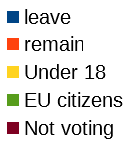
Of a population of 65.5 million in 2016:

17.4 million voted leave.

16 million voted remain.

13 million were under 18 and ineligible to vote.

3 million were EU citizens not entitled to vote despite working and contributing.

16 million didn’t vote at all.

As a graph, this looks like this.

imageunnamed

For this Conservative MP, the bloc represented in dark blue is an “overwhelming majority.” For Michael Howard these are “the people”, or at least the people that count – in whose image the nation must be recast. This is also about the control of the 17.4 million. Their views were and are far more diverse than they have been presented, but for people like Howard they are a useful statistic forever frozen in 2016 – the time of The One True Vote.

This sets us up for continuing crisis and polarisation. A political project that seeks to slash and burn regulations and protections for workers rights and the environment, that favours the replacement of the civil service with ad hoc committees of businessmen, that is prepared to see social security, farming and manufacturing go to the wall by slashing tariffs, and the re-ignition of the Irish troubles over a reimposed border, cannot afford to have a consensual approach. The sheep must be separated from the goats and the goats must be slaughtered. The cultural revolution style shrillness of the headlines – CRUSH THE SABOTEURS – ENEMIES OF THE PEOPLE –  matches the disruptive scale of the project and also the impossibility of it being carried through without a breakdown in an agreed political framework in which differences can be resolved without violence. It is in this context that a reviving UKIP is seeking to build an effective  street fighting movement led by Tommy Robinson, pulling firms of football hooligans into some very large and aggressive mobilisations which have attacked trade unionists and the police.

If Brexit is averted the crisis will continue because everything that then goes wrong will be attributed to “the great betrayal” – in the same way that Germany was only defeated in World War 1 because the army was “stabbed in the back.” Untrue myths are often the most potent – because they cannot be tested. The scale of this remains to be seen, but anyone who thinks that just remaining in the EU as it currently is will solve all our problems has not noticed the economic stagnation of the euro zone, the impasse of Macron, the backsliding of Germany on its climate change commitments and the continent wide spread of US backed ethno-nationalist currents likely to make the next European parliament the most right wing in its history.

If Brexit is not averted – especially if we get a hard version – the grim realities are likely to turbo charge a hunt for further “saboteurs” and “enemies if the people”.

Although the weariness at all this is often expressed in the infantile injunction to “just get on with it” – as if “it” was something that you could “just get on with” – most people want to be able to get on with their lives without massive upheaval and disruption. Remaining, or the softest possible Brexit, like Labour’s deal or Norway plus, offers the best chance of relative stability in which “The People” can realign around more fundamental questions.


The old order is dying, the new struggles to be born*.

It was the contrast that did it.

The old

On March 15th at 11:20 in the morning there were two groups of secondary school students standing outside the National Gallery on a trip. They looked as though they would do what they were told, accept what they were given; or – if given the chance – resist it in secret underhand ways, damaging to all concerned.

Bedecked in black (always black) Academy blazers, they were lined up, orderly, standing still with barely a twitch, silent, a bit resigned but tense and sullen looking; as though having had to be socialised by psychological defeat. They were collectively individualised; isolated from one another all together: sameness one at a time.

They were staring blankly, incuriously seemingly at nothing, eyes mostly unfocussed and inward, as though the centre of London were no more interesting than a dentist’s waiting room; passive enough to be ready for a future holding little promise of security, a home to live in or worthwhile, well paid work to do.

The established faith – an untruth universally acknowledged –  that education is the way up and out – that if you work hard and get your grades you’ll get on, that each of us is pitted against each other in a battle for a big car and a big house, status, standing or celebrity and that social mobility “up” to a lifestyle that burns its way through the planet’s resources in a desperate search for something to fill the holes in our souls is a real or worthwhile enough dream for everyone to buy into – hanging over them like a preordained defeat; with the occasional Pygmalian escapee only serving to mock those left behind.

No doubt their school would get a “good” or “outstanding” from OFSTED for successful socialisation of the next generation; shaving off the edges of their square pegs the better to fit compliantly into the corporate round holes of a world in which their dulled, test drilled uniformity is the human equivalent of the crash of species – from rain forests and insects to amphibians, big cats and primates; and their replacement by mono-cultural plantations, 5 billion factory farmed cows and 20 billion chickens poisoning water courses in a mountain of manure.

Their teacher stood in front, half looking away, aware but glazed, with the slight smile of a man whose behavior management systems were beyond having to make exceptional personal efforts; but who was nevertheless avoiding eye contact.

A new hope

Five minutes later and a stone’s throw away, spread across the whole of Whitehall, moving fast and tumultuously, laying siege to Downing Street and bouncing up and down on the walls of ministries, thousands upon thousands of their contemporaries came pouring up the road in a torrent of banners, chants, singing, slogans and conversations; calling for their elders to wake up to the threat of runaway climate change.

The Horses on guard at Horse Guards Parade bucked and cantered in a sort of solidarity as their breast plated riders struggled to retain control and blank expressions.

The creative energy was palpable. The intention serious. The mood a mixture of exuberance at taking action, earnest seriousness and a sense of responsibility in getting their message across, defiance in breaking bounds, fueled by an exasperated rage and fear at the cloth eared mulishness of a society so wedded to its old ways of doing things that it is sleep walking into a disaster that is clearly seen yet downplayed to invisibility – in the school curriculum even more than the news.

“I am no longer accepting the things I cannot change. I am changing the things I cannot accept” read one of the banners – a welcome echo of the 68 slogan “Be realistic – demand the impossible” because if what seems impossible is what is necessary for us to survive as a civilisation, we have to face up to it.

In the 1960s some people were sufficiently scared of nuclear war to take direct action to try to shock wider society into opening its eyes to the threat. People sat in the road to block traffic. The students did the same. Sitting in the road and chanting “turn your engines OFF!” as a direct comment on how everyday habits of getting around are helping set us up for disaster. The difference now is that nuclear war is an event that could or could not happen whereas climate change is an event that is happening. Every year it gets more apparent and the urgency of dealing with it gets through to more and more people, despite the millions poured into poo pooing it by fossil fuel companies; exhibiting the same profit defending criminal irresponsibility shown by their counterparts in tobacco and asbestos but on an apocalyptic scale.

These students were unsupervised, running things themselves; improvising a route with lively elan and running rings round the police. They broke through the limits of official dialogue and behavior in a self disciplined orderly disorder. Adults with them were supportive participants with no need to exercise control because the students were dedicated to a higher purpose and were controlling themselves.

In finding the voice that their generation needs, they have overflowed the bounds of business as usual. Their understanding, initiative, creativity, formidable organising skills, capacity for coherent and constructive argument, wit, research skills, courage and humour; have developed a sense of agency, mission, solidarity and empowerment that makes them the leaders in society and education today.

Those Ministers and Head teachers who think it enough to mouth platitudes about missed education and threatening detentions – to try to derail this movement and dampen their students down into the same subordinated, depressed  state as the poor souls outside the National Gallery – are failing to grasp the opportunity for social and educational change that their students are serving up to them on a plate; and of course a staggering lack of any sense of proportion. Many of these students have already stepped into a world beyond one in which the old ways have any meaning or resonance.

They have opened a breach in the old order. Time for the rest of us to pour in behind them.


*Quote from Antonio Gramsci.


Weirder than Takoma Park

On my daily morning fitness and shopping run down to Sainsburys – a good route that I can manage  without stopping because its downhill all the way – I pass through a labyrinth of alleyways on the Springfield estate that zig zag down the hill like a mountain terrace.

There is usually a small pile of discarded beer tins and cigarette packets cluttering up along the fences – the suburban detritus of bored youth or demoralised old age – but this morning, rising above all that and neatly duct taped in a line along one of the creosoted fences were three tulips in full bloom. Having been there overnight they were bowing their bright red heads in an elegant silent swoon, like imprisoned princesses awaiting their fate – or a random art installation with no cultural agenda.

It must have been a significant act for someone for them to buy that number of tulips – or, more menacingly, cut them from someone’s garden – bring them to that spot and tape them up in a line – carefully equidistant – just there. An odd place for a romantic gesture; or a shrine; or a ritual: or a warning.

Down at Wembley Asda  – the stadium looming in the near distance like a newly arrived space craft –  there are people collecting money. It’s not very clear what for. One elderly woman – who looks like she is begging because she has no charity sign, but is turned out too smartly and has far too posh a voice has made herself up all over in lime green face paint, so she looks like a very thin version of Fungus the Bogeyman wearing a shimmery raincoat. As she approaches, a small child riding in a supermarket trolley cowers in terror, her safe world suddenly threatened.

The time’s out of joint. Episode 1. “I cannae hold it Captain, she’s going to blow…”

On September the 19th 2014 I found myself walking towards Hendon tube station unsure about which country I was in. The Scottish independence referendum had been the previous day and I hadn’t heard the result.

It was like being suspended between possibilities. Schrodinger’s country – alive and not alive at the same time. The early morning street bathed in pale sunlight, and all the people going about their business, would have been the same, and just as solid, but which state we were in, and where we might be heading, seemed fluid, full of possibilities, most of them bleak.

Were we still in the Britain we had grown up in, surviving a little while longer with its familiar outlines, dusty old emblems and narcissistic nostalgia; or had Scotland broken away into a brave new dawn on the back of the enthusiastic support of barely half its people, having to lug along the bewildered resentment of the rest like Braveheart with a limp; leaving behind a wounded greater England (or lesser UK) – with Wales and the North of Ireland as awkward appendages cued up to eye the exit – the long slumber of continuity broken by edgy debates about who – after all – we think we are – or, for that matter, were?

Uncertain speculation was resolved prosaically by the front page of the Metro in the Hendon Central entrance. Return to normal. No terrible beauty born. Continuity had won out, allowing the old order to drive on for a few more miles as though nothing had changed – rather like the Duke of Edinburgh in his 4×4 on a country lane on a darkening evening with poor visibility –  but in reality just as a  chrysalis – a thin papery wrapper with deeper, darker stirrings within it – English nationalism – in its stubborn, bloody minded, “I’ll cut my nose off to spite my face if I want to,  because its my bloody nose; and don’t you come over here telling me not to – its none of your bloody business” mode – probably the worst of them.

Had the SNP won in 2014 they, like the Catalan nationalists more recently, would have faced the problem not only of how and how far to disengage with deep structures of economic, political, cultural, personal and emotional love hate relationship that had been taken for granted for years and years and years, but also how to manage a people polarised – just over half wanting to press ahead with a new identity, with the other half no longer feeling completely at home because they had lost something essential to their sense of themselves – which I suspect would have felt like an amputation to a lot of people; still feeling the sensation in ghost limbs, as an awful reminder that they weren’t there any more

At least, in their case, the nationalism was an inclusive one. Anyone who lived in Scotland would be considered Scots, regardless of their origin or anything else. An adjustment would have been difficult, but there was some sort of forward looking prospectus for it. Continuing to co-exist within the wider framework provided by the EU – setting common ground for the tension with the bilateral relationship with England- would have set relatively limits to the poison and polarisation generated by any divorce – just as it had allowed peaceful co-existence between the “two traditions” in the North of Ireland; pending a long term demographic shift towards a united Ireland. Love (or making it) conquering all in the end.

A loosening of absolute identities, allowing people with a differing sense of identity to share a space to live in, is at the heart of belonging in most countries that are going well, looking forward and outwards. Identities are not simple. They are multiple. Every society is to a greater or lesser extent multicultural, multi ethnic, multi faith, multi lingual and divided by class; and every individual’s sense of belonging is a unique combination of these big things and lots of little ones (illustrated rather graphically by the case of the former Jihadist who abandoned ISIS and wanted to come home because he missed his mum, pasties and Dr Who). To loosen things further, all these aspects of identity also overlap with people in other countries; which creates international identities that can be a challenge to the notion of absolute allegiance that all states seek to foster because they want people to die for them. “I vow to thee my country…”

That means that it is possible, outside of periods of crisis, and unless a state defines itself in absolute nationalist terms as belonging to ONE people, defined by blood, for people to co-exist peacefully; even while imagining the country they live in in completely different ways and as a very different place. A metaphor for this is China Mieville’s The City and the City – where the very different cities of Beszel and Ul Qoma occupy the same space operating on different rules and perceived at different ends of the colour spectrum – while their citizens see each other – and the other city – only as a glimpse on the edge of perception.

It’s at moments of crisis – when the economy no longer holds out a future of promise, when people begin to struggle to make ends meet in the here and now, that mutually exclusive visions become more forceful and frenetic, discourse becomes coarse, the centre falls apart – because the arguments really matter – and implicit aspects of identity become explicit and visible and fundamental. When this occurs there is the shock of a rift and the beginning of a prolonged crisis.

To be continued…