A green, yellow morning, a bit of autumnal nip contesting with sunshine that still shines with more of a touch of oven that it has any business doing in September.
In our local park, where this year’s meadowing is somehow stragglier than last, some are gently working out on the public gym, while – in the middle of a sweep of grass and some way from others – a dozen or so men sit on a circle of chairs they have carried there to hold council on the issues of the day. An informal echo of Saxon times, when the Moot of the Hundred of Gore met nearby just south of Kingsbury Circle.
Nearer, a Yoga class of 30 – the maximum legal size for a public gathering – is laying on the ground in a rough socially distanced circle. The instructor – rather nervy and intense for a Yoga teacher – tries to get them to rise on their forearms and adopt the Cobra pose. Most seem to have fallen asleep and don’t.
An aging bloke in a white captain’s cap leans jauntily on a tree chugging Skol, though it is a little early in the day and the sun definitely hasn’t passed the yardarm yet. A scattering of discarded cans around him shows how much he cares.
On the main drag and a family is packing shopping in the boot of their car. Mum and children have no mask. The paterfamilias – as a sign of standing presumably – has one of those plastic face guards that make him look like a lightweight welder on a break.
The Library has reopened. It is quiet – too quiet. There are possibly three of us in there. There is no table for newspapers any more, so the elderly can no longer recharge their prejudices by leafing through the Mail and the Telegraph. Hashtag “ill wind”. There is a hand sanitiser worked by a foot pump so you don’t have to touch anything with your hands – clever. And when you go in you have to leave your name and contact details with the librarian just in case. This is the first time I have ever had to do that anywhere. Which might be one reason – alongside the lack of a functioning App – that track and trace is not working as well as it should.
My primary school headteacher – Mr David – had about five stories that he told us several times a year; on the presumption that regular repetition of eternal truths was preferable to the pursuit of novelty.
A slight, neat, wiry man with crinkled hair and a crinkled forehead, widows peak and Bible black eyes; and a bit of a black hole quality to match – seeming to absorb energy more than radiate it – he was never seen to speak – or act – outside his role.
This was in the early 1960’s of course…
Religious Instruction was just that. Bible stories. Lords Prayer in Assembly every day. “Forgive us our trespasses”. A prayer before home time. Chairs up then “Hands together. Eyes closed.” And no one allowed to go until everyone had stopped fidgeting. It sometimes took minutes that felt like hours.
The stories had the familiarity of everything else about Assemblies. The closed seasonal cycle reflected in the hymns we sang every morning. Hymns for autumn, spring, summer, carols for Christmas – “Lord dismiss us with thy blessing” at the end of term – every term – (as the official benediction shared with every other school in the country) subverted in the playground by the more raucus
“Two more days of school, two more days of sorrow.
Two more days in this old dump and we’ll be home tomorrow!”
also probably shared with every other school in the country and sang with delirious abandon as we wheeled around with our arms across each others shoulders like a cartoon of solidarity – in a wild mood that evaporated as soon as the bell went.
The words of the hymns, hung on the tall wooden partitions high above our heads, in books that seemed six feet long and almost as thick, as weighty as a slab of commandments; great scrolls handed down from on high that had been there for ever and ever amen, their pages turned with great poles that looked like pikes*- “Thus is was and ever more shall be”– with poor old Mrs Smith plonking the tunes out on an upright piano; in a style more driven by concern for audibility than inspiration or feeling. Production line piano playing. She only ever cut loose at the end, as we all trooped out to class, with a non religious familiar tune that she obviously liked (which I have never heard at any other time in any other place) and played with a bit of bounce and gusto (and possibly relief that she’d got through an act of vocal worship without any bum notes).
The stories were each told with exactly the same intonation every time. That of a disappointed judge. A steady, slightly grim and downbeat construction of the mental walls our ancestors had always lived inside – if they had been good – and the standards against which we should expect to be held. He always had an air of world weariness and disappointment in the failings of humanity in general (and us in particular) probably inevitable in an intelligent Jewish man of his generation; barely twenty years after the death camps casting an overwhelming shadow of the recent past; with a sea of tiny South Essex factory fodder looking up at him as a portent of what the future was threatening. I imagine that something like the Duke of Wellington’s remark about his army at Waterloo might have gone through his head at times. “I don’t know what they do to the enemy, but by God they frighten me.”
We were, almost to a child, the offspring of factory workers. When we were in first year Juniors we were asked where our dad’s worked – it being assumed that our mums were all housewives ; and it was, Thames Board Mills, Thames Board Mills, Hedleys, Thames Board Mills, Tunnel Cement, Thames Board Mills, Docks, Thames Board Mills. And so on. All 44 of us. Gillian Brainwood’s family owned the pet shop on Clarence Road; but she was our entire middle class cohort. Only one of these workplaces is still there. Hedleys soap works, now Proctor and Gamble. The rest are long gone, as is the future we were being prepared for.
Because that’s what the stories were all about. We were destined for small roles, bit parts in someone else’s world, but we needed some self respect to be able to carry them off.
For want of a nail, the shoe was lost, For want of a shoe, the horse was lost, for want of a horse, the rider was lost, for want of a rider, the message was lost, for want of a message a battle was lost, for want of a battle, the kingdom was lost – all for the want of a horse shoe nail.
The little Dutch boy who did his duty by his community by plugging a hole in a dyke with his finger and dying of exposure rather than let the tiny leak grow into a flood that would drown them. Tough one for seven year olds this.
Aesop’s fable about the foolish dog that was carrying a bone across a bridge, looked down, saw his reflection, became greedy for the bone he could see, opened his mouth to bark – and dropped his bone into the river.
And, consider the ant thou sluggard…the Ant and the Grasshopper. All very puritanical. A good life being about hard work, frugality, keeping your nose clean and your head down and yourself to yourself – and the probably fatal consequences of hedonism.
And an odd one for a Primary School that seemed to be told with particular relish. “Now that I am a man, I have put away childish things.” This posed the future as a sort of joyless trap. All work and no play. As serious as the elder relatives that would come and visit and sit in the hard chairs by the windows talking about serious everyday things in a serious everyday way.
All this was about restraint and discipline, the potential nobility and necessity of working hard as its own reward, playing a small part and doing it well, and also of being content with what you had, not being greedy or wanting too much – because there’s not enough to go around. Don’t use it or there won’t be any. This was two parts solidarity to three parts know your place.
In some ways, grim and narrow. Definitely not “aspirational” in neither an individual nor collective sense; because it was assumed what our future was going to be. Thames Board Mills, Thames Board Mills, Hedleys, Thames Board Mills, Tunnel Cement, Thames Board Mills, Docks, Thames Board Mills…we would be going round the cycle, feeding the factories with our labour, forever and ever amen. A few might make it up, out and away, but most would not. The thought that any of this could be redefined and reordered was beyond the limits of what could be thought. Even sacrifice for the greater good was defined as a way to keep things as they were.
The Spring of 1968 was three and a bit years on…
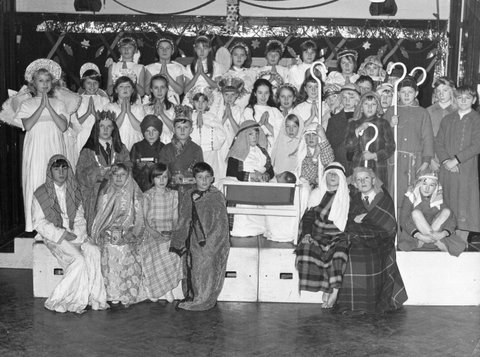
Portrait of the author as a young oik. Front row. Tasteful white tea towel and checked blanket. Quarry Hill Nativity Play Xmas 1964. Acting debut. “Third Shepherd”. One line.
*This is, of course, a mix of two memories becoming more than the sum of their parts in a creative re-imaging of my primary school as even more like Gormenghast than it actually was. The poles were for opening and closing the high windows. Similar poles were in use in the school I worked in until a couple of years ago – where they still opened and shut all the upper windows in the cathedral height classrooms; or at least those that had not been painted shut by a team of painters who might have benefited from one of Mr David’s homilies; had they ears to hear with, or had they not been working for a bunch of cowboys who quoted cheap and moved on fast. The Hymn books were on a Heath Robinson system of pulleys, so they could be pulled down and the pages reverently turned to the appropriate hymn, then re-hoisted above our heads like a flag ceremony. Less spectacular, but every bit as much of a ritual.
Just when you thought it was safe to go back to the beach…
We are being told that it is a “moral imperative” (1) to get all our children back into school from September and that this is “non negotiable”. (2)
The problem for the government is that the Virus does not negotiate.
Sir Jeremy Farrar of the Wellcome Trust pointed out in Sunday’s Observer “The gradual uptick in cases has shown us we’ve now reached – if not already exceeded – the absolute limits of easing restrictions.” (My emphasis).
Chris Whitty of the official SAGE said the same. “We have probably reached the limits of what we can do.”
Although the death rate is steady at a low level, the number of new cases has began to rise. Death rates follow cases with a two to three week lag. Government gambles to try to reopen the economy and get people to “splash the cash” (3) that they don’t have and fear they are going to have even less of very soon- including the bizarre suggestion that people who can continue to work safely from home should travel in to work so they can buy some takeaway sandwiches – have “already exceeded the absolute limits” beyond which the infection rate goes up again.
The government has therefore paused further reopening, but not closed anything down except locally. That is more likely to slow the pace at which the infection rate increases than start driving it back down again. They do not have a Zero COVID strategy, with a single minded aim to eliminate the virus. This is a precondition for actually being to reopen the economy on any basis at all. Without it, whatever the measures and encouragement and boosterism, people will be voting with their feet and trying to stay as safe as they can.
We are therefore stuck in a push me pull you situation in which the government is trying to nudge people in two opposite directions at the same time. People are supposed to wear masks in shops. But many don’t. Just 3 out of 9 of us in my local Tescos a couple of days ago. And this is not enforced. All very lackadaisical.
The low point for new infections was on July 7th, when it was 352. By 10 August it had risen to 1 062. Almost tripled in a month. We are not in the same mess that the USA is in, but if you extrapolate these figures to the end of the month – the point at which schools are projected to reopen – we could be heading that way.
There has been an argument that school age children do not spread the virus in the same way as adults. There is no indication that this is the case for Secondary students and in the USA 97 000 cases were reported among the under 19s within two weeks of schools reopening in late July. (4)
The question therefore is – what concrete steps will the government take to make it safe to return to school? This is not yet a done deal. And the ball is in their court. At the moment they are talking about “trade offs” – which is a back handed admission that they expect the reopening of schools to have an impact on increasing infections, so they will need to close down other sectors to soak that up. If that is their intention, we need to see the modelling that it is based on – assuming of course that they have some and are not just going to make an amateurish punt with their fingers crossed.
Sir David King’s estimate is that reopening schools will add 0.5 to the R rate. With the average R rate running at nearly 1 across the country, unless there is a serious reduction in infections in the next three weeks and he commented “We need a proper test and trace system by September. Otherwise full school opening will put us right back. The Government has a month to deal with the level of infectivity as it stands now. Reopening schools should be a priority, but we believe we are nowhere near the point where it can be done safely…” (5)
The belated recognition that outsourcing track and trace to SERCO to run it through a national call centre with no local follow up, has not been effective – as many people are reluctant to pass on information, is an essential recognition of reality. So local authorities are now tasked with sending workers out to knock on doors and fill the gaps. But this needs to be functioning on the ground, the R rate needs to be coming back down and the health and safety checklist jointly agreed by the NEU, UNISON, GMB and UNITE needs to be met and fully functional in every single school if there is to be any chance of doing this safely.
“Words are bullets” is an expression used on the US Alt Right to express an essential political point; that it doesn’t matter whether an assertion is true or not, so long as it creates a desired emotional response, thereby creating a version of the truth in which the listener is emotionally invested and from which they can be mobilised – often against their own interests.
Their focus on ruthlessly targeted knee jerk reactions, designed to short circuit thought or reflection with a blaze of righteous certainty deeply rooted in fears, creates an essentially theological form of politics; in which anyone putting an opposing argument or providing inconvenient information is cast into the realms of Satan.
When you have such masters of the art of “alternative facts” as Donald Trump and Mike Pompeo* running the most powerful and dangerous country in the world – and on the occasions that their view reflects an extreme form of the broader interests of their class and not just their fraction of it – the whole of mainstream discourse in every country dominated by the US becomes infected with this style of discourse.
If you listen to Radio 4 a lot it seems like there’s a daily bash China slot, with Chris Patten and Tom Tugendhat on permanent speed dial; or with a hammock set up for them in the corner so they never have to leave. Sometimes I’ve switched on in the middle of one. You get to recognise the voice. Its the same with the Guardian. Every day there’s something. And its all from one point of view; which is presumed to be the truth. Contrary voices are squeezed out, not allowed air time or column inches, for fear that the bubble of speculation built on assertion will pop if challenged.
Campaigns like this don’t happen by accident. The old joke about how odd it is that every day there’s just enough news to fill the papers hints at the issue. What is being highlighted and what is being ignored? And if variations on the same story are relentlessly repeated to the point that it becomes a distorting prism through which the rest of the world can be misperceived, whose agenda is being served?
Most of the reporting on China is a mutually interlocking series of assertions and stories from pro US sources that feed off and reinforce each other but with very little actual evidence.
As a declaration of interest, I take the view that lifting 800 million people (give or take 50 million) out of extreme poverty in the last four decades – as China has done – is a staggering and positive achievement that benefits the whole of humanity, not just the people of China. These people’s lives are usually seen as a statistic. 800 million just means “lots” to most people. But, if you think about it, 800 million people is 13 times the entire population of the UK, two and a half times the entire population of the USA. So, imagine everyone you know and have ever met or ever seen and think of what it would mean for each of them to have gone from an income of $309 a year in 1980, to $10 099 in 2019. (1) I also take the view that this progress has been because China is not run by its capitalists but by its Communist Party. Trump has grasped this more than many on the European Left – as he has complained that China has an unfair economic advantage because the state directs investment, and the CPC directs the state. Quite so.
There are no “alternative facts”. Facts are facts. But narratives are constructed by emphasising some facts and downplaying others, by focusing on and sometimes exaggerating helpful information, and skidding quickly over anything that’s awkward. This blog is an attempt to challenge some of the dominant narrative on China in alt right and mainstream media (which increasingly overlap) and politics. So, what I am writing here is an attempt to challenge a dominant narrative by stressing the points that it hides, or elides, or ignores in a way that creates space for deeper thought and a fuller perspective.
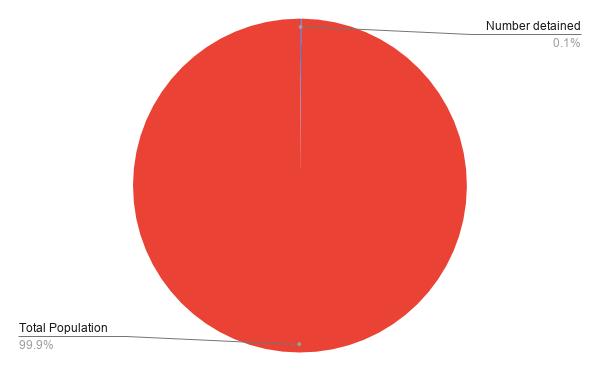
A recent statement by faith leaders in the UK repeats the assertion that China is holding a million people in camps in Xinjiang. The Chinese deny this flat and say they have arrested around 14 000 people (out of a total Uighur population of over 11 million) in a campaign to squash a Jihadist separatist movement that has killed 458 people, mainly by knife attacks, but also with bombs and by driving into pedestrians at high speed.
Number arrested according to China
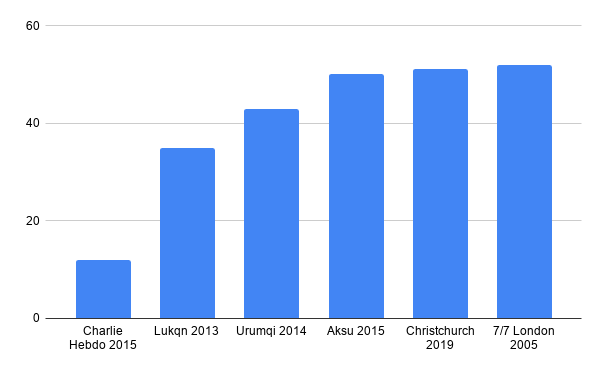
The people killed in these attacks are not much noted in the “West”. The attacks themselves are dismissed as “minor terrorist attacks” in reports in the Guardian. In fact several of them were more severe than the Charlie Hebdo shootings and have comparable casualties with the shooting in Christchurch in 2019 and the London bombings in July 2005; neither of which could ever be described as “minor” without a justified storm of indignant protest.
Not so minor
In fact, overall the accumulated casualties from these attacks (458 people) (2) is more than four times the 101 people killed in mainland Britain in blowback from the Troubles in the North of Ireland between 1971 and the turn of the Century. None of that would be considered “minor” either. But licking our own wounds while ignoring those of others was ever the Western way.
The way these people’s deaths are written out of the journalistic record – and therefore political reckoning – in the West, stands in stark contrast to the way the 2 977 victims of the 9/11 attacks were given proper respect. Film after film, documentary after documentary; on their lives, their loved ones, their final recorded messages; so after a time everyone who watched the News felt a connection with these people in a way that made the US reaction of invading two countries – one of which had absolutely nothing to do with the attacks – and start two wars which killed up to a million people – seem almost proportionate. A graphic example of the way a narrative can distort objective judgement. I write “up to” a million because the Iraqi civilian casualties of this invasion were not counted. Their lives literally didn’t count. Not even recorded. All lives matter? Not in this case. Nor in the case of the victims of the attacks in Xinjiang. The policeman cut to shreds in front of his children, the leader of the Mosque in Kashgar who was hacked to death in 2014, the Uighur girl who was an aspiring dancer who lost her leg in a bombing in 2014 and is now a doctor. None of these people have found the dignity of a reference in the Western media. Nor have any of the other 455 casualties either.
The figure of 14 000 detained is simply dismissed in Western accounts. It is taken as read that the Chinese are lying and the State Department – despite its record -is telling the truth. That presumption runs through all the coverage.
The “estimates” of 1-3 million people detained that have been made by far right “researcher” Adrian Zenz, which he admits himself are speculative and which have been effectively debunked here (3) are sometimes qualified by News organisations like the Guardian or the BBC – employing a homeopathic water memory of journalistic ethics – with words like “alleged”; but are nevertheless then taken as fact despite the paucity of evidence (and the wild variation in the figures).
The problem with this assertion is that the buildings identified as camps – or re-education centres – could not possibly contain the number of people Zenz is speculating are in them.
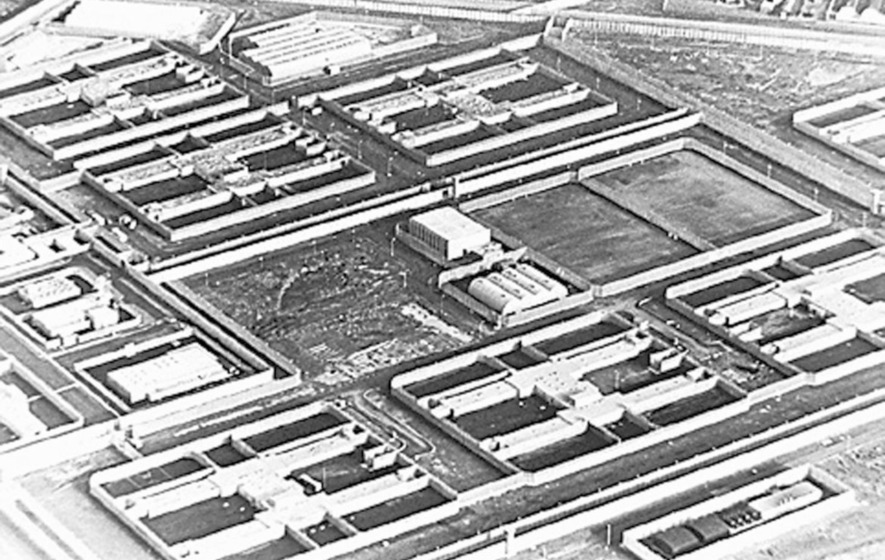
To hold a million people you would need five hundred and fifty complexes on this scale. Where are they?
This is not in Xinjiang. It is an old aerial photo of the H Blocks in the North of Ireland, where Republican and Loyalist prisoners were held during the “Troubles”; and Britain showed its commitment to human rights by allowing 11 Republican prisoners to starve themselves to death in the 1981 Hunger strike rather than concede their demand for political status. This complex looks as though it could hold a very large number of people. But it never held more than 1 800 at any one time. To hold a million people you would need five hundred and fifty complexes of this size and, with 300 people per H block, 3 333 blocks of this sort. Imagine what that would look like on satellite photos and how hard they would be to miss. What follows is not a typo or glitch. Its what 3 333 buildings like this would look like.
In the BBC analysis of satellite imagery they conclude that between 2011 and 2108, thirty seven such centres have been constructed. Thirty seven. Nowhere near 500.
They go on to cite Zenz discovering “dozens” of construction contracts, which he has asserted are for these camps. Dozens. Nowhere near 500.
Zenz – who does not speak or read Mandarin – presumes that all these contracts are for camps not reeducation centres or anything else. In fact, in the last five years the Chinese government has invested more than $70 billion on the development of infrastructure in Xinjiang, which is the Central Asian hub of the Belt and road initiative.
When BBC reporters tried randomly phoning people in Urumqi and asking them about what the big new buildings were in the places they had seen them, everyone replied “Oh, they are re- education centres.”
Images of the re-education centres functioning as re-education centres that appear in Chinese media are dismissed as window dressing in the West, but were endorsed by a delegation from Muslim countries. An invitation has also gone to the EU to carry out a similar fact finding trip, but has so far been turned down.
One of the BBC photos shows a school playground with additional buildings put in. They presume that this is a conversion to be used as a detention centre rather than an expansion of classroom space to enable the enrollment of additional students. This has also been commonplace in the UK as portakabins have been placed on playgrounds to provide classrooms the demographic bulge that is now making its way through Secondary School.
Uighur children have enrolled in schools in increasing numbers and since 2017 they have been guaranteed 15 years of free education, conducted bilingually, to overcome a backlog of poorly resourced education and weak results, which has led to poor employment prospects up to now. (4) With the rapid development focused on the Belt and Road initiative leading to a 6.5% annual growth rate, there has to be an equally rapid expansion in education provision.
The Uighur population has traditionally missed out a lot on this. So, $1.2 billion has been invested in school buildings and in 2017 an additional half a million Uighur children enrolled in early years provision. This is presented by Zenz and the BBC as an attempt to squash Uighur culture and remove children from their roots, but the more balanced Burgen Report stresses the opposite. (4) The difficulties and opportunities of bilingual education in previously backwater regions of a fast developing country raised here are not peculiar to China. In rural South Africa children learn initially in their home language but increasingly make a transition to learning in English, because of both the vastly greater range of learning materials in that language and the greater efficacy of learning it to communicate beyond the locality. To learn other subjects in both languages and become fluent in them at the same time will take a lot of resourcing if it is to work.
A further $280 billion is being invested for sustainable development, creation of jobs and poverty alleviation and there are guaranteed quotas for minority employment.
Bullet words “Genocide” and “Concentration Camp” have gone alongside accusations by Ian Duncan Smith and others that China is “Nazi”. Put those words together and the implication is that the reeducation centres are death camps. That doesn’t have to be explicit. The hint is in the phrase. It s meant to freeze questioning or contradiction. It is also absurd. There are no reports that anyone has died in these centres; compared with a death rate of 264 people per hundred thousand in US prisons. Overall, the Uighur population is growing fast – in absolute terms and as a proportion of the population. It has more than doubled since 1978. The “one child” policy was never applied to the Uighurs, or any other ethnic minority in China.
Accusations of “cultural genocide” don’t match with the awkward fact that there are now ten times as many Mosques in Urumqi as there were in 1989, and visitors report people going to them quite normally and naturally; as in this recent report.
Our delegation wasn’t a fact-finding mission; we didn’t have a specific aim to verify the truth of these various allegations. We did however walk freely around Ürümqi and the Muslim quarter in Xi’an, and failed to see any evidence of religious or ethnic oppression. In Ürümqi one sees mosques everywhere; indeed Xinjiang has one of the highest number of mosques per capita in the world. Walking well off the beaten track, we saw hundreds of Chinese Muslims, wearing their distinctive Uighur dress (including headscarves for many women) and going about their lives without any indication that they were living in fear of persecution. We ate in Uighur restaurants, in which halal food was served and alcohol wasn’t available. (5)
The points put above are widely accepted in the world outside the bubble of the US’s closest allies. In the UN the Chinese position is supported by 50 countries, the US by just 22.
*A recent op piece in the Washington Post commented that Pompeo is now lying about his lies.
It only struck me today, almost half a century on from reading this line in T.S Elliot’s 1915 poem The Love Song of J Alfred Prufrock, that there is more than one way to measure with coffee spoons.
I had always assumed that it referred to measurement by length. Spoons from the coffee drunk during the day, laid end to end in a surreal contemplative performance of the emptiness of routine.
Probably three of them.
The parameters of a small and narrow domestic life. Probably lonely. Personal coffee spoons. Laid end to end in a journey to nowhere very much.
At the time I first read the poem, 1971, measuring quantity with coffee spoons wasn’t an activity that allowed comparisons to be made. Coffee was measured in a very limited and regular way.
One spoon of Nescafe instant.
Never any variations. An iron law. Always the same.
In the 50’s it had been one spoon of Camp Coffee (which – being an evil chicory beverage the colour and consistency of Worcester sauce – was neither coffee nor, indeed, camp).
Measuring by quantity implies real coffee. Lovingly spooned into a cafetiere by someone middle class imagining themselves to be an artisan, carefully curating depth, colour, aroma; an activity salvaged from pointlessness by becoming a ritual of superficial class mobility.
Not that that journey has been far.
And why coffee spoons not teaspoons? Teaspoons would be more prosaic, everyday, common – especially in 1915. The word also sounds too short and sharp, like a hammer hitting a nail. Tea! Too definite. No room to breathe or contemplate. A clipped clink that is just too precise. A “just get on with it” sound. The word coffee sounds like someone slowly smoking; inhaling and exhaling with a whiff and a rasp, staring at the smoke coiling lazily towards a stained sepia ceiling.
It also has two syllables.
Prufrock, though, was measuring his life in small domestic measures during the First World War; in which other men’s lives were measured in yards of No Man’s Land, the length of a coil of barbed wire, the number of paces in a forced march to the front, the slow dying fall of a flare in the night, the inches of sludge drowning duckboards at the bottom of a trench, the last choking breaths after a gas attack.
And so, to the shell shocked silence of peace.
Let us go then, you and I, When the evening is spread out against the sky Like a patient etherized upon a table;
The UK economy has been hit worse by the Coronaviris crisis than any other in the developed world. (1) The OECD projects an 11.5% drop in economic activity.
Under the impact of this economic pressure, the government is compounding its problems by trying to unlock the economy before the virus is contained and without adequate systems for containing it; which sets us up for chaos.
The measures announced by the Chancellor on July 8th are hopelessly tactical, lack any strategic vision capable of mobilising people behind it; and amount to little more than a set of minor bungs to Conservative supporting sectors – the stamp duty holiday primarily benefiting private landlords, the £1000 retention bonus just a top up for firms that are secure enough to retain their workers until January.
The decisive question for any economic recovery is investment. If the government and/or companies invest, the economy is stimulated, work is done, goods are made and services provided, income is generated, tax revenue comes in, workers are hired and so on, in a virtuous cycle.
The problem we have is that we have a government which believes that the purpose of economic activity is not “the greatest happiness of the greatest number”, nor the most efficient use of available resources to enrich the lives of the people, or address deep rooted threats to our civilisation like poverty or ignorance, let alone the degradation of the environment we live in and the breakdown of the climactic conditions we need to survive. They believe that the purpose of the economy, and society come to that, is to produce profits. All else flows from that.
That’s why they are not committed to state led investment to put as many solar panels as possible on as many roofs as we can find and wind farms in all the potential places, to retrofit our housing and public building stock to reduce energy demand and bills, to strategically invest in urban mini forests and rewild swathes of the countryside, to electrify our remaining railways – to mention just four initiatives that could generate jobs while cutting carbon emissions as drastically as we need to. Instead, they are giving tiny nudges to the private sector in the hope that they will invest – in anything, they are not fussed about what – instead.
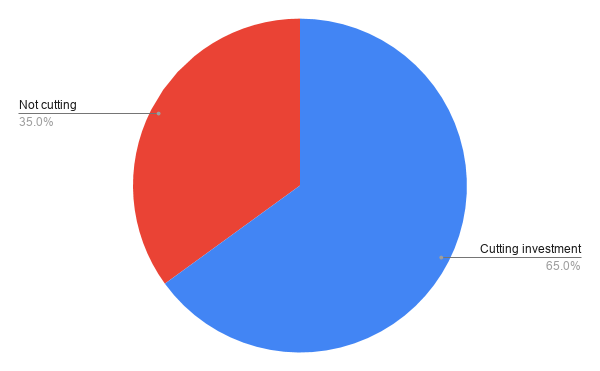
The problem with that is that they won’t. The private sector is risk averse and will only invest if it thinks a profit can be turned on the investment. If the experience of ten years of austerity – in which this approach was tried to death – isn’t enough to convince, a recent survey of company finance directors by Deloitte should be enough to administer the coup de grace. Sixty five percent of the companies surveyed said that they will be cutting investment in the next three years.
The Private Sector is not going to invest.
That is because eighty percent of them expect their revenues to decrease in the next year.
80% also believe that their business faces uncertainty – could close – in the next year too.
This is underlined by the latest projection from the Office for Budget Responsibility. And what a reassuringly anal retentive title that is; conjuring images of mean spirited accountants in their counting house, counting out their money, and taking care of the pennies so the pounds can take care of themselves. They project that – left to itself – the economy will not recover until the end of 2022 and unemployment will rise rapidly to 10% in the meantime. One in ten workers having to claim and scrape by on Universal Benefit.
For the government’s approach, there is an even more serious problem. Investment from the private sector is contingent on profitability, and most of the companies in the survey are cutting dividends to share holders and cutting down on share buybacks, which inflate the salaries of top executives. No profits, no “animal spirits”, no investment. Boris Johnson can wave all the Union Jacks he likes; his patriotic verbal bluster does not affect the hard nosed financial calculations currently being made, except, perhaps negatively as the gap between his “global Britain” rhetoric and the reality of what we are heading for at the end of the year is clearly understood in business circles.
Fewer than a quarter of firms are increasing Dividends (profit payments) almost two thirds are paying nothing.
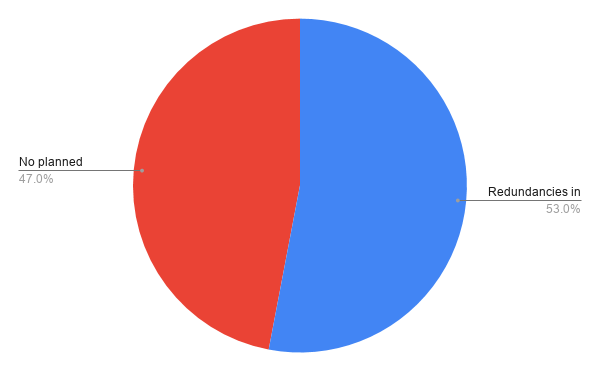
This is overwhelmingly the case for manufacturing, in which 90% cut payments. The Manufacturing and Engineering employers organisation MAKE UK reported on 20 July that only 15% of companies are back to full time working and begged for an extension of the furlough scheme for another six months to help prevent the worst loss of skilled jobs since the 1980s. (2) With the cut off point for the scheme in October, firms are already starting redundancy processes so they can carry out the legally required consultation period before the axes fall. This is on a very large scale in manufacturing, with just over a half of them planning redundancies in the next 6 months. Other hard hit sectors, like hospitality and retail, are not going to be saved by a few half price pizza vouchers for slow days in half of August.
Of those planning redundancies, 8% are looking at between a quarter and a half of their workforce, while a third are looking at a tenth and a quarter. Imagine how it feels to be working in one of these places now.
The Chancellor’s statement that “this is not a time for orthodoxy and ideology” is about to be exposed. Without drastic government action, and direct investment, thousands and thousands of workers are about to lose their jobs, which will prevent any recovery taking place at all and put people all over the country into desperate straits. The ending of the eviction ban this week just as this kicks in adds a whole extra layer of insecurity and threat.
No doubt the government considers this bracing and character building because, instead of investing, they are planning to cut regulation and launch twenty Free Ports, which will suck such investment as there is to zones that don’t pay tax and blight everywhere else. As if what is holding these companies back from the scale of investment that is needed is the “red tape” that holds them to minimally acceptable standards of behavior towards their employees and the environment.
Crucially, this is not what the company finance directors told Deloitte. They did not say they were primarily concerned with regulation. They were very clear about the three factors which inhibited any investment plans.
1. The Coronavirus pandemic.
2. The prospect of a No Deal Brexit.
3. Worsening Geo-political conflicts (for which read Trump’s trade war with China and the fear that worse could follow). (3)
So, the three big issues preventing the private sector from investing are the central plank of the government’s agenda – “get Brexit done”- their willingness to be dragooned into a fight with China by the USA and their failure to get on top of the virus.
The paradox of this is that had a Corbyn Labour government been elected in December neither a supine response to pressure from the USA to engage in a trade war, nor a no deal Brexit would have been on the agenda. Nor is it possible to imagine that such a government would have handled the Coronavirus crisis worse than this one has. Almost without exception, the countries that have performed most catastrophically have been wedded to neo-liberalism. The allegiance of the business class to Conservative rule therefore comes across as a form of self harm, but underlines the essential perception that, for them, economic well being, even of their own firms, comes second to continued control of the economy by their class. If they are prepared to hammer themselves in this way, the harm done to the rest of us is collateral damage that barely registers on their radar.
Faced with the scale of this crisis, the response to all these issues from the Labour opposition should be clearer, louder and sharper and demonstrate the vision that the Conservatives lack.
The Coronavirus pandemic. Its clear from this that squashing the virus down to nothing is a precondition for a serious economic recovery. That’s what was done and is happening in China. And New Zealand. That should be Labour policy. Not hinting that the UK will be “left behind” if it tries to do so. Particularly because the government here is instead hoping that the number of cases will continue to decline, even as they remove the conditions that enabled it to do so. Scientific advice, including from SAGE, is that this is rash and unlikely to come off. Countries in Europe that reopened when their level of infections was lower than the UK are now facing a rebound. While the UK is as yet nowhere near being in the sort of mess the USA is in, with exponentially rising infections and a daily death rate double what it was last month, there’s a sense that Johnson is looking down the barrel of the threat is crossing his fingers, touching wood and feels lucky. Labour has called for the furlough scheme to be maintained in specific sectors, which is a sensible bottom line and the least that could be expected from a half competent government, but to retain jobs we need a far stronger commitment to a jobs guarantee that involves retraining and redeployment from sectors that are going belly up and to actually put the vision and plans for a green transformation right up front as an alternative to the collapse that the Conservatives are about to preside over. A Green Jobs campaign is imperative. The UK commitment to this – £3 billion -is excruciatingly small.
No Deal Brexit. 65% of companies have made no preparation for conditions after 31 December because they don’t know what they are going to be. Here we go, over the cliff. What the wreckage will look like on the beach next year is anyone’s guess. Labour made a mistake in not pushing for a transition extension. We should argue for a unilateral declaration of continuity with existing arrangements until a deal can be made and ask the EU to reciprocate.
Connivance in the growing US Cold War with China. This is already impacting on inward investment. Tik Tok has already shelved plans to build its HQ outside of China in London – losing a potential 5 000 jobs. The removal of Huawei from the 5G network, and proposals to extend this to 4 and 3 G, will both cost directly and cut the efficiency of the broad band service available (because Huawei technology is in advance of any of its competitors). The increasingly aggressive campaign from Ian Duncan Smith and his allies on the right of the Conservative Party to join with the US in breaking the world economy into two spheres of influence will be very damaging for all concerned – even if, as too often happens, trade war does not lead to the real thing as it escalates. A nervousness about this on the part of the government, who have given quite a slow time scale to strip out Huawei technology and hinted to the company that they are doing so under duress and might back off once no longer under Donald Trump’s heel (so much for taking back control), has not been matched by any doubts from Labour’s foriegn policy team, who are trying to prove to the US that they are back to being Atlanticist true believers and have been urging the government on. This is a disastrous policy that should be reversed.
Anneliese Dodd’s comment “If people felt Labour was only criticising and not suggesting solutions, they would question what on earth we’re doing” is quite right, but requires some solutions to actually be put. That would mean
Argue for whatever action is necessary to protect public health and eliminate the virus as the fastest way to be able to regenerate social activity (not just the “economy”).
Put forward a plan for massive state led investment in green transition both as an end in itself and a way of generating the employment we need to avoid economic collapse.
Resist the demands from Trump for the world economy to be broken in two and for the UK to tie itself to the less dynamic half – with the USA projected to account for 3.3% of world growth in the next two years to China’s 51%, according to the IMF, and developing countries, most of which will align with China, accounting for over 40% of the rest.
Argue against a No Deal Brexit and for an extension of current arrangements to prevent even further economic disruption as we go into 2021.
“I tremble for my country, when I reflect that God is just.” Thomas Jefferson.
In Monday’s Commons debate on scrapping the Hong Kong extradition treaty, Conservative MP and former Foreign Office Minister Tobias Ellwood said the following, ” For decades now, we have turned a blind eye to China’s democratic deficit and human rights violations, in the hope that it would mature into a global responsible citizen. That clearly hasn’t happened. Is this now the turning point where we drop the pretence that China shares our values?”
The accusations made against China are grim ones which they strongly deny, but coming from the countries that brought you – just in recent years – waterboarding and other “enhanced interrogation” techniques, Abu Ghraib, Guantanamo Bay, Special Rendition, the Fallujah Free Fire Zone and extra judicial drone assassinations (with 601 casualties in Yemen alone between 2011 and 2017) (1) you have to wonder what human rights values “we” have been modelling; and how China has supposedly diverged from them, by allegedly doing what we have done in plain sight for so many years.
It has to be said that it is a strange sort of “genocide” in which the ethnic group supposedly being targeted is rapidly growing in numbers and proportion of the population, and an odd kind of “cultural/religious suppression” in which the number of Mosques has increased by a factor of ten in the last thirty years. Just over 2000 Mosques in Xinjiang in 1989, over 24 000 now.
“Our Values?”
Does Mr Ellwood mean that a tough line with street protests to “dominate the streets or you’ll look like a bunch of jerks”, is way out of line with anything a Western power would contemplate or carry out? (2) If so, he hasn’t been paying much attention lately or, indeed, ever.
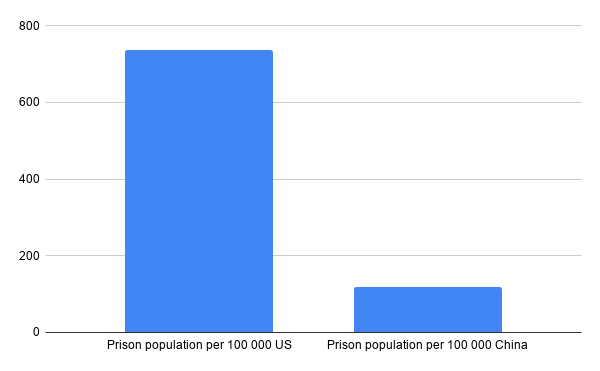
Does he mean that mass incarceration is unacceptable? This would be odd, because the USA currently locks up 2.1 million people, 25% of the total global prison population; way above any other country and far more per head than China does; while England and Wales, with 145 prisoners per hundred thousand people, have the highest per capita prison population in Western Europe and Scotland is not far below; all well above China’s 118 per hundred thousand (3).
Land of the free?
Can he mean the exploitation of free, or ludicrously cheap, prison labour to produce goods for well known companies? Again, this would be odd because that’s what US prisons do. McDonalds, Wendys, Wal-Mart, Starbucks, Verizon, Sprint, Victoria’s Secret, JC Penney, KMart, American Airlines and Avis are documented beneficiaries. (4)
He can’t mean interning people without trial who are in rebellion against the state, because that’s what the UK did in Kenya, Malaya, Cyprus and the North of Ireland and the US did with its “strategic hamlets” programme in Vietnam. So, that would be completely in line with “our values”, wouldn’t it?
Nor can he mean that sterilising ethnic minorities is out of line with “our values” , because that’s what the US did throughout the twentieth century at home- 25-50% of native American women in the 1970s, a third of the female population of Puerto Rico between 1938 and 1970, countless Black women given unnecessary and involuntary hysterectomies (Mississippi appendectomies), 150 prisoners in California as recently as 2010 – and to many more abroad throughout Latin America and beyond, including up to 200 000 indigenous women in Peru in the 1990s. (5)
He can’t mean disregarding local democratic rights and imposing an unwanted regime from the outside, because that’s what the United States has done 20 times by invasion and another 56 times by interventions short of that since 1949. Some of these have been very bloody. Two million Vietnamese killed, half a million Indonesian Leftists massacred in 1965, thousands and thousands throughout Latin America for decades. Whatever you think of China, it would take them a long time to catch up with a record like that.
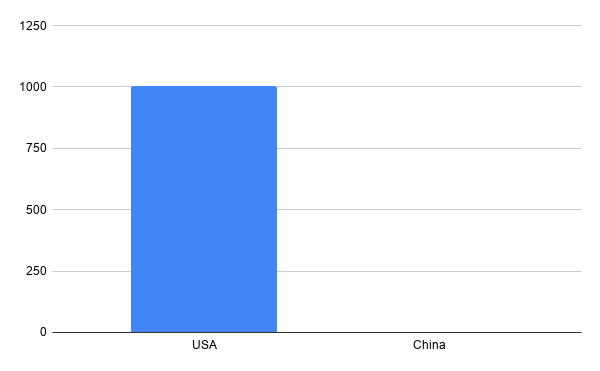
Nor can he mean communities feeling unsafe at the hands of the police force that is meant to “protect and serve” them. The chance of being shot dead in the streets by the police was approximately 2000 times greater in the US than in China in 2019. (6)
The raw figures for 2019. USA 1004, China 2. The US population is a quarter of China’s.
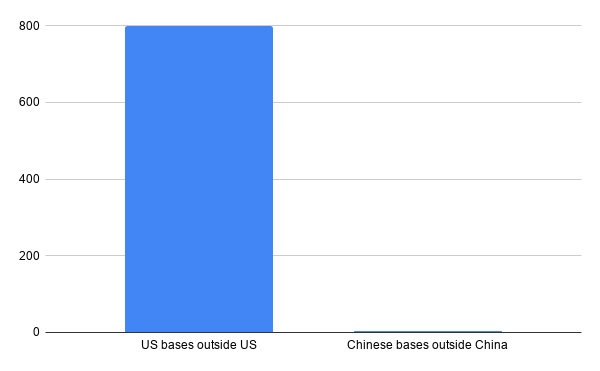
Perhaps he means having a threatening military posture to intimidate other countries? But here again the US posture is far more threatening, both in terms of military expenditure, on which the US spends $4 for every $1 spent by China…
Who is threatening who here exactly?
…and even more starkly in terms of overseas military bases, of which the USA has 800 and China has 3.
Even the UK has 16, more than five times as many as China. If you look hard, you’ll just about see them.
Who is “A Global Responsible citizen”…?
A responsible global citizen faces up to the fundamental challenges facing humanity and seeks co-operation to solve them. The gravest threat to all of us is climate breakdown. China is committed to the Paris Agreement, has met its targets early and raised them. The United States under Trump is walking out of the Agreement on the grounds that “we believe that no country should have to sacrifice economic prosperity or energy security in pursuit of environmental sustainability,”Wells Griffith, Trump’s envoy to the Katowice COP 2018. (7) If every country adopted the US approach, we’d have no hope of avoiding the melt down of our civilisation. Its not mature and its not responsible. The unilateral, selfish action they are taking threatens all of us with catastrophe. Mr Ellwood does not appear to have noticed, or, if he has, does not think this to be of any significance.
In the immediate global crisis caused by COVID19, the records of China, the UK and US certainly show a divergence in values. China put public safety first and, despite an initial fumble by local officials, managed to crush the virus and keep domestic deaths down to just over 4600. In the UK and US, by contrast, commercial considerations and half baked libertarianism has led so far to almost twice as many deaths in the US as there were cases in China with the virus well out of control and infections rising exponentially again. The most conservative figure for UK deaths is ten times the Chinese total (and therefore 200 times the rate per capita). A little humility about this on the part of the people responsible for it might not go amiss.
The political effect of this in China has been to boost the standing and legitimacy and standing of Xi Jinping and the Communist Party. (8) This was always far stronger than Western opinion has ever been able to comprehend, but looking out from a society that has been kept largely safe – as well as having risen from extreme poverty in living memory – the mounting casualties and sheer chaos of the “West” shocks and horrifies popular opinion. The first duty of government, after all, is to keep its people safe. Job done there. Not here.
Economically, the Chinese economy is now recovering. It was already larger in purchasing parity terms than that of the United States before COVID hit. The seeming insanity of the efforts by the Trump administration to reopen their economy while cases are rising is explained by their fear of falling further behind. The IMF projects that 51% of world growth in the next two years will be in China. The US, by contrast, will account for just 3.3%.
As the virus spreads exponentially again, pushing the US proportion of global deaths back up to 15%, from a low of 9% last month, employment and economic activity have gone through the fastest collapse in history. This stokes the US political crisis and fuels the Black Lives Matter uprising. This titanic crisis of health, survival and livelihoods – and the Trump adminstration’s callous indifference, bluster, denial and authoritarian incompetence- has revealed to a popular majority that the enemy is at home and in high places.
The controlled response to the virus in China has saved the world many infections and deaths. That of the USA continues to threaten any other country that trades or deals with it.
China has put a moratorium on debt repayments from 66 struggling developing countries. The USA has imposed sanctions on Iran and Venezuela. (9)
China has pledged that any vaccine developed in the country will be a common good for the whole world. President Trump has applied “America First” even to this, cornering the market in available treatments, gazumping other countries supplies, while, with the UK, insisting on patent rights (which puts pharma profits above cheapness and availability). Clearly a divergence in “values” there.
The increasingly delirious accusations being made against China – which in the media are presented as a labyrinth of mirrors, with each story of each allegation being reported as though they were evidence of it – reflect the desperation of a US ruling class who can feel the earth falling away under their feet. The majority of the world, as reflected in UN votes, do not believe this US narrative. Twice as many countries voted with China on both Xinjiang and Hong Kong as voted for “Western” resolutions; which were supported only by wealthy close US allies, the imperial bubble that likes to think of itself as “the global community.”
And the Left?
The dominant current in the UK Labour Movement, the Labour Right, historically gives the US complete credence. Even devotees of an “ethical foreign policy” are usually highly selective about where they look to demonstrate their ethics. I hope that what is written above is enough to convince that this position doesn’t have a leg to stand on – morally or in any other respect. For the right, this is a matter of realpolitik, so whats true doesn’t really come into it. But there are also currents that identify themselves as “far left” and take a militant line on domestic politics, but never saw a US intervention they didn’t like, nor a State Department attack line they are unwilling to shout through a social media megaphone. For all the reasons above, a pro Washington line is the most reactionary position that can be taken and, in current circumstances, will lead those that espouse it down a road towards giving the USA the social support it needs to threaten a war that could kill us all.
Others, more on the left, will have no illusions about the messenger, but will accept part or all of the message; and will consider articles like this too uncritical. The bottom line here is, that whatever critical view is held about China, or actions it is alleged to have taken, these currents do not line up with Washington and are not willing to allow themselves to be used in giving support to the war drive that is already taking place in economic sanctions and aircraft carrier deployments.
It is stopping these that is the imperative. Arguments about other matters will only be able to continue if the gathering momentum towards war and environmental collapse are stopped and the precarious structures of global co-operation are strengthened.
We are living through a paradox. The continuing slow decline in COVID infections and deaths in the UK – which the government is claiming as a success – is happening largely because the population has been ignoring government attempts to get them out and about and spending.
The R rate has stayed just below 1. This means that the number of infections continues to slowly decline, though the Prime Minster’s boast that the UK is now testing more people than Germany. France, Italy and Spain simply indicates how much worse the situation is here than there – because we HAVE to carry out those tests.
Keeping safe despite government advice.
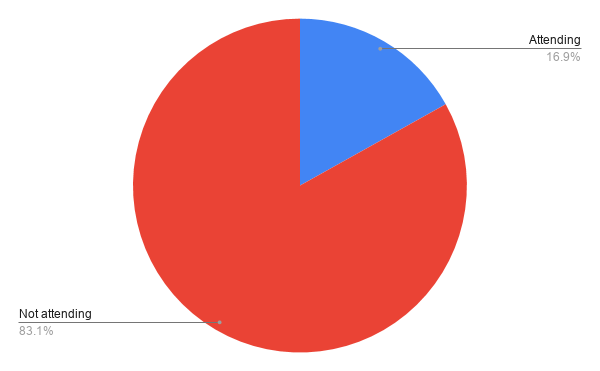
Schools. Despite strenuous government attempts to reopen schools before the end of term – as a precondition for getting parents back to work – the continued dogged insistence by the education unions that conditions had to be safe enough to do so meant that this plan had to be abandoned. So, only 16.9% of students were in school on 9 July. This figure had been the same for the preceding two weeks and looks like this. (1)
School attendance June – July.
Imagine if the government had got its way and a significantly larger proportion of students and their teachers had had to go in to school. Is it possible to believe that this would not have had a negative impact on the R rate? There is no doubt that the education unions, led by the NEU, have saved lives.
Shops and pubs and bars. Since reopening, there has similarly been a dramatically reduced footfall in inessential shops, pubs, restaurants and cafes compared to this time last year. Pubs and fast food are running at about 30% of last year’s level, while retail overall is still 40% down and restaurants are 60% down. The effect of this cautious response on the part of the public has been to keep the R rate just declining.
So, the more the government’s boosterism succeeds in enticing people out, the more likely it is that the R rate will go back up. The conflict between these clashing imperatives will be played out throughout August. Boris Johnson is gambling that the current rate of decline is going to continue at its current rate – always a risky thing to take for granted – which would mean that the virus would be almost eliminated by late October. But at the same time he is taking measures to further significantly ease the restrictions which have allowed that decline to take place. If this overcomes the caution currently being shown by the population as much as he wants it to, and everyone is enticed out by the mouth watering prospect of a half price pizza on an August Tuesday, a further slow down in the rate of decline can be assumed and a rebound cannot be ruled out.
A further paradox is that the understandable caution being shown by most of the population has made the government wake up to the value of masks. This is not so much the result of them suddenly realising that a virus transmitted by aerosol projection from the breath will be severely restricted by mask wearing; more a desperate search for something – anything – that can boost confidence enough to get more people out and about. They have had to pay the price of a few fringe idiots on their libertarian wing – who see the requirement to become slightly uncomfortable too much of a price to pay to keep their neighbours safe – demonstrably cutting up their Conservative Party cards on social media in protest at this tyrannical requirement and staging a demo at Speakers Corner against the threat of vaccination and being microchipped by Bill Gates and George Soros. Takes all sorts.
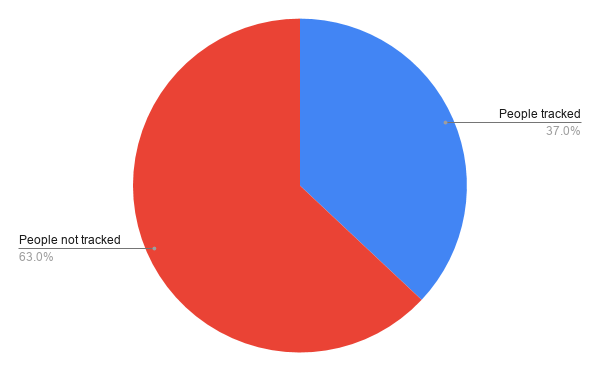
More seriously, the government’s confidence that any further outbreaks can be identified and tackled at a local level is undermined by the current ineffectiveness of the contact tracing system; which needs to be contacting at least 50% of the people who have contracted the virus to work effectively. Over the weekend of 18-19 July it was only contacting 37%.
At least 50% needed for this to work.
In Blackburn , a local hot spot possibly on the verge of local lock down, only 44% of 779 close contacts of one infected person had been followed up. (2)
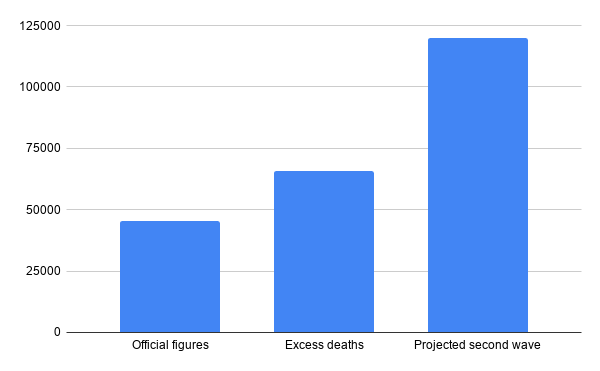
In his July 17th speech, the Prime Minister said that he was hoping for “a more significant return to normality from November at the earliest – possibly in time from Christmas” while at the same time conceding that “as we approach winter, we will need to go further – not least as many more people will show Covid-like symptoms as a result of seasonal illnesses.” This could be an understatement. Last week, senior Doctors and Scientists convened by the Academy of Medical Sciences warned that a second wave could kill 120 000 people on top of the 65 000 excess deaths we have already had.
Just when they told you it was safe to go back in the water.
Back to the Office? Perversely the government is pushing for people who are currently safely working at home to go back into work from August 1st, presumably on the public transport they should be avoiding at the busy times they will be expected to use it. This contradicts the advice of the Chief Scientific Officer, Sir Patrick Vallance, who flatly stated that “there is absolutely no reason to change” this guidance. In ignoring this the UK government is following the example of the USA, where Centre for Disease Control guidelines for reopening schools have been shunted aside as “impractical” and “expensive” by President Trump. The council chair of the BMA, Dr Chand Nagpual, warned “To introduce measures for shops, but not other situations where Physical distancing is not possible – including some workplaces – is illogical and adds to confusion and the risks of the virus spreading.”
If Boris Johnson still claims to be “following the Science”, he is doing so from further and further behind; which means that he will neither eliminate the virus nor preside over an economic recovery. We are heading for a feisty autumn. The next Blog will look at the economy.
The US and its allies are accusing China of carrying out “genocide” through birth control methods against the Uighur population in Xinjiang, even though the Uighur population is rising quite rapidly.
China flatly denies this accusation. It would contradict both the PRC Constitution – which guarantees equal rights to all ethnic groups in China and aims to help promote their economic and cultural development – and the observable practice of the state towards ethnic minorities; which include positive discrimination measures that would be denounced as “political correctness gone mad” in the West, but is seen by the central government as important for improving the economic development of ethnic minorities. * The previously strictly applied one child policy did not apply to ethnic minorities; and its recent relaxation in Xinjiang, as well as elsewhere, has simply put the Han population there on a level footing.
It seems that the USA is looking in the mirror and shouting at its own reflection. The accusations they are directing at China are exactly what the US has done itself – on a very large scale – both at home and abroad.
Overall, this has become an established, habitual practice. “U.S. women of color have historically been the victims of forced sterilization. Some women were sterilized during Cesarean sections and never told; others were threatened with termination of welfare benefits or denial of medical care if they didn’t “consent” to the procedure; others received unnecessary hysterectomies at teaching hospitals as practice for medical residents.”
They have used this on
Native Americans, with 25-50% of Native American women sterilised between 1970 and 1976. Full report here.
Black Americans, especially in the South. “Mississippi appendectomies” was another name for unnecessary hysterectomies performed at teaching hospitals in the South on women of color as practice for medical students… A third of the sterilizations were done on girls under 18, even as young as 9. The state also targeted individuals seen as “delinquent” or “unwholesome.” A full account is here
LatinX women. In Puerto Rico, approximately a third of the female population was sterilised between the 1930s and 1970s and this has also been common on the US mainland.
Prisoners, the most recently reported cases being 150 women sterilised in California prisons between 2006 and 2010.
It was also applied on a global scale. The 1969 Bolivian film Blood of the Condor was based on stories told to the film maker by indigenous women in the Andes of US Peace Corps style “aid” workers sterilising them without consent; so it was clearly not an abnormal practice. The furory caused by this film led to the expulsion of the Peace Corps from the country.
It was openly stated in official US State documentation. In 1974, with defeat looming in Vietnam, officials under Henry Kissinger wrote National Security Study Memorandum 200, which argued “… that population growth in the least developed countries (LDCs) is a concern to US national security, because it would tend to risk civil unrest and political instability in countries that had a high potential for economic development. The policy gives “paramount importance” to population control measures and the promotion of contraception among 13 populous countries to control rapid population growth which the US deems inimical to the socio-political and economic growth of these countries and to the national interests of the United States since the “U.S. economy will require large and increasing amounts of minerals from abroad” and the countries can produce destabilizing opposition forces against the US.”
One of these countries was India, and the forcible sterilisation of 6.2 million men during the state of emergency in 1976 followed direct US pressure. Its legacy is continued drives directed at impoverished and minority women, which are still taking place on a significant scale and causing loss of life, as can be seen from this report from 2014. The Guardian noted in the same year
“Sterilisation camps” are held in Chhattisgarh between October and February as part of a programme to control India’s population, which stands at 1.26 billion. Women who go through the surgery are given 1,400 rupees (£14) by the state, the amount reportedly paid in this latest case.
A total of 1,434 people died from such procedures in India between 2003 and 2012.
Authorities in eastern India came under fire in 2013 after a news channel unearthed footage showing scores of women dumped unconscious in a field following a mass sterilisation.
A right-wing US site also reports that the US helped finance the sterilisation campaign of Peru’s President Fujimori in the late 1990’s, “largely aimed at lower-income women and members of indigenous populations living in the Peruvian highlands” and affecting up to 200 000 women.
From this its clear that even if all the specific accusations currently raised against China were true – and many of them are lurid – they would neither be peculiar to it nor distinct from the customary practice of the countries making the accusations. More to the point, the accusation of “genocide” is contradicted by the reality of a growing Uighur population in Xinjiang.
*Ethnic minorities were exempt from the population growth control of the One-Child Policy.
Ethnic minorities have guaranteed places in the National People’s Congress as well as governments at the provincial and prefectural levels and participation in the CCP is encouraged.
Some ethnic minorities in China live in autonomous areas which guarantee the freedom to use and develop their languages, and maintain cultural and social customs.
Preferential economic development and aid has gone to these areas.
Minorities have widely benefited from China’s minimum livelihood guarantee program (known as the dibao) which was introduced nationwide in 1999 and had nearly twenty million beneficiaries by 2012; and, depending on province, lower tax thresholds and lower entrance requirements into university.
Just over the crest of Wakeman’s Hill there used to be a house that my children were very frightened of when they were little. The path to the front door was overshadowed by huge pine trees; making it seem like a portal to a darker place, “where clowns live”.
For some time only one of these trees has survived. It stood impossibly tall and straight like an arboreal member of the Brigade of Guards. An imported species, with no local eco system to keep it company, it nevertheless had a certain dignity, respectably keeping itself to itself as befits life in a suburb.
On Saturday it was under assault. A hectic squad of tree butchers were bustling around a wood chipper, grinding and spitting through its amputated lower limbs. High up over their heads, a “tree surgeon” in a hard hat stood on the stumps of these, bent on arboricide and rapidly slicing his way though more with a chain saw, which he sometimes let drop to swing from the rope on his belt as he climbed higher. The effect on the pine was to make its remaining foliage resemble an arrow head on a long shaft, that was pointing accusingly at the sky. “Father, father, why hast thou forsaken me?”
An hour later, coming back from the shop a strong smell of pine resin covered the hilltop as a parting gift and lingering presence, an aromatherapy of death.
In the gutter. Growing to the stars.
Meanwhile, on the other side of the hill, a foxglove had somehow managed to grow and bloom in the gutter. Life finds a way.







 Urban ramblings
