Quiet, but not quite quiet enough.

With the sudden sharp and shocking increase in Coronavirus infections there are fewer people out and about, and they seem to be moving slower, more carefully, more wary and considerate, aware of the fragility of life and taking the time to live its most mundane moments more fully.

The traffic is sparser and has lost the feverish quality of the return to normal that everyone knew wasn’t a return to normal, a sense of living on thinner ice than we’d thought, with too many cars moving too fast, hurrying through, cutting each other up, drivers with frightened eyes, vehicular Social Darwinism; now back to the calm between storms.

Outside Tesco, it is peaceful and tidy. A few weeks ago there were flocks of discarded plastic bags doing dances in the air on the vortexes of wind that were whipping and wheeling, floating up and drifting down, like some elegant, new, ugly life form.

In the meadowed part of the park, the wildflowers planted by the council to save the bees are having a late surge; now head high in places, an impressionists palette of magenta, buttery yellow and cornflower blue waving in the wind and pale autumn light. Magnificent.

Passing the local High School – on the “concern” list for the Local Authority after cases of COVID – and a year group “bubble” is out in the lower school playground. A couple of hundred students scattered in the usual tight clumps, giving no impression that anything unusual is going on.

Though the Moot of eight old chaps that used to sit in a circle smack in the middle and take it in turns to hold forth and put the world to wrongs has dispersed, the socially distanced Yoga class on the far side of the park carries on as normal with all thirty of its participants doing the downward dog in a wide circle, rule of six or no rule of six. Were they to be arrested, the charge sheet would be surreal. A few elderly people without masks puff and wheeze on the outdoor gym.

Picking up some light reading from the library and both the latest Le Carre (1) and Mick Herron (2) efforts involve increasing tension between UK and German Intelligence in the context of Brexit; with double agent plots in both. Herron’s barely disguised satire on Boris Johnson gets full marks from a battery of reviewers in the Telegraph, Mail and Express; indicating more self awareness from those titles in their culture section than they would ever admit to in News and Comment. Surprising they didn’t called it treasonous.

In my local Tesco they have moved the toilet rolls into the same row as the Newspapers. Looking at the headlines this morning, I can see their point.

1. Agent running in the field.

2. Joe country.

Are we “testing too many children”?

Amid the chaos of a government strategy that is trying to press on the brakes while putting its foot on the accelerator at the same time, a study led by Professor Russell Viner of University College London and Great Ormond Street argues that schools should be the last places to be shut, that children are less susceptible to catching the virus than adults, and that too many children are being tested.

Lets look at these one at a time.

Children are less susceptible to catching the virus than adults?

Prof Viner’s own study is more ambiguous about this than the argument he rests on it. As it says… “This study provides no information on the infectivity of children.” My emphasis. (1) In other words, once children have the virus, there is no evidence that they don’t pass it on on the same scale as adults do. This is underlined by the following observation “There is weak evidence that children and adolescents play a lesser role than adults in transmission of SARS-CoV-2 at a population level.”(1) In other words, not enough to make a definitive case. Prof Viner’s comment to the press that “susceptibility tells us a little about transmission. You have to be able to catch the virus to transmit it” (2) instead rests his whole case on susceptibility.

So, lets look at that.

The summary of the study lumps all age groups under 20 into the same category in order to make the point that – as an aggregate – they are less susceptible than adults; just over half as likely to catch the virus. There is, however, a statistical sleight of hand in this that is so obvious its embarrassing to have to point it out. There is a huge range between the youngest and oldest age groups covered in the study; which concluded that an adult level of susceptibility starts at 17 or 18, that there is less susceptibility among younger children and that there is too little data on adolescents to draw a firm conclusion.

Taking this to be the case, it means that sixth forms, FE and Universities are all institutions in which adult levels of susceptibility – and on Prof Viner’s logic therefore transmission – can be assumed. The current rapid increase in infections at Universities seems to bear this out.

If there is too little data on Secondary age students, but given that there is a clear distinction between students older than them with those younger, its reasonable to assume a rising curve of susceptibility by age (other things being equal – which – of course – they might not be). Empirical evidence since the start of term in September seems to bear this out, with a rising trend of infections among students in this age group. (3) Social distancing measures and small bubbles at Secondary level should be a no brainer given that this is the case. A “bubble” comprising an entire Secondary Year Group – which can be anything from 120 to 300 students – is wildly risky when you consider that the same students outside school can be penalised for meeting in a group larger than six. The National Education Union has proposed a series of measures to try to keep schools safe, which have been ignored by the government, but will need to be taken on board if schools are not to be shut on a wide scale. (4)

This is underlined by Office for National Statistics figures on infections which show a slight decline in infections among early years and Junior age children, but that “The current infection rates have been highest among teenagers and young adults.” (5)

Whether junior age children are less susceptible, or simply follow the well established tendency for the virus to hit the oldest age groups hardest, is a moot point. Given that Prof Viner’s report is a meta study of many different studies from around the world without a common modus operandi, it could well be that because younger children for the most part get a milder, sometimes asymptomatic illness, the scale of infection has been missed simply because they haven’t been tested. To go back to the initial point – this has no bearing on how infective they might be. So the risk factor in Primary schools – apart from the small minority of children in this age group who do get it badly – is to the educators and families that asymptomatic and untested children might pass it on to; especially where they, for cultural or economic reasons, live in multi generational households. Its a lot easier not to “go home and kill grandma” – in Matt Hancock’s delightful phrase – when Grandma lives in her own place somewhere else, not jammed into an overcrowded flat with the rest of the family.

A study from Massachusetts General Hospital (6) rings some alarm bells in this respect. They found that ” The infected children were shown to have a significantly higher level of virus in their airways than hospitalized adults in ICUs for COVID-19 treatment...Transmissibility or risk of contagion is greater with a high viral load...Alessio Fasano, MD, director of the Mucosal Immunology and Biology Research Center at MGH and senior author of the study commented. “During this COVID-19 pandemic, we have mainly screened symptomatic subjects, so we have reached the erroneous conclusion that the vast majority of people infected are adults. However, our results show that kids are not protected against this virus. We should not discount children as potential spreaders for this virus.” They further underline the vulnerability of the most deprived communities. “The researchers note that although children with COVID-19 are not as likely to become as seriously ill as adults, as asymptomatic carriers or carriers with few symptoms attending school, they can spread infection and bring the virus into their homes. This is a particular concern for families in certain socio-economic groups, which have been harder hit in the pandemic, and multi-generational families with vulnerable older adults in the same household. In the MGHfC study, 51 percent of children with acute SARS-CoV-2 infection came from low-income communities compared to 2 percent from high-income communities.

So, its clear that concern that children can both catch the virus and infect others is very far from being “unscientific” or “misplaced” as Prof Viner claims. (2)

Too many children are being tested?

The Massachusetts study therefore concludes that  “routine and continued screening of all students for SARS-CoV-2 infection with timely reporting of the results an imperative part of a safe return-to-school policy.” This is the opposite of the bizarre suggestion from Prof Viner that too many children are being tested.

His argument rests on the essentially reactive and sketchy character of the ramshackle testing regime in the UK. “There is clearly limited capacity in testing at the moment.” (2) Tests are not routine and continual, they follow symptoms and anxiety about them. Prof Viner’s argument is that too many tests are being administered to children who are exhibiting symptoms of the normal Autumn snuffles. However, since these symptoms often overlap with Covid – cough, high temperature etc – how is a school (or parent) supposed to know which is which? Is it not better to err on the side of caution and insist on the testing regime becoming adequate to the needs, rather than just crossing our fingers and hoping for the best? Just accepting that testing is inadequate is hardly a good approach. There is also a complication here in that a study by Kings College reported on the BBC Inside Science programme indicates that children’s symptoms are often not the same as those of adults – particularly including fever, headache, fatigue, and loss of appetite resulting in skipping meals. (7) In a small echo of Ibsen’s Enemy of the People (or the Mayor in Jaws) in one London borough a union Health and Safety Rep has had his school email account closed down for circulating this programme to his members, presumably on the principle that what you don’t know can’t hurt you. The Kings study is not a lightweight piece of work and a serious government would take it on board and adapt its guidance.

There is a further paradox, which is that the paucity of testing and the long wait for results to come back, means that more teachers and students with symptoms go home to self isolate than might need to do so – because – without a test result – they have no way of knowing whether their symptoms are Covid or not. This means that schools in areas with high infections are being seriously hit by staff absence and, as infections increase, more schools will have to close.

So, far from ramping down testing in schools to match its current inadequacy as a national system, we should be ratcheting it up so that it is systematic, rapid and comprehensive enough to get a grip on the virus and eliminate this risk.

Schools should be the last places to be shut

The question isn’t whether anyone wants to see schools shut down. No one does. Its a matter of what conditions are required to keep them open. The problem with the government’s approach is still that its failure to set up a comprehensive test, track and isolate system, its tendency to lean on the most optimistic possible interpretation of “the Science”, and its failure to adopt any of the measures proposed by the teachers’ union means that – as this collides with the real world and infections grow – schools will be stretched increasingly thin – as more staff go off with symptoms – and/or shut down if there are serious outbreaks. It must be borne in mind that schools were closed in March not because the government was keen to do so, but because the impact of the virus was beginning to close them in a chaotic way: as students, teachers and TAs went off to self isolate with symptoms and concerned parents started keeping their children at home as a precautionary measure.

A strategic weakness of Prof Viner’s argument has nothing to do with the science of his study. He argues that “As part of learning to live with this virus, we need to be keeping schools open.” (2) He presumes that we have to “live with this virus”. This fits with the government approach of trying to manage it with half measures – 10pm closing time for pubs and cafes – and local lockdowns – during which infections have continued to rise on the affected areas. We can no more live with the virus than we can live with climate breakdown. We have to eliminate it with a Zero Covid strategy. (8) It took the Chinese just six weeks to do this for domestic infections following this strategy. We are now six months into the sort of hokey cokey lockdown strategy favoured by this government, with another six penciled in. See Blog on this site: A Zero Covid strategy is needed both for public health and economic recovery.

  1. https://jamanetwork.com/journals/jamapediatrics/fullarticle/2771181
  2. https://www.theguardian.com/society/2020/sep/27/too-many-children-tested-for-covid-leading-study-schools
  3. https://www.theguardian.com/world/2020/oct/02/covid-cases-among-secondary-school-aged-children-rise-in-england
  4. https://neu.org.uk/coronavirus-neu-national-recovery-plan-education
  5. https://www.ons.gov.uk/peoplepopulationandcommunity/healthandsocialcare/conditionsanddiseases/articles/coronaviruscovid19roundup/2020-03-26#charts
  6. https://www.eurekalert.org/pub_releases/2020-08/mgh-rsc081720.php
  7. https://www.bbc.co.uk/sounds/play/m000lyz4
  8. https://morningstaronline.co.uk/article/b/socialist-labour-mps-call-zero-covid-strategy-such-new-zealand

Trump Jesus?

Contrary to this graffiti, Trump’s COVID infection does not imply divine favour.

I expect that the writer sees the two as compatible figures to rally behind; which sets a conundrum. Imagine Jesus as Trump. Imagine Trump as Jesus.

Not strictly compatible figures. Its as hard to imagine Trump throwing the money lenders out of the Temple or saying any of the following –

“Blessed are the meek”

“Turn the other cheek”

“It is easier for a camel to thread the eye of a needle than a rich man enter the kingdom of heaven,”

“Render unto Caesar what is Caesar’s” (i.e. pay your taxes)

…as it is to imagine Jesus Christ slapping on the fake tan.

Trump does not sacrifice himself for the good of others, instead throwing anyone available under a bus to save himself. Different M/O as they say in detective fiction.

I wonder if a sign of becoming middle class is writing your shopping list in the margins of a copy of the London Review of Books.

At all hours of day and night, the current Autumn gales – more and more intense as the climate breaks down – keep setting off the alarms on the row of motor bikes parked opposite. A set of small alarms for a big crisis.

In the window of the Sim Sim Bakery. “Money can’t buy you love. But it can get you Vegan Falafel”. Obviously the next best thing.

A Zero Covid strategy is needed both for public health and economic recovery.

Contrary to received opinion in the UK there is no “trade off” or “balance” to be made between a health first, eliminate the virus strategy on the one hand and an economic recovery on the other.

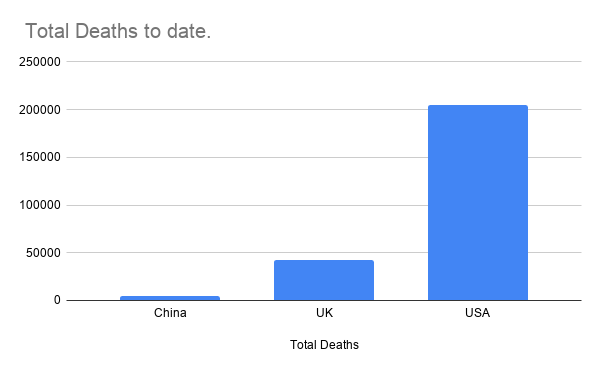
Half hearted lockdowns and premature attempts to “save the economy” in the UK and USA have led to a far higher level of deaths than in China. China carried out a massive social mobilisation and strict lockdown, which eliminated domestic infections within six weeks. Subsequent infections have come from people coming in from outside; and these too have been dealt with very quickly. The UK and USA, by contrast, have so far had 27 weeks, have failed to eliminate the virus and are now looking at another 27 at least- just to get through the winter and the additional difficulties caused by the overlap of COVID with annual Flu – with no guarantee that a vaccine will bring an end to restrictions.

There have been around 100 deaths in China in total since mid May. In the USA deaths are running at about 750 a day and have done for weeks.

This has also not allowed a revival of economic activity. Quite the contrary as we can see. Again, the contrast with China is instructive.

The IMF projects China as the only G20 country that will grow this year.

Attempts to reopen the economy while infections are running high has simply led to a rebound in infections, leading to students and teachers being sent home from school, University students in quarantine, local lockdowns and a series of bewildering half measures from government that it can’t keep track of itself; all of which prevents any economic recovery capable of firing on all cylinders. The attempt to “live with” the virus while hoping for a vaccine means an economy gummed into permanent quagmire.

So, the shortest route to an economic revival is via the most determined measures to eliminate the virus, as we can see here.

Figures accurate as of 1/10/20

Smash the State?

Where’s King Kong (when you need him)?

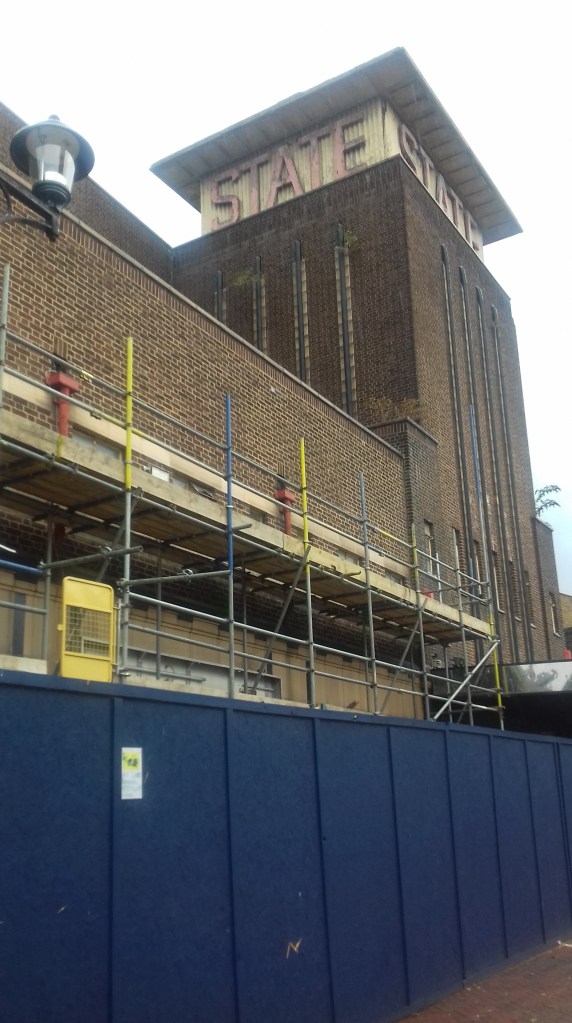
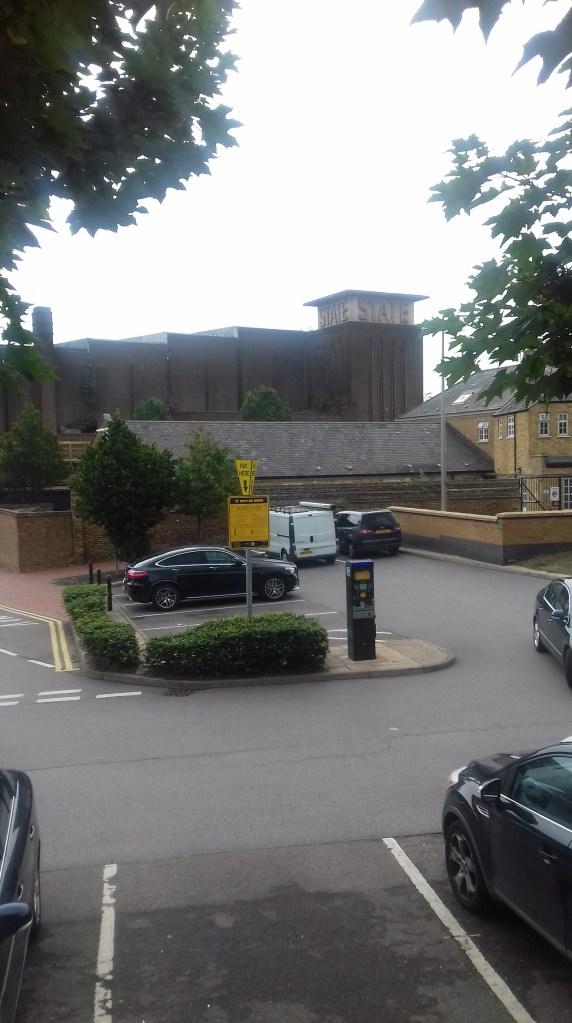
Looming over the heart of my home town, and haunting it like a reproach, is a huge presence that is simultaneously an absence. The State cinema in Grays Essex, a great cathedral of a place, opened in 1938 with seating for 2,200 people, complete with a mighty organ capable of rising colourfully from the orchestra pit like Vincent Price from the grave, has been kept in Grade 2 listed mothballs since 1988, with the paint slowly fading and the buddleia slowly growing, a giant amphitheatre for pigeon poo; having been finally killed off by the opening of a multi screen at Lakeside and the rise of VHS rental: which also left the adjacent High Street as a by passed ghost of its former self at the same time.

The State was so in big in so many ways. Its capacity was more than twice that of the Odeon Leicester Square (a puny 950). In fact, in the list of world’s biggest cinemas, it comes third, after the truly monstrous Radio City Theatre in New York (5,960) and just below Le Grand Rex in Paris (2,750) and way ahead of the Astor in Melbourne (at 1,150, even smaller than the Ritz). So, New York, Paris, Grays…(not Peckham). If you want a feel for the scale of it, the cinema scene in Who Framed Roger Rabbit was shot inside it. A swashbuckling gesture of bravado for a small town worthy of the Errol Flynn films it showed, it dominated the skyline and still does.

Only its smaller, dowdier younger sibling the Ritz, huddled away up the hill with its back to it, and with a tighter 1500 capacity, stands any comparison. The Ritz always had an inferiority complex, completed as it was in a hurry in 1940, with lots of corners cut and expenses spared. “Don’t you know there’s a war on?” An inessential building at a time when all the local railings were being sawn down to make Spitfires; pointlessly as it turned out because the quality of the metal was so poor. (2) Sadly – and characteristically – its entry in the Cinema treasures web site states baldly “No one has favourited this Theatre yet.” (3) Although less loved, the Ritz nevertheless survived in a zombie half life as a Bingo Hall, before being born again as an evangelical mega church in 2016; just in time for Trump and Brexit. Truly the Lord moves in mysterious ways.

The State brought a little whiff of luxury to a town built on factories and docks and in its heyday the place hummed. Before television people would “go to the pictures” several times a week. If not to the State then to the smaller but somehow more elegant Regal – up on New Road past the train station, or just round the corner to the older Empire – the first cinema in town, seating for 800 and a bit of a flea pit. But the State was classy. The tower over the entrance was lit up with neon lights that changed colour, a little bit of Broadway on George Street. A uniformed commissionaire complete with peaked cap and aguillettes called out the prices of the remaining tickets and ushered people up the curving sweep of stairs to the circle or down the slope to the stalls. He was memorialised in cardboard replicas as the cinematic glory days faded in the 50′ and 60s, with life size, if battered and dated, cut outs of uniformed bell boys half bowing and smiling a Stan Laurel sort of smile while pointing the way to the seats.

Generations were moulded by it. Hundreds of kids queuing up as late as the 60s for a Saturday Matinee all the way down the street clutching a thru’ppeny bit for the stalls (4) and round the back to the car park, excited to watch the latest Norman Wisdom or the Magnificent Seven or Guns of Navaronne or 101 Dalmatians, cheering the goodies, booing the baddies and giving the sloppy scenes a groan. Collective – and often dubious, mass bonding. Anyone growing up there between 1938 and 1988 will be grateful for its shows as the pretext for a first date – and probably first kiss. If these things were memorialised with plaques, the place would be buried in them.

Closure cut all that dead. The heart of the town no longer had a heart. After a partial reopening of the ticket area as a wine bar in the 90s, the building has stood empty as a memorial to itself and slowly crumbled ever since.

A planned rebirth as one of Tim Martin’s soulless boozing warehouses – perhaps as a reward for Thurrock having delivered the largest urban leave vote in the country – may fall victim to Coronavirus. But even if it doesn’t, this is a bit like being reincarnated as a lesser being. Life Jim, but not as we know it. All the same, if it comes back to life, there will be many ghosts, the actors – their technicolour all faded away, flickering in the smoky beams from the projector that is no longer there: Yul Bryner behind the bar, Margaret Rutherford nursing a G&T with her bicycle leaning against her table, Kenneth More leaning over the balcony like the bridge of a Destroyer in the North Atlantic -and all the multiple ghosts of our younger selves…

1. “One, two, three four, don’t forget the class war, Two, Four, Six, Eight, organise to smash the state.” Anarchist slogan. Trad. Anon . There is something appealingly domestic about this slogan. Like a to do list. Buy baked beans, Put out cat, Overthrow hegemony of Bourgeoisie.

2. I was quite shocked when I first went to posh areas of London to find handsome railing still intact. “All in it together” has always had its imitations.

3. http://cinematreasures.org/theaters/22456

4. Paying the extortionate price of 6d for the posher seats was seen as a sort of betrayal.

Trying to keep up with the Kardashians will kill us.

Most carbon accounting is done country by country. While this is useful – as it is what states do – or don’t so – that will determine whether humanity is able to hold global heating below a level that will be survivable for human civilisation – it is also partly mystifying in missing out on who is primarily responsible for the threat that affects all of us.

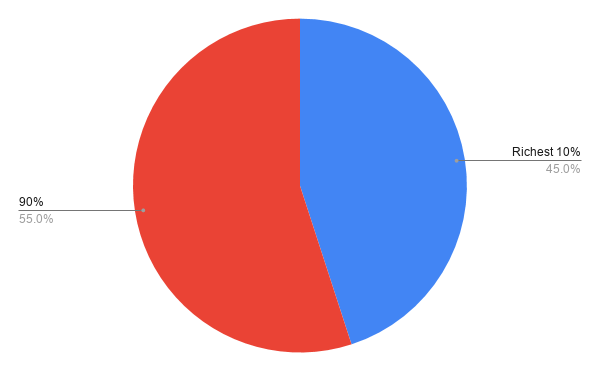
A new report from OXFAM and the Stockholm Environment Institute tears away this veil by looking at the income levels of those responsible for the lions share of greenhouse gas emissions between 1990 and 2015. (1) The findings are stark.

Within the 10%. the Richest 1% (just 63 million people) were responsible for 15% of carbon emissions.

This can be seen by sector.

The richest 10% are responsible for 75% of aviation emissions
And 45% of all land transport emissions. SUVs were the second biggest driver of global carbon emissions growth between 2010 and 2018.

So, if you look at this per capita, each person in the top 10% has a carbon footprint 250 times larger than everyone in the bottom 50%. That looks like this.

This is a direct ratio between the richest 10% and the poorest 50%.

The Report argues that cutting carbon emissions is therefore overwhelmingly urgent in the wealthiest countries, primarily the US and EU, which is where the majority of the 10% – and almost all of the 1% – are concentrated.

An economy in which profits are generated by hooking people onto a false “apirational” dream that emulating the conspicuous consumption of the uber wealthy in all sorts of cheap and nasty ersatz forms – with velocity and quantity substituting for quality – “Too much is never enough” – “Faster, Faster, Faster” – “You: only better” – “Keeping up with the Kardashians” – will kill us. Even the uber wealthy themselves; hunker down in a survival bunker, or flee to New Zealand and Patagonia though they might.

The delirious quality of a lot of current political discourse – and the increasingly frantic culture war distractions from the right – comes from the tensions involved in trying to stick to this suicidal course.

The policy prescriptions in the report are in line with the findings of the first UK Citizen’s Assembly on the climate crisis, have widespread public support and a lot in common with Labour’s Green Industrial Revolution policy.

“Wealth taxes, luxury carbon taxes – such as carbon sales taxes on SUVs, private jets or super yachts, or levies on business class or frequent flights – and wider progressive carbon pricing to fund, for example, the expansion of universal social services;
• Ending the tax-free status of aircraft fuel, unconditional aviation industry bailouts and tax breaks for company cars;
• Public investment, including to create decent job guarantees, alongside working-time reductions where appropriate, for example in:
o building infrastructure for electric mobility, public transport, cycling, walking and digital communications to create alternatives to carbon-intensive transport;
o improving energy efficiency of housing, especially to reduce energy bills for low income or marginalized groups;
o expanding low-carbon sectors like health and social care which overwhelmingly benefit women, low-income and marginalized groups;
• Banning advertising in public spaces, requiring more circular business models and a right to repair on manufactured goods, and changing corporate governance to curtail companies’ short-termism and create accountability for long-term social and environmental impacts;
• Setting science- and equity-based national targets to reduce carbon emissions from consumption as well as production,
• And, critically, incorporating principles of social dialogue at all levels to ensure that the voices of workers in affected industries, women, low-income and marginalized groups are heard in designing just transitions to an economy that keeps global heating below 1.5C”
(1)

The political problem is that they strike at the wealth, power and prerogatives of the top 1% whose interests our societies are structured to serve. Their resistance to polices like these – taking a peculiarly grotesque form in the Trump administration, but not restricted to it – goes some way to explaining why countries that consider themselves Socialist – like China, Cuba, Vietnam – whether they have received benediction in this respect from the Western Left or not – have done rather better at reducing the carbon intensity of their economies (see Blog – Mike Pompeo is standing on thin ice – and its melting).

  1. https://www.oxfam.org/en/press-releases/carbon-emissions-richest-1-percent-more-double-emissions-poorest-half-humanity

Memo to the Chancellor: OECD calls for Green Stimulus.

The September Economic Outlook Report – Coronavirus: Living with Uncertainty -from the Organisation for Economic Co-operation and Development (1) is worth reading; not least because it fires several shots across the bows of the course the UK government is already pursuing and warns of the consequences.

It makes four key points.

  1. China is the only large economy that is recovering this year.
  2. Global co-operation is needed both to fight the virus and ensure an economic recovery.
  3. Premature attempts to balance budgets and revert to fiscal conservatism will choke off any recovery.
  4. A Green stimulus is both necessary to avoid climate breakdown AND to ensure an economic recovery and this has to be state led.

All quotes from the original document. Emphasis and bullet points added.

  1. “China is the only G20 country in which output is projected to rise in 2020, helped by the earlier timing of the virus outbreak, rapid control of the virus, and the policy support provided to enable a quick rebound in activity. (p6) “A sharper-than-expected recovery took place in China, with activity returning quickly to pre-pandemic levels by the end of the second quarter, fuelled by strong infrastructure investment”. (p 2) Put simply, this means that China squashed the virus with a thorough lockdown that lasted just six weeks, keeping deaths and economic damage low. After which, the state invested directly in infrastructure. Putting public health first with a zero COVID approach provided secure foundations to reopen the economy. The state investing directly built on them. Trying to recover without squashing the virus is trying to build on shifting sands. The current talk in the West of “living with” the virus and the sort of push me pull you, hockey-cokey lockdowns, alongside eat out to help out schemes and such, guarantee that there will neither be an elimination of the virus nor an economic recovery with any momentum behind it. The ongoing Chinese recovery has also had a beneficial impact on the rest of the world economy, limiting the extent of its decline; a reality not noticed in the West, buried under the avalanche of diversionary accusations and aggressive moves on trade sanctions coming from the White House.
  2. Global co-operation and co-ordination are needed to tackle the severe health challenges all countries are facing. No country is able to obtain the range of products necessary to combat COVID-19 purely from domestic resources… Greater funding and multilateral efforts are needed to ensure efficient production of medical products and allow affordable vaccines and treatments to be swiftly available everywhere, rather than being limited to particular countries. ” (p9) “Enhanced global co-operation and co-ordination is essential to mitigate and suppress the virus, speed up the economic recovery, and keep trade and investment flowing freely”. (p 9). This is in line with the “win win” approach advocated by the Chinese, and the opposite of the zero sum almost mercantilist operations of the US administration; which has defunding the World Health Organisation, imposed sanctions on Iran and Venezuela, and ramped up its trade war with China while the Pandemic has been in full flood. The OECD projects upside and downside scenarios, with a fuller recovery if global co-operation and fiscal support are worked through, and a stunted one if not. They project that the downside scenario is more likely. Its quite clear where the responsibility for that lies.
  3. “The aim must be to avoid premature budgetary tightening at a time when economies are still fragile”. (p 2). “With the recovery remaining hesitant, sporadic outbreaks of the virus still occurring, and many sectors still struggling to adjust, fiscal and monetary policy support needs to be maintained to preserve confidence and limit uncertainty“. (p8) “Premature withdrawal of fiscal support in 2021 would stifle growth, as occurred in the aftermath of the global financial crisis in many countries” (p 10) ) This is stating directly that obsessions with deficits, all the arguments about balancing the books and not spending more than you earn, and all the household budget analogies that sustained the austerity narrative for the last ten years would choke off any recovery now as effectively as they did in 2010.

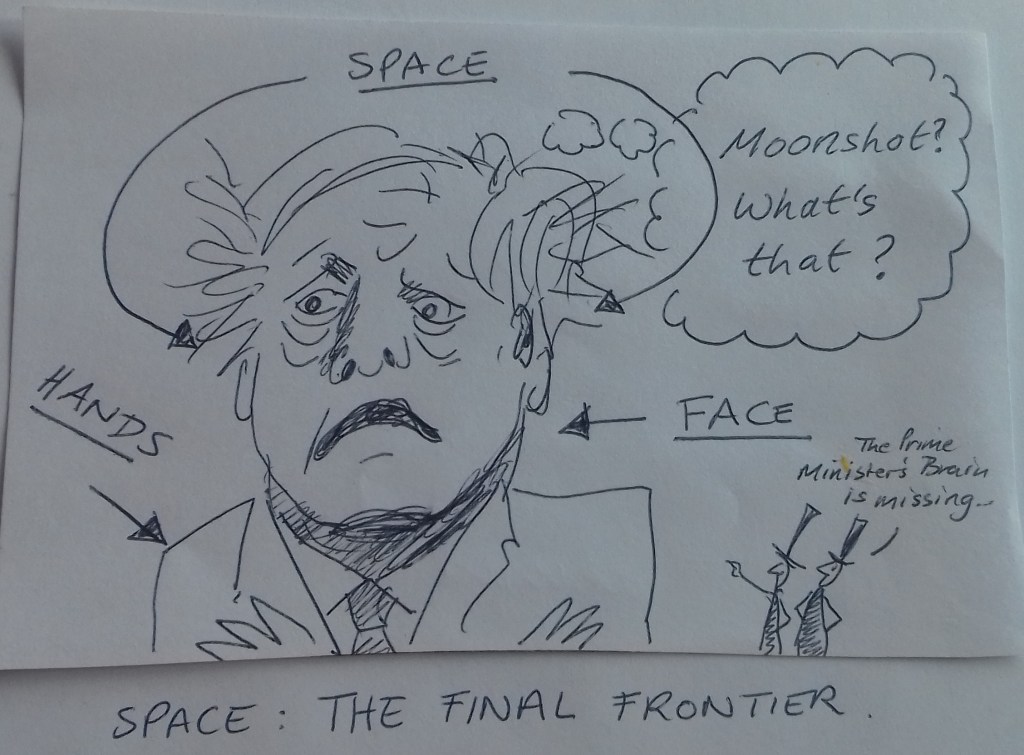
In the UK we have a government that thrives on ambiguous, even contradictory, policy statements spiced up by overblown rhetoric – we are opening up, while staying alert, going back to work while preparing for another lockdown, having a border check in the Irish Sea while not having a border check in the Irish Sea, proclaiming “world beating” systems that don’t work, launching a “Moonshot” initiative for universal mass testing involving a supposed £100 billion investment in technology that doesn’t exist yet and which the Prime Minister forgets about two days later. These sustain themselves in the air until they confront reality and then come crashing down. To have your cake and eat it you have to be powerful enough to impose the costs of that onto other people. The UK is now far weaker than the mental habits of its ruling class allow for, hence a style of politics that is quite delirious by historical standards. Despite arguments that are still being heard here that there will be no return to austerity, the signs of what the government will do are not good.

  • the impending abandonment of the furlough scheme on the argument that “the country can’t afford it”- in contrast to the extension of these in Germany, Italy and France – leading to impending job losses estimated at between 700 000 (the Daily Telegraph) and 2 million (The Guardian).
  • the failure by central government to shoulder the COVID costs imposed on local authorities which, combined with a loss of income from business rates means they face a £2 billion shortfall in income this year, which will mean cuts to services and local public sector jobs.
  • the abandonment of the evictions ban, leading to a quarter of a million people facing the possible loss of their homes.
  • the increasing practice of companies like British Airways sacking staff then re-employing them on worse terms and conditions
  • resistance to any demands for financial recognition of the value of front line workers and a continuing wage freeze for most public sector workers.

The paradox of this is that the UK government has no strategy beyond hoping that people will go out and spend – which is rather tricky if you’re scared of losing your job, or have already lost it, or having your wages cut and may be evicted from your house because you can’t afford the rent.

4. Governments need to invest directly “Prospects for a sustainable recovery could also be strengthened if governments move beyond income support and stimulate aggregate demand directly through public investment. With long-term interest rates close to zero in many advanced economies, the social rate of return on public investment is likely to exceed the financing costs for many projects. Investment is particularly needed in areas that have large positive externalities for the rest of the economy and where under-investment might otherwise occur due to market failures, including in health care, education, and digital and environmental infrastructure.” (p11)

“Government efforts to support the economic recovery also need to take advantage of the opportunity to incorporate the necessary actions required to limit the long-term threat from climate change.

  • Sector-specific financial support measures should be conditional on environmental improvements where possible, such as stronger environmental commitments and performance in pollution-intensive sectors that are particularly affected by the crisis.
  • The potential for an extended period of substantially lower fossil-fuel prices than previously expected further raises the urgent need to introduce effective incentives for firms to invest in energy-efficient technologies.
  • Governments can also help directly by implementing well-designed investments in low-carbon infrastructure and making use of opportunities to support behavioural changes that may help a low-carbon transition, such as facilitating teleworking and enhancing widespread availability of high-speed broadband in rural areas”. (p13)

This is in marked contrast to the UK government’s pressure to workers who could work at home to go back to the office, its failure to put any environmental conditions on bail outs, its removal of subsidies on renewable energy, its spending nine times as much on road building schemes as on energy retrofitting for homes.

The OECD Report provides an implied critique of what we are already seeing from the UK government that Labour could use to focus a “national consensus” on green recovery and social justice that already exists (2) but is belied by the Government’s approach. Nothing would be worse than ignoring this to try to triangulate with Johnson instead.

  1. https://www.oecd-ilibrary.org/economics/oecd-economic-outlook/volume-2020/issue-1_34ffc900-en;jsessionid=aB3y0MW2ISPKKRj07Mj5-dTx.ip-10-240-5-97

2. The  All Party Parliamentary Group on the Green New Deal Reset Report published on Thursday showed among other things that two thirds of the public think the Government should intervene to make society fairer, 66% of UK adults want the government to prioritise health and wellbeing, 65% support rent caps, 57% support some form of universal basic income, 63% support a jobs guarantee, over 90% think NHS workers and care workers should get better pay and conditions, more than 70% think nurses and carers should be paid more, over 82% think supermarket staff and delivery drivers should have better conditions, people who have been able to work flexibly during lockdown, want to be able to continue to do so for some or all of the time in future and there is majority support for investment in local community hubs, green spaces on the high street, residential spaces and cultural ventures, the development of local neighbourhoods so they are more varied and welcoming, more green spaces, and access to green space for all and permanent reductions in traffic. Full report here. https://reset-uk.org/

Best laid schemes? Are schools “COVID safe”?

Possibly in a “limited and specific way”.

Helmuth Von Moltke, commander of the Prussian forces in the Franco-Prussian war (1870) made the practical observation that – in military matters – “No plan of operations extends with any certainty beyond the first contact with the main hostile force” – usually quoted as the less subtle, “No plan survives the first contact with the enemy”.

And so it is with Coronavirus and the widespread reopening of schools.

Von Moltke’s point – that plans have to be adapted to fit realities, that pressing on regardless can lead to disaster, and that it is always useful to have at least one Plan B and some defence in depth, appears to have passed the UK government by.

Daily COVID infections rose slowly and inexorably in the UK from the low point of 352 on 6 July; and reached a seven day rolling average of 1338 by September 1st; after so many people had eaten out to help out in August.

In the two and a half weeks since schools have reopened, this has risen to 3003 per day on a seven day rolling average; and there’s no doubt at the moment that the only way is up.

Schools reopening will not be the only factor here, but it stands to reason that having more nearly 9 million students and 750 000 educators going in and out of work every day is going to have an impact, leaving aside what happens when they get there.

Government guidance on this is based on out of date presumptions and groundless assertions. “Now, the circumstances have changed. The prevalence of coronavirus (COVID-19) has decreased, our NHS Test and Trace system is up and running and we are clear about the measures that need to be in place to create safer environments within schools.” (1)

To take these one at a time.

1. Circumstances were changing even as they were writing this. The prevalence of the virus is increasing again sharply now and is already above the level it was when the initial lockdown was launched in March; and the R rate is above 1 everywhere, which means that the genie is getting back out of the bottle. The last update of this guidance was on September 10th, when this was already apparent; so they are marching boldly forward with their eyes firmly shut. The death rate is now also beginning to rise. The WHO is warning of a significant increase in infections as we go into the Winter.

2. The problems with Test and Trace are yet another “World Beating” fiasco. Outsourcing a public health imperative – to SERCO for goodness sake – was never a good idea. It is the reverse of Deng Xiao Peng’s dictum “I don’t care whether a cat is black or white, so long as it catches mice”. In this case the government seems less concerned with whether their cat catches mice than if it makes money for some of their friends. For this to work, the tests need to be available plentifully and locally and the results turned round quickly. Suggesting to someone in Telford – if they eventually get through -that the nearest available test is in Aberdeen – indicates how thinly this system is stretched. Average waiting time for a test result, if you can get one, is now 83 hours, not the targeted 48. Schools have been allocated 10 tests each to avoid the first problem. Nevertheless, as COVID symptoms are similar to more regular illnesses, a precautionary approach will mean that everyone in the Protective Bubble will have to be sent home at the first sniffle and wait for nearly a week for the test to confirm whether this indicates COVID or not. As this is extremely disruptive, most schools are sending home the individual with symptoms, but not the whole bubble until a positive test result has come through. As COVID is asymptomatic in its most infectious period, this is likely to mean that the infection will take hold within the bubble on a more widespread basis. Even sending home individuals is nevertheless already having an impact on attendance – as presentee-ism among staff and students (coming in when ill) is no longer feasible as a way to keep the show on the road. Much larger numbers of students are being sent home, in some schools after a precautionary temperature check on their way in. This is leading in some schools to teachers being told that they have to set up online lessons for students at home at the same time as in person lessons in the building – simultaneously presumably.

3. The new restrictions on social gatherings – no more than six people together – do not apply in schools because schools are supposed to be “COVID safe” managed environments. There are a number of problems with this.

Some discrepancy here? This is for a medium sized school.
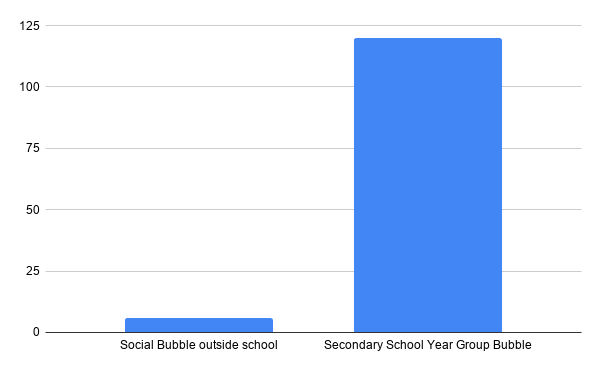
  • It is now not contested that secondary school students and upper primary students over the age of about 10 both contract and spread the virus just as much as adults do. The government puts that like this “There is no evidence that children transmit the disease any more than adults”. Indeed. Nor any less. Nevertheless, the restrictions on class and bubble sizes in place in the Summer have now been relaxed to an absurd degree. “In secondary schools, particularly in the older age groups at key stage 4 and key stage 5, the groups are likely to need to be the size of a year group to enable schools to deliver the full range of curriculum subjects and students to receive specialist teaching” My emphasis (1) A whole year group can be up to 300 strong for a large Secondary School. As Bubbles go, that’s a big one. So, students with the same capacity to contract and transmit the virus can mix with up to 50 times as many people inside school as they can outside. This reflects a failure by the government to act on NEU proposals to requisition additional space and employ additional staff so distance can be maintained and Bubbles kept small.
  • As it is down to individual school managements to make their own plans, there is a wide divergence in what is being done. Many school leaderships have worked immensely hard, risen to the challenge and set up rigorous social distancing, one way systems, have teachers not students moving between classes to minimise corridor contact, and strict book marking protocols – where books are kept for 72 hours before being marked and another 72 before being returned, all parental contact is via zoom and masks are worn wherever necessary. Others have not. In a borough somewhere in London, students in more than one large Secondary are still moving in herds (without immunity) between lessons, masks are not worn, teachers asking about book marking protocols are being told – in one case – to “just get on with it”, whole year group assemblies – physical ones – are taking place (with 120 students) and there is even a suggestion in one school to hold a Musical Performance at Xmas, with rehearsals in the meantime.

The NEU has agreed a checklist with UNITE, UNISON and the GMB to hold school managements to the strictest possible implementation of government guidelines and will support its members in balloting for action where these are breached. But in the absence of a national Zero Covid strategy it is hard to see how even the best laid plans will cope with intensifying contact with the hostile viral force. The Plan B being urged by the NEU, particularly the emphasis on preparing for blended learning and resourcing children without access to laptops, is a bottom line to fall back on (2); but it is becoming increasingly apparent that we need the elimination of the virus if any recovery at all is to viably take place and the sacrifices made in the Spring and early Summer – not least by our children – be squandered.

  1. https://www.gov.uk/government/publications/actions-for-schools-during-the-coronavirus-outbreak/guidance-for-full-opening-schools
  2. https://neu.org.uk/coronavirus-neu-national-recovery-plan-education

A Government of the 9%?

On Saturday the Tory Tabloids fired a co-ordinated broadside, from their front pages on every news stand in the country, hailing the triumphant achievement of a free trade deal with Japan as the first hurrah of the new “Global Britain” – now almost freed from the EU scaffolding that has been holding it up for the last forty eight years. These were usually accompanied by a picture of Liz Truss looking oddly happy – safe in the knowledge that there is little danger that Japan will be selling us any cheese. (1)

A deal with Japan is an important one. Japan is the world’s fourth largest economy. Only China, the USA and EU are bigger. But trade between it and the UK is actually very small, and not likely to grow by very much as a result of this deal; so maybe the Brexit supporters should put down their Union Jack party poppers and “Rule Britannia” song sheets and contemplate some realities.

Japan accounts for just 1.9% of UK exports, compared to 46% for the EU. So detaching the country from a free trade deal with a bloc that takes nearly half its exports means that there would need to be more than 23 deals with countries like Japan to make up for it (and these deals would have to be on the same lines as the benefits and obligations conferred by EU membership to have a comparable impact).

There are two problems with this. There are no other countries like Japan. Those that come closest – developed, wealthy and large – are mostly in the EU.

Comparison of UK trade with EU, USA and Japan from ONS Pink Book 2019 (2)

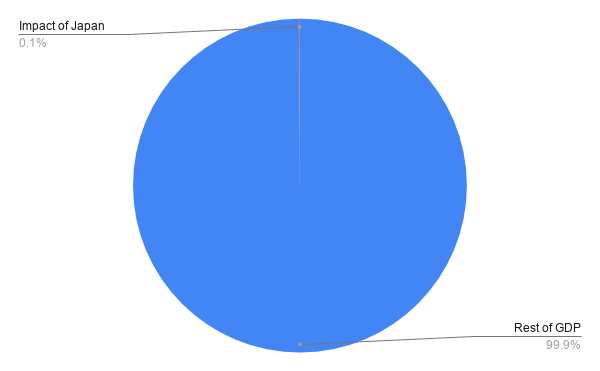
Moreover, the trade deal itself is not exactly going to have a dramatic impact. The Department for International Trade projects that it will increase UK GDP by ….wait for it …0.07% …after 15 years. That looks like this.

Impact of Japan Free Trade Deal after 15 years

Blink and you miss it.

The government’s own analysis of the impact of a no deal Brexit – on the other hand -is that, over the same 15 year period, UK GDP would be 7.6% smaller (and with a Free Trade Agreement 4.9% smaller). (3) Clearly, they know what they are doing.

Only 9% of the UK population think that a no deal Brexit would be a “very good outcome” for the UK and another 15% that it would be a “fairly good outcome”. That’s under a quarter of the population. Despite the government. And despite the daily barrages from their cheerleaders in the press. 31% think no deal would be “very bad” and another 19% “fairly bad”. That’s half the population. So, the government – in pushing for no deal – can no longer claim to be representing the 52%, at best the 24% who could put up with it, and most accurately the 9% who are really keen.

What is odd in this situation is that Keir Starmer has just written in the Daily Telegraph that it is time to “move on” from this debate, in which the government is on the rack – in a minority, heading for the economic debacle of no deal, and has just snookered itself by blocking off its preferred alternative deal with the USA by reneging on its agreement with the EU over the North of Ireland; because Congress won’t ratify any deal that messes with the Good Friday Agreement.

Where exactly does he want us to “move on” to?

  1. https://www.youtube.com/watch?v=n_wkO4hk07o
  2. https://en.wikipedia.org/wiki/List_of_the_largest_trading_partners_of_United_Kingdom
  3. https://blogs.lse.ac.uk/brexit/2020/08/26/a-no-deal-brexit-may-still-be-more-costly-than-covid-19/

Half unlocked

A green, yellow morning, a bit of autumnal nip contesting with sunshine that still shines with more of a touch of oven that it has any business doing in September.

In our local park, where this year’s meadowing is somehow stragglier than last, some are gently working out on the public gym, while – in the middle of a sweep of grass and some way from others – a dozen or so men sit on a circle of chairs they have carried there to hold council on the issues of the day. An informal echo of Saxon times, when the Moot of the Hundred of Gore met nearby just south of Kingsbury Circle.

Nearer, a Yoga class of 30 – the maximum legal size for a public gathering – is laying on the ground in a rough socially distanced circle. The instructor – rather nervy and intense for a Yoga teacher – tries to get them to rise on their forearms and adopt the Cobra pose. Most seem to have fallen asleep and don’t.

An aging bloke in a white captain’s cap leans jauntily on a tree chugging Skol, though it is a little early in the day and the sun definitely hasn’t passed the yardarm yet. A scattering of discarded cans around him shows how much he cares.

On the main drag and a family is packing shopping in the boot of their car. Mum and children have no mask. The paterfamilias – as a sign of standing presumably – has one of those plastic face guards that make him look like a lightweight welder on a break.

The Library has reopened. It is quiet – too quiet. There are possibly three of us in there. There is no table for newspapers any more, so the elderly can no longer recharge their prejudices by leafing through the Mail and the Telegraph. Hashtag “ill wind”. There is a hand sanitiser worked by a foot pump so you don’t have to touch anything with your hands – clever. And when you go in you have to leave your name and contact details with the librarian just in case. This is the first time I have ever had to do that anywhere. Which might be one reason – alongside the lack of a functioning App – that track and trace is not working as well as it should.