The Words of the Prophets…

…are written on the subways walls, and tenement halls” or, very often, the walls of pub toilets. In the toilet at the Chandos pub, wedged between St Martin in the Fields and the Colosseum, and reached up a narrow twisting staircase lined with black and white photos of opera singers, you’d expect something classy.

Above a startlingly black and white diamond floor, someone has written gnomic messages in the tiny capitalised writing of the obsessive along the grout between the wall tiles. “The World is flat”. “The World is grey”. “Trump is a bump in the road” The last of which can’t help but make you wonder “Where to?” Rather than clean up these rather faint assertions, the pub management has drawn over them in coloured marker; which paradoxically draws attention to them and makes decoding what you can and can’t see underneath a bit of a mission.

Behind the cistern, someone has written, bolder, larger, in green, red and black, “Free, Free Palestine!” then poignantly added “please!” drawing an angry retort in scrawled biro, most of which has been equally angrily scribbled over so only the sentiment “Let us finish the job” can be read. A third person, presumably the one who scribbled it out, has drawn an arrow to the sentiment and added “You did that in 1948”. So, at the pub toilet in the Chandos, as in the Oxford Union, its evident that Israel’s exercise of its “right to defend itself” has blown away any pretence it had at moral standing with every bomb it has dropped, every tactical success lays the ground for strategic failure; and the writing is now on the wall.

Graffiti in pub toilets varies with the clientelle. Back in the seventies in York, when I was more inclined to be a regular than the very occasional visitor I am now, the Spread Eagle in Walmgate seemed to specialise in satire at the expence of John Smiths brewery. Just above the urinal, someone had written, “You don’t buy the beer here, you rent it”. Somone else had added “Don’t take the piss out of John Smiths bitter – you might remove its entire liquid content”. In the more sophisticated refuge of the York Arms, a cosy mostly gay pub tucked snugly in behind Bootham Bar, there was a line in arch and witty comments about anything and everything. Most were a fleeting laugh, but, for a reason that is mysterious to me, this one has stuck. “To be is to do” Rousseau. “To do is to be” Sartre. “Oo be do be do” Sinatra.

A similar mixture of the cod profound and the down to earth was written on the whiteboard on the concourse of Piccadilly Circus tube station that was crowded with people rushing hither and thither in an even busier than usual pre Xmas crush, giving a Hallmark sentiment a practical punch line. “Life is about the journey, not the station – SO KEEP MOVING”.

A sticker in the tube car read “My girlfriend said it was her or Reading – I still miss her sometimes”. My initial thought was that Reading is a nice place, definitely deserves to be a city, but not so nice as to break up over living there, and that this was a strange way to promote its charms; until I tumbled that it was about the football club. The same thought applied though…

Another tube advert illustrated the limitations of synthetic phonics as a method of teaching reading. It read “Whne yuo cna’t dceipher thier priicng bnudles”. I expect that most people reading this will have had no trouble working out what that said, because you’d have been using your sense of meaning and syntax to work with your knowledge of possible letter/sound correspondences (which can vary in English, vowels being especially slippery, as in “I like reading in Reading” or “Gove loves to move”). If the sentence had had a jumbled word order as well as a jumbled letter order, it would have been much harder to work out.

The problem with an over dogmatic phonic approach to reading is the insistence that meaning follows decoding, when it is necessarily very often the other way round. Even when learning the phonemes themselves, its a lot more effective to do so from a word that has meaning for the learner (like their name, or words like “Mum”) than a random list.

The brain works like a very sophisticated version of the spellcheck/predictive text systems that are now on phones. As you type, the system will give you possible options for words that might make sense if they come next. As you type more letters, the words change as the possibilities narrow.

This perception is important from the off, as without making sense being built into the process, there is a danger of what used to be called “barking at print”, where a child might learn to decode the sounds and pronounce the words, but be reading them as a random list. This might get good marks in the phonic screening children in Year 1 have to do, which is set up exactly as a random list, many of them as “non words” to eliminate any input from meaning contaminating the purity of the letter,sound correspondences; but it doesn’t allow lift off into self sustaining reading for pleasure or information – because the activity is abstracted from all that.

More creative mishears. In a discussion on the antecedents of the HTS in the Al Nousra Front and Jolani’s split from ISIS, I misheard the name of the ISIS caliph Abu Bakr Al Bagdhadi as Big Daddy, which conjured a different image altogether.

Fox Hunting by Bus in Search of Nirvana

On the pavement outside Kwikfit, two of the monks from the Buddhist Temple on Kingsbury Road, resplendent in smouldering saffron and crimson, but simultanously down to earth in grey woolly socks and hats (a sartorial middle way) walk past. One of them has his nose in a leaflet about life insurance, which he might well have need of if he doesn’t look up before he gets to the edge of the pavement.

When waiting for the 324 bus outside Brent Cross, there is always a steady stream of 112 buses heading for the headily named Tally Ho Corner in North Finchley. To give the bus a bit of panache the destination board on the front reads FINCHLEY Tally Ho! as if grinding up Ballards Lane from one bit of nondescript bit of suburbia to another had all the dash of a hunt of sherried up hoorays jumping their horses pell mell over hedges, and hurtling through the countryside in full tilt pursuit of the foxes that now slink around our bins at night – probably at Tally Ho corner too. The arrival must be an anticlimax, but that exclamation mark gives the journey a bit of imaginary zip. In the same way that there is a suburb of Polokwane in South Africa that is called Nirvana. I don’t suppose its all that, but having it as a destination on the front of a bus…wonderful! Saves all that reincarnation.

That time of Year #1. The Nativity with no baby.

In the midst of the great Temple of Mammon that is Brent Cross Shopping Centre, a not quite life size Nativity scene is installed on the first floor. It looks normal enough until you notice that, in the midst of the manger, where the Christ baby should be, there is a void.

As a result the hand and face gestures that should express awe and wonder are more akin to shock and bewilderment, puzzlement or even irritation. Where’s that baby gone? He was here a minute ago?

The Gold and Frankincense seems to have arrived with two of the Three Magi, but there’s no Myrrh for the third. Its obviously a result of something prosaic – some of the parts haven’t been delivered perhaps.

Nevertheless, it comes across almost as a statement of doubt. The absence at the heart of doctrine. Faith without object. Or perhaps as a practical joke, or a Shopping Mall Treasure Hunt – find the missing Son of God and win a Waitrose voucher (bonus points for the missing Myrrh).

A small dog strains on his lead to sniff through the barrier at one of the plastic sheep, trying to work it out.

John Wesley’s Twinned Toilets, and other scenes from Central London

On the Metropolitan Line on the way to the joint unions and climate movement rally for a just transition outside the Treasury building, a bloke gets on the tube wearing a blank expression and a black jacket with the legend “Find your own way” on the breast pocket. Its hard to tell if thats a personal philosophy, or advice.

Rising up through Westminster tube station, built at a time of intense de-industrialisation and therefore designed to look like the inside of a power station, a crocodile of kids on a school trip walk across on a higher level. They are wearing scarlet peaked hats, which are a bit MAGA, but, small as they are, they seem calmer, more mature than the people you get at Trump rallies. Odd moment at one of those recently. He complained that the teleprompter had cut out. You mean that stuff is scripted?

At the Portals of Power. Outside the Treasury building (author with Greener Jobs Alliance banner in evil looking black hat).

A lively rally outside the Treasury. A mix of Scottish trade unionists and other UNITE members, the Stop Rosebank campaign, Campaign Against Climate Change, Greener Jobs Alliance, Greenpeace and Scottish FOE. More women than men, including among the speakers. Lots of speeches and chants, people passing sometimes bemused, but a lot of honked car horns and fist pumps from drivers. A letter signed by 60 organisations calling for the government to fund a transition for North Sea Oil and Gas workers so their skills can be redeployed, handed in at the end. It would cost about a billion a year – small change given the totality of government spending and a sixth of what they are spending on maintenance on the Trident missiles they occasionally misfire into the Carribean on tests. Hopefully, when it was handed in by a delegation that included UNITE and Greenpeace representatives, someone from the Treasury was engaged in a discusion about it and was given some food for thought.

In the basement of Central Hall Westminster, the enormous HQ of the Methodist Church, they have a cafe that is a bit hidden away, named after John Wesley, founder of the Church, which a little group of us from the Greener Jobs Alliance repaired after the rally for a bit of caffeine fuelled repair and bounce ideas off each other. Its a light and airy cafe. A bit of a discovery. Good coffee. One of my comrades in Green arms was very complimentary about their bacon rolls. Its a little odd because Wesley himself was not especially fond of coffee. In his Primitive Physick, his rather austere guide to diet and exercise he notes that “Coffee and tea are extremely hurtful to persons who have weak nerves.” However, while he was not especially fond of coffee, he definitely didn’t like tea, blaming it for “Symptoms of a Paralytick Disorder” in himself and, watching people on the street, concluded that there was a lot of that about. He gave it up altogether in 1746, arguing with a friend that “You have need to abhor it as deadly Poison, and to renounce it from this very Hour.” Now they sell mugs with his face on it, but without the quote.

Although, equally oddly, he didn’t note that coffee and tea can be exteremely hurtful to persons who have weak bladders, one of the best things about the place is that they have twinned their toilets with facilities their church has built all over Africa. Every urinal has a little photo above it of a thatched shack in Zambia, or the DRC explaining where it is. They are all unique. The urinals are all the same. None of them is by Duchamp. The shacks are like the Ventilated Improved Pit toilets at Vanghani school in Limpopo, South Africa that I visited in 2005. A gigantic pit with a long drop from a basic toilet seat. The idea being that whatever goes down will be absorbed and the hole will never fill. Works very well. No need for flushing. The pictures felt like humanity and hope.

On the corner outside Westminster Hall, a bloke in his sixties is standing with a home made contraption with a message about the overuse of plastics that looks like a full size crucifix for plastic bottles, which hang from the cross bar like shot game birds. Its so large that its hard to miss. I go over and offer some encouragement and find out that he is doing it off his own bat, not attached to any campaign, just personally motivated to get a worthwhile message out there. Beats sitting at home watching Homes under the hammer I guess. I suggest it might be an idea to have a map showing nearby water fountains and he says that there aren’t any nearby, and those that do exist are often hidden away in odd corners, perhaps so they don’t get worn out by anyone using them.

Opposite him, a big blue banner and EU flag with the slogan “We’re still here because Brexit is still crap”. I think this might have been the bloke who played “Things can only get better” as an accompanyment to Rishi Sunak’s ill judged General Election announcement; one of the things contributing to Sunak’s increasingly frustrated demeanor as he talked on through the wind, talked on through the rain, and walked back into Downing Street very much alone. Perhaps “Singing in the rain” might have been better.

By the statues in Parliament Square, a tour guide rattles through his spiel to a group of teenagers with 1,000 yard stares. General Smuts is turning green behind them.

On my way back down the tube, a family of French tourists walks up the steps towards the exit. As they get half way up, the two toddlers with them, who look like illustrations by Shirley Hughes, look up and out and catch an eyefull of Big Ben at a sharp angle, framed by the humdrum surroundings of the exit and backlit by a bright blue sky, all tall, gothic, gold and glittering in the sunlight, and their eyes widen and jaws drop – “OOOOH! Wah!”

Love a bit of awe and wonder.

Fear and Loathing on Kilburn High Road.

Chatting to some stall holders at the Brent Green Day at the Kiln Theatre about how the vibe inside it, quiet, prosperous, with a clientelle that is evidently well to do – drifting over from various manifestations of Hampstead perhaps – is such a striking contrast to the hard bitten, impoverished, tough dramas of everyday life on the streets outside. The Kiln puts on a lot of challenging drama, addressing some of those issues, but rarely engaging with the people they affect, in a sort of performative bubble, it seems to me.

Outside Tescos a woman sits on her knees begging. A bearded, slightly wild eyed, man marches past and snarls “Why don’t you get up off your arse and get a job? How about that?” He marches on feeling better about himself no doubt. The woman just stares.

Further up, outside a pawnbrokers, a ragged looking bloke with wild looking hair and some missing teeth sits astride a Lime bike waiting for something and mutters at me as I walk past. I ask him what he said and he repeats “Do you buy gold?” I am wearing a preoccupied expression, a crumpled shirt, with at least one curry stain, and carrying an overfull rusksack and Morrisons plastic bag. I’m not my idea of a gold dealer. Deep cover perhaps? Or perhaps a different sort of “gold”?

High Noon in Fairfields Crescent?

Because it is so steep, few cars run up or down Fairfields Crescent. Its therefore tempting to walk down the middle of the road. A move that irresistibly conjures up a projection into an old Western like you are approaching three gunslingers with bad intent (and no lines). The heroic mythologies of John Ford aside of course, projecting ritual duel like six gun shoot outs – when the historic reality was that most people who died of gunshot wounds back then were shot in the back – it comes with a series of grand musical accompaniments in the head. The theme from The Big Country probably the grandest; and most thrilling. From 1958. The year before Sputnik ushered in the age of the Space Opera.

Half way back up Wakeman’s Hill from dumping our old, clapped out oven at the Community Skip; which appears every couple of months for two hours only at a convenient local spot – a wonderful innovation from the local council that prevents an awful lot of fly tipping – I spot a very thin, quite small, semi deflated Father Christmas suspended half way up the front wall of a house near the summit. Originally meant to look like he was climbing purposefully up with presents, encapsulating hope and anticipation, he is now hanging with his limbs dangling at awkward angles like an animal someone has shot, perhaps as a warning to other Santas not to try it. At any time of the year…

As Wakeman’s Hill is long and steep, and the old oven heavy and awkward, I took it down on the chassis of our shopping trolley, which worked extremely well. Wonderful invention. Everyone should be issued with one when they retire as a rite of passage. Let the wheels take the strain. It should be in Manifestoes at the next election; One Person. One Trolley!

Being away in Thurrock most of the time at the moment, local changes in Kingsbury jump out when you come back. One pleasing development is the number of Lime Bikes that are obviously being well used. A scattering outside the tube station, and some outside flats, showing that people are using them for short term commutes, probably regularly. Some are dumped on their side – which is slobbish of whoever does it – and I tend to pick them up even though my knee is too far gone to use them, as they should be presented by all of us as the community asset they are, not the piece of pavement clutter cyclophobes like to moan about on the local “Next Door” (let’s moan about something local) site.

Nine Women’s Morris, and an effervesence of Swifties in Wembley

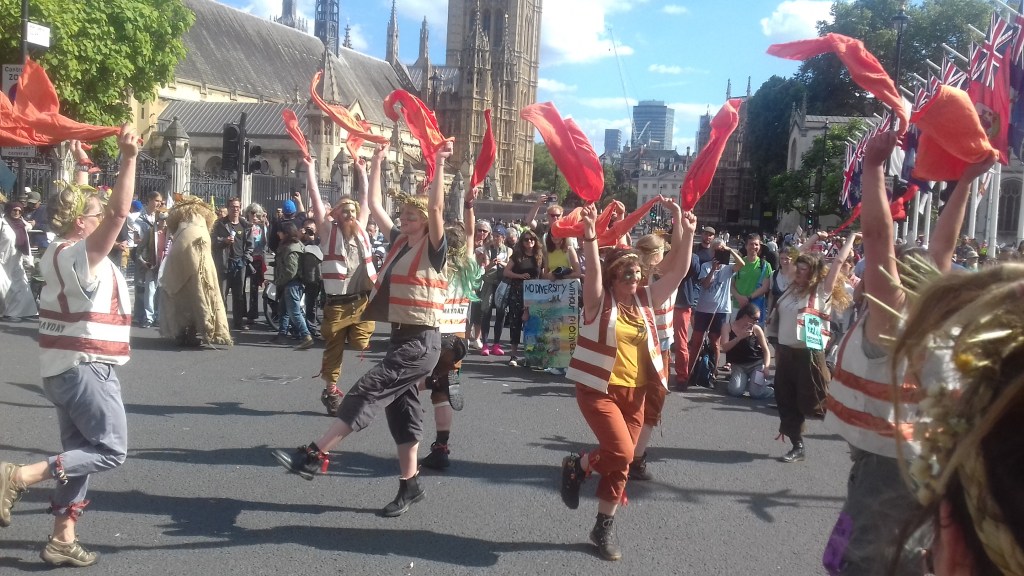
At the end of the huge Restore Nature March in London on Saturday, the magnificent Mayday Morris team from South Devon finish off with a display of pagan exhuberance in Whitehall. The brown shrouded figure with antlers in the background wanders in and out like a gentle reminder of doom.

Descending into the false industrial bowels of Westminster tube with a flood of other marchers heading for home but not demobilising, there is a group of a dozen or so people dressed up immaculately with beautiful garlands of flowers in their hair – full blooming roses very prominent – who seem like a small contingent of aspirant minor deities. Stuck in the crush before accessing the platform I ask them if they were from the march or where they, perhaps, a hen party. Turns out they were Swedes living in London who were out celebrating Midsummer Day – a big deal in Sweden, where summer days are very long, and midwinter days barely peek into existence.

All the way up to Wembley, the Jubilee line is overwhelmed by a tsunami of sequins, silver stetsons, body glitter and dangly earings as an almost entirely female army of Swifties heads for the Eras show at the stadium. The atmosphere is effervescent and excited, packed out and hot. At each stop, a few get off, and a few more get on. A bloke with a strategically placed tuba on a trolley has to struggle to get out. At one stop, the driver announces the train is ready to depart before a crush of people have got off, so passengers heave themselves against the doors as the counter crush from the platform push themselves into spaces that aren’t there. A quick dash across the platform to the air condition wide open spaces of the Metropolitan Line – there’s even seats – proves a wise move. The importance of local knowledge. At Wembley Park, the platform is overwhelmed again. In dismal weather, the sequins would be defiant. In bright sunlight, they sparkle like a wave crest.

In stark contrast to the football. To slightly misquote Barnesley FCs inspirational song, to the tune of Blue Moon, “England… its not like watching Brazil”.

Why can’t our High Streets be Orchards?

Odd scenes in North West London and South East Essex

Walking past the Thameside Theatre and a woman is furtively picking what looks like lettuce leaves from the flower beds at the front. I assume that she is wild scavenging, and now that I look like a harmless old geezer, complete with arthritic limp and shopping trolley, I feel emboldened to talk to strangers, so I ask. “Are those edible?” Waving them to underline her point, she says, “They are for my tortoises”. In Todmorden this is what everyone does. For over ten years they have encouraged people to plant food on any vacant and unused land, and for anyone who needs it to pick it. This brightens and greens up the streetscape, creates community – as loads of people plant things in all sorts of places – and provides extra fresh food, in season, for anyone who needs it. This has been picked up in lots of other small towns, but Hull is about to try it out on a city wide scale. We should all do it. Why can’t our High Streets be orchards too?

Three shops in Rainham. Vape shop. Fried Chicken shop, Undertakers. In that order.

As the C2C train arrives at Dagenham Dock, the small girl wearing a blue jacket with white angel wings designed onto the back – who has hitherto been exploring the physical space around her Mum, who sits a bit careworn in her mac and hijab, and elder sister, who is glued to her phone – lifts her head and listens. Perhaps its because the recorded announcement is done in posh. Emphasising all three syllables – “Dag-en-ham”, not the local version that makes the middle one redundant – “Dag – nem”; thereby bringing out its full rhythm and range of sounds. The drum beat of the syllables too; Dagenham Dock, boo, ba, bum – BOM! The percusive consonants at the start of Dagenham, the extended hum at the end Dagenhmmmm– the sharp crack of “Dock!” She seems enchanted by it and, all the way to West Ham, she keeps repeating it in various forms – stretching it out, making it jerky and jumpy- making it an impromptu nursery rhyme with no meaning but a definite music.

Of course, the part of my brain that still thinks in Lesson Plans started working out how to canal this spontaneous exploration into a rhythm game: sit in a circle and clap and chant the the names of stations; always ending at Mornington Crescent obviously…

Outside the Magistrates Court on the Edgware Road, a couple of pararazzi snipers with huge photolens cameras lurk in ambush, presumably waiting for a celebrity wrong ‘un to emerge at the top of the steps; the name of the Court photogenically framing them in more ways than one. One scopes out a shot from behind a tree, perhaps nervous of being seen by his mark.

An Attenborough out take – and other stories of managed decline.

Now that we are back on Greenwich Meantime, and the nights start in the afternoon, I’m reminded of one of my grandmother’s phrases “Don’t half get late early doesn’t it?”

At the corner of the park there is an area of once ornamental plants that is now decidedly unkempt and casually rubbish strewn. It abuts an area with a few trees that provide cover to ground level and a dark and rather menacing glade alongside the path that everyone hurries past. This has become something of a haven for rats in the last few months.

They are definitely becoming a bit bolder. On Sunday morning last week several of them were frolicking in the sunlight a little away from a flock of pigeons. One of the pigeons, possibly curious (I don’t know how curious pigeons get) waddled over and got into one of the rat’s personal space, so it jumped up and snapped at its breast before getting back to moseying around on the grass with a mouth full of feather, as the pigeon, armed with no more than a corn pecking beak and an injured sense of dignity, backed off in a huff. Not quite the Serengeti, but could fit into the latest Attenborough series about urban wildness, given the right camera angle and magnification.

It doesn’t help that some people feed the pigeons, sometimes in a big way, which also feeds the rats; and others dump half eaten fast food near the bins instead of in them. Every night is take out night.

At the other end of the park near the Shisha lounge, another rather plump rat makes one of those bum bouncing runs they do when they are in a bit of a panic, heading for cover, as a fox, magnificently red in the early morning light, stands stock still and watches it with lordly indifference.

Where are the raptors when you need them?

A bit of guerilla gardening might be a good move if the council would agree to it. Put live plants into the scuzzy ornamental patch, having cleared it, and for volunteers to keep them up, along with clearing away the rubbish and undergrowth that gives the rats the cover they need.

The following Sunday morning, another sunny day in which colours in the park seemed to have been reimagined as a painting by David Hockney, there was no sign of the rats on their main territory. Perhaps they were having a lie in.

Most of the park is fine, busy, full of dog walkers, exercise classes, little parliaments of elderly men putting the world to rights, but these sad rodent ridden corners need sorting out.

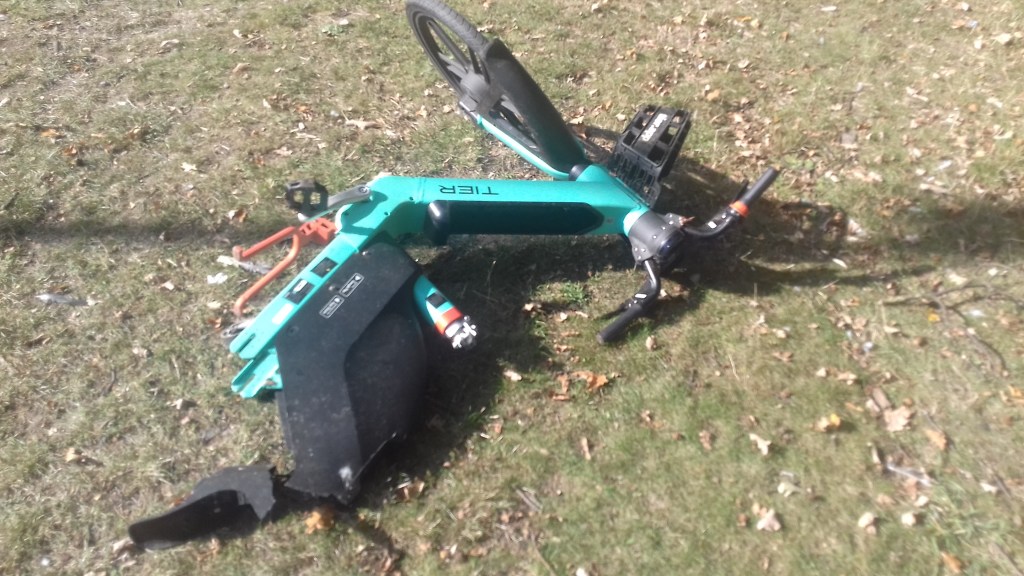
Someone had vandalised and abandoned an electric hire bike near the shops. It could be a metaphor for what Rishi Sunak is doing to the government’s climate targets.

A bright green double decker arrives with a paint job on the side announcing it as the 1,000th London electric bus, which is good to know. Only 7,000 to go. In Shenzen they converted all 16,000 of their buses to electric in one year, but TFL is doing well by Western standards. The millionth Morris Minor was painted Lilac, which was quite daring for the time.

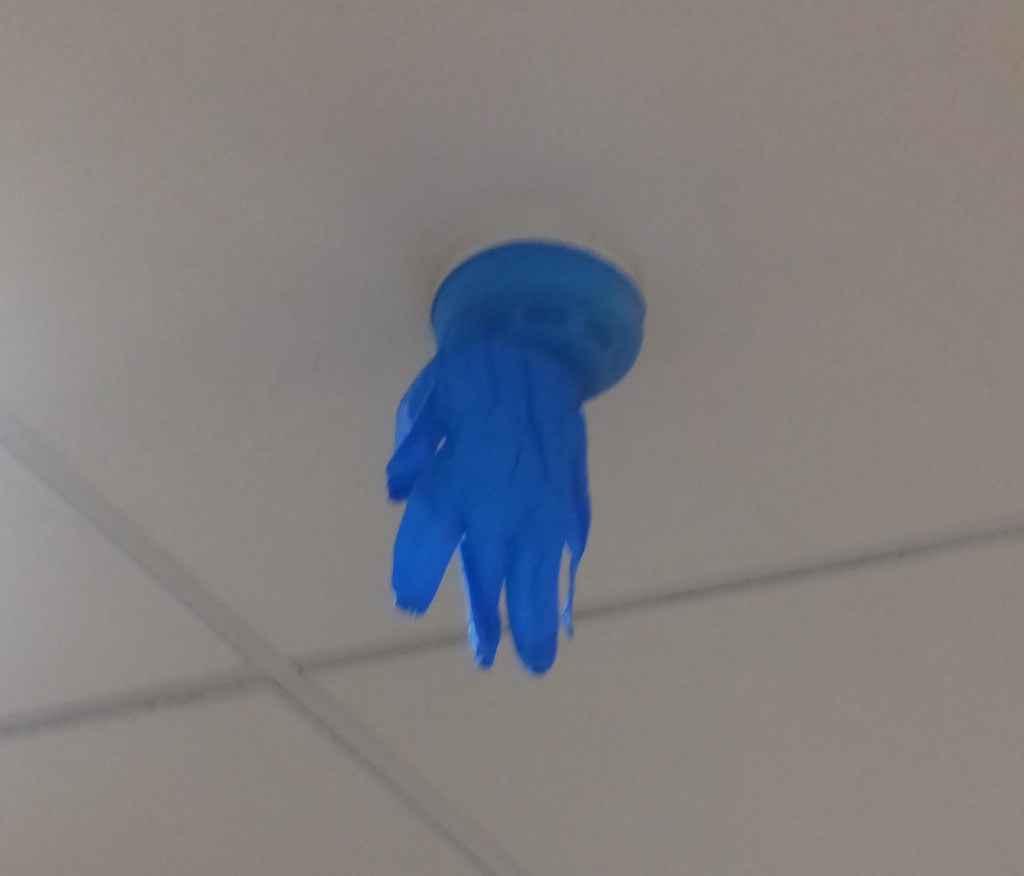
At the Health Centre in Alperton for my Covid jab and its a real industrial process. The waiting room packed out, the queue half way up the corridor to the entrance. All elderly. All looking for a seat and not always finding it. The space, excitement and bonhomie of the first wave replaced by a kind of unsettled grumpiness as everyone is jumbled too close together cheek by jowl. The bloke in charge of feeding in the queue has an air of can do enthusiasm that shall not be moved, and moves everyone through as quickly as possible. Overhead, possibly covering a camera, someone has placed a nitrite glove that looks like a shrunken blue udder, or an AI plasticated version of “The Beast with Five Fingers”. “Its the horrible hand, its operating again!”

After the rains, a dead slug lies on the pavement like a tiny beached whale.

The houses in Roe Green Village, built originally to house the workers for Airco, look as though they were purpose built for Xmas card scenes. All red brick and high pitched roofs with dense green hedges, just waiting for a thick snowfall, to be scattered with glitter and festooned with, tasteful, lights. Of course, the people who first lived in them built military aircraft in the First World War.

On the way back home, a group of ten middle aged adults, some with lanyards, walk along Roe Green in pairs like an extremely well behaved school crocodile.

On the way up the hill, I pass a man walking down who has some sort of palsy, has his head down a bit concentrating on walking and is shaking his arms like he’s having a bop. So I wish him a good morning as I pass, and he nods. Only connect.

From Yorkshire to Buddha

On the Metropolitan line, heading North by North West, a small boy dressed in a blue puffa jacket emblazoned with yellow lightning flashes – to show he is a live wire – determinedly pulls himself up on the bar above the seats where his parents are sitting and languidly swings himself along with the same seemingly effortless grace you’d expect from an orang utan. His parents ignore him and no one else pays him any mind. The loneliness of the short distance gymnast.

In Chili Masala at the bottom of the hill, waiting for a take out while being serenaded by film music on the flat screen on the wall, all yearning, echoey lyrics and shots of beautiful young people staring longingly at each other on dancefloors and across roofs: or doing formation dances on the tops of steam trains – as you do. Rather more surreal, a grim faced man in black standing in front of a brand new bright yellow JCB parked in an industrial wasteland straight out of Tarkovsky’s “Stalker” sets about a small army of disposable henchmen, also in black but wearing V for Vendetta masks with a base ball bat and small axe and a choreographed balletic grace. On the wall, a solid home made open fronted MDF box, with the words HAND SANITIS shakily scrawled in sharpie. Empty now of course. I still have a few sachets of Clinell wipes in my back pocket that I tempted to post in it to make it seem a bit less sad.

In the window of one of the flats on the way to the doctors, someone has stuck up one if those centre spread St Georges flag pull outs the Sun does during football tournaments and left it there long afterwards; no more inclined to take it down than I am to remove the Clinell wipes from my back pocket. Over time the ink has faded from the letters not inside the red cross, so it now reads “t’s coming om”.