A Place to Live….

A look at two housing developments in Thurrock from the last 100 years, and one for the next 100, which show how the places that get built for us to live in reflect and reproduce the dominant ideas, and the relationship of class forces, in society at the time they are developed.
1920s:Homes fit for for Heroes

In the immediate aftermath of World War 1, and with the Russian Revolution haunting their imaginations like a nightmare, the powers that be in Britain embarked on a period of mass affordable social housing for rent run through local authorities to maintain decent standards and accountability. Council houses. Until widely denigrated in the 1970s in the run up to “Right to Buy” a solid, affordable and secure place to live, generating an income from the council that paid off the initial loan taken out to build them, pay for maintenance and improvements, and provide a steady income once the loans were paid off.

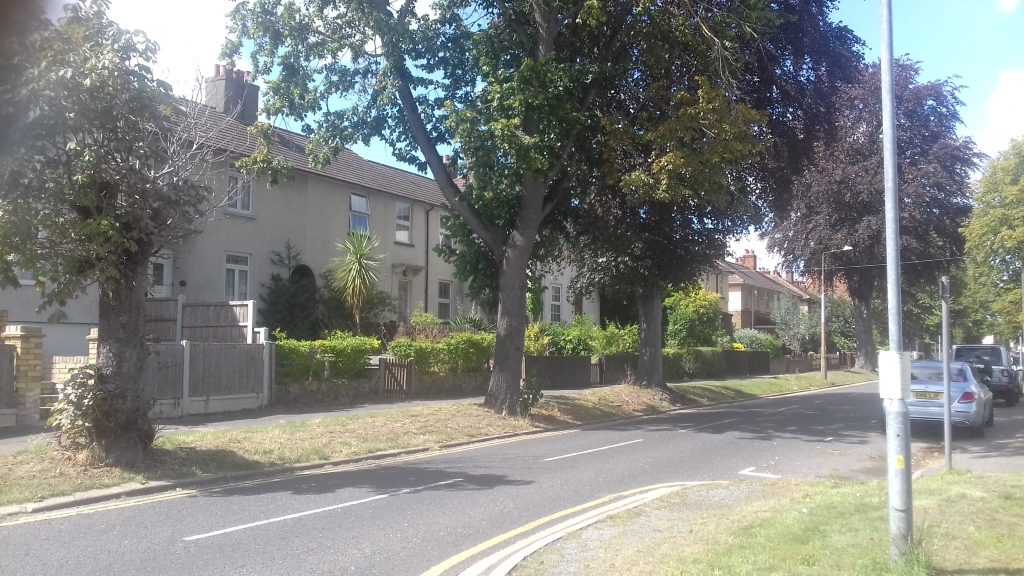
The Grays estate of over 1,000 homes pictured above was built in the mid 1920s and was one of those. I have to declare an interest at this point. I grew up on this estate. One of my great uncles knocked in the posts that laid out the road plan. My Dad was born on it in 1930, my mum moved to it as a toddler; and they still live there now at the age of 93.

These were standard designed “family homes” with three bedrooms – a big one, a middle sized one and a little one, a bit like the Three Bears. There was an outside toilet for each house – not shared like they would have been in a tenement, a small front garden and a more substantial allotment out the back for people to grow vegetables, like nearly everyone did at first, and, in some cases, keep chickens, as some still did as late as the 1960s. Early on, nearly every one had substantial posts for washing lines, many acquired one way or another via the docks; many of them, like ours, former ships masts. Nearly everyone did washing on a Monday and there was almost a competition to get the washing up on the lines first; almost like flying a flag.
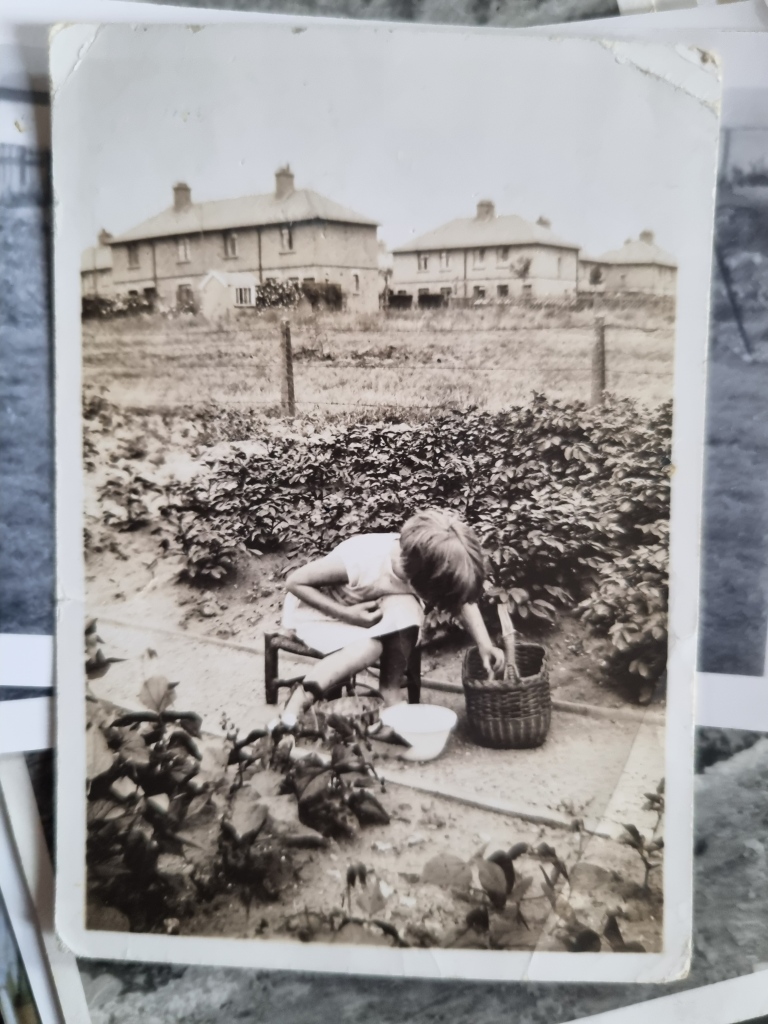
My Mum as a child shelling peas in the back garden of her parents house, circa 1936 or 7.

Smack in the middle of the estate was a recreation field with a small set of children’s play equipment in the North Eastern corner. Until after WW2 the influence of Sabbatarianism meant that every Sunday a Council employee would clank through the field wreathed in chains “like Marley’s ghost”, as my dad put it, and chain up the swings and merry go round; so the Sabbath would not be defiled by the satanic influence of children having fun. And, although there was one off licence in a small parade of shops, grocers, chippie, Co-op, post office, there was no pub. This may have been because the Old High Street down by the river – and easily in staggering distance -was full of them, but it gave the place a sober character; no one reeling home singing after closing time.

Built long before mass car ownership, the streets gave access to van or horse and cart delivery for the coal merchants – as heating was from coal fires – and groceries. Each road was bordered by a grass verge planted with trees at regular intervals, with every other tree a flowering variety like Horse Chestnut. This arrangement is still intact in places, as in the picture above. In the picture below more than half of the trees have been cut down, and the grass verges have been paved over in the last 30 or 40 years to provide parking bays for cars; which makes the streets feel more bare, less nurturing. This goes along with privet hedges being grubbed out and either replaced with fences or left open so paved over front gardens can provide space to park even more cars.
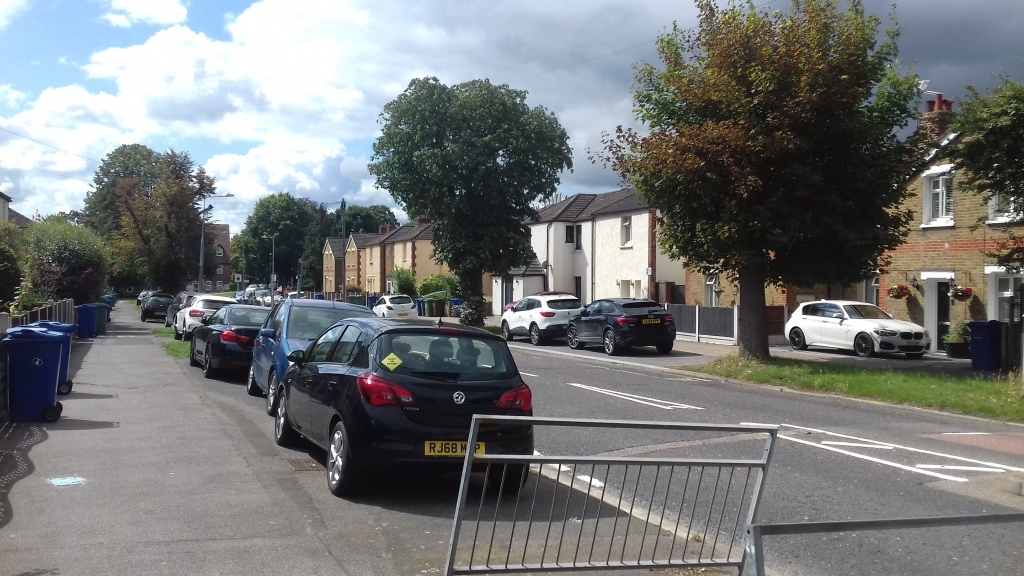
This coincided with the impact of Right to Buy. In 1979, the Council had upgraded the whole estate, remodelling both floors in each house to build in (two) inside toilets, open up the kitchens and take out the pantry storage spaces that had been superseded by most people having fridges by then. This was done by decanting tenants into other, similar houses while the work took place, block by block, on a standard model using economies of scale. It was a triumph of social provision. Paradoxically, this made the upgraded houses a very desirable purchase when the Thatcher government went on its “Property Owning Democracy” drive in the early 80s. As houses were sold off, with no right for the Council to use the proceeds to replace the stock, little marks of difference started to appear. Different front doors or windows. The occasional column. Some stone cladding. A little lion on a gatepost.

This did not have the desired political effect. The ward this estate is in has always – always– returned Labour councillors; and still does, by some margin. Not that it was ever politically homogenous. Even in the sixties, when the whole area was industrial working class and the Labour vote was weighed as much as counted, there were clearly identifiable Tories here and there – having the Daily Express delivered, wearing blazers with silver buttons, putting Pirate Radio Station stickers in their car rear windows (while looking like the sort of people who wouldn’t listen to them in a million years). During the 2017 election, when Thurrock was a three way marginal between Labour, Conservative and UKIP, a walk through this estate turned up so many Labour posters and garden stakes that it looked like a shoo in for Polly Billington. In the end, she came second, 500 votes behind the Conservative and a little ahead of the Kipper. Close run thing, but indicative the widely polarised political character of different localities in the same Constituency.
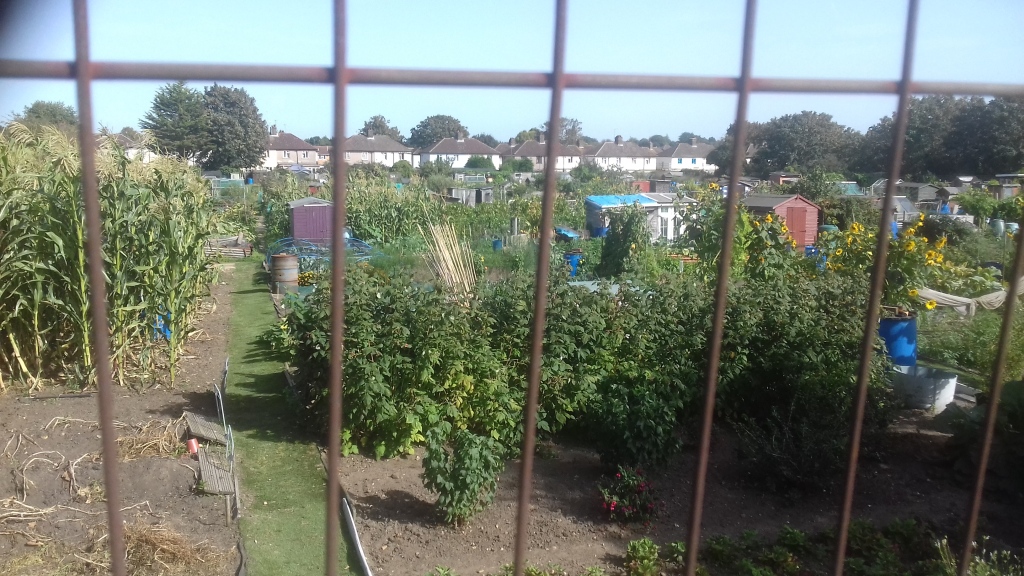
This estate was, and is, also buttressed by allotments that are still well used. This is a view from Hogg Lane, with Chafford Hundred, the alternative universe viewed below, behind and out of sight on the other side.

A final point to note is that a substantial minority of the houses have been enveloped with insulation and look oddly fatter and, being painted white, almost continental. Its not clear how many of these are remaining social housing and how many are those that have been bought. But it is clear here as well as in most other streets you can walk down in the UK that most people with limited wealth at the lower end of the “home owning democracy” can’t afford to make the changes that are socially necessary as individuals; meaning they have higher carbon emissions than they need have, and the higher bills to go with it. An eloquent demonstration of the limits of the market, and transition by piecemeal consumer choice. A wholesale retrofit doing all the houses in one go, with all the benefits of economies of scale on the same model as the 1979 refurb, would be more effective; and is another example of what neo-liberalism has cost us.

1980s: Chafford Hundred, by contrast, is almost an embodiment of what might be called Late Thatcherism. This is a huge development of 5,600 houses built on the land above the old worked out chalk pits on a derelict farm, between Hogg Lane in Grays and Lakeside by the Dartford Crossing; and is a classic piece of late 1980s urban redevelopment, named after an ancient Anglo Saxon County division that once extended from Brentwood to the river, Ongar to Childerditch. It sounds reassuringly retro with undertones of chaffinches and chaff from wheat fields. Almost rural and bucolic. An Essex echo of dreamy little towns in the Chilterns.

But, what’s in a name?

The architecture is box pastiche – standard boxes with historic local style flourishes to give “character” and instant “heritage” – all jammed together a bit too closely for privacy and ease, but too separate for community – snaking around curving roads that lead nowhere but to each other. There is no real centre to it. It feels like an American suburb shrunk to meaner English dimensions.
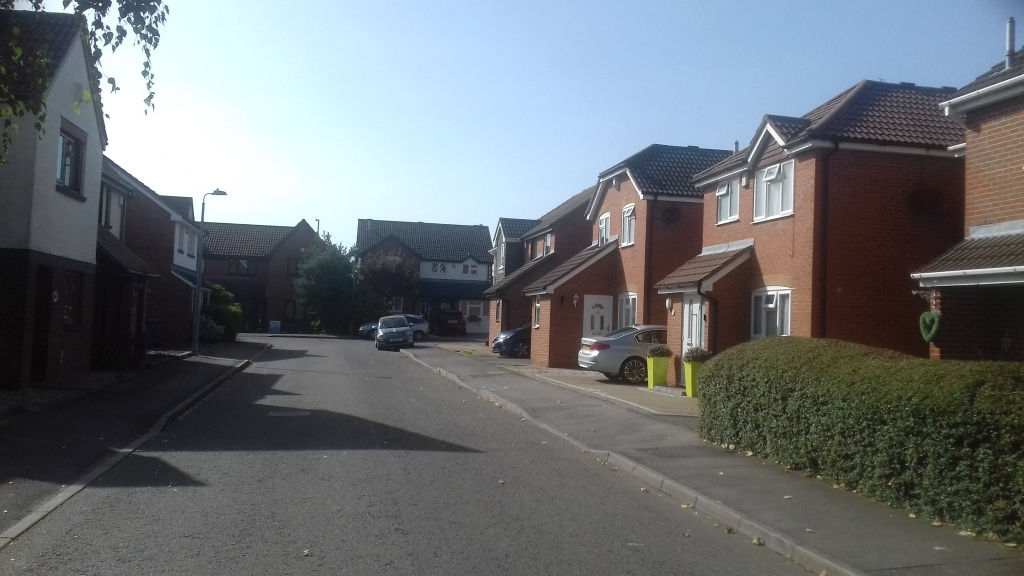
Little boxes on the hillside, Little boxes made of ticky-tacky, Little boxes, Little boxes, Little boxes all the same…

A few little shops and a doctors surgery with everything retail sucked into the enormous commercial gravitational field of the Lakeside Shopping Centre, on the far side of a foot bridge over the railway line.

There’s only one tiny park for the kids, unless they want to trek off down the pits, which have been remodelled as nature reserves, so the developer – a consortium of Blue Circle, Tunnel Holdings (the old cement firms that worked out the pits) and West Thurrock Estates – could cram on as many units as possible for sale.

Its saving grace is that is has a railway station that connects it to London (Fenchurch Street) and Southend, and everywhere en route. As a result many of the people who live there commute in to work in the City. More a place to be stored in when not working than a place to live. In the property crash of the early 90’s house prices halved and more than half the homes were repossessed; which must have been a shattering experience at the time.

Politically, Chafford was represented solidly by Tories, with Conservative councillors winning every election from 2004 to 2021, displacing the Lib Dems, who won in 2002. In May this year – after the Council’s Conservative leadership had managed to bankrupt Thurrock with unwise commercial investments – Labour won a seat there for the first time.

2020’s New Town Centre?

In the 1970s there was an attempt to boost the High Street, which at that time still had a Woolworths and Marks and Spencer, by building a small shopping mall with attached multi story car park to the rear of it. At a time when the car was still considered the future and places like Leeds were carving themselves up with urban motorways, the idea was that people would drive in, have a place to park in the multi story, and load up.

This was never fully realised even early on, the multi storey being decidedly underused, but when the Lakeside shopping centre opened 5 miles up the road by the Dartford crossing at the end of the eighties, everything shrivelled. Lakeside had big flagship stores, a wider range of everything and was not much harder to get to. Everything in the town centre moved downmarket. The vibe in the centre now, if you walk through it, is decidedly sparse. Even the Wilko has now gone.
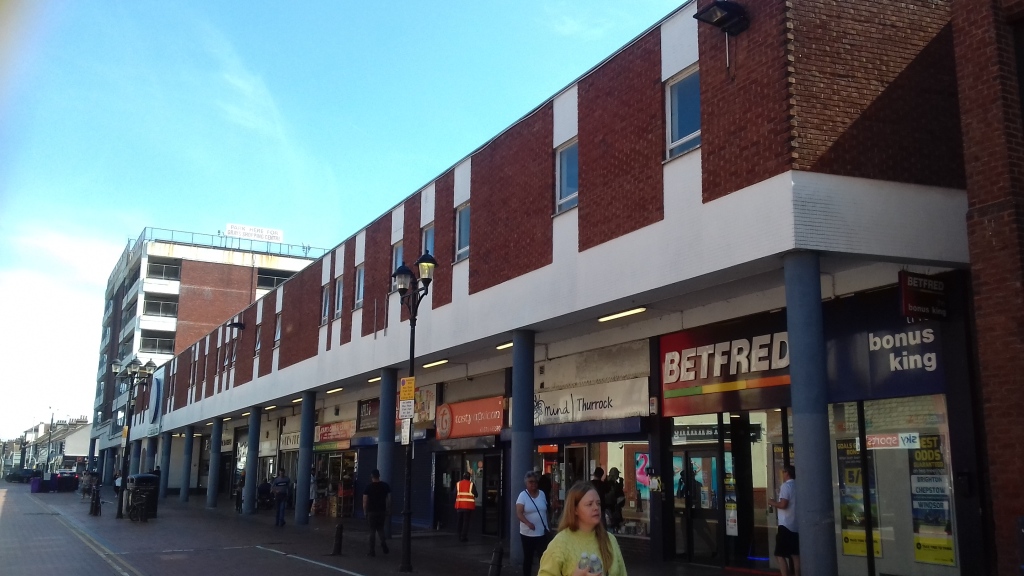
This was the future once…

So the owners, like the owners of retail space elsewhere, are looking to realise capital and build in a customer base by building high above the shop. The ongoing income from retail however, is dwarfed by the enhanced value of the real estate. Similar schemes in North West London include the Edgware Road Sainsbury development at the Hyde – that is proceeding apace -and the Broadwalk Centre in Edgware, which is generating some opposition from people used to living in a sleepy greenish suburb, suddenly about to be overshadowed by 20 storey towers.

The Grays Plan is not quite so gargantuan, but envisages, modern high rise blocks around a square. You can see an idealised version in their video here, complete with weird holograms of oddly shaped people doing strange things.

Their description of their plan has the same slightly corporate unreality as the holograms in their video.

Key features of our proposals:

  • Enhance and revitalise the town centre and public square 
  • Re-invigorate the retail and leisure offer
  • Boost the night-time and leisure economy within the town
  • Create space for community use and independent-focused retail
  • Create a vibrant and safe public realm with open spaces and increase biodiversity in the heart of town
  • Bring forward new homes in an accessible and sustainable central location
  • Improve pedestrian connectivity across the town
  • Introduce design-led, landscaped spaces for the whole community 
  • Facilitate pedestrian linkages with the Thameside neighbourhood 
  • Support the creation of new jobs and opportunities

All this is currently being discussed and I think the apposite questions are these. So, I have sent them in, and await a reply.

  1. How many people, roughly, do you envisage will be living in the development?
  2. What proportion of the development will be social housing for affordable rent? If there are any, will these be of the same quality as the rest of the development and integrated into it?
  3. Related to that, what proportion of the apartments will be for sale at what sort of prices?
  4. Will there be a residence requirement to avoid people buying higher end flats as an investment and leaving them empty (as is far too common in London).
  5. What does the proposed “space for community use” consist of? Will the public square be public or will it be privately owned?
  6. How will the development increase the biodiversity of the town centre?
  7. Will the apartments be zero emission ?
  8. I note that you say that, given the proximity to good public transport links, many people will have no need of a car but, if enough of the flats are high end, most of the people who live in them would probably want one, especially for leisure use. Would you consider building a car share club into the development to minimise the amount of space needed for car parking – and help pull the residents together into a community?

The developers will probably want as many expensive flats as they can get, which will build in a well heeled consumer base above the remaining retail space on the ground floor and maximise their revenues from sales. But this will be in a tension with the pressing housing need in a fast growing borough, with people spilling into it from London in a very steady stream* looking for somewhere more affordable to buy or rent. How this tension works out will determine what this development becomes.

*The ONS used to produce a migration flow maps for local authorities – sadly discontinued after 2020, which showed that when people leave Thurrock they go all over the place, but nearly everyone who moves into it does so from London.

I remember this when it was all fields… What kind of housing and where?

Recent contrasting visions of housing development from Michael Gove and Lisa Nandy pose some questions about what kind of homes we want to live in, where we build them, in what kind of communities, with what level of facilities, what standards they are built to (in terms of carbon emissions/sustainability size/dimensions and quality) who builds them and how (and what their motivation is) who owns them and is responsible for upkeep?

There is a consensus between both major Parties that “home ownership” is an aspiration and a good thing in itself. This presumes

  • an atomised pattern of housing that is presumed to be for individuals or families acting as consumers first, members of a community second*.
  • that those individuals or families are in a position to afford to buy and them maintain them: which is increasingly not the case. Go for a walk around an average suburb and you find a lot of houses in a bad state of repair, with owners unable even to “keep up appearances”.

A market not simply determined by demand exceeding supply – but also massively distorted by the intervention of finance capital seeking assets, and doing so by bumping up land prices to an astronomical extent – requires house prices to stay high, but mortgages to be sufficiently affordable not to cause a crisis. What happened in new developments like Chafford Hundred in Essex during the property crisis in the early 90s, when a slump in prices combined with increases in interest rates and half the properties in the area were repossessed, is a stark warning of what can happen when the market fails – as it must when prices get overheated, as they now are. The attempt by the Bank of England to cut inflation by raising interest rates, thereby paradoxically raising the price of staying in your house if you have a mortgage, is heading in that direction.

This points to a paradox. With a growing population unable to find somewhere affordable to live, with two thirds of childless single adults aged between 20 and 34 still living with their parents, a trend that rose by a third between 2010 and 2020, its generally agreed that the UK is 4.3 million homes short. Hence the pressure on both potential governments to have a plan to build a lot more of them. But, if a lot more of them are built, there is a downward pressure on prices. And a lot of property investment relies on them staying high.

This is putting the market above people’s needs and wants.

Ask almost anyone what they want and its a place to live that’s affordable, spacious enough to spread out in without feeling squeezed, solidly built so there are not a lot of costs in maintaining it, well insulated so energy bills can be kept low, with access to green spaces (if not a garden, then a local park, grass verges and street trees, maybe allotments) and amenities within walking distance and decent transport links. If construction is determined by the market and the demands of developers, the homes that meet and exceed these standards will be for the people who can afford them the most; places like the Welborne development in Hampshire. Homes for the rest of us, for sale or rent, will be poky, crammed together, built with corners cut and materials skimped on.

Gove’s announcement, counterposing dense brownfield urban development to “concreting over the green belt” aims to hit two targets at once.

  • Defuse the nimby reaction in leafy Tory rural seats that put paid to previous Tory housing growth targets after they lost the Chesham and Amersham by election to the Liberal Democrats in 2021.
  • Allow population growth to be housed by keeping it urban; so that existing city facilities don’t have to be replicated in new developments, thereby cutting costs.

If done properly, this should implement 15/20 minute neighbourhoods, which is easier to do in cities; and this should be a cross Party consensus. A dense local population provides demand for shops and services and keeps them viable. There are so many cafes and bakeries in Paris because there are seven storeys of apartments built above them full of people who will be popping in and out for a baguette or expresso. This also, however, has to be combined with integrated town planning that takes account of transport needs – ensuring public transport links and pedestrian/cyclist priority to inhibit space gobbling cars – and green spaces; so the dense population has air to breath and space to share and regenerate its soul.

Gove’s approach is a bit more Wild West and desperate than that.

Part of it is a “make do and mend” set of proposals on buildings conversion that relax the criteria for permitted development rights. As this would be market led and carried out in the interests of developers and landlords, it is likely to see a rash of glorified living cupboards being shoved into old office developments by inserting ticky tacky partition walls. This would be a triumph for the same entrepreneurial spirit that has already led to people living in partly converted garages and family homes carved up into tiny flatlets, but with more of an official nod and a wink.

This could be a further step towards shanty towns, or new suburban slums, accelerating the downward slide we are already seeing in many areas. The absence of space and proper cooking facilities in Homes in Multiple Occupation is a boon for fast food outlets; but also leads to a tsunami of litter and infestations of rats and foxes happy to fatten up on the half eaten chicken wings that alienated people dump in the streets.

We should also bear in mind, when listening to Gove wax lyrical about beautiful architecture uplifting the human spirit, that Conservative MPs voted down Labour proposals that private rented homes should be “fit for human habitation”. Presumably they think that people who can’t afford to live anywhere other than an unventilated room with a bed and Belling in it should just see the black mould on their walls as a motivation to make better lifestyle choices; or, perhaps, that anyone living in places unfit for human habitation do not deserve to be classified as human.

This was not received well.

The Local Government Association noted that “expanding permitted development rights risks creating poor quality residential environments that negatively impact people’s health and wellbeing, as well as a lack of affordable housing or suitable infrastructure.”

Shelter said that “Converting takeaways and shops into homes and restricting building to city centres won’t help. It could risk creating poor quality, unsafe homes that cause more harm than good” and instead the government “should put its money where its mouth is and get on with building a new generation of social homes.”

Moreover, property consultancy Knight Frank’s said the plans are “unlikely to have meaningful impact on housing supply”.

The exception to an insistence on city brownfield sites is “Garden Villages”. Gove rhapsodises about Welborne as an example of these. Semi rural middle class enclaves which look as though they are designed to cement a population of Conservative voters into Blue Wall seats.

Welborne, is a 6,000 home development between Southampton and Portsmouth, that will be built over 30 years with a £2billion price tag. It has self consciously retro architecture, with a limited range of design styles that is almost regimental. Look at the images of how they imagine it on their website and there’s something eery about it. A replica of an imagined past; with the same monstrous quality as if a contemporary composer were to write in exactly the same style as Haydn. No matter how good it was, it would still sound wrong; out of time and out of place. About half of the houses have chimneys as a motif (hopefully not for wood burners, which would be worse) and there is no sign of solar panels. It looks like a Homes fit for Heroes Council estate but with more generous proportions, steeper roofs and semi bowed windows – for that Georgian gentrification look – and wider grass verges; each house defended from the others by a dense wall of privet. It presents itself as a place for people who are so nostalgic for the past that they want to live in a replica of it, but with lots of mod cons. Presumably it will be possible to twitch the curtains by remote control.

Needless to say the proportion of homes that will be classified as “affordable” will start out at 10% (rising to “up to 30%”, which seems unlikely). So, 90% of the homes will be unaffordable for people on average incomes, which will define the sociology of the place and determine its character from the off. They might as well have a sign reading “No Riff Raff” on the approach roads.

And it will be roads. Connections to anywhere else will be via a new Junction on the M27 that is a confirmed part of the development. The possibility of a rail link is at a more exploratory stage, though essential if a vision of green streets designed to facilitate walking and cycling internally is not to be fatally undermined by a need to have a car to get anywhere else. The images on the site have nice mature tree lined streets with relatively few parking bays. How this would stand up to the pressure of frustrated, and well heeled, car owners demanding a place to park can only be imagined.

This is at conception stage. Garden villages that have actually been built have been described as “Amazon deserts”. Sparsely served with amenities, so nowhere to go or meet people locally, socially isolating, dependent on cars to get anywhere that has anything worth getting or doing. Places to store people when they are not working, or while they are, if doing so remotely. Exactly the opposite of what we need.

Lisa Nandy, for Labour, proposes to

  • Restore centrally determined local housing targets and make it mandatory for LAs to have housing plans.
  • Organise new construction through Local Development Corporations.
  • Build on the green belt -and make it easier to reclassify agricultural land to build on it.
  • Shift balance in renting so social housing is more common than private renting.
  • make house building central to Labour’s investment plans.

This poses a number of questions.

What standards will these homes be built to?

Building anything now that is not zero carbon emissions is storing up an expensive retrofit job for the future. If these homes are not part of the proposed £28 billion annual green transition investment they become part of the problem. Apply proper standards and they are part of the solution.

  • Will they have solar panels and heat pumps fitted as standard?
  • Will they be designed to be properly insulated to keep cool in summer and warm in winter without too much use of energy?
  • What specification will there be for design(s) to minimise construction waste and recycle unused material from one site to another?
  • What specification will there be for minimum spaces/facilities per person, so that total numbers are not inflated by building lots of small units.
  • Will any sophisticated control technology be designed to be as simple as possible to operate?

Will they be built in communities?

  • What local commercial, social and community facilities will be required to make any development viable on the 15 minute model?
  • Will the transport infrastructure require affordable, regular and reliable public transport links to larger centres with streets designed around people not parking spaces?
  • Will there be car clubs so the flexibility of occasional car use does not require the – personal and social -burden of owning one?

How will they be built and who will build them?

  • If Councils have the responsibility to develop the local housing plans to meet the local housing targets, will there be a mandated target that most of them will be social housing at the highest standards (as above) at genuinely affordable rents? The imperative to squeeze out the deplorably neglectful and chaotic private rented sector clashes here with Nandy and Starmer’s obsession with the “dream of home ownership”. The notion that inequality is best dealt with by means of “aspirational social mobility” up a structure that remains increasingly unequal, rather than actually reducing inequality was never viable, but in the Anthropocene is an absurdity. Building a massive new wave of Council Housing at genuinely affordable rents would be the best solution to meet people’s needs. This is crucial, alongside scrapping “right to buy” because housing associations have become developers rather than social landlords and council estates contain a mix of tenures because of it. Many of the houses or flats where tenants have exercised the right to buy are now owned by developers or large-scale private landlords who invariably charge much higher rents than councils. This will only stop when renting socially is restored as a good thing in itself, and no longer denigrated as just safety net for people who can’t afford to buy. Affordable social renting also allows geographical mobility. There are streets, even towns, where people are stuck with deteriorating properties and no work to pay for improving them, unable to afford to go anywhere else or to sell house that as no-one wants. To deal with a similar situation in the 1970s Housing Improvement Areas were introduced and the local state stepped in, took over these streets through Compulsory Purchase Orders, improved them and then rented them.
  • This relates to who will build these homes. The best way to do it would be Local Authority Direct Labour Organisations, with a unionised workforce on decent terms and conditions, proper training through FE College hubs (including a climate module to develop a sense of mission) and an option for workers building new Council Homes to take up a tenancy after working for six months. When this was done in New Towns like Stevenage, it had a knock on effect of greater civic engagement after it was built. This is in contrast to the sense of resentment that comes off luxury housing construction sites; where workers are putting up places to live (or invest in as an absentee owner) that are so far beyond their wages that it can’t help generate a profound alienation. If this work is contracted out to developers, as it is at the moment, their imperative to maximise profit will determine everything else; and all other goals will be subordinated. Developers prioritise the latter. they are building profits first and homes a long way second.
  • Which relates to the question of who will be on the Local Development Corporations and who will have the whip hand? Will there be community and trade union representation or will it primarily give developers quasi state powers? It has to be said that Gove aims to develop outer East London using an LDC to override the powers of the London Mayor and any local accountability at all, building Docklands 2 down through Thamesmead, a linear riverside development (on a flood plain) that when first envisaged in the late 80s was referred to as Heselgrad.
  • There is an additional problem with leaving developers in the driving seat, which is that if the private housing market begins to collapse, as it is now, developers will stall developments as they fear they won’t be able to sell; then any ‘affordable’ social rented property that is part of it will also be stalled because they are tied together.
  • We should note that the current definition of ‘affordable’ requires a minimum income of about £80,000, especially if through shared ownership, more than double the average UK income of £38,000 pa. Council rents, are the only level that is genuinely ‘affordable’.

What parts of the green belt will be built on; and is it necessary?

  • Nandy usually refers to brownfield sites within the green belt, disused garages and so on, but by making it easier to reclassify agricultural land, its clear enough that a wider range of places is envisaged. So this poses all the questions above about standards, community facilities and public transport links.
  • However, there are over 35,000 empty properties just in London and 100,000 around the country that could be CPO’d by local authorities, and this could limit the extent of any need to build on the Green Belt. In London in particular, many of the luxury flat developments built in the last decade or so along the Thames are empty because they are bought by finance capital as investments. In Kensington and Chelsea one in eight homes is long term unoccupied and one in three in the City of London. It is scandalous that they are lying empty when it takes hundreds of thousands of pounds and 80 tonnes of CO2 to construct a new house. So, CPO first, new build second would save time, money and resources; in the case of London about a year’s worth of new builds.

Will Labour stand up to the developers?

  • Developers will want new build first, subsidies, the minimum of demands and the maximum profit.
  • In recent years, they have pushed back hard against net zero standards on grounds of cost – and the Cameron government caved in to them. They are now campaigning hard against a demand from Natural England that they take into account the impact of new developments on water tables, and look like they are going to get away that too.
  • They will do so again. Building homes to the standards we need will cut into their bottom line, or cost more. They will argue that targets can only be met if standards are relaxed. In the same way that Harold Macmillan built a record number of houses in the late 50s by relaxing the standard size expectation for each unit. Architectural shrinkflation.

The signs in this are not good. Labour’s overall approach to business was summarised by an unnamed executive in a long report in the Evening Standard (25/7/23) as “the plan is clearly ‘don’t force us into loads of new rules by your behaviour. Sort it out yourselves, make some money, then we’ll take the tax to pay health and education’.”

In building its a starting point that there will have to be “loads of new rules” if we don’t want to replicate what we’ve had up to now.

*With 36% of households being single individuals in Scotland and 30% in England and Wales the scope for the exploration of more shared accommodation to cut costs (all round) and loneliness should be much more on the agenda than it is.