An open letter to Alastair Campbell

Dear Alastair,

As an intelligent man and seasoned journalist, as well as one who was as close to the centre of political power in the UK as anyone ever gets – and indeed as a specialist in the management of news – you will have weighed every word of your open letter to Jeremy Corbyn very carefully.

You end it with a plea for him to consider the message rather than dismiss it because of the identity of the messenger. This is a common theme of late, but you will know that the identity of messengers is a relevant aspect of responding to the message. Who are they, what is their overall view, and what axes do they tend to grind, whose interests are they representing, why are they choosing to send this particular message at this time and what effect is it likely to have, are just six questions that come to mind. So, the message and the messenger tend to be inextricably linked; as I’m sure you would concede, if you reflect on your own practice as a spin doctor for Tony Blair.

But, for the sake of utmost clarity, lets look at the message you sent. I will take your points in order.

“Britain is in a moment of peril” facing the prospect of a no deal Brexit, with Boris Johnson as Prime Minister, but “I see no sign that you…have grasped the seriousness of what is happening, let alone devised a strategy to respond and defeat it.” This is very odd. Labour has always opposed no deal. It has voted against it in Parliament consistently. Jeremy Corbyn is currently on the stump around the country holding rallies opposing it. He says he opposes it in every TV interview. Labour stands for a people’s vote on no deal or any deal Johnson can get – though – with his current provocations on the Irish backstop – its obvious he isn’t trying to get one. Labour, uniquely, seeks to unite all those who oppose no deal, both those who favour remaining in the EU and those who favour leaving the political structures but retaining membership of the customs union and single market. The reason for this is that Labour’s position is based on defending the living standards of the majority of the UK population – not limited and polarising notions of “identity” . Labour is not just about the 48% versus the 50%, it is about the 99% vs the 1%. If the country is facing an “existential crisis” it is clearly in the interests of the 1% to try to define all politics in relation to the 48:52, however paralysing that turns out to be.*

Labour’s stance has the advantage of not lumping people who favour a soft Brexit in with the no dealers as an undifferentiated mass of “leavers”; which allows the latter to increasingly hoover them up as a tribal hinterland who just haven’t become full true believers yet. You seem to disregard this risk, which is helping the no dealers towards a majority. Most people in this country want to get on with their lives, do not live in a political bubble, do not write or read letters like this, and could live with any number of political variations as long as their lives are not thrown into chaos by adventurist politicians.

This position is quite clear to me. I can only conclude that you can’t see it because you either haven’t looked, or don’t want to see. It also strikes me as very odd indeed that your response to an existential crisis for the country caused because its government has been captured by a dangerous faction, is to launch an attack on the only political party that could possibly form an alternative government. It is, of course, par for the course for every institution that supports the status quo to drown out any policies that appeal to people on the basis of their class interest; thereby making the identity discourse the only show in town. Although I take you at your word that you have only discussed this issue with close family and friends, it is consistent with articles in the Guardian at the weekend by Jonathan Freedland and Jonathan Powell, arguing for Corbyn to go and Labour to join some sort of “centre” regroupment with no political definition other than remaining in the EU. This is essentially pickling the politics and economics of the 2010 – 15 coalition in aspic and presenting it as a solution; when it helped set up the “left behind” component of the leave vote in the first place.

You argue that if Johnson were to hold a recall referendum between No deal and Remain, Remain would win. Labour agrees and would campaign for Remain were that to happen – as you know. Remaining concerned about Labour’s position on this must take a real act of will.

You then say that Johnson is likely to opt for an early general election because he thinks he can win. If that is indeed your view, isn’t the logical thing to do to support and back up the only Party able to form an alternative government rather than attack it? Taking a fatalistic attitude that current opinion polls are the last word on possible results did not work out too well for Theresa May in 2017 did it?

As a journalist who learned his trade in the pre-digital era, you will be familiar with the phrase “today’s news is tomorrow’s chip paper.” The same applies to conventional political wisdoms. Given how quickly the bad news is already piling up – bad receptions for Johnson in his tours of Wales and Scotland – described by the BBC as “bumpy” – a sharp drop, already, in the value of the pound, the CBI warning against no deal and commenting that preparations for it are as desperate as filling sandbags in a flood – you might save the bedroom but you’ll lose the kitchen – and even that Johnson’s poll bounce is entirely at the expense of the Brexit Party – its quite possible that one of the only things that might save the government and their hard Brexit project are these gratuitous attacks on the opposition from people who should be concentrating all their fire on the government.

It as if the existential crisis of the country takes a back seat to overthrowing the Labour leadership. Fatalistic phrases (“the country may have decided…” on any current analysis..”) – especially when used to obscure a preference – could be fatal here; not so much for Labour but for the prospect of actually stopping no deal.

You say that you have spent “several weeks trying without success to have explained to me the process under which I was expelled for voting Liberal Democrat in the European elections.” I think most of the readers of that sentence will be able to work that one out; and it wouldn’t take them several weeks to do so.

LBJ once remarked that he kept J Edgar Hoover on as Director of the FBI because he preferred to have him “in the tent pissing out, rather than outside the tent pissing in.” Labour is a big tent, but I’m sure you recognise that being inside it pissing in is not a reasonable or acceptable position.

You say that the Party no longer represents your “values”. Quite a number of people will read that with a sigh of relief. The sort of values that allowed you to distort reality to sell participation the war in Iraq, in which hundreds of thousands of people were killed, is not something that sits comfortably with Party members today. Praise be for that.  But you say you want a Party and leadership that stands up for the many not the few and for that to be clearly spelled out. These are Labour’s campaigning pledges. Which of these can you not accept? Which do not represent your “hopes for Britain”?

  1. Increased funding for the NHS with more nurses and doctors to give patients the care they need.
  2. A Real Living Wage of £10 an hour and no increase in Income Tax or National Insurance for 95% of people.
  3. A Green Industrial Revolution creating 400,000 jobs.
  4. Free school meals for all primary school children and reduced class sizes for all 5, 6 and 7 year olds.
  5. Keep the Winter Fuel Allowance, free TV licences and bus passes for pensioners.
  6. A public vote on any Brexit deal. Labour will campaign to Remain against No Deal or a bad Tory deal. 

We will be fighting Boris Johnson – and Nigel Farage – tooth and nail – in Parliament and out. We will put a motion of no confidence when we can win it, not play games with it like the Liberal Democrats. You say that you are unsure who you are going to vote for in the next General Election, but you know that the only practical governmental alternative to Boris Johnson is Labour. Choosing this moment to try to engender a split must be music to his ears.

*For a fuller exploration of this argument see Mike Wongsam – Brexit and the progress of Jeremy Corbyn in Transform 6.


Freeports – giving up control .

Fresh in his job as Conservative Party Chairman in the the new kamikazi Brexit government, James Cleverly announced on Radio 4 that they have plans for 6 “free ports” to get up and running once the UK is “freed” from the obligations of EU membership. By the end of the week Liz Truss had upped this to ten.

This makes clear what their intentions are and undermines any claims by Johnson that it will be possible to maintain good relations with “our friends in Europe” once these are in place.

Despite their rhetoric about “Brussels red tape”, they know that if they want to sell goods into the EU they have to meet EU standards. There’s no getting around that even if they wanted to go on a path of cutting costs and corners on quality to go for a cheap and nasty strategy; at least so far as selling into Europe is concerned. Companies that concentrate on the rest of the world could, however, find a niche for shoddy goods if their costs were low enough.  How far they have to go to make the workers of this country poor enough so their costs are low enough to compete with qualitatively poorer countries is an experiment they will no doubt be keen to try out.

Cleverly argued that setting up free ports would “bring money into the exchequer.” This is odd; because the whole point of them is that companies using them do not have to pay domestic taxes or customs duties; leading to a direct loss of revenue compared with now. The only logic would be that, faced with a UK outside the EU market, international capital will need some serious incentives to even consider investing here.

A “free port” is a classic third world development strategy for countries desperate to attract footloose capital, any capital, by slashing taxes and regulations to zero (or near as dammit) within them. They have also been adopted in the United States, as US capital seeks to withdraw itself from any financial obligations to the society that sustains it. A Free Port is a place in which the writ of the investor runs more than that of the elected government. They will have taken back control from the people. “Democracy” will kneel before them with its begging bowl out. It is a direct abdication of sovereignty. Far from “controlling our own laws” we would be giving them up to footloose multi nationals – who take from everywhere and have obligations nowhere.

The big claims being made for them should be taken with a shovel full of salt. The Centre for Cities Report* on Enterprise Zones – on which Freeports are modeled, points out the following issues.

  1. Over optimistic job creation predictions Estimates cited alongside Johnson’s announcement claim that Freeports will add £12 billion to the economy and create 150,000 jobs. Just as, in 2011, the Treasury claimed that enterprise zones would create 54,000 private jobs by 2015. They didn’t. In fact between 2012 and 2017 the zones had created just 13,500 sustainable private sector jobs.
  2. Hype about the type of jobs.  95 per cent of these 13,500 jobs were lower skilled, so the zones have not provided the answer for areas wanting to shift their economy from lower-skilled to higher-skilled economies.
  3. Displacement Of all the jobs in enterprise zones in 2017 that were not there in 2012, at least one third moved from elsewhere.

Full report here.  https://www.centreforcities.org/blog/why-free-ports-do-not-hold-the-answer-to-job-creation-in-a-post-brexit-world/

This displacement means that places without this special status are being set up to shrink and shrivel from a lack of investment, further reducing revenue to the exchequer. The consequence would be a creeping expansion of zero taxation regimes to as many manufacturing or trading areas trying to compete by offering further incentives.

EU regulations forbid Free Ports, so, as this is aimed at attracting investment from countries in the EU that expect companies to pay their fair share of tax, this would aggravate relations with them.

The domestic “benefits” of such ports accrue mostly to landowners within them. It remains to be seen how far regulations safeguarding workers rights will also be slashed in this desperate race to the bottom.

How low can we go? Quite a bit further if we let them get away with it.


There and back again. Pakistan 1992 – Part 1. Getting there by Aeroflot.

In Pakistan it is said that PIA – the initials of the national airline – stand either for “Perhaps I’ll arrive” or “Please Inform Allah.” We went one better than that and traveled by Aeroflot. This was in the first flush of post Soviet gangster capitalism in which life expectancy in Russia was falling to 57 (for men) and Aeroflot’s aircraft were falling out of the sky almost as rapidly.

“Vy did you come so late?” huffed a squat, fierce eyed Aeroflot official, who looked like she was taking a break from putting shots for the Red Army; her eyes arched and nose quivering. “Traffic” we lied smoothly, so as not to slow ourselves down even more and satisfy a giant ego in a tiny uniform.

Russian pilots wear enormous hats to show how important they are.

The inside of the airport looked like a 1930s cinema with no screen. The plane itself was comfortingly big and looked sturdy and no nonsense. Decorated throughout in brown formica. Style by committee. Worn, carpet backed seats had seat numbers on the backs. That meant that most of the first time Aeroflot travelers used to western airlines sat in the seat behind the one they were meant to be in; leading to a lot of confusion and flustered hostesses; exasperated beyond measure because this happened so often and they didn’t seem to have worked out why.

In 1992 Aeroflot found it hard to cope with vegetarians. The iron trolleys clunked down the aisles like a convoy of T72s, pushed by a hostess who looked like Meryl Streep with a sneer. We asked for vegetarian meals and she looked startled and disgruntled – as though this was the final straw. She pulled out a napkin with a list of seat numbers, waved it under our noses and muttered – “I only haf TEN meals – you are not HERE” and that – as far as she was concerned – was that. We explained that we had definitely booked them and her colleague – a plump baby faced guy with a gentle demeanor under a pile of curly blond hair leaned over coaxingly – “Vould you like Feesh?” – presumably on the basis that meat is murder but fish is justifiable homicide. Puzzled that we wouldn’t, he wandered away promising to try to sort something out in the fullness of time, with a Micawber like faith that something would turn up. Wandering back later in his amiable way – possibly having put this problem into the “leave them long enough and they’ll put up with it” box – we asked him again. He frowned, remembered vaguely, waved a finger to denote that all things come to those who wait and drifted off to the galley – where one unclaimed veggie meal sat resplendent in green eco tinfoil. He presented it to us with the graceful apology of one of nature’s gentlemen and we shared it.

It turned out quite tasty, despite the rather grey appearance of the baby sweetcorn. Everything was enhanced – potentially- by Aeroflot mustard. This stuff was a real nose blaster – a coarse oral dynamite that exploded its way from the taste buds to tingling nasal extremities with a terrifyingly rapid inevitability; making each mouthful an exciting and dangerous challenge. Very good for colds. Highly recommended.

Moscow Airport

Midnight. Minus 8 degrees. Misty. A few pale lights. Heavy snow. An articulated truck with a bus on the back drove emptily by. A hyper modern terminal needing a good clean. Tall brown columns holding up the roof looked like giant toilet roll tubes. Hard face guards in furry hats.

A shuttered enclave of feverish capitalism in a cold climate; a toehold of speculative trading – a levis shop, duty free booze and perfumes, and the heart of the place, a brightly signposted “Irish Bar”, a replica Dublin pub complete with Guinness and Shamrocks, shiny wooden bar and beer pumps but neither soul nor craic and, of course, closed.

A seed of the reborn Russian spiv imperialism that was the best that Yeltsin and Gaidar could offer was embodied in the flinty faced woman at the all night hard currency cafe who asked for £1.70 for a (disgustingly watery) cup of instant coffee (6 times what you’d have paid for it in London at the time) then offered to pour it into two glasses so we wouldn’t steal the cup in revenge.

People were sleeping in doorways all round the terminal. An island of souls in transit from here to there or back again, never making contact with the Russia outside this oddly dispiriting bubble of a place.

The toilets had neither seats nor paper.  Graffitti in English read – “This toilet is made of total crap”.

Outside, in a flurry of light winter snowdrifts and eddies and shifting air currents, snow was softly, gently burying newly arrived aircraft and the runway in thick drifts like icing on a wedding cake.

Inside, a leading member of the SWP and his partner drifted past with incongruous familiarity amid fierce denunciation of someone’s deviations – “and that article he wrote was disgusting!”

On to Karachi

Before we could get into the air again they had to blast the snow off the wings, and they did. This had settled several inches thick and they had to use a hose on a mobile gantry. Completely routine. Going on all over the airport with a calm efficiency. In a climate like that, all engineering had to be seriously heavy duty and watching it work was a wonder.

On the plane, the hostesses had their own solution to the usual seat confusion. “Sit where you like – its free seats.”

Opposite us, a thick set blond youth was fidgety with exhaustion. He kept putting his feet up onto the seat in front – forcing it sharply forwards so the bloke sitting in it got upset, turned round a swore at him. So, he tried plan B and laid down in the aisle, forcing people to step over him. After enough of them had stepped on him instead, he tried Plan C, leaning his head awkwardly onto his food tray; causing the bloke in front to recline his seat and squash him. So, he sat up and pushed back and the bloke in front turned round and hit him. We wondered whether he was on something.

We dozed fitfully though the early hours until woken by a flood of white light through all the windows. It was like light from another dimension. Not the soft, washed out water colour light back home, it was a light so bright it was almost an assault; so many stages higher on the path to heaven.

Down below, the pock marked desert; a baked and crumbling moon landscape, brown and khaki, utterly arid, breaking into the jumbled sprawl of Karachi – shanty town shoved against shanty town, punctuated by clusters of higher flats and offices, all bleached white in the light and crushed up together with more shanties squeezed into every available space.


Why is Labour accused of antisemitism and the Conservatives not?

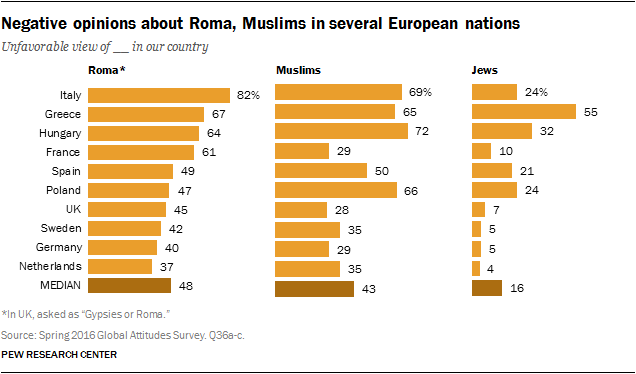
In any political conflict there is a tendency for heat to obscure light. Statistics quoted in a body of text are often not absorbed. So what follows is an attempt to set out the facts graphically and provide some interpretation which shows how they differ from misleading popular perceptions.

  1. According to Pew Research antisemitism in the UK is very low; both as compared with the median level in Europe and as compared with the national level of Islamophobia and anti Roma sentiment. This does not mean that it is not happening nor that it is not deep rooted in some quarters.
Negative opinions about Roma, Muslims in several European nations

2. Research carried out by MORI on behalf of Jewish Policy Research indicates that strong antisemitic sentiments were very low from the far left right across the political spectrum until you get to the far right; at which point it almost quadruples.

JPR’s central argument – that there is a direct correlation between antisemitic attitudes and hostility to Israel – is undermined by their own survey. This shows that there is indeed a direct correlation between antisemitism and hostility to Israel on the far right – where the figure overlap almost exactly – and almost complete disjunct on the far left – where there is significant hostility to Israel but almost no corresponding level of antisemitism. It would be hard to argue from these figures that the direct correlation between antisemitism on the right and hostility to Israel is not indeed a reflection of overall racism on the right; nor that the lack of such an overlap on the left can reflect anything another than  an anti racist position – which defends Jewish and other ethnic minority communities domestically – and extends this to the human rights of Palestinians in Israel.

antisemitism.PNG

3. Surveys carried out by the Campaign Against Antisemitism have shown that there is more of a problem with antisemitic attitudes among supporters of the Conservative Party than the Labour Party (Figures as original).

4. This is born out by research from The National Centre for Social Research which shows a very welcome overall decline in racist attitudes overall, that these are less commonplace among Labour supporters than those of other parties and, crucially, that these have declined very sharply since Jeremy Corbyn was elected leader of the Labour Party. It is worth noting that racism rose across the board after 2001, reflecting the “war on terror” and everything that went with it, and that racist attitudes are almost TWICE as prevalent among supporters of the Conservative Party than they are among Labour supporters.

5. It is also the case that it is the Conservative Party that has links at a European level with dubious Parties and movements that either deny or belittle the holocaust or celebrate the participation of their citizens in the Waffen SS. This was detailed in an article by Jonathan Freedland in 2009 in which he asked “where is the outrage?” An appropriate question.

https://www.theguardian.com/commentisfree/2009/oct/20/conservatives-european-allies-holocaust-deniers

It is reported on Wikipedia that Jewish organisations quite rightly complained about these links to the Conservative Party in 2018. There have been, however, no marches on Conservative central office, no “enough is enough” placards, no weekly headlines in the Jewish Chronicle targeting them, no declarations of an existential threat. Instead, the greater incidence of antisemitism within the Conservative Party and right generally has been ignored in a single minded focus on making out that Labour has much more of a problem that it does – to the extent that the popular perception is now the inverse of reality.

The figures for Labour are quite revealing when you look at them graphically.

Figure 6. Number of Labour Party members accused of antisemitism as a proportion of the membership.

The ratio of 1:817 (1106 cases out of 550 000) is so small that the number of accused (the thin blue line) barely shows up on the graph.

accusationsgraph

Moreover,  4 in 10 of those accused turned out not to be Party members in the first place. Of the cases referred by Margaret Hodge, only 20 out of 200 were actually Party members.

Further, of the remainder, more than half had their cases dismissed for lack of evidence. Only 1 in 10 of those accused have either been expelled or resigned. Some of those who have been accused or expelled are Jewish.

Three dissonant shirts

A woman walks past in a mass produced T-shirt that reads “Dare to be Different.”

Another – with a red and angry face – is decked out in a purple shirt with the word LOVE in enormous letters.

A third on the bus, whose “Choose Cheerful” shirt does not make her smile.

This is not to denigrate the women wearing these, but simply to point out that the constant pressure to “be positive”, “keep calm and carry on”, “keep smiling” is a way of normalising the unbearable in a way that can make it worse. the impact of what might be called “compulsory happiness” regimes in workplaces creates a tension between outward appearance and inward feeling that destroys people’s souls.

Bumping into Members of Parliament

On the fringes of the Rally called by the Labour Party in Parliament Square to launch the summer campaign to dethrone Boris Johnson and, just after his big black motorcade has nosed past us like a mini me version of Trump’s, his brother, the tall, slim, cool one with the humour bypass, resplendent in a bright blue suit, strolls through the clusters of Labour members gathered underneath the statues of Millicent Fawcett and Nelson Mandela. One of our possible GLA candidates gleefully gives him an earful about how embarrassing it must be to have such a racist brother and he gives her a cold stare as though she is something he has just trodden in – that frown and wrinkled lip and sneer of cold command*. Further on he is ambushed for a selfie by a member with a sense of humour and they pose briefly together under the unfortunate statue of General Smuts.
Last Saturday I walked past Tom Watson on a traffic island on the Bayswater Road; heading into Kensington Gardens with a subdued and anoraked young woman in tow. His face was blank, transparently unreadable in a poker faced fugue – working out his next political move while his legs worked on auto pilot.
In April I found myself standing behind Frank Field on the escalator at Euston. He had the hooded eyes and pursed mouth of a man who distrusts his own flesh- tightly wound into himself – a neat, elderly medieval monk in tweed.
Last summer on the platform at Westminster tube I came across Grant Shapps – a walking alias – an aging youth, tieless in an expensive camel overcoat – talking on a mobile phone as though he were arranging a liaison, or a hit, and knowing he could get away with it.
At Kings Cross last month I ran into John Prescott – actually ran in to him – as I made haste to get out of a car on the Victoria line (having been absorbed in reading and forgetting where I was and what I was doing) just as he ran on; so we collided in the doorway. Both of us instinctively moved to the left to avoid more damage. He didn’t look happy but no punches were thrown, or – this being the tube – words spoken.
*Shelley – Ozymandias

Where Tom Watson goes wrong part 2. Venezuela.

Just after the turn of the century I read an article in the Washington Post that quoted a State Department report on a crisis in – I think – South East Asia. I then read a statement from the (Labour) UK Foreign Secretary at the time which expressed the UK’s stance on the same issue using almost identical language and some of the same turns of phrase. This cutting and pasting illustrates the point that the dominant current in the Labour Party has often been as supinely Atlanticist as the Conservatives, especially in government. What made this shocking was that the Foreign Secretary concerned was Robin Cook, a man with more principles than most, who at least held out the prospect of an ethical foreign policy as an aspiration.

Getting up the arse of the White House and staying there was an indelicate turn of phrase from Tony Blair, but could be taken as a constant of Labour leadership policy from Gaitskell onwards – with Labour’s opposition to the Suez adventure completely in line with the policy of the Eisenhower White House – albeit with the odd wobble from Harold Wilson keeping my generation out of the Vietnam war (thank you Harold) to Neil Kinnock’s briefly heretical gestures on Nicaragua during the 1980’s and Ed Miliband’s resistance to intervention in Syria (resisted of course by a substantial part of the PLP keen to “do our bit”). The UK has, nevertheless, taken part in virtually every US intervention – Iraq, Yugoslavia, Afghanistan, Iraq (again), and in Libya worked with the French as US proxies- as a matter of national consensus whatever the composition of the government – with only the Labour left awkward squad coming out against in Parliament – sometimes – and increasingly – representing the majority view in society.

Arguments for all these interventions have depended heavily on the notion of the West as a defender of human rights; but the human cost of each of them has been dreadful of course. Three to five million people displaced in Iraq alone and estimates of deaths that range from 98 000 to nearly a million.

I had the same sensation that the text I was reading was a routine palimpsest of someone else’s words when reading the section on Venezuela in Tom Watson’s letter to Labour Party members this week. This was odd in several respects. The tone was ringing rhetoric, not at all the slightly rambly meander that we are used to from Tom: drawing out the detailed bye ways of some aspect of domestic policy that particularly obsesses him. This makes his letters interesting in places where he has genuine expertise but all to often rather inconsequential; as titanic questions like climate change only just peep above his horizons.

Since I have been getting his letters, Tom’s attention very rarely raises to anything beyond the domestic agenda. This may be because, for him, matters of foreign policy outside of Europe are simply a matter of cutting and pasting US State Department press releases; and therefore an area in which an lack of attention is almost required. If you accept the dictates of the Pax Americana – even under Trump – as a given – there really is little point in paying attention to it. Its almost above your place. Until it comes under threat; and at that point Tom will jump to attention and do his bit for it. Of course, one of the threats to it is the leadership of his own Party.

If you look at Tom Watson’s voting record between 2003 and the present day he voted FOR UK military interventions six times (against twice and absent three times) FOR the Iraq war five times (absent once) and FOR an investigation into the Iraq war once – and AGAINST fourteen times. His stance is clear. The casualties involved do not appear to make him squeamish. No doubt he would do it again.

Jeremy Corbyn represents a different kind of socialist tradition, which has hitherto been a very small minority in the UK Labour movement – that sees its alliances in seeking to transform the relations of domestic wealth and power as bound up with other movements and countries internationally that are seeking to do the same. The crisis for traditional Labour currents – like that represented by Tom – is that they have preset limits on the extent to which they are prepared to challenge the powers that be.

Blair’s “Third Way” perception was that a Labour government could only come about if it explicitly did NOT make any challenge to people ” getting filthy rich” – let alone those who already were. This was only possible at a particular moment in UK politics – when the USA’s unipolar moment coincided with rapid globalisation and continuing oil revenues allowing a superficial modernisation on social issues while leaving archaic institutions, imbalances and failings substantially intact. From the 2008 crash that tradition has run into the sand across Europe; and is either facing electoral oblivion after participating in pro austerity coalitions and/or serious challenge to its left. In the UK, the capitulation of the old leaderships to austerity means that the awkward squad now leads the Party – but the defenders of the old order are fighting tooth and nail to save it for the outmoded politics they represent – and if that means destroying it, so be it.

Tom has used an extraordinarily biased report for the UN from former Chilean President Michelle Bachelet on the current crisis in Venezuela and framed it as an attack on international solidarity. “Do not defend the indefensible because someone decides for you that it is socialism.”  Quite so, so lets not skid along the rhetoric, lets make a serious analysis of what is and is not defensible and make our own minds up about what is socialist and what is not.

First, a matter of style. Tom takes a BBC report as evidence but, in his own account, removes all the conditional words that indicate that an inaccurate picture may be being painted. Words like “allegations”, and phrases like “may indicate” are removed from Tom’s account the better to stoke indignation. Accuracy is not a consideration here. Given the way the intelligence services were caught out “sexing up” the “dodgy dossier” you’d think Tom might be a bit more cautious. He does not mention that the Venezuelan government has pointed out 70 factual errors in the draft report, arising from its authors having ignored most of the evidence gathered inside the country or submitted by anyone other than the opposition; relying instead on unverified allegations from opposition supporters in exile – who are responsible for 82% of the statements in the report – none of which are independently corroborated.* Far be it from them to have an axe to grind. These are people who demonstrated with the slogan “Bomb us – we have oil too” so a shovel full of salt might be in order. A more accurate way to talk about this would be to say that the Venezuelan opposition accuses the government of all sorts of dire things and the government denies it.

The same method – of giving credence to opposition allegations while dismissing those of government supporters – was also used in reports from Amnesty and International Human Rights Watch. Why they would produce such a politically biased account is a question for them. The background is that they operate in an international human rights framework in which the US and its allies affect the position of international moral arbiters while ensuring immunity for themselves, their secret services and black ops agents, torturers and armed forces. No US personnel will ever be put on trial in the Hague. Civis Americanus sum. Human rights organisations compete for funds in a world in which the ten main sources are all US Trusts with a particular view of the world+. Any organisation that wants to survive as a viable enterprise has to tailor its view to theirs even if, like Amnesty, they are primarily funded by individual donations. For an assessment of Amnesty’s reports on Venezuela see here. https://venezuelanalysis.com/analysis/14357

You would think from reading Tom Watson’s account that Venezuela had not, since the election of Hugo Chavez in 1999, transformed aspects of Venezuelan society as a conscious attempt to build a 21st century socialism in a way that most Labour supporters would want to defend. Tom sneers about a “socialist paradise”. No one would claim that, but they have done the following in very difficult circumstances.

  • extended education to all and eliminated adult illiteracy – building new schools and universities and giving out 4.8 million computers to students to carry their whole learning course from nursery to university
  • extended health care – free at the point of use – to all areas – building clinics in the barrios
  • provided aid and free or cheap oil to countries in the Caribbean suffering from natural disasters or unnatural economic pressure from the United States ($1.3 billion direct aid and $359 million debt forgiveness to Haiti after the 2010 earthquake for example – between double to three times the $650 million that came from the whole of the EU).
  • cleared slums and built two and a half million new homes (for free or very low rent) towards a target of 5 million by 2025, and they are still building
  • passed laws against gender, racial and age discrimination and boosted participation by women and the ethnic majorities at every level in society
  • vested Venezuela’s natural resources in the Venezuelan people
  • generated popular participation in all these missions and projects, so the poorest sections of society that have befitted most from them are also integrally involved in their design and running
  • presided over a sharp increase in the number of people registered to vote – up from about 75% in the 1990s to 96% today (from 11 million to 19 million).

Nor in Tom’s account is there any reflection that Chavez and his successor Nicolas Maduro have won every Presidential election from 1998 to the most recent one in 2018 – in which Maduro won 67.8% of the vote to his nearest rival’s 20.9%, Venezuelan elections use a system described in 2012 by former US President Jimmy Carter in unambiguous terms; “the election process in Venezuela is the best in the world”.

Nor does Tom seem to notice that, since 2014, Venezuela has been subject to sanctions from the United States that are designed to overturn the results of these democratic elections – after an attempted coup in 2002 failed. Kissinger’s injunction to “make the economy scream” applied to the Allende government in Chile in the early 1970’s is being applied to Venezuela today. After all, as Kissinger explained then, “I don’t see why we need to stand by and watch a country go communist due to the irresponsibility of its own people”. These sanctions have been supported by a coalition of wealthy developed countries (principally Canada and the EU) and US client regimes in Latin America, but spurned by the rest of the world. Not just Russia and China – but everyone else. The effect of these sanctions – on top of a drop in world oil prices that has slashed Venezuela’s annual revenue from $43.9 billion in 2014 to $5.918 billion in 2017 – has been crippling for the Venezuelan economy, but only partly the desired political effect. Support for the Venezuelan Socialist Party has declined but remains substantial and still outnumbers the opposition, especially in the poorer areas where people know and fear what a US led regime would do to them. Latin American has enough experience of this for people to know.

Tom also appears not to have noticed that the man in charge of the US operation in Venezuela is Elliott Abrams. This is a man with form. He was in charge of Central American operations for Ronald Reagan in the 1970s; which involved support for Contra terrorists in Nicaragua (financed by illegal arms for oil deals with Iran) building up the death squads in El Salvador – whose modus operandi included the sorts of horrific murders currently associated with ISIS or Mexican drug cartels; perhaps a clue as to where both got their ideas from – and supporting the Guatemalan government of General Rios Montt – whose campaign against the Maya in Yucatan led him to being tried for crimes against humanity and genocide just before his death in 2017. A question for Tom. What do you think a Venezuelan regime installed at the behest of this bloke would look like – and what do you think it would do to the Venezuelan working class if it took power?

Tom really should be aware that a Center for Economic and Policy Research report co-authored by economists Jeffrey Sachs and Mark Weisbrot, states that US sanctions have deprived Venezuela of billions of dollars needed to pay for essential food and medicine, leading to a rise in disease and mortality and the displacement of millions. This has disproportionately harmed the poorest and most vulnerable Venezuelans resulting in 40,000 deaths and a 31% rise in general mortality from 2017 to 2018. 40,000. Tom somehow misses this.

By late 2018 more than 300,000 people were at risk due to lack of access to medicines or treatment; including 80,000 people with HIV  16,000 people who need dialysis, 16,000 people with cancer, and 4 million with diabetes and hypertension unable to obtain insulin or cardiovascular medicine. As a former diabetes sufferer you might think that Tom would have more empathy. Instead he describes anyone that points to the responsibility of the Unites States and its supporters for this suffering as “cynics”. Oh to be so innocent.

Tom argues that “Democratic Socialism requires consent”. This is interesting on two counts. Firstly, the sort of socialism being developed in Venezuela requires not consent but participation. So will any attempt to seriously transform the UK through Labour’s investment plans and Green Industrial Revolution. Secondly, the implication of Tom’s argument is that the Venezuelan government does not have consent from its people because there is a violent and racist US supported opposition, primarily drawn for the wealthy elite who formerly ran the country and kept hold of its benefits for themselves. These are taken by Tom to be “the people”. He ignores not only successive election results in which more of “the people” have voted for the government than the opposition, but also very large recent demonstrations supporting it. His caricature of a government ruling by fear over a cowed people is belied by these shows of support. Its fair to say that the impact of the economic crisis has reduced the support that the government has, but the opposition vote has not grown; which says quite a lot about the limits of their appeal. Overthrowing the government will also mean crushing its supporters. There is no neutrality in this. When there is a conflict, anyone who stands aside is consenting to the victory of the power with the greatest force.

So, withdrawal of support from Venezuela by our Party or our unions would be a green light for a US intervention of the sort that Tom has voted for elsewhere in the world; and would, no doubt, have a similar result; with human rights as much a consideration as they were in the Fallujah free fire zone or in Abu Ghraib.

Tom says that the people of Venezuela “deserve a future that they consent to and can forge together.” Quite so. Support for the opposition won’t achieve that. A peaceful and democratic way out of the crisis requires, on the contrary, the mass support that the government has to be taken into account, the opposition to abandon attempts at coups, a dialogue between government and opposition (consistently offered by the government) an end to US sanctions and no further attempts to violently overthrow a democratically elected government from inside or outside the country.

Hopefully all democratic socialists can agree on that.


*https://www.venezuelasolidarity.co.uk/wp-content/uploads/2019/07/Reply-to-Bachelet-report-5-July-20197424.pdf

+

Top Ten Funders of Human Rights Projects Worldwide

1. Open Society Foundations – $261.1m

2. Ford Foundation – $171.1m

3. National Endowment for Democracy – $105.7m

4. W.K. Kellogg Foundation – $59.2m

5. Oak Foundation – $40m

6. Atlantic Philanthropies – $39m

7. Arcus Foundation – $36.6m

8. Vanguard Charitable Endowment Foundation – $32.9m

9. Bill & Melinda Gates Foundation – $31.4m

10. Susan Thompson Buffett Foundation –  – $28.5m

One of Ours?

Having just read a book about the Battle of Britain (by James Holland, younger brother of the better known and more controversial Tom) I have been looking up more nervously than usual whenever a helicopter flies overhead.

Holland is one of those World War 2 historians who focuses entirely on the struggle in the West- the wrong end of the telescope perspective characteristic of the British view. His six dream dinner guests (in a Daily Telegraph article in 2012) – Errol Flynn, Field Marshal Alexander, Cecil Beeton, Keith Miller (cricketer and Mosquito pilot) Ingrid Bergman (primarily to gaze at) and Guy Gibson (the Dambuster) – gives something of a clue as to where he is coming from; as does a curious passage in which he describes Hitler’s aversion to “Jewish Bolshevism” without the inverted commas.

Nevertheless, there are some interesting insights in his account which challenges a lot of received wisdom about 1940: particularly the central myth that Germany had an overwhelming advantage in numbers and material and Britain was simply a democratic North European island, not the centre of a global Empire with enormous reserves of power. In fact, in 1940, the Wehrmacht was less motorised overall than the British Expeditionary Force and had fewer divisions than the French army alone at the start of their offensive and even fewer tanks – and those they had were less well armed. The paradox of the Blitzkreig was not that it was a manifestation of overwhelming power, but an outrageous gamble with just enough forces to try it on that just about came off – which led the Nazi high command to think that similar absurd attempts to chance their arm would work just as well. A self mesmerising belief in their own ubermesch capacity would increasingly come unstuck as time went on. Material reality has a way of imposing itself and did so during the Battle of Britain.

Production. Losses on both sides were extreme. Of the 1,963 serviceable aircraft available to the RAF in May 1940, 1,744 were destroyed by the end of the battle, killing 1,544 air crew.  “The thing that’s always worried me about being one of the few is the way we keep on getting fewer”. Flight Officer David Campbell. The Luftwaffe started with 2,550 planes of which 1,977 were lost by the end, along with 2,585 air crew killed and another 925 captured. This was hard to replace for both sides but, during 1940, Britain produced 15,000 aircraft (about 300 planes a week) to Germany’s 10,000 (200 planes a week) and trained more pilots. The RAF repair system was also quicker than the Luftwaffe’s. So, from May to September the balance of forces was moving inexorably in one direction.

Strategic sense. The German aim was to have decisive air superiority to enable a cross channel invasion with air cover by September. Goering wanted to smash the RAFs Fighter Command in 3 or 4 days and – misled by over optimistic “intelligence” reports from Beppo Schmid (described by Anthony Beevor as “the most disastrous intelligence officer the Wehrmacht ever produced”, possibly because he’d worked out that the best way to prosper – or indeed survive – in Nazi Germany was to tell the higher ups what they wanted to hear) which underestimated RAF fighter strength by 75% at the start and never readjusted- he thought he could get away with it. Like the US army in Vietnam, mesmerised by its massive “kill” count statistics into a belief that it was winning, he kept thinking that one more big push was all that was needed to finish the job; when, in fact, the RAF was getting stronger and the Luftwaffe was getting worn out. He kept shifting priorities too, in a way that was inexplicable to a lot of his pilots – who couldn’t understand what they were expected to do. The RAF, by contrast, had a more straightforward approach – keep enough fighters in the air to grind the raiders down every time they came over and keep replacing the men and machines that were being destroyed – and stuck to it.

The tactical use the Luftwaffe made of its aircraft – within this badly thought out “strategy” – was perverse. In the ME109E they had the most effective fighter aircraft in the battle – faster than the Hurricane, on a par with the Spitfire and with a far more powerful armament. RAF fighters were seriously outgunned and had ammunition for only 15 seconds of firing – so their approach was primarily to get up high, dive, shoot and run. A ME109 had cannon as well as machine guns and could fire for 55 seconds. They were, however, hamstrung by Goering’s order to fly above the bombers at the same speed they were going – which was so slow that it was hard for the pilots not to stall their fighters. The Luftwaffe’s bombers were so slow primarily because of their High Command’s obsession with dive bombing. The Junkers 88, designed as a very fast medium bomber which could outrun a Hurricane and give a Spitfire a good race, had to be redesigned to give it a dive bombing capacity; which made it easily catchable by both. Even the huge and ungainly HE 177 – probably the ugliest bomber ever designed – which was intended to be a long range heavy bomber – had not come into production because Heinkel were still working on making it capable of diving – making the outmoded HE111 the main workhorse of the bombing offensive. Towards the end of the battle – and looking for new gimmicks – Goering settled in the wheeze of putting bombs under ME109’s – which its pilots were not trained for, slowed them down and made them more vulnerable. This genius for self sabotage reflected an aspect of Nazi thinking that believed its own myths – that victory was primarily a triumph of the will. Believe in something hard enough and reality will shape itself to match it. An idea that still resurfaces in odd places – from Noel Edmunds’s notion of “cosmic ordering” to Boris Johnson’s stance that a successful Brexit will result from “belief in Britain.”

The human factor. RAF pilots had leave. The strain of continuous flying would be relieved. Air battles were so quick that pilots lost their best friends in seconds, had to fly back, refuel and rearm and take off again. The constant adrenalin rush, fortified by Benzedrine (for the RAF) or Piratin (for the Luftwaffe) ground down the nerves of the pilots. The RAF culture was to get away from this in the evenings – and “talking shop” in the pub or dance hall was frowned upon. The Luftwaffe culture was more dour. Pilots would often sit and discuss tactics when they weren’t flying, so there was no time in which their minds weren’t on the job. Worse, they just kept flying continuously, sometimes several sorties a day, while their friends and comrades were killed around them. The phenomena of Kanalkrankheit (Channel sickness) with pilots either cracking up or pulling a sickie, became increasingly prevalent as September dragged on. A lesson for managements everywhere. Workers need breaks to function.

The underlying point of all this is that Nazi Germany – with an over leveraged and under resourced economy – was only capable of winning short, fast wars and – once it had started – was compelled to keep trying to do so until they bit off more than they could chew in Operation Barbarossa. The Battle of Britain, in wearing out their air force in a long battle of attrition, was a small harbinger of how their entire war machine was to be ground to total destruction by the Red Army after 1941. As Hitler commented to Finnish dictator Mannerheim in 1943 – surfacing from his barbiturates in a moment of realism and lucidity and seeing the writing on the wall – “who would have thought any country could produce 3,000 tanks a month?”


It’s cricket Jim, but not as we know it.

In my local barbers. a tiny shed of a place next to a juice bar, tucked inside a mini mall carved out of an old shoe shop. “Cricket” is on the radio as the barber – a quiet Asian guy who massages my head at the end by knocking it about a bit – buzzes over with the number 2 clippers and my head re-emerges one haircut more lined. The one day world championship roars in the background. The commentary and the crowd are both raucous urging the big hitters to hit big under intense time pressure. Everything rushed, exciting and frenetic. A game that imposes its action not one that draws you in. All over and wrapped up in no time. As I got up I nodded at the radio and said “not the same game as a test match is it?”

In the summer of 1975 I was employed to pick fruit on a farm some miles south of York. It was hot and boring and a couple of other workers brought portable radios to lighten our load with Radio 1’s summer playlist; consisting as it did primarily of the Bay City Rollers and “Woah! I’m going to Barbados” by Typically Tropical played several times an hour.

After a while, around 11 in the morning, someone turned their dial across to Radio 3 to catch the Ashes Test between England and Australia and landed in the middle of an arcane discussion between two of the commentators about the science of swinging a ball in moist conditions; occasioned by a letter from a professor at Cambridge arguing that it was contrary to the laws of physics to do so, even though all fast bowlers did it. This was a different and more intriguing world than anything that could be offered by David Hamilton or Dave Lee Travis.

After a while, others switch over and there is nothing in the wind louder than the snick of leather on willow, Brian Johnstone’s plummy voice rhapsodising over someone’s kind gift of a chocolate cake for afternoon tea and the then youthful Henry Blofeld* name checking the occasional passing bus and flock of pigeons; and the sense of an extraordinary spaciousness in the game…”and there is no run…”

Knowing that we were settled in for a five day ritual, played outside, during an English summer in which infinitely minute changes in the weather – the light, the wind, the moisture in the air, the dampness or dryness of the field or the wicket – could and did affect how the game was played; and even whether it could be played at all. Commentary about an approaching bank of cloud was pertinent factor that we knew the players were taking into account in their multi layered calculations of where they were and what they needed to do.

Each ball in each 6 ball over was a tight battle of wits between bowler and batsmen. For the bowler. whether to bowl over or around the wicket, which length to pitch at, what speed to bowl at, whether there were any spin or bounce in the wicket, how old the ball was, where to place the fielders, how to tempt a batsman into a rash shot. For the batsman, the need to calculate whether a ball needed to be hit, had to be hit and which could be flicked through a gap – all the while taking account of his own score, with the approach to centuries and half centuries especially being a nervous time, the precariousness or safety of the innings and the time left to find the runs they needed. At times a spell of assured bowling would stall the runs and a succession of maiden overs (with no runs scored) would put all the pressure on the batsmen.

The tension of this, and the release of it one way or another when the tiredness of a bowler or a slight shift in the weather allows a batsman to knock a boundary or two and suddenly the field is having to change to hold off the fours and the batsmen can start sneaking singles; or a frustrated batsman takes a risk on a ball he should have left and is snaffled up by the slips – meaning a new batsman has to come in and take time to find his eye and rhythm.

The long periods of apparent stasis punctuated by sudden euphoric shifts in fortune are all hedged around with a poetic language of field placings as reassuring and obscure as the shipping forecast and sounding a bit like long lost country villages- the gully – the slips – deep mid wicket- silly mid off – long leg; and arcane rituals worthy of Gormenghast – like the tradition of the Umpire standing on one leg whenever the score reached 111; considered very unlucky because it looks like a wicket with the bales knocked off, and known as a “Nelson” because at the end of his life Admiral Nelson supposedly had one arm, one eye and one ball.

Even during the days when play was stopped for rain, no one switched back to Radio 1. We listened to the endless stream of anecdotes and speculation as though we were cramming the lore of the game to make up for all the lost time we’d wasted while we were ignoring it.

CLR James – in Beyond a Boundary – argued that cricket was an attempt by an unpoetic people to encapsulate and codify the infinite. A one day match has its moments, but does not begin to approach this.

Post script. Having listened to the end of the ODI world cup final all I can say is that although this version of the game does not have eternity, it definitely has its moments.

*The commentators were, almost to a man, almost cartoon like public school, dyed in the wool Conservatives; often having a moan that England couldn’t play test matches against Apartheid South Africa because of “politics” and so completely absorbed in their own world that it was hard to think they could imagine any others. Even Fred Trueman’s turn from 1974 onwards as permanently grumpy working class Yorkshireman – in more recent years reprised by Geoffrey Boycott as a sort of continuity tribute act –  was absorbed and tolerated for its backward looking disgust at the declining standards of English cricket – taken as a metaphor for the declining status of the country. John Arlott was an exception, a man of broad human sympathies, whose commentary was as poetic as it was informative.