- the impact of coronavirus on Denmark has been much lower. 93 deaths per million to date, compared to the UK’s 511. (1) That looks like this.

- There were a relatively manageable 170 new infections and 10 deaths in Denmark on the date schools began to reopen (2) partly because they had closed down earlier in the cycle, whereas in the UK the infection and death rates are still running very high – with 3560 new infections on 15 May and 384 deaths (3). On a per capita basis that works out at 28 new infections per million in Denmark and 54 per million in the UK; 1.66 deaths per million in Denmark and 5.86 per million in the UK.

- The assumption that this will reduce automatically to manageable levels in two weeks time does not take account the impact of the easing of the lockdown which has taken place in the last week.
- In fact, the infection rate (R) in Denmark initially went up from 0.6 to 0.9 in the two weeks following the reopening of schools, which could be taken as a warning. The other measures in place have since enabled that to reduce; so these would also have to be in place here to get a comparable result.
- In Denmark there was also complete openness about the science, precautionary projections of potential infection rates – assuming that children spread the virus at the same rate as adults, rather than resting reopening on a hope that they don’t – and an engagement with teachers unions. All of these are what the education unions are asking for in the UK too.
- The easing of the relatively weak lockdown in force in the UK – which reduced deaths by about half as compared with the continental normal of 60-70% -until last Sunday’s announcement from Boris Johnson that workers “should be encouraged” to return to work has already led to an increase in the infection rate from a range of 0.5 to 0.9 to a range of 0.7 to 1. (4) In a week! When the infection rate gets to 1 and beyond it begins to run out of control again, so the government is playing with fire. Reckless is the word. They say that if it does, they will retighten. Given their tendency to just cross their fingers and whistle and hope, we can’t leave it up to them. The unions and the BMA are right to resist.
Author: urbanramblings19687496
VE Day – The Bear in the room.

With the 80th anniversary of VE Day being treated as a celebration, affirming the “glorious past” that Reform’s Andrea Jenkyns would like us to be dragged back into, and a recent YouGov survey showing
1. That a majority of people in the Uk believe that the defeat of Nazi Germany was primarily because of the efforts of the UK, with significant support from the United States and a tiny contribution from the Soviet Union; the exact reverse of what actually occured and
2. that 70% of the people surveyed think it likely that there will be another World War within the next 50 years.
its important to put the historical record straight.
The disturbing aspect of the latter point is that this is being set up with a kind of fatal fatalism. With the current Labour government’s Defence Review premised on being in a “pre war period” and this being reported without any serious questions revealing either
1 That the UK and its allies have been in a state of more or less constant war for decades, so “pre war” is hardly an appropriate phrase.
2 A state of preparing for a war with “Russia, China, Iran, North Korea” – the countries listed as “the deadly quartet” by George Robertson in the Defence Review- or all four at once, is preparing for a nuclear war. With the USA having a “first strike strategy” designed to overwhelm it targets with a wholesale nuclear assault that would not only slaughter millions in a matter of hours, it would also cause a nuclear winter that would make human life untenable on this planet thereby finishing us all off even if “successful”. This is therefore an insane course of action that anyone remotely interested in human survival should be busting every nerve to oppose.
The story that is told of World War 2 in the UK is done through local optics and has a distinct moral arc. From early hesitancy, Chamberlain and Phoney War, to survival and stand alone defiance in the face of disaster, Dunkirk, Churchill, the Battle of Britain, the Blitz and the Battle of the Atlantic, through to the turn of the tide at El Alamein, Atlanticism affirmed by the USA arriving (late but welcome) like the cavalry in a Western, D-Day, a Bridge too far, late atrocities from Doodlebugs to Belsen until the final victory with Hitler dead in his bunker.*
This was a titanic struggle and left almost half a million UK dead between 1939 and 1945. Thats about 1 in every 100 people. Most families lost someone. Mine lost 2. None of that should be downplayed. But, unfortunately viewing this war through domestic lenses means that an overall objective perspective is usually lost and distorted. Its a bit like viewing the world through a virtual reality helmet that makes everything away from the foreground almost invisible.
When I read an account of the Battle of El Alamein in The Eagle in the 1960s, it was headlined as the turning point of the war. At the end of the article was a single reference to another battle that took place at the same time in Russia called Stalingrad. But that was it. It was referenced as a relatively obscure event. And this sums up how most people here see the Eastern Front. Shrouded in mist. Probably nothing like as significant as the events “we” were involved in.
This graph shows the numbers involved in the two battles. It is quite clear which was the more decisive event.

The casualties in both battles underlines the complete imbalance between the scale of the struggles. El Alamein was an important defeat for the Axis, but Stalingrad was crushing and decisive.

And this is not an aberration or an isolated example. The German armed forces were predominantly deployed on the Eastern Front. This graph shows the deployment in 1942 when 139 of 181 Divisions were concentrated on the Russians; (2) but this was the characteristic pattern from the initial attempt at an overwhelming Blitz in Operation Barbarossa in 1941, through Stalingrad in 1942, the greatest tank battle in world history at Kursk in 1943, right through the huge Soviet offensive of Operation Bagration in 1944, at the same time as D Day, that crushed 28 out of 34 Nazi divisions, effectively destroying Army Group Centre, and on to the final Gotterdammerung of 1945.

This is reflected in the the overall casualty figures for each country; which can be quite startling when you first look at them. (3)

The scale of the loss of life in the Soviet Union stands out. UK losses were 1 in every 100 people. Soviet losses were 1 in every 7. Think about the scale of that for a moment. We should reflect on what that means about what that war was, where most of it was fought; and adjust our historical memory accordingly. For the Nazis, the war in the West was a war between colonising powers, the war in the East was a war of extermination against Untermensch. A very good way to get a fuller grasp of this and the sheer scale of the Soviet resistance to it, is to read Vasily Grossman’s epic novel Stalingrad (the Twentieth Century’s answer to War and Peace). It was the Red Army who broke the back of the Wehrmacht and therefore of the Nazi regime; and we should give respect where it is due.
*This narrative is bolstered by annual commemorations and a huge output of books, films, TV series, from documentaries to comedies. I wrote the first version this with the BBC News D Day output in full flight behind me. At one time The Great Escape was shown so often at Xmas that a greetings card was produced showing a motor cyclist in the distance with mountains behind him and the legend “This year Steve McQueen will make it over the wire.” So World War 2 – even as it fades from living memory – remains a dominant touchstone of popular national culture and people are encouraged to identify themselves within the glow of its myths. And this is very potent. The Washington Post reported a few years ago that surveys of opinion in the UK showed that most people believed that World War 2 was the defining and most crucial moment in British history. The same article pointed out that surveys of opinion everywhere else in the world showed the view that this was the British Empire. The disjunct is revealing and characteristic. In every national crisis the media reach for World War 2 metaphors and play the Vera Lynne records, dust off the Churchill quotes, and we are invited to keep calm and know our place. This enables the ruling class to make any number of screw ups safe in the knowledge that anyone seeking to point out awkward truths can be painted as someone who is trying to “politicise a crisis” or, in extremis, is a “traitor”. As long as we go along with it, this locks us into an interpretation of ourselves which cements us into roles and stances defined by the social relations appropriate to late Empire, and thereby makes facing uncomfortable realities more difficult and moving beyond our limitations impossible, and gets us ready for more wars as a continuation of the same national epic. When the Queen ended her pep talk on Coronavirus with the words “We’ll meet again” perhaps the most appropriate response is “We can’t keep meeting like this.” And remembering the Bear in the room is one step in helping us to do that.
- Figures from here. https://en.wikipedia.org/wiki/Battle_of_Stalingrad https://en.wikipedia.org/wiki/Second_Battle_of_El_Alamein
- Figures from here. https://ww2-weapons.com/deployment-german-forces-1942/https://ww2-weapons.com/deployment-german-forces-1942/
- Figures from here. https://war.wikia.org/wiki/World_War_II_casualties
Wearing down the front line
😳😳😳😳😳😳😑😑😑😑
See ITV NHS Staff survey below.
If, in a life or death struggle, your front line workers are feeling like this, even though they are putting on the bravest face they can manage, you have a serious problem that you need to address.
Since warfare is the lowest common metaphor for any struggle, it should be noted that it is a commonplace of military strategy that a successful offensive – or defence come to that – is dependent not simply on soldiers being well trained and equipped, with plenty of back up in reserve and a plan flexible enough to innovate under the impact of opposition and the unexpected; it also, crucially and decisively, depends on the state of the soldiers themselves. What is their morale? How far do they trust their leaders? Have they been fed? How long have they been fighting? Have they slept. How exhausted are they? How are they coping with the deaths they have seen. How many have shot their nerves, are shell shocked, have PTSD? How worn out are they?
Its not just where they stand, what their strength is on paper. Its whether they have any strength left. This is particularly crucial if the struggle is projected to go on for a long time.
On Friday, Boris Johnson held up the UK as a positive example to other countries because our Health Service has not been overwhelmed by Coronavirus. This took some Chutzpah because on Friday 9 (and still today) the UK’s daily death rate was second only to the USA; so we are no example to anyone.
More to the point, Johnson was assuming that staff in the front line are in a position to cope for the prolonged period of partial lockdown and ‘living with the virus” that too many factions in the UK government and – worryingly, the opposition too – envisage as the “next stage’ – possibly starting as early as May 18th. A shorter, sharper campaign to eliminate the virus; with the lockdown tightened until new infections were well down and deaths in single figures took China 6 weeks across the whole country and 11 in Wuhan before there were cautious steps taken to ease off. The problem here is that our infections per capita – thanks to the complete failure to prepare and get a grip in February and early March -are massively above the worst peak in China, so even this will take us longer.
Instead, the entire debate is about how much and how fast things can be relaxed. That will mean that there is a danger of the virus rebounding. Germany – which has a much more effective testing and tracing system than anything in the UK relaxed restrictions last Monday when death rates were down to just over 1000 a day. Every day since the number of new infections rose. It had reached just over 1400 by Friday. What happens in Spain and other countries with even higher infection rates, let alone the US States that are determined to “reopen” with no safety net at all will be even more instructive.
The pressure this will put NHS staff under will be intense. it cannot be taken for granted that the line will hold. A survey of NHS staff carried out by ITV last week came up with some alarming results. Just under 6 out of every 10 workers reported feeling stressed beyond a point they could cope with (57%). 1 in 10 reported having suicidal thoughts (11%). One in 30 reported self harming (3.4%). Half report that there has been insufficient support. (1)
What this means is that NHS workers need more than claps and badges. They need PPE, respect and support from managers (and no gagging orders on telling it like it is to protect official myths); and above all a clear strategy from government to eliminate the virus, not the prospect of continual ongoing “management” of it.
Institutional racism and deaths in the front line.
“Its the National Health Service not the International Health Service.” Matt Hancock.
Charity begins at home, but solidarity, by definition, doesn’t.
The disproportionate fatality rates among BAME front line workers in the Health Service is clear and shocking (1). Matt Hancock’s assertion above, and the Conservative election leaflets promising to “protect the NHS” by limiting immigration are shown up as the mean spirited disgrace they are by the deaths of so many doctors, nurses and health care support workers who have been sent into work without adequate PPE with the same insoucient carelessness with which the Conservatives have dealt with the Grenfell fire – before and after. The figures for Doctors are particularly overwhelming.


The sheer number of Doctors and Dentists from BAME communities should be enough for those benighted sections of “the white working class” unwilling to extend solidarity beyond their own ethnicity to reflect that the “immigrants overwhelming the health service” are largely the people who are working in it and a huge proportion of the people we are clapping and cheering for every Thursday night. The horrifying number who are dying in the front line of this crisis should be something to make them show a bit of respect, if they can tear themselves away from that latest bit of online Sinophobia from Tommy Robinson.
The disproportion is even more stark for BAME Nurses and Midwives, who are 20% of the workforce but 71% of the fatalities.


And Healthcare support workers, who are 17% of the workforce and 56% of the fatalities.


Caroline Nokes MP Minister for Government Resilience and Efficiency in 2017, said this in relation to emergency preparation.
‘Resilience does not come easily but the UK has long experience. Call it what you will, but whether through the fabled ‘stiff upper lip’, ‘Blitz spirit’ or just a stubborn determination, our resilience can be seen at the forefront of our handling of emergencies.’
This is essentially an admission that they never bothered to be prepared on the basis that “British pluck” would make up for an absence of PPE stocks, testing equipment, emergency systems set up and ready to go. The savage irony of all this narcissistic nationalist mythology is that the most resilient communities in the country, those that have had to deal with the Windrush scandal and the hostile environment, are those that have also had to “take it on the chin” in the coronavirus crisis too. The old normal – that we are “all in the same boat’ but, as in the Titanic, some are in first class with access to lifeboats looking down their noses at the people in steerage without, and thinking they should be damn grateful to be on the boat at all – has carried its way through this crisis. We cannot allow it to define “the new normal” too.
Remember the dead. Remember their names (2). Fight for the living. PPE for all. No end to the lockdown without WHO conditions being applied in full.
(1) The figures in this blog come from this recent study. https://www.hsj.co.uk/exclusive-deaths-of-nhs-staff-from-covid-19-analysed/7027471.article
(2) All are listed here. https://thinklab.com/ToryFibs
Who can you trust?
The UK government’s explanation of why it has decided to stop comparing the UK’s Coronavirus infection and death rates with China’s is deeply ironic. They say that Chinese stats can’t be trusted.*
There is a more obvious explanation; that China has been very successful in keeping its death rates down while the UK has not, that this is deeply embarrassing, and becoming more so as time goes on.
This is what that looks like in deaths per million as of April 26 (1).
. 
This is significantly worse than the previous week. The Chinese figure is unchanged (on 3.3 per million) – because the virus is under control – while the US and UK figures deteriorate (from 101 to 168 per million for the US and from 206 to 305 per million for the UK) (1). This figure means that the Chinese can now start to safely reopen their economy. It is quite clear that the UK and US cannot do so safely at this level. Denial is essential to even contemplate doing so. ** Whitewashing out the discrepancy with China, is a further aspect of playing down or ignoring their experience and any lessons that could be learned from it – could be preparing the ground to do so at an unsafe level.
The trustworthiness of UK official figures is also questionable. While the daily death rate is confined to those who have died in hospital after being tested and serves a purpose in tracking trajectory, it does not include anyone who has died anywhere else; and no one in government is keen to point out that the headline figure is not the total of people who have actually died: which is considerably larger. This may be considered a sin of omission, but it nevertheless serves a purpose in downplaying how bad things actually are; another form of denial.
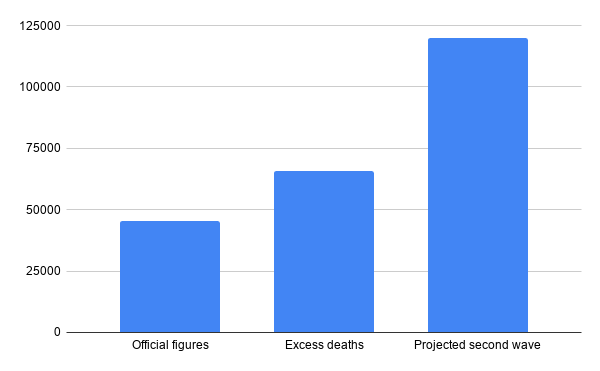
A Financial Times analysis (2) incorporating the Office for National Statistics figures on all deaths concluded that the official UK figure of 17 337 deaths up to Tuesday 21 April is less than half the actual figure. That looks like this.

*This is odd, because the WHO does trust them (as does the Financial Times; whose job it is to provide accurate information for the business class). A logical next step in this trajectory will be to downgrade relations with the WHO – which also serves a purpose in that it stubbornly insists on tighter conditions for easing lockdown’s than the UK government is prepared to contemplate. See previous blog.
**It is clear that the ground is being prepared to do this. Train operating companies are preparing to open up 80% of services by May 18th. Statements by Nicola Sturgeon and Mark Drakeford on behalf of the Scottish and Welsh governments on Friday on easing the lockdown to “live with” or “live alongside” the virus indicate that a reopening is being planned that is a response to commercial, not health, pressures. When Keir Starmer says that the UK risks being “left behind” in its consideration of “exit strategy” in the context of other countries beginning to ease restrictions, this applies pressure in precisely the wrong direction. The UK has the second highest daily death rate in the world right now. As of April 25, that looks like this.

The points he – and the rest of the Labour and trade union movement should to be making are:
1. That the only safe exit is one in which the WHO ‘s 6 conditions are met in full and
2. That the current lockdown should be tightened to include ALL non essential work; as the quickest route to an exit is through cutting off all possible routes to infection.
3. We can no more “live with” the virus than we can live with climate breakdown.
(1) https://www.statista.com/statistics/1104709/coronavirus-deaths-worldwide-per-million-inhabitants/
(2) https://www.ft.com/content/67e6a4ee-3d05-43bc-ba03-e239799fa6ab
Re-opening to the virus? How the UK government’s conditions for ending the lockdown differ from the WHO.
These are the WHO’s conditions for a safe ending to lockdowns These are very clear and are aimed at eliminating the virus.
- Disease transmission is under control
- Health systems are able to “detect, test, isolate and treat every case and trace every contact”
- Hot spot risks are minimized in vulnerable places, such as nursing homes
- Schools, workplaces and other essential places have established preventive measures
- The risk of importing new cases “can be managed”
- Communities are fully educated, engaged and empowered to live under a new normal
These are very clear and are aimed at eliminating the virus. In China, the point at which disease transmission was under control was when deaths were down to single figures.
As in China, at that point the Health system has to know where any new infection takes place and have the equipment and infrastructure to rapidly intervene, test, contact trace and isolate to prevent it getting out again. This virus is very infectious and spreads very quickly.
At that point, anyone coming in from an area where the virus is still in spate will need to be tested and quarantined if need be and all schools and workplaces will have to have the appropriate preventive measures in place and be fully equipped.
The last point is as crucial as the others. Communities have to know the risks, know the procedures and recognise that this is not a blip that will “disappear like a miracle” (D.Trump) but a threat that will still be lurking at least until a vaccine is produced – which is scheduled to take 18 months if all goes well. So, even when we are out of the woods, we could still meet a wolf; and have to be on our guard.
The UK government puts different conditions. They say
- The government must have confidence that the NHS can still provide sufficient critical care and specialist treatment across the UK.
- Secondly, there is a need to see a sustained and consistent fall in the daily death rate to be confident the UK is beyond the peak of the outbreak.
- There also must be reliable data from SAGE that the infection rate has decreased to manageable levels.
- Testing capacity and PPE must be in hand to meet supply for future demand.
- There also must not be a risk of a second peak of infection that could overwhelm the NHS.
As the words are not the same, the differences must be deliberate. While some of them sound similar, the devil is in the detail.
- Being “beyond the peak” can be any time from when death rates start to decline in a “sustained and consistent” way. It does not necessarily mean that the death or infection rate would be under control if the restrictions were lifted.
- There is no specific mention of schools or workplaces, no mention of imported cases, no mention of having to minimise the risks in vulnerable hot spots.
- There is an emphasis instead on making sure that the NHS is not overwhelmed. A laudable aim in itself, but when you consider that it is currently being achieved by pre-triage on the one hand and rapid removal of the elderly into hotspots like care homes on the other, you can see its limitations.
- There is no mention of communities being fully educated, engaged and empowered to live under a new normal, which reflects the UK’s relatively lackadaisical lockdown.
- Having infection rates at “manageable levels” does not mean the same as having them “under control.” “Under control” means on the path to elimination. Manageable means copeable with, not overwhelming.
- Avoiding the “risk of a second peak” is not the same as eliminating the virus. Their bottom line is that the second peak should not be so great as to overwhelm the NHS. That could describe the current situation. The NHS is not being overwhelmed, but the UK has the second highest daily death rate in the world.
- The phrase “testing capacity and PPE must be in hand to meet supply for future demand” implies that there is going to be a future demand. This is not the same as having a system ready and primed to “detect, test, isolate and treat every case and trace every contact”. Managing. Not eliminating.
So, we have a half way house policy here. Just as the UK “lockdown” is half a lockdown.
The danger is that there will be a return with infections at too high a level; so the rate of infection will go up again, without adequate PPE, without a testing and contact tracing system in place – with schools one of the first places to open simply to have kids taken care of during the day so the economy can “open” (in Trump’s phrase) and their mums and dads can go back to work.
This would let the genie back out of the bottle and then require restrictions to come back in to stop it running out of control. So instead of getting a grip and crushing the virus in one determined go, we end up with a reactive yo yo of restrictions going up and down; with the presumption that a vaccine will arrive like the cavalry coming over the hill. The problem with this – of course – is that it might not.
So, an apposite question for Labour (and others) to be asking is why it is that the government is not adopting the WHO guidelines without equivocation.
Lives rest on this.
Do What Works.
The per capita death rates from COVID19 are expressed here in how many deaths there have been in China, the USA and UK per million people. The figures are taken from here from 15 April.
https://www.statista.com/statistics/1104709/coronavirus-deaths-worldwide-per-million-inhabitants/
The Chinese figure has been uprated from 3 to 4.5 to reflect the backdated increase in deaths in Wuhan announced yesterday. In case the figures for the USA and UK are not clear on the graph, these are; USA 101. UK 206.
While the US response is widely and rightly seen as a mess, there is a tendency in the UK to give the government far more of a benefit of the doubt than it deserves. 
It should be clear from this that China’s experience should be studied and learned from, while the UK and US are not models to be followed.
The bottom line right now is that China did not end its lockdown until deaths were in single figures. The relaxation of social distancing now being contemplated in parts of Europe and being discussed in the UK will let the genie back out of the bottle. Disaster will follow if this course is pursued. The only safe path to an exit is through a tightened lockdown.
UK daily death stats seriously understated.
Understatement is not a charming national characteristic in this case. The Office for National Statistics (ONS) – which does a weekly update to take into account the deaths that have taken place outside hospital – has just published the following.
Our data shows that of all deaths in England and Wales that occurred up to 3 April (registered up to 11 April), 6,235 involved COVID-19 compared with the 4,093 deaths reported on 4 April 2020 by @DHSCgovuk http://ow.ly/4kHD50zdo9L
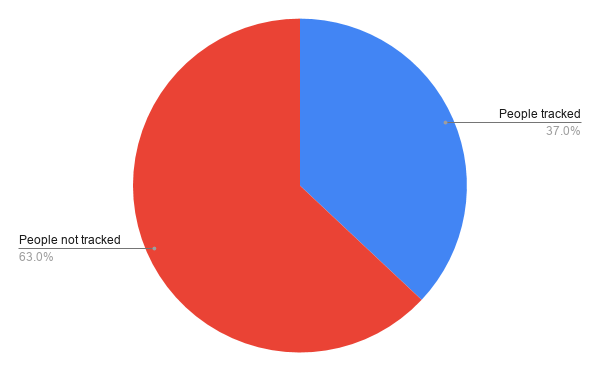
So for the week ending 3 April the total Coronavirus deaths in the UK were half as high again as those being announced by the government. 6,235. Not 4,093. That looks like this. the daily totals announced in the press briefings are just the blue part of the circle. Bear the in mind every time a new figure is announced.

While including these on a daily basis would be very difficult – and attempts to do so in France have led to wild fluctuations in daily totals that make trends harder to discern – these additional deaths should be factored in; and the provisional nature of the daily figures made clear at the daily press briefings.
With many of the most vulnerable elderly people in particular pre-triaged not to take up hospital beds and reports of significant spread of infections within Care Homes – where staff are even less likely to have proper PPE than front line medics – this gap could well grow in the next week.
The rate at which the UK and US are taking an increasing share of the daily deaths can be seen here in the FT. https://www.ft.com/coronavirus-latest.
My next post will look at these death rates per capita.
US and UK death rates stand out.

This graph shows the totals of reported global deaths for April 10th. With the usual caveats that many places in the developing world may be under reporting – the figures for the USA and UK stand out starkly. One in three of all reported deaths in the USA. One in six in the UK.
UK daily figures only include deaths in hospital, not those at home or in Care Homes; so the actual figures will be worse; probably significantly so. The Office for National Statistics will be updating these on Tuesday, so I will do another graph to take that into account then.
Three things to note.
- The number of deaths in China on 10 April was zero.
- With the UK death rate projected by the IHME (1) to hit a peak on April 17th with 1 674 deaths on that day, this is not a time to be prioritising talk of “exit strategies”.
- Those concerened with these should be studying the Chinese experience of cranking society back into life – as the only country that has began to do so an a large scale.
Death and Exits. A stronger challenge needed from Labour.
- The necessary measures to effectively suppress coronavirus cost China a 20% drop in its economy in one quarter. They were prepared to do that, did it, and we should learn from them. In doing so they averted a potential 11.5 million deaths in a few months (assuming an 80% infection rate and 1% death rate).
- The confused half measures being taken in the “West” will take longer and lead to more deaths. This graphic from the FT illustrates the impact of the different approaches used in China and the US in deaths per million.
This was from March 31st, so the Chinese bubbles will still be the same size. The US bubbles will now be significantly larger, and be even larger than that next week, and the week after. On March 31st 1550 had died in New York. By April 7th it had risen to 5489; so the New York bubble here should be just under four times as big.
- This raises a real scream of financial pain from fractions of capital who are willing to sacrifice lives to keep the system running as it is. Open or covert advocates of “herd immunity” in the UK, Presidents Trump and Bolsonaro, the Wall Street Journal, columnists in the Times and Telegraph have taken this line; sometimes with absolute swivel eyed consistency (Bolsonaro); sometimes seeming to concede one moment, only for the content of the argument to pop up again even as the label is disavowed. This account of the argument in the cabinet on this is very revealing. (1)
- We in the Labour movement have to be completely unambiguous that lives come first. Herd immunity was not “probably” wrong (2). It was wrong full stop. If allowed to “work through” the population we could have had half a million deaths – which is more than the total UK casualties in World War 2. – by the autumn. The first step to an economy designed to serve the people is not to sacrifice the people for the economy. That applies directly to any “exit strategy”.
- The best time to have taken all necessary measures to eliminate the virus was when we first knew about how dangerous it was – instead of dicking about for two months – the second best time is now. That includes the government using powers to require industry to manufacture PPE, ventilators and whatever equipment is needed to effectively expel this virus out of the population – as demanded by UNITE, UNISON, the BMA and RCN last Friday. (3) This kind of emergency measure to meet urgent human need – and over riding the imperatives of profit – is a model for reorganising the economy more broadly as companies crumble under the impact of prolonged shutdown.
- Labour should be demanding that that is what is done. The government approach here is for the state to subsidise business with no social quid pro quo; and that cannot be accepted. George Osborne – who snuffed out a mild economic recovery in 2010 with his austerity policy – was on Radio 4 yesterday arguing for the state to take “equity shares” in medium size businesses to stop them collapsing. This is a repeat of the 2008 Bank bail out – satirised at the time as “socialism for bankers”. State led investment should be just that; job creating, socially necessary and environmentally imperative measures that will allow our society to recover on a sustainable basis.
- With the UK projected to have the worst casualties in Europe as a result of the Conservative government’s approach, the Labour leadership should not give them any blank cheques in the name of “national unity”. The privilege being allowed into the room where the decisions are taken – even as spectators – is only ever extended by the Conservatives if they want someone else to become complicit in their failures and share the flak with them.
- human encroachment on wildlife habitats and the use of wild animals for food – ebola, COVID19
- and the intensification of factory farming – H1N1 Swine Flu – which emerged from gigantic (and disgusting) industrial pig farms in the US.
The wholesale overuse of antibiotics in this sort of “farming” is also a clear and present cause of the rise in anti-biotic resistance that is also a significant and growing health risk for all of us.
- The economic “Exit Strategy” Labour should argue for – once the virus has been eliminated -is for the state to regenerate the economy and employment through investment in the transition to sustainability that we need. The plan is already there in the Green Industrial Revolution which Keir Starmer pledged in his campaign would be “at the heart of everything we do” but didn’t mention at all in his victory speech.
- The proof of the pudding on this will be whether he and the Shadow cabinet COVID19 Committee make this the core of the recovery strategy and a clear line of divide with a government that will want to go back to the free market “ideology” they claim to have abandoned in a fit of bipartisan generosity; but actually because it gave no tools to deal with the Coronavirus crisis adequately and it won’t provide the tools for an effective recovery either. Dumping dosh onto companies in the hope they will use it wisely won’t work. Stating this is basic.
- We can’t afford another wasted decade like the last one. The politics of austerity treated the profit motive and private ownership as a sacred cow. Only by creating the conditions for profitable production could companies be induced to invest. It failed. They didn’t do it. Huge cash piles were not deployed or invested.
- The Tories are in government and will try this again. They will fail again at great cost to those least able to bear it.
- The climate crisis really is one that we are all in together and we can’t wait for dealing with it to become profitable in the short term.
- We have ten years to make a significant enough dent in carbon emissions that we are not toast in the medium term. If we don’t borrow from the future, there won’t be one.
- We need those wind farms, insulated homes, reforested uplands, sustainable vehicles as part of the recovery – and that won’t happen without state investment.
Labour’s job is to keep banging away at this and in no way to become complicit in the idea that dealing with climate change can wait until we have regenerated the economy as it was enough to have enough left over to make a transition with what we can “afford” over and above normal functioning. We have to recover by and through the transition if we want a future.