Boris Johnson – “the Saudi Arabia of wind”.

“The food here is terrible. Yes, and such small portions.” (1)

“Hmm. This is burnt AND undercooked.” (2)

This is Boris Johnson’s ten point plan for the Environment with comments (in italics). This “plan” is an almost random curates egg of proposals with no overall strategy – other than a series of hopeful nudges at the private sector in the hope that it will take up the slack and fill the gaps between the limited and truncated ambition and the almost laughably small commitment the government is putting in to realise it; bringing to mind the two jokes above.

“Imagine Britain when a Green Industrial Revolution has helped to level up the country.”

You might have been able to achieve this by voting Labour last December, but for now you just have to imagine.

“You cook breakfast using hydrogen power before getting in your electric car, having charged it overnight from batteries made in the Midlands. Around you the air is cleaner; trucks, trains, ships and planes run on hydrogen or synthetic fuel.”

The poverty of imagination in this vision is almost numbing. Imagine instead that you don’t need to go to work by car every day because there is effective broadband that allows you to work for home more often; nor have to pay through the nose to use a car to travel, because everything you need is within a fifteen minute walk or cycle ride; with longer journeys covered by clean, efficient electric buses, trams and trains or community car clubs. Imagine fewer vehicles and less space required for them, with car parks turned into parks with bike hangars; with a car scrappage scheme paying for travel passes and electric cycles. Imagine your home properly insulated and fueled with renewable energy – and imagine no homeless because we have built an additional 500,000 council houses to passivhaus standards. All of this is doable.


“British towns and regions — Teesside, Port Talbot, Merseyside and Mansfield — are now synonymous with green technology and jobs. This is where Britain’s ability to make hydrogen and capture carbon pioneered the decarbonisation of transport, industry and power.”

Towns and regions and cities all over the world will need to be synonymous with green jobs. This has to become a global norm. Hopefully Britain will do its bit in this global process without striking vainglorious poses about world beating systems – or Apps. CCS will be important for heavy industries but research into it has been going on for a long time without viable results – and can be a fig leaf for carrying on as normal while we wait for a technological solution that might not come. It is not a basket to put most of our eggs in.

“My 10-point plan to get there will mobilise £12bn of government investment, and potentially three times as much from the private sector, to create and support up to 250,000 green jobs.”

“Potentially” – “up to.” So, maybe not even that much. £12 billion of government investment is – frankly – peanuts – and compares pitifully with the £27 billion earmarked for expanding the road network; not to mention the sums being pledged by comparable countries in Europe.
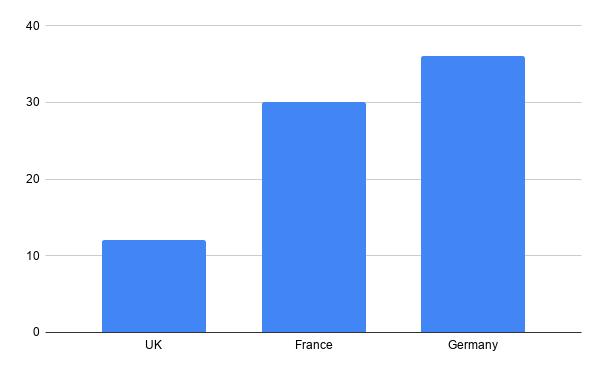
Not exactly “world beating” is it Boris?

The Green Jobs Task Force was announced a couple of days ago with the supposed aim of generating 2 million green jobs by 2030; yet here we have a plan aiming to generate “up to” just 250,000 (an eighth of that figure). Are they making this up as they go along?


“There will be electric vehicle technicians in the Midlands, construction and installation workers in the North East and Wales, specialists in advanced fuels in the North West, agroforestry practitioners in Scotland, and grid system installers everywhere. And we will help people train for these new green jobs through our Lifetime Skills Guarantee”.

And there will be an airport in the Thames Estuary and a bridge between Scotland and Northern Ireland and, and..Moonshot, what moonshot? Typical broad brush fabulism from Johnson. What are the specifics? How many? Where? Doing what? What funding is committed to apprenticeships in the desperately needed areas and who will manage the transition? What is the plan for overhauling the curriculum?

“This 10-point plan will turn the UK into the world’s number one centre for green technology and finance, creating the foundations for decades of economic growth.”

In your dreams Boris! If you look at the patents filed for renewable energy technology, the UK doesn’t even get its own column, being bundled in with the “rest of the world”. China is right out there in front with 7544, with the USA trailing on 2059, Germany on 571 and Japan on 89. So the UK is well below that. (3)

This ten point plan has neither the ambition or the imagination to stimulate a more positive and creative contribution to the global effort we need from this country – preferring instead post imperial fantasies of being back up where we belong: a slightly greener gated community.

The phrase “decades of economic growth” implies that this can be growth of the sort we have nowwith an ever intensifying pattern of work taking over our entire lives and making depression an epidemic, compensated by accelerated consumption to fill the holes in our souls; overlaid on a widening gap between people in poverty and insecurity and those who need the FT “How to spend it” supplement to work out how to dispose of more money than they know what to do with; rather than the growth in security, health, care, wellbeing, community and shared cultural creativity we need.

This Plan could well be retitled, “everything must change so that things can stay as they are.” (4)

One — we will make the UK the Saudi Arabia of wind with enough offshore capacity to power every home by 2030.”

This is the least we can do. All this is already planned for and on the stocks. There is no mention of onshore wind which the Conservatives have gone out of their way to discourage; hitherto favouring fracking and now fantasising about mini nuclear power stations instead. Perhaps people should be given the choice as to which they prefer in their local area. The comparison with Saudi Arabia is another absurd vainglorious pose. Saudi Arabia exports vast quantities of oil. This programme does not even supply all domestic energy demands.

Two — we will turn water into energy with up to £500m of investment in hydrogen.”

The prominence given Hydrogen here implies that it will be the main plank in replacing natural gas for heating and cooking, rather than looking to going wholesale with electricity generated by renewable sources – either on the grid or on local grids or using heat pumps. There is no rationale here – or exploration of alternative costings – for why they have gone with this. However, the investment allocated is so tiny that it won’t make much of a dent in any transition they have in mind; and there is that wonderful get out of jail free phrase “up to” again; so it might not even be that much.


Three — we will take forward our plans for new nuclear power, from large scale to small and advanced modular reactor.”

There are no specifics here nor any rationale. The small modular reactors are unproven technology. So is the technology currently being built at Hinckley point for that matter, which is already over budget and off target. Investment in nuclear takes a very long time. It is also absurdly expensive compared with wind or solar power – and becomes more so as time goes on. the government is committing to a herd of white elephants. (5) The excess costs for taking on this less than optimal option will be paid for by everyone’s energy bills.

Mean costs per megawatt hour of electricity.


Four — we’ll invest more than £2.8bn in electric vehicles, lacing the land with charging points and creating long-lasting batteries in UK gigafactories. This will allow us to end the sale of new petrol and diesel cars and vans in 2030. However, we will allow the sale of hybrid cars and vans that can drive a significant distance with no carbon coming out of the tailpipe until 2035.

Five — we will have cleaner public transport, including thousands of green buses and hundreds of miles of new cycle lanes.”

After decarbonising the energy grid, which the proposals above fumble, this is the most important sector to get a grip on. Emissions have been rising, largely because car companies have been pushing SUVs and there are more cars on the roads overall. SUVs also have a negative impact on road deaths for anyone unfortunate enough to collide with them.

The ban on new fossil fuel car sales from 2030 is welcome, though the loophole for hybrids implies that they don’t pollute. They do. And they should be included. SUVs should also be phased out as rapidly as possible and the companies that build them fined substantial sums every year they continue to do it.

A green transition in transport does not simply imply a 1:1 swap between fossil fuel cars and electric cars, but a significant shift away from cars altogether. The investment in gigafactories will be more significant in the transition to electric public transport. Unlike most cars, buses are in almost continuous use. This can be done much quicker than the snails pace currently projected even by TFL – the best run local transport network in the country. In Shenzen in southern China, they converted every single one of their 16,000 buses from diesel to electric in one year (2016). Where there’s a will…Making the most rapid transition also requires a coherent national transport plan – both to tie city neighbourhood together and provide a web of connections for rural areas too. That requires investment in public transport that is genuinely public.

The level of investment in bike lanes is absurdly small. “Hundreds of miles”, when you consider that there are 247,100 miles of roads in the UK.


Six — we will strive to repeat the feat of Jack Alcock and Teddie Brown, who achieved the first nonstop transatlantic flight a century ago, with a zero emission plane. And we will do the same with ships.”

Air travel is significantly down as a result of COVID. Heathrow expansion is probably dead. Much to the relief of anyone who lives anywhere near the airports, who have reported a wonderful release from a constant barrage of noise. There is no mention here of the need for transition for workers being made redundant by this industry. A Magnificent Men in their Flying Machines competition to build a zero carbon emissions aircraft capable of getting across the Atlantic is another of Johnson’s imperial nostalgic wheezes and as fanciful as the Thames Garden Bridge. Serious work on reducing the carbon emissions of shipping is crucial however, and tacked on as an afterthought it seems. Nothing is spelled out here about how this is to be done, nor who will do it, nor is any investment earmarked. It should be.

Seven — we will invest £1bn next year to make homes, schools and hospitals greener, and energy bills lower.”

Must try harder. The schools sector alone needs £28 billion by 2030 to get to zero carbon. Retrofitting housing would be best done through a national plan using local authorities to grow skilled direct labour workforces able to utilise economies of scale with a rolling programme starting with the worst off estates and areas. The current system of grants for homeowners via accredited local installers – of which there are too few – leads to an incredibly inefficient and time consuming system in which improvements are made in penny packets by those most able to afford it – whose energy bills are then subsidised by those that can’t. A perfect example of an unjust transition. The Conservative obsession with treating all situations as an opportunity primarily to benefit small business plays well with their base – mostly small business people – but is the retrofitting equivalent of growing wheat in flower pots.


Eight — we will establish a new world-leading industry in carbon capture and storage, backed by £1bn of government investment for clusters across the North, Wales and Scotland.”

The small total of investment implies that this will be about as world leading as the COVID App and not especially immediate in its impact; and therefore more likely to be playing the role of a fig leaf or gesture to allow business as usual to carry on.


Nine — we will harness nature’s ability to absorb carbon by planting 30,000 hectares of trees a year by 2025 and rewilding 30,000 football pitches’ worth of countryside.”

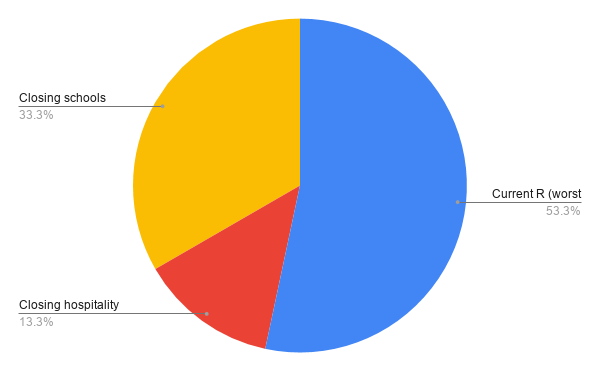
If you work out that the mean average size of a football pitch is 0.72 hectares, this means that the proportion of land in the UK scheduled to be rewilded in this plan looks like this.

And the annual tree planting total very little more.


“And ten — our £1bn energy innovation fund will help commercialise new low-carbon technologies, like the world’s first liquid air battery being developed in Trafford, and we will make the City of London the global centre for green finance through our sovereign bond, carbon offset markets and disclosure requirements.”

 An energy innovation fund is a good thing, but the aim should be to produce the most usable technologies for the greatest number of people – not follow the commercial imperative that means it will follow the demands of the people who can afford it: thereby skewing research in the wrong direction. “He soon became a specialist, specialising in diseases of the rich.” (6)


“This plan can be a global template for delivering net zero emissions in ways that create jobs and preserve our lifestyles.”

A global template cannot be one in which every country claims it will be world beating and a world leader anymore than everyone can be above average. It does appear to be a plan to “preserve our lifestyles” as they are now – with no reflection that if they were duplicated across the world we would need three planets to sustain them – with strenuous efforts put in to avoid anything that might actually make them better but don’t follow a commercial imperative.

“On Wednesday I will meet UK businesses to discuss their contribution. We plan to provide clear timetables for the clean energy we will procure, details of the regulations we will change, and the carbon prices that we will put on emissions.”

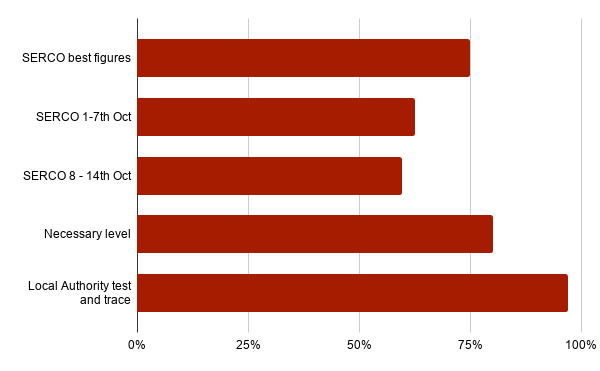
Let us see how much of a contribution comes from business and, conversely, how much contribution they are given. Hopefully the process of managing this will not be outsourced to SERCO or companies run by friends of the cabinet.


“I will establish a “task force net zero” committed to reaching net zero by 2050, and through next year’s COP26 summit we will urge countries and companies around the world to join us in delivering net zero globally.
Green and growth can go hand-in-hand. So let us meet the most enduring threat to our planet with one of the most innovative and ambitious programmes of job-creation we have known.”

It would be nice if we were going to. But this plan is a feeble shadow of what is needed. The government currently has polices that will get to a fifth of the 2050 target. This plan will barely improve on that because only a third of it is new money. An investment of £68 billion would create 1.2 million green jobs in the next two years. The TUC and others have presented the government with detailed plans that it has not picked up on. The consequence will be mass unemployment AND a failure to meet the green transition targets we so desperately need.

  1. From Annie Hall.
  2. From Desperate Housewives.
  3. https://www.statista.com/statistics/1117831/patents-filled-renewable-energy-technologies-by-country/
  4. Lampedusa The Leopard
  5. https://uk.reuters.com/article/us-energy-nuclearpower/nuclear-energy-too-slow-too-expensive-to-save-climate-report-idUKKBN1W909J
  6. Tom Lehrer

Trump’s support is not primarily working class.

A conventional trope of mainstream discourse about Donald Trump’s base of support – from Hilary Clinton’s “basket of deplorables” onwards – is that they are primarily rustbelt rednecks. People who in France – with due allowance for the superiority of American dentistry – would be referred to as ‘les sans dents.” This is reflected in a certain discourse on the left that portrays his vote as primarily that of the “left behind”.

This is not the case.

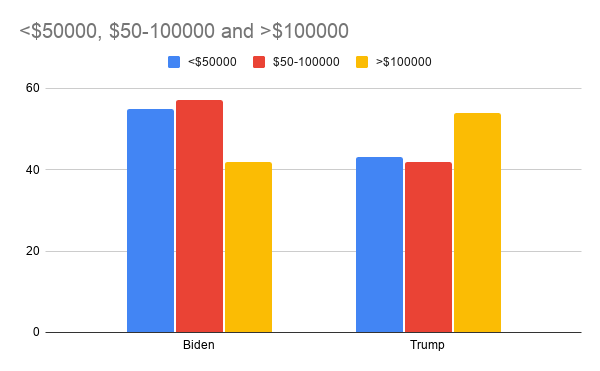
The figures are very clear. Biden had clear majorities among people earning below $100 000 a year. Trump a clear majority amongst those better off. A similar mystification happens in the UK about the Brexit vote; with mainstream commentary – and some left currents – reinforcing the notion that its heartland was in places like the former Red Wall – whereas in fact its strongest concentration of support was in prosperous small town Southern England – Hampshire having the edge over Hartlepool.

Biden’s support among the worst off increased by 4% over Hilary Clinton’s result in 2016 in fact.

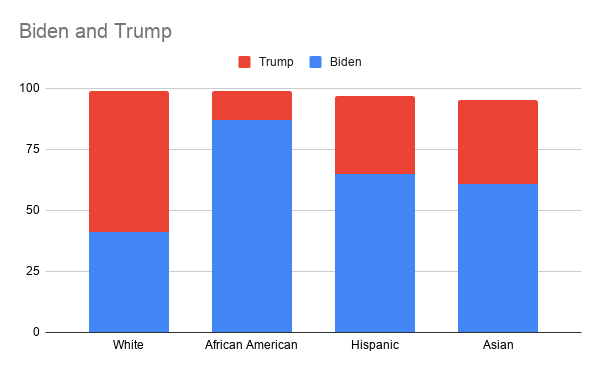
Polarisation by ethnicity is even more pronounced. Ethnicity overlaps with class. The median white household income in 2018 was $66,000. The median Black household income was $42,000. Putting these two together makes it clear that the bulk of Trump’s working class support is likely to be white. The potency of racism in Trump’s base – with dog whistles increasingly replaced by trombones – should never be played down.

However, given the depredation of the pandemic and the shambolic response to it by the administration – with casualties in 8 months running at four times the level of total US losses in eight years of the Vietnam war – the question has to be asked, why did anyone vote for him at all? Further, there was a slight increase in Trump’s support among Black and Hispanic men and white women.

The proportion of the electorate made up by these groups is this.

Some of the explanation for this is economic.

Trump has never been a “sound money” Republican. He is a real estate chancer who doesn’t pay his taxes or settle his debts – and he took that approach to the economy as a whole. So, while the main gainers from his huge tax cuts were the wealthiest of the wealthy, his failure to be remotely concerned with “balancing the books” meant that he did not carry out an austerity programme; and the resulting natural growth in economic activity meant that average wages went up across the board (from £63.9K median income in 2016 to $68.7k in 2019). Although this is simply a continuation of a trend started under President Obama (1) – and the same goes for economic growth and employment rates overall) this appears to have influenced a significant number of voters who are grateful for any small mercy they can get.

The result of that is a budget deficit of staggering proportions; which is coming home to roost for the next administration. Trump’s approach here could be seen as the application of an imperial Labour aristocracy strategy – the economic equivalent of “we’re going to build a wall and Mexico is going to pay for it.” The US economy is going to expand, and the rest of the world is going to pay for it. “USA! USA!”

The implications of all this for what’s going to happen next are also stark. Voters who voted for Trump were 75% motivated to vote FOR him. This was less the case with Biden, far more of whose voters were motivated primarily to vote AGAINST Trump. This was not by accident. Biden ran on a “character” and “competence” ticket – more concerned to show himself to be a safe pair of hands than give many firm commitments about what he’d do with them. Something that might strike us in the UK as familiar.

This is underlined by votes for the House and Senate, in which expected Democrat gains were not achieved.

The line of the centre and right in the Democrat Party is to blame the left for this. This ignores something fundamental. AOC has put round figures showing that every single Democrat candidate for the House of Representatives who campaigned for universal health care got elected – whether they were in previous Democrat or republican strongholds. Universal Health Care is supported by 72% of Americans – but it was not mainstream Democrat policy; which is represented more faithfully by Blue Dog West Virginia Senator Joe Manchin who proclaimed to MSNBC news that “we (sic) can’t afford Medicare for all. We can’t even afford Medicare for some”. An approach that plays well with the Democrat Party’s corporate donors but hardly a motivator for its working class supporters. Similarly, a $15 an hour minimum wage IS Democrat policy – but they did not campaign on it in a series of crucial areas – like Miami Dade County, where it was on the ballot as a specific proposal for local law and was passed by 25 points, while Biden barely scraped a majority by 3 points.

Even while mobs of Republican hard core protestors were demonstrating outside counts chanting “Stop the count!” or “Count the votes!” – depending on where they were – Trump confidante Chris Christie blithely announced that the challenge for Biden was whether he wanted to “unite the country” – with the people trying to steal the election from him – or “unite the Democrat Party”. This was echoed by mainstream media commentators who argued – and perish the thought that there was any self interest involved here – that the election result showed that the USA was a “centre right country” and Biden should now unite with the Republicans to isolate and crush the wing of the Democrat Party that actually has some answers.

Take that course – looking for national consensus on the terms of the right – and disaster looms in the mid terms and then the 2024 election.

1 https://www.businessinsider.com/charts-contrasting-trump-economy-obama-bush-administrations-republicans-democrats-2020-10?r=US&IR=T#economic-growth-under-trump-was-barely-above-both-obama-and-bush-before-the-pandemic-wrecked-it-1

In the Early Afternoon Twilight…

Signs of seasonal change in the Park as two green tractors, heavy as tanks, make a getaway to the road after slicing down the remaining wildflower blooms in the bee meadows; leaving a dull neatness with a few surviving magenta blooms still glowing beside their tyre marks – delicate survivors.

There is a more pensive air even than last week – when the heavy rains made the footpaths run like creeks, the fresh fall of acorns crunched underfoot in the golden oak tree mulch and the last big socially distanced excercise group spread in a wide circle doing side push ups in the mud, rivulets of rain running down their cagoul hoods and soaking them through; hard to tell if they were there out of commitment or a sentence to community self improvement in adverse conditions.

Today, people walked in ones or twos, or with dogs, and kept an eye on each other as we passed; and the outdoor gym equipment was fenced off again. Two blokes with hoodies – who looked a bit like they had escaped from an Assassin’s Creed game – worked out furtively inside – having got in by limbo dancing presumably.

Among the shops, a man with his shirt off and an angry glare sits with a couple of suitcases full of junk for sale.

In one of the new trees, a large plush tiger, its stuffing whitely exposed along a terrible rent in its back, is jammed between the branches. Although its paws are crossed casually its expression is one of intense humiliation and annoyance.

One of the few survivors of Brent’s year as Borough of Cultures is this mural of local boy George Michael on a cut through to a car park between Winkworths and a Romanian Supermarket. I’m not sure it speaks to anyone and seems to be an assemblage of parts that don’t quite cohere. But, perhaps that’s the message. And perhaps life is like that.

Rather bleak, menacing and obscure mural – more foreboding than celebration.

On the way back up the street, the shirtless guy – now fully dressed – is standing in the middle of the road being honked by considerate motorists and shouting at a bloke trying to drive away from the kerb in a black SUV. With the body language of a man taking charge, he advances to the front of the vehicle, still shouting, and bangs hard on the bonnet. Although he is shouting loudly its hard to tell what he’s saying. After the third bang the bloke in the car gets out annoyed and starts squaring up. “Shirtless guy” retreats a bit then puffs himself up. No words but both of them saying “Yeah? Come on then” as the traffic flows in between. Everyone watches in puzzled bemusement. All that’s needed is a David Attenborough commentary – “the humiliated males make a ritual aggressive display with out-thrust chests and loud cries…” The driver gets back in his car and heads off, not before shirtless guy has given his windscreen another thump – on the other side this time just to be symmetrical.

‘Twas the Night before lockdown.

The Mutual Self Help WhatsApp group set up on our road is now mostly used for neighbours to post up some spectacular photos, advertise lost cats and check with each other if the Virgin Broadband internet connection has gone down AGAIN.

On the walk past the park down to the shops J remarks that she keeps being sent ads for for something she has only talked about on the phone and not clicked on. Alexa is watching you.

An electric sign above the entrance to Aldi asks people to stop and wait if it is showing red and come in if it is showing green. It is showing red. Everyone is going in. Some jobs have to be done by people. A sign on a door is advice from a technological slave. A person on a door sets up a relationship with a peer. Even if they’d put the stop/go lights in a cardboard cut out of a person – like those replica Policemen they use to nudge people not to shoplift at Morrisons – it would have worked better. Even a picture of eyes looking at you clicks on your conscience.

Coffee with COVID?

In the vast Lebanese eatery by the tube station, where we risk a coffee, a brisk trade is given a slightly edgy feel by impending closure – and the way that the black clad, elegant staff, who sashay between tables carrying trays above their shoulders in one hand with an almost French flourish, are all wearing masks that don’t cover their noses. S showed us a poster that compared wearing a mask without covering the nose to wearing a condom that just covers the testicles. With picture. This is now impossible to un-see every time someone comes past wearing their mask in an “off the nose” style.

Out of the windows of the Bus, people scurry past the shops in the twilight wearing masks, stocking up. Posters spell out the current level of warning and measures to be taken. A recorded announcement proclaims the need for all passengers to wear masks. Several people without them show no sign of having heard it. The style is dystopian and isolating – feels like being on a different planet – rather than humane and mobilising. Probably the best the Tories can do. They can only mobilise in national terms. Humanity is a bit beyond them.

On the way back up the hill, our local UKIP supporter’s cinema screen TV lights up the street with the interminable US presidential results programme’s hypnotic red and blue dyptich glowing in a darkened living room. Biting their nails for the wrong result.

Listening to Radio 4 while washing up – as you do – I realise that Michael Buerk’s voice is two parts sigh to three parts sneer.

The road to the COP -from Zero COVID to Zero Carbon in Seven Arguments.

1. The Coronavirusis crisis is one aspect of environmental blowback. “When sorrows come, they come not single spies, but in battalions”. Shakespeare. Henry IV part two.

Every Pandemic this Century – from SARS to Ebola to Swine Flu – has resulted from diseases jumping the species barrier as human pressure on the environment has increased. COVID is therefore part of the same crisis as climate breakdown and we can expect more of pandemics like it.

While we have been preoccupied with COVID this year, climate breakdown has accelerated alarmingly. Just because fewer people are looking does not mean its not happening.

  • The polar ice caps are melting faster than we thought.
  • As a result, methane – an extremely potent greenhouse gas in the short term but hitherto frozen in the tundra – is now being observably released: the beginning of a feedback loop that could be beyond our capacity to hold back.
  • Forest Fires in Australia, Siberia, the Amazon and California have been even more intense and widespread than last year.
  • Exceptionally heavy rainfall has led to significant flooding in the Nile Valley, Japan, China, Indonesia, South Korea, Nepal, Pakistan, Mongolia and India.
  • The sixth mass species extinction gathers momentum, including the catastrophic drop in invertebrates.
  • The Insurance company Swiss Re has just produced a report (1) spelling out that without drastic action one country in five faces the potential collapse of their eco systems in the foreseeable future. Australia and South Africa are the most vulnerable. India – where a sixth of humanity lives- is not far behind.
  • An assessment by the US armed forces last year (2) projected widespread water shortages by the end of this decade and, in the coming decades, mass migration on an unprecedented scale as parts of the world become uninhabitable, widespread disorder and political crisis, wider spread of tropical diseases, increased strain and collapse of power grids, infrastructure and systems of governance, the army having to step in as civil society collapses and then possibly collapses itself.

These crises will not come along conveniently one at a time, but pile up with increasing frequency and intensity. So, dealing with the pandemic just to “get back to normal” is like treating the symptoms of an acute infection only to put yourself on palliative care for an underlying chronic condition and waiting to die from it.

2. You can no more argue with the laws of Physics than you can with a virus.

Responses to Coronavirus parallels responses to climate breakdown. Denial and magical thinking – …”its a hoax”…”its going to go away folks”… “it’ll be like a miracle”. Machismo and downplaying the scale of the threat… “its like flu, just like flu”. Clutching at Faith immunity – “I am protected by the blood of Jesus” -or folk remedies – drink tea, ingest tumeric… or maybe bleach – or touting world beating scientific “Moonshot” systems that exist entirely in the realms of thought. The desire to carry on with “the economy” as normal goes along with direct subsidy with no strings attached for companies that are too big to fail.

Exactly the same as the approach to climate breakdown – “its a hoax”…”its contested science”…”its the end of times and part of God’s plan”…”its just natural and normal temperature cycles”…”we’re going to make a technological fix which means we don’t have to alter anything else we do” (which may not work or may work a bit too well)…and so on. And the desire to carry on with “the economy” as normal goes along with direct subsidy with no strings attached for companies that are too big to fail.

The hubris involved in thinking that the threat of either the virus or climate breakdown can be stopped with a smartarse argument comes to grief at the point that reality can no longer be ignored and the other imperatives suddenly don’t look so urgent. Neither can be filibustered or bluffed.

Boris Johnson’s statement on Saturday that “We have to be humble in the face of Nature” – delivered with that throwaway carelessness of his that makes even the most profound thoughts seem trivial – was a recognition that if the UK government carried on trying to keep the economy as open as it is, hospitals would be overwhelmed within a fortnight – which would collapse his government. The situation is as bad as it is because they left this response so late, and the inadequacy of the measures being taken reflects their reluctance to carry them out at all. The laxness of the new measures compared with March – with schools staying open – means that they won’t be enough.

With climate change, if we wait until the point that reality is overwhelming us, it will be too late to do anything other than try to salvage something from the wreckage.

The 2007 US Report The Age of Consequences put that like this. “Governments with resources will be forced to engage in long, nightmarish episodes of triage: deciding what and who can be saved from engulfment by a disordered environment. The choices will need to be made primarily among the poorest, not only just abroad but at home.” (3)

So, the potential for collapse is real, it is urgent, it can’t be wished away and every day that is lost, every piece of distracted procrastination, is making it more likely. The forces whose interests are expressed by the US and UK governments are proving themselves unfit to lead humanity.

3. Global Degrowth is no solution.

“It became necessary to destroy the town to save it.” Unnamed US Major in Vietnam.

The point of taking action to avert climate breakdown is to save human civilisation. Trying to do so by crashing it defeats the objective.

There has been some welcome and serious soul searching among people in wealthier countries about the treadmill quality of work and the hollowness of attempting to fill a soulless life with frivolous consumption; with much discussion about reordering social and personal priorities. In countries with a 3 and 5 planet lifestyle – the USA, Europe, Japan, Australia – this is positive and needs to be deepened.

However, in most of the world, overconsumption is not the problem. The poorest half of the world’s population are responsible for just 7% of carbon emissions, while the impact of the economic dislocation resulting from the virus and the measures needed to contain it has hit them hardest. The World Bank estimates that 88-117 million people will be reduced to the extreme poverty level of less than $1.90 a day by the end of the year: with a further 350 -450 million down to less than $5.50 a day. (4)

So the impact of the virus – as a dry run for a degrowth policy – has hit the poorest hardest, in exactly the same way as climate breakdown does.

This poses the question of the nature of the way a recovery from Coronavirus is organised, what its objectives are; and the seriousness with which governments use it as an opportunity for a massive investment in transition – or fail to do so.

COVID lockdowns have led to a reduction in CO2 emissions – with estimates varying from 5-8.8% by the end of the year – by shutting down a huge range of economic and social activity (5). But to be on track for keeping temperature rises down to 1.5C we’d need that reduction to be sustained at 7.5% every year from here on. This could not be done without either maintaining a similar or even more drastic level of economic slowdown – Schools. Out For Ever – OR by seriously repurposing everything we do so that we can continue to reduce global poverty AND reduce greenhouse gas emissions. The former course could not be done with social consent – and would spark a serious resistance to it.

The Gilets Jaunes slogan “You’re concerned about the end of the world. We’re concerned about the end of the month” gives us the challenge to take account of both. That requires social and political mobilisation to make it the agenda and to consciously carry it through at every level.

4. States matter.

The pledges made in the Paris Agreement are essential but not enough. The aim of Paris is to keep temperature rises below 1.5C – 2C at the most. Pledges made so far – if fulfilled – would hold things down to just 3 – 4C and – if not fulfilled – even hotter. This is why the Agreement is a dynamic process requiring countries to periodically ratchet up their pledges as far as their capacity permits.

The problem is that not all countries are willing to do that. Trump took the US out of the Agreement on the basis that it was “unfair” to it.

This is why Xi Jinping’s speech at the UN pledging to hit peak emissions before 2030 and zero carbon by 2060 is so significant. In real terms China is already the world’s biggest economy and shoulders a lot of offshored carbon emissions by manufacturing goods for wealthier countries.

  • It is the only G20 economy already recovering from Coronavirus, while all the others are still mired in failing to deal with it.
  • It is the dominant trading partner of a growing slice of the world. Its state directed investment in renewable energy and electric vehicles are world leading and gives the opportunity for market dominated societies to buy into energy transition on the basis of what’s cheapest.

So, if it decides to become an “ecological society” that is a really big deal and will pull other countries in the right direction. It creates a trajectory and a momentum that we need to pile in behind and increase.

The point isn’t to “stop the fossil fueled wheels of Chinese industry” (5) – wheels which have taken 800 million people out of extreme poverty in two generations – but to power them with renewable energy.

Its decisive that this is a unilateral commitment, not dependent on what other countries do. China has hitherto held back to some extent, considering that a lead should come from countries that are far wealthier and have a far higher historic legacy of greenhouse gas emissions. But the bike race start, with each country looking nervously at the others; not wanting to get too far ahead in doing the right thing in case it costs them, is over. They are breaking from the pack. The coming Five Year Plan will spell this out.

In so doing they can provide a viable model for other developing countries to improve living standards while reducing carbon intensity that the USA simply can’t.

US politicians like to say things like “The US way of life is not up for negotiation – period.” (6) and at the last COP in Katowice in Poland, Wells Griffith, Trump’s international energy and climate adviser put it like this: “we strongly believe that no country should have to sacrifice their economic prosperity or energy security in pursuit of environmental sustainability“. (7) As if environmental sustainability was simply an option that we can take or leave, or that economic prosperity and energy security could in any way be possible without it – even for the United States.

The US way of life as presently led – the routine air travel, the sprawling suburbs, profligate and inefficient use of fossil fuels, grotesque levels of military spending- would require five planets worth of resources to sustain it if generalised across the globe. That means that it can only be carried on at the expense of the rest of the world and cannot be viable model of the future for anyone else.

And the longer it tries to carry on as it is the more disastrous it will be for the people of the US itself. It can’t sustain itself as an environmental gated community. There’s not a lot of point building a wall to keep out climate refugees if the forests are burning behind it. You can’t stop a hurricane with a fence – or a nuclear bomb. The campaign for a Green New Deal is pushing the US to rethink, transform and revolutionise its society as deeply as the Black Lives Matter movement does.

Trump’s withdrawal from Paris, and attempt to animate an international bloc of climate change denial incorporating Brazil’s President Bolsonaro and others will put the world in more serious peril if the US electorate injects itself with bleach and re-elects him for four more years on Tuesday.

If elected, Biden would take the US back into Paris, though it would remain to be seen how far the US would revert to its previous role of making haste slowly on the necessary measures. However, it is clear that Trump’s Cold War offensive is common ground with Biden – which will make the global co-operation we need more difficult.

LBJ once famously said that he had kept Herbert Hoover on as Director of the FBI because: “It’s probably better to have him inside the tent pissing out, than outside the tent pissing in.” The US role as hitherto dominant economic as well as military power means that it grants itself the right to piss anywhere it likes, whatever tent it is in.

The global co-operation we need is not a matter of each country trying to corner the green market to gain competitive advantage in a kind of environmentally sound economic social Darwinism of the sort floated by Elizabeth Warren in her version of the Green New Deal – which was all about the US reclaiming its rightful place as global leader.

Nor – over here -is it a matter of the trade union movement pledging its allegiance to “UK PLC” so long as there’s enough of a local supply chain – on the basis that UK Green Jobs are more important than Green jobs in Spain or Denmark or China. We need some trade union international organisation and mutual solidarity across borders not self subordination under national flags. This is not easy, but the framework needs to be the maximum benefit for the minimum investment, a plan for Green Jobs everywhere – as there is no shortage of things that need doing – and an emphasis on wholesale free or cheap transfer of the required technology to the developing world.

This is a key issue for Labour and the Environmental movement. Lisa Nandy has argued that solving global problems will require engagement with China. However, the framework for that engagement looks increasingly like a doubly subordinate Labour complicity with the Conservatives in lining the UK up to being an auxiliary in US attempts to retain its weakening grip on global dominance by ramping up propaganda, trade and military confrontations with the Chinese in a way that will undermine the co-operation needed. If we intend to put averting climate breakdown first – which we must – we need to oppose the New Cold War.

5. “Extractivism” is a disorientating framework.

There is a view common among western NGOs and some environment campaigns that the problem with the world economy is “extractivism” – the process whereby raw materials are taken out of the ground and exploited. An inappropriate generalisation of the basic truth that we have to keep 80% of the world’s known fossil fuel reserves in the ground if we are to avert disaster. This is most coherently linked to a degrowth perspective (see above). It usually makes no distinction between states that are trying to control exploitation of their raw materials for the benefit of their population and those that simply sell them to multi-national capital.

In the last year Bolivia has provided a text book illustration of why this approach is so disorienting.

The election of Luis Arce of the Movement for Socialism as President of Bolivia last month has been widely celebrated. This is, however, one year on from a coup against his MAS predecessor Evo Morales, in which the US, its social media myrmidons and tame mainstream media (The Guardian notably among them) were able to stampede sections of the environment and Labour movements into ambiguous or hostile positions supportive of a coup by the far right supported by the military.

Since taking office in 2006, Morales had presided over a rapid increase in popular living standards, health and education based on nationalising Bolivia’s mineral reserves and using the proceeds to reinvest in the population and written protection for “Mother Earth” into the Bolivian constitution. Life expectancy rose from 65 in 2006 to 71 last year.

During the coup – bamboozled by a barrage of articles denouncing Morales as a “murderer of nature” – and images of a mass demonstration labelled “this is what a mass environment movement looks like” (that was actually of a demo by a white racist separatist movement dominated by fossil fuel oligarchs taken in 2008!) – some environment groups in Europe picketed Bolivian Embassies; providing the coup with green cover. Morales was deposed and had to leave the country, police and soldiers opened fire on protestors, fascist thugs beat up MAS supporters and leaders, installing an unelected President who described indigenous rights as “satanic” and started dismantling Bolivia’s universal health care system, starting by sending Cuban Doctors home – which was to compound the impact of Coronavirus. Over 8 000 deaths in a country with a total population not much bigger than that of Greater London.

Bolivia has the world’s largest reserves of Lithium. Morales aim was to develop this with investment from China and Germany, partly to supply the huge Chinese demand for electric batteries (as of 425 000 electric buses in the world 421 000 of them are in China), but also to manufacture both batteries and electric vehicles in Bolivia. This is rather different from simply selling the raw material to Tesla (whose shares rose after last year’s coup). Hopefully this can now get back on track.

“Extractivism” does not distinguish between the two; but that distinction is decisive.

Despite the electoral victory for Morale’s Party last month, the far right have been demonstrating outside army bases calling on them to intervene and an army general has threatened to do so if the army is not “respected”. The US is biding its time. Don’t get fooled again- about Bolivia or anywhere else!

6. The current UK government is not capable of a serious lead on COVID or climate breakdown.

The condition of the Empire is fatal; but not serious” joke from the last decades of the Austro- Hungarian Empire that could have been written about Boris Johnson.

I shall do such things! What they are, I know not…” Shakespeare. King Lear.

The UK will be chairing the COP in Glasgow next November. Caught in their Brexit Zugzwang, in which every move they make weakens their position, they will follow very closely whatever the US decides to do and cut their cloth according to whoever the President is.

They have proved incapable of developing a Zero COVID strategy, and they have no adequate plans to match their supposed target of zero carbon by 2050. Despite adopting the slogan Build Back Better, their biggest proposed recovery investment is a spectacularly perverse £29 billion on extending the road network; and they propose to leave matters to the markets. There “comes a moment when the state must stand back and let the private sector get on with it” (Boris Johnson at the 2020 Conservative party Conference). Waiting for a private sector that is on state life support and “wouldn’t voom if you put six million volts through it” to “get on with it” is a bit like expecting a late stage COVID patient to breathe without a ventilator. This applies both to Coronavirus and climate breakdown.

Labour, Trade Unions, and the environment movement have to be absolutely clear that the state has to lead, the state has to invest – and the aim of that investment is not to hand juicy contracts to SERCO or personal friends of the cabinet – but directly and urgently into energy systems, reforesting and rewilding, retrofitting, repurposing and configuring towns and cities and the transport between and within them, overhauling the education system to inform, reskill and mobilise people to participate actively in this process at all levels.

There can be no “constructive opposition” or search for “national consensus” based on self subordination to the flawed presumptions of a political Party that is out of its depth and past its sell by date – as the Conservatives are.

The UK is chairing the Glasgow COP. But this government stands for business as usual leavened with a few token gestures and a thin coat of self congratulatory greenwash. Our job in the next year is to make sure that that our voice is heard louder than theirs.

7. All roads lead to the COP.

From 2018 to 2019 – as climate breakdown became increasingly evident, in “natural disasters” and increasingly freakish weather, in a way that could be sensed and felt as well as observed or read about – the school student strikes and XR rebellions electrified politics and helped push the climate breakdown onto the popular agenda. The last Parliament passed a resolution introduced by Jeremy Corbyn declaring a climate emergency and local authorities all over the country have now done the same. These are now being embodied in Climate Action Plans at local level. However, even then, most Conservative MPs abstained on that resolution – showing that at national level they just don’t get it – and the impact of COVID on local authority budgets is squeezing any resources available to carry them out.

Mass civil disobedience underlined the emergency character of climate breakdown. Normality is not possible when things are not normal. Thousands of people were prepared to be arrested. Centres of cities were occupied and street theatre replaced cars. In a national political context of a split in the ruling class over Brexit, a Conservative government in crisis as the chronic immobilism of May gave way to Johnson moving fast and breaking things, with possibility of the most radical (and green) Labour government ever sparking panic in high places and a tsunami of malevolent lies to stave it off, there was a vaguely insurrectionary feel last year in which almost anything seemed possible.

But the theory that civil disobedience in itself it would be enough to “bring down the regime” because if we had enough of it the disruption would be too expensive looks a bit different in the context of COVID. The disruption and costs of this environmental backwash – just from this one pandemic – has been so enormous that it has dwarfed any disruptive effect of any and all of the demos we have ever had. We should indeed be humble in the face of nature.

Nevertheless, there is now a very large coalition of forces across society – that recognises that we can’t leave it to the people who are failing us on COVID to manage climate breakdown or be our face to the world.

The instinct of the current Labour leadership is that policies are things you put in manifestoes and try to implement in government on behalf of people but not necessarily with their involvement. That approach will let the Conservatives off the hook of their failures. And we don’t have time to wait for the next Labour government before we push for action from this one and employ a Gramscian strategy of using every lever of power and and influence available to us to make the changes we can and to build an irresistible force to push the current government to move further than it wants to in the right direction.

We will need mass mobilisations in every form we can get – and every element of the Labour movement, trade unions, local parties, local authorities, campaigning groups – needs to be part of it both AT the COP and in the run up to it.

COPs are dominated by corporate interests. Fossil fuel companies are there lobbying hard and twisting arms. Trade Unionists pushing for a Just Transition in the ITUC delegation do what they can, but delegations have tended to be small and underpowered. We need General Secretaries to be there – and not just from this country. We need mayors of towns and cities that have declared climate emergencies to be there – hopefully the whole C40 (8). And we need a very loud and public groundswell of popular support for the most rapid moves to a Just Transition; so the corporate and government delegations are in no doubt that millions of us are watching them and we have them under siege.

1. https://www.swissre.com/media/news-releases/nr-20200923-biodiversity-and-ecosystems-services.html

2. https://climateandsecurity.files.wordpress.com/2019/07/implications-of-climate-change-for-us-army_army-war-college_2019.pdf

3. https://www.cnas.org/publications/reports/the-age-of-consequences-the-foreign-policy-and-national-security-implications-of-global-climate-change

4. .https://blogs.worldbank.org/opendata/updated-estimates-impact-covid-19-global-poverty-effect-new-data

5. http://socialistreview.org.uk/432/focus-china-east-green. For a critique of this article see https://urbanramblings19687496.city/2020/11/01/the-east-is-greening/

5. https://www.nature.com/articles/s41467-020-18922-7

6. George W Bush https://www.washingtonpost.com/gdpr-consent/?next_url=https%3a%2f%2fwww.washingtonpost.com%2fworld%2feurope%2fthat-was-awkward–at-worlds-biggest-climate-conference-us-promotes-fossil-fuels%2f2018%2f12%2f10%2faa8600c4-f8ae-11e8-8642-c9718a256cbd_story.html

7. https://www.washingtonpost.com/gdpr-consent/?next_url=https%3a%2f%2fwww.washingtonpost.com%2fworld%2feurope%2fthat-was-awkward–at-worlds-biggest-climate-conference-us-promotes-fossil-fuels%2f2018%2f12%2f10%2faa8600c4-f8ae-11e8-8642-c9718a256cbd_story.html

8. https://www.c40.org/

The East is Greening

The East is Greening

Martin Empson’s argument in Socialist Review (Focus on China: The East is Green? Feb 2018) poses more problems than it answers – but they are key ones for the left and environmental movements to explore and clarify.

His argument that China’s “economic model” is based on massive state investment, low pay, manufacture for export and promotion of domestic consumerism does not draw out that its determining feature is that its the state that predominantly drives investment not the private sector; and poses the other items in the list as though they are unchanging – though wages are rising, and there has been a shift from export focused production to internal development, especially in the last ten years: which has been complemented by a shift up in the value chain; with increasingly sophisticated and high quality goods being produced; some of them world leading.

Donald Trump has complained that China’s state directed investment gives it an “unfair advantage” in economic development over the United States. Which begs the question why the United States is so loathe to use similar methods if the effect is so positive. Answering that question leads to clear implications about which class those states exist to serve. It also means that China has more opportunity than most to direct the scale of investment need to make a transition to a sustainable economy.

Quantifying China’s development gives us some stark headlines.

Between 1990 and 2018, life expectancy has gone up significantly faster than in the USA. From 69 to 75 years in China as compared with 76 to 78 in the US.

Average per capita income has also grown dramatically, from $990 per person per year in 1990 to $16 760 a year in 2018. This has caught up with and now overtaken Brazil; and accelerated well beyond India which started out slightly wealthier on average at $1 120 per person per year in 1990, growing to $7 060 by 2017 – about half China’s rate.

Clearly, the “low pay” is no longer so low – and – if China is considered a socialist state – this can be considered a purpose of the economic development. But, even if you think that China is a variant of capitalism, it is clearly a very positive development for most people in China.

We should note what a staggering and positive achievement this is. 750 million people taken out of extreme poverty in one generation. That’s just under three quarters of the global total in that time (1.1 billion) according to the World Bank. Problems remain, about 60 million people – mostly in rural areas and roughly equivalent to the entire population of the UK – are still dirt poor and addressing their needs is the focus of the current five year plan.

This is a good thing, and the left and environmental movement should be unambiguous about that. People in China largely are; which is why the CCP has positive support.

Martin’s argument that China’s rapid development and improvement in living standards is “driving environmental disaster”- and denying that “technical solutions” are available – implies that this development should stop. This is nowhere stated explicitly, but the implication hangs over the whole article in phrases like “consumerist fantasy” and “stopping the wheels of China’s fossil fueled industry.”

It is important to bear in mind that the presumptions we are used to – living in a highly developed, affluent society that has outsourced its manufacturing (often to China) and takes certain levels of development and well being for granted – are not normal for most people in the world. While people in the green movement in the UK have a live and relevant debate about pathological levels of over consumption in late capitalism, nearly half of people in China live in rural areas, with, especially in the North West, poor living standards, limited transport and connectivity, use coal for domestic heating, and would consider our discussions a self indulgence of the pampered and privileged. Connecting these people to a grid – as in the current five year plan – would be a positive development – and significantly reduce the extremely inefficient and polluting use of coal as a domestic fuel. Anyone who remembers what coal fires did to laundry (and lungs) in the 1950’s and 60’s should get the point.

His central charges are that China is still 62% dependent on coal for energy production, that coal power stations are being built as part of the belt and road initiative, that China is developing fracking, that hydro-electric power comes at a colossal environmental cost, that the Chinese renewables sector is inefficient and that Chinese manufacturing industry both consumes huge quantities of raw materials and produces lung choking quantities of pollution.

These are real issues and real challenges. The solution to some of them is technical, unless you presume either that the answer is degrowth – or a problem of political leadership – as Martin seems to do. The political will, however, is there. Xi Xinping argues, as Martin quotes, that China aims to be a model for “independent” economic development on a global scale – that’s economic development not dependent on the dictates of the World Bank and IMF – and to take a global lead on the environment and climate change. Xi Xinping quotes Engels – “Any harm we inflict on nature will eventually return to haunt us.” Quite so. They get it. Even if you ignore this evident publicly proclaimed commitment, Martin’s argument that, rather than the CCP, the political answer lies instead with people involved in environmental protest and workers in the fossil fuel sector (taking power presumably) has a number of problems. There is no indication that the latter have any leadership role in this at all. Martin cites one strike in 2002 in Daqing that “showed their potential combativeness” . So, one strike, in one oilfield, seventeen years ago. This is a pretty thin basis for an alternative strategic prospect. Moreover, it was about pay, not environmental sustainability. Experience globally shows that -sadly-workers in fossil fuel sectors are not often in the front line of campaigning for a transition that will cost the jobs they already have and are used to- unless there is a very clear prospect of redeployment and/or the sector itself is contracting. Three examples from elsewhere; in order of positive to negative.
Canadian oil workers in the tar sands and their unions have adopted Just transition as a response to the accelerating collapse of tar sands extraction, undermined by lower oil prices.
The GMB in the UK – while favouring a Just transition in principle -responded to the Parliamentary Committee on Climate Change recommendation to cease production of gas hobs and connect no new housing to the gas grid from 2025 by calling for the government to ignore the advice.
At the time of the Katowice COP last November, the Silesian branch of Solidarnosc, which covers coal miners and workers in heavy industry, adopted a position denying climate change because they see the response to it as a threat to their jobs.
Further, the movements on environmental damage are not discouraged by the CCP. Quite the reverse. “Having this urban middle-class outcry about air quality actually gives the leadership a lot of legitimacy to push through some of the difficult reforms they have been wanting to achieve.” Ma Tianjie, Beijing managing editor of Chinadialogue (cited in National Geographic 5/5/17). It goes on. “Today, officials “are very serious” about improving air quality, says Tonny Xie, director of the secretariat at the Clean Air Alliance of China. “I’m pretty convinced of that” and cites an example. “With stunning (but typically Chinese) speed, the government has built a nationwide network of monitors tracking levels of PM2.5—the tiny combustion particles that penetrate deep into the body, causing not only breathing problems but also heart attacks, strokes and neurological ailments. More surprisingly, the government has made the data from those monitors publicly available. It has done the same with measurements taken outside thousands of factories. Anyone with a smartphone in China can now check local air quality in real time, see whether a particular facility is breaching emissions limits, and report violators to local enforcement agencies via social media. The level of information compares favorably to what’s available in the U.S. Under the old system, local officials were evaluated almost exclusively on their region’s economic health. Now environmental concerns, particularly air quality, are given greater weight.”

Martin’s argument that the people involved in struggles against environmental degradation and by workers in the fossil fuel sector “hold the key” to transformation to a sustainable economy begs the question of what these movements – were they in power – would actually do that would be different to what the CCP is already doing.

So, what further measures are being taken and how effective are they; to what extent is China greening and how could this be accelerated? How much of a transition is already taking place?

CO2 emissions
When you look at a map, China is about the same size as the United States. In purchasing power GDP it is already larger and, other things being equal, is projected to be twice as big in ten years – hence the current trade war to try to slow it down. But its when you consider population that China’s significance hits home. China has one in five of the world’s population – as many as the whole of North and South America, Western Europe and Australia combined. It has 65 cities with a population greater than a million and 8 bigger than London – and manufacturing is 40% of its GDP: so its CO2 emissions are bound to be very large – 30% of the global total. The CCP acknowledges the difficulty –

“energy consumption has grown too quickly in recent years, increasing the strain on energy supply. Fossil energy resources have been exploited on a large scale, causing a certain amount of damage to the eco-environment.”
PRC State Council White Paper on Energy Policy 2012

Nevertheless, China’s per capita emissions remain half that of the United States and below that of Germany. A trajectory of rapid increase – of 10% a year from 2000 – 2010 declined sharply to 0% in 2016, then creeping back up to 1.7% in 2017 and 2.3% last year. This is not good news, but was still below the USA’s increase of 2.8% and India’s 5.7% for the same year.

Technical solutions
Some of the way that China is attempting to square the circle and hold back carbon emissions, while continuing to develop, are to reduce carbon intensity by increasing efficiency and linking up grids, so that”energy consumption per unit of GDP has been decreasing year by year.” (PRC State Council 2012). “The state implemented a series of energy-saving renovations, such as of boilers, electrical machinery, buildings and installation of green lighting products.” Along with measures to make sure that
“the energy utilization efficiency of new projects in the heavy and chemical industries, such as non-ferrous metals, building materials and petrochemicals, is up to the world’s advanced level
The gap between the overall energy consumption of China’s high energy-consuming products and the advanced international level is narrowing.” (PRC State Council 2012)
These are indispensable technical measures and made a dent in CO2 emissions of between 10* and 20%** from 2006 – 2011, and this has continued since. The potential is qualitative. On this chart, you can see the increasing impact of these technical measures in counteracting the impact of economic growth up to 2016.***

Further, the proportion of renewable energy produced by wind power has a lot of room to expand by increasing efficiencies. More grid connectivity for existing sites, better siting and choice of turbine and optimum height for the next wave. These are technical fixes. There is no political obstacle to them.

The same applies to solar – and this is beginning to move beyond catching up into taking a lead. “Trina, a Chinese company and the largest solar panel manufacturer in the world, broke the world record on the efficiency of multicrystalline-silicon solar cells in 2014 and 2015.”

Expansion of Renewable Energy
According to the International Energy Agency, 36 percent and 40 percent of the world’s growth in solar and wind energy in the next five years will come from China, roughly double its proportion of the world’s population.

According to the UN, China leads in investing in renewable energy “China …. accounted for 32 per cent of the global total investment, followed by Europe at 21 per cent, the United States at 17 per cent, and Asia-Oceania (excluding China and India) at 15 per cent. Smaller shares were seen in India at 5 per cent, the Middle East and Africa at 5 per cent, the Americas (excluding Brazil and the United States) at 3 per cent and Brazil at 1 per cent “. This is a result of political decisions. To put it another way, why isn’t the rest of the world investing on the same scale that China is – and what would be the impact if they did?

The National Energy Development Strategy Action Plan has set targets for

wind power to reach 200 gigawatts (GW) by 2020, up from 129 GW in 2015

solar capacity to reach 100 GW by 2020, up from nearly 43 GW in 2015

geothermal energy capacity to reach 50 million tons of coal equivalent by 2020.

and to reduce coal’s share of total energy consumption to 55 percent by the end of 2020 and cap it at that level: compared to 64 percent in 2015.

****https://www.nextbigfuture.com/2017/04/china-2020-and-2030-enegy-plans.html
Between 2013 and 2017 China’s investment in renewable energy doubled. The proportion of energy produced is rising rapidly, albeit from a low base. Wind was 4% in 2016, 4.7% in 2017. Solar was less than 1% in 2016, up to 1.8% a year after. Another $360 billion is going into the sector up to 2020, creating 13 million jobs (16 times as many as the US).

China is now the world’s largest producer, exporter and installer of solar panels, wind turbines, batteries and electric vehicles.
China now also has a clear lead in terms of the underlying technology, with well over 150,000 renewable energy patents as of 2016, 29% of the global total. The next closest country is the U.S., which had a little over 100,000 patents, with Japan and the E.U. having closer to 75,000 patents each.

China is also investing in international renewable energy projects For example, the BRICS New Development Bank, of which China is a participant, gave its first round of long-term green loans worth $811 million last April to fund clean energy projects to its members.****

Conclusion
So in response to Martin’s charges
that China is still 62% dependent on coal for energy production. It is. Without throwing millions of people out of work and into destitution there has to be a plan to reduce this. There is. This is coming down, and faster than expected.
that coal power stations are being built as part of the belt and road initiative. Though has been the case, China is increasingly investing in renewable power generation in other countries as well as at home and taking initiatives to “pursue the new vision of green development and a way of life and work that is green, low-carbon, circular and sustainable.” Xi Xinping at BRI Forum May 2017. Its China’s investment in wind and solar technology that now makes it the cheapest form available everywhere.
that China is developing fracking. In the UK, coal has nearly been eliminated as a major energy source partly by a shift to gas. The argument now is the need to rapidly move away from this towards fully renewable energy sources without an extended period of using gas as a “transition fuel”. China, with 60% dependence on coal for energy, has more of a case for making the same shift from coal to gas that the UK already has. Wind and solar, though expanding rapidly, are not scheduled to produce any more than 20% of total energy by 2030, even at the gigantic rate of investment that China is making, so a shift within fossil fuels to a less damaging one is more defensible there than it would be here. The 17 billion cubic metres projected to be pumped out by 2020 will replace coal. Fracking in Chinese conditions is rather tricky, so there are limits to the extent that this will be developed.
that hydro-electric power comes at a colossal environmental cost. This is true for the big projects especially, but without them China would be even more dependent on coal. They account for 18% of energy production in China. About the same as wind and solar combined. Now that they are built there would be little gained in shutting them down and an awful lot of coal would end up being burned instead.
that the Chinese renewables sector is inefficient compared to the West. The developmental lag that this reflects is being closed and efficiency enhanced. The scale of the investment and the intensity of the research has already closed this gap in some areas and exceeded them in others.
and that Chinese manufacturing industry both consumes huge quantities of raw materials and produces lung choking quantities of pollution. The pollution is a massive concern shared by government and people. It is, unevenly, going down. China no longer has any cities in the worst ten globally as a result of the measures taken, though still has many in the worst 50. The impact of Chinese demand for goods has
Footnotes

* China “has eliminated small thermal power units … saving more than 60 million tons of raw coal annually. In 2011, coal consumption of thermal power supply per kwh was 37 grams of standard coal lower than in 2006, a decrease of 10 percent.” 2012 PRC State Council Energy Report

**”From 2006 to 2011, the energy consumption for every 10,000 yuan of GDP dropped by 20.7 percent .”
Rapid development in non-fossil energy. 2012 PRC State Council Energy Report

*** https://www.sciencedirect.com/science/article/pii/S014098831930082

**** “One of the key factors driving these changes is that, unlike traditional fossil fuels, renewable energy sources are widely available around the world. Whether it is solar or wind power, tidal energy or hydroelectric plants, most countries have the potential to develop some clean energy themselves. This means that many countries which currently have to import most of their energy will in the future be able to generate their own power – helping to improve their trade balance and reducing their vulnerability to volatile prices.” (Forbes. Jan 2019, China Is Set To Become The World’s Renewable Energy Superpower, According To New Report)

Biting the Sound Bites 2 – Roadkill.

One of the features about COVID arguments is the tendency on the Right to throw in remarks that are supposed to be common sense, but which are very revealing when you take a step back and examine them.

In these remarks, numbers are often thrown around with complete disregard for what they actually amount to. A model for this is one Donald Trump’s sentences where he’s talking about big numbers; and he can’t help but expand them in series; like an eight year old does in the playground – millions, billions, gazillions. This works on the difficulty most of us have in envisaging and comparing numbers beyond those we can comfortably grasp from everyday life; so qualitative differences are easily obscured or missed because both numbers translate as “lots”.

One of these frequent flyers is the notion that, as we can’t have a risk free society, it is perfectly alright to let the COVID virus rip – often posed as if this is a test of moral fibre. The example of socially acceptable risk that is habitually trotted out is that of traffic accidents; on the lines that if we are prepared to go out on the roads every day we should equally be prepared to go into a crowded cafe and take a deep breath.

In this argument, the first – and most obvious – point as far as the UK is concerned is that casualties from Coronavirus so far are qualitatively greater than road accidents. Official Government figures for the UK show over 43,000 deaths from COVID19 in 2020. In 2019, there were 1,752 deaths from road accidents. (1) Deaths from COVID in the UK are more than twenty times greater than those from traffic accidents.

A preparedness to accept traffic deaths as a normal level of risk shows how abnormal COVID19 actually is.

There has been no significant variation in this level for the last ten years in the UK – as increased safety measures like 20mph limits have been counterbalanced by an increase in traffic.

The second point is whether we should consider the level of deaths from road accidents to be socially acceptable or take them for granted.

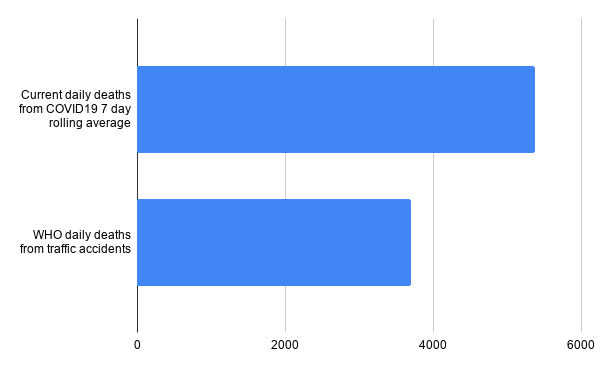
This is particularly the case when you consider that on a global scale, traffic accidents are a far more significant cause of death. The WHO reports that around 3,700 people die every day from road accidents around the world. That is below the current daily death rate for Coronavirus, but in the same ball park. (2)

Global Road Carnage – a socially acceptable risk?

It is surely entirely coincidental that the people arguing most strongly that road deaths are an acceptable price to pay for living in a modern society also think the same of COVID19 and are so often those in social strata least vulnerable to either. Your perspective on dying on a ventilator or being being flattened by an SUV seems to depend on how far you are at risk of the first, whether you drive an SUV or walk; or whether you live in a part of the world that has robust highway safety measures in place or not. 90% of the worlds traffic accidents happen in middle and low income countries – three times higher than the rate in wealthy countries (and the economic impact of this has been reported as greater than the total amount they receive in aid). (2) How often does a risk become more acceptable the less the person grandstanding is exposed to it? As the old Irish expression has it – “Its easy to sleep on another man’s wound.”

On a global scale then, the carnage on the roads is a threat that requires urgent action to reduce it.

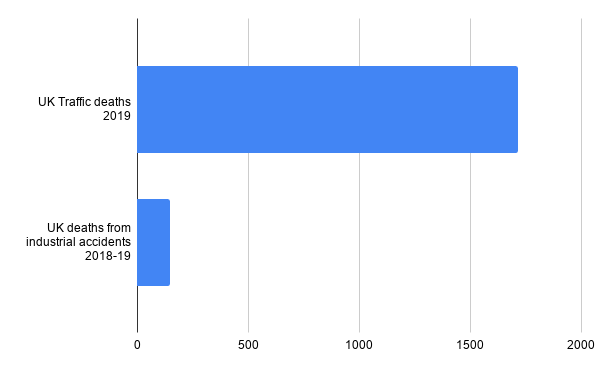
Even in the UK, the scale of deaths on the roads dwarfs those from Industrial accidents. 12 times as many.

So, while COVID is a significantly greater risk than road accidents in the UK, road accidents themselves are in a different league than all the industrial accidents in the country put together. That also requires attention when considering transport policy as well as health and safety. Part 2 follows.

  1. https://assets.publishing.service.gov.uk/government/uploads/system/uploads/attachment_data/file/922717/reported-road-casualties-annual-report-2019.pdf
  2. https://www.cdc.gov/injury/features/global-road-safety/index.html

Biting the sound bites – “its no worse than the flu…”

As the pandemic has rebounded and restrictions are necessarily being brought back in – however reluctantly – some discredited old chestnuts from the Spring have been picked up, dusted off and pressed back into service in the hope that – if they are repeated enough with sufficient self confidence – people will take them seriously – and even repeat them under the impression that they are being bravely iconoclastic.

This is easy to check. The World Health Organisation figures for annual global deaths from seasonal flu give a range from 290,000 to 650,000, depending on the virulence of the strain. This is with normal health measures an vaccines deployed. The comparison looks like this.

So all the exceptional measures taken have kept COVID deaths down to somewhere between one and a half and three and a half times the annual impact of season flu in an eight month period. Imagine the death toll if we’d actually have tried to “let it rip” and “take it on the chin.”

In the UK, on average seasonal flu kills 17,000 people a year. Official government figures (which are on the conservative side in more ways than one) state that there have been 43,726 deaths so far. The ONS statistic for the number of excess deaths for the COVID period compared to annual averages is over 67,000 – a more accurate indication of its impact. That looks like this.

The columns for COVID should have an arrow head on them – because they are still going up.

With no vaccine and with exceptional hygiene and social distancing measures deployed, global deaths from COVID19 are over 1,008,000 so far; and with a daily death toll at a steady 5,000 or so it clearly has a long way to run until either an effective vaccine is found or effective measures are taken to eliminate the virus. It bears repeating that it took China just six weeks to eliminate domestic infections – keeping their total death toll below 5,000; so the aversion in the West to learning from their experince is looking more and more like self harm as time goes on and the casualties mount.

All figures accurate as of 20/10/20.

Two immediate positive steps towards zero Covid.

SAGE reported in September that an immediate 2 week circuit breaker lockdown was needed to stop the rapid increase in COVID infections. The government decided instead to cross its fingers and hope that half measures would do the trick. They haven’t. The government is now “guided” by “the science” and is no longer “following” it. They seem to think that “the science” is malleable and the virus will respect their other imperatives. It won’t.

Pundits are arguing that Labour’s support for SAGE’s call makes such a circuit break “politically impossible” because the government will now lose face if it calls one – an implicitly therefore that if one doesn’t get called that’s somehow Labour’s fault. So many have said this that it is clearly a line fed to them through the lobby. Just think for a moment about what that says about the priorities of this government. Even putting it about that saving Boris Johnson’s face must take precedence over saving people’s lives is a piece of gaslighting on a whole new level – even for this lot.

Instead we have the “three tier ” system which SAGE has said very clearly won’t be enough, even if all the restrictions in the third tier are followed strictly.

So, what can we do?

The R rate (18/10/20) is currently at 1.2 – 1.5 for the whole of the UK. SAGE has said that closing down the hospitality sector would cut this by 0.2 – getting it down to 1 – 1.3. Closing schools would cut it further by 0.5, getting it down further to 0.5-0.8. The National Education Union is therefore completely right to call for schools to be included – because without schools being shut the circuit won’t be broken, but with their closure the R rate would be below 1 even for the highest estimates.

This shows the reduction in R assuming a current rate of 1.5
This shows the reduction in R assuming a current rate of 1.2

So, it is clear from this that closing schools is essential to get the R rate down below 1. The question that flows from this is how far down can the R rate be forced and over what period and whether a circuit break – albeit a minimum necessary measure – is adequate to eliminate the virus in the way that China did in just six weeks (and without which no sustainable recovery is possible)?

The other step forward that could be taken is to scrap SERCOs contract for test and trace and reconfigure the whole system so that it is properly run through the Health Service and local authorities. The figures on this are stark.

Sticking with SERCO shows that the government is less interested in getting a grip on the virus than using a health emergency as a pretext for further outsourcing. The jury is not out on this any more, privatisation fails.

The “Rule of law” is a “Fundamental British Value” except when its expedient for it not to be.

Under the terms of the Prevent Programme, teachers all over the country have to teach that the rule of law is a “Fundamental British Value” (with capital letters). In passing the SpyCop (Covert Human Intelligence Sources) Bill last night the Johnson government has made this impossible to do with a straight face.

This Bill was drawn up because abuse – some of it sexual -by under cover Police officers was being found to be illegal – so the previous unwritten code – the nod and the wink from on high – was not enough to give them protection from the courts. This is not an overdue attempt to regulate and limit such actions, but to give them legal cover and impunity.

There are three aspects to this.

  1. It legalises illegal acts without limit. Even the USA says that rape and murder in pursuit of “the national interest” are beyond the pale. The argument that this is covered by adherence to the European Convention on Human Rights would be a bit less shaky if they were prepared to write these restrictions into the law as a prohibition. The actual wording of the Bill is that agents have to “take account of” the provisions of the ECHR. Presumably in the same way that the government is “guided” by the science on COVID. So that should all work out well.
  2. It gives a license to kill (presumably with knife, gun or bare hand among other things) to a wide variety of state actors, with an appropriate sense of proportion of course. Not just the Police, Security Services, but (bizarrely) the Food Standards Agency. As the government briefing on this details “Only (sic) the intelligence agencies, NCA, police, HMRC, HM Forces and ten other public authorities will be able to authorise criminal conduct”. (1) Ten organisations – beyond the usual suspects -can allow their agents to break the law! This is the full list. MI5 and other intelligence bodies, Police forces and the National Crime Agency, Immigration and Border Officers, HM Revenue and Customs, Serious Fraud Office, UK military forces, Ministry of Justice (investigations in prisons), Competition and Markets Authority, Environment Agency, Financial Conduct Authority, Food Standards Agency, Gambling Commission and Medicines and Healthcare Regulation Authority.
  3. The criteria for illegal acts are drawn widely and vaguely. Illegal acts can be carried out to “prevent disorder” and to promote “the interests of economic wellbeing of the UK”. That’s a pretty broad brush. It is using provisions that should be a final resort, strictly limited to preventing violent criminal acts or terror attacks to a far wider range of dissenting views and actions. As written, the interpretation of “economic wellbeing” would cover an industrial dispute for example. And there is no doubt which side the intervention would be on. Trade Unions have been infiltrated in the past. Employers organisations have not. When you consider that we have a government whose interpretation of “order” is that peaceful protest to draw attention to the climate breakdown is a “criminal threat to the UK way of life” (Priti Patel) you can see how – and where – this is targeted.

When you consider consistent practice – that of the huge number of political groups that have been spied on by undercover agents since 1968, only 3 of them have been from the far right – compared with 4 into the Anti-Apartheid Movement, 14 into anti racist groups, 19 into Justice Campaigns (including that for Stephen Lawrence) and 21 into environment organisations – you can see from this who the security forces see as a threat, and – possibly more damning – who they do not. (2) That looks like this.

Seven times as many secret police infiltrating environmental organisations than fascist ones.

That the British state and its governing Party feel significantly more threatened by campaigns for racial justice than it does from fascists reveals a lot about it. It comes from the people who gave us the “hostile environment” and who feel that keeping up statues honouring colonialists and slave traders is a part of “our” heritage; not the source of either reflection or shame.

This legislation is the state unmasking itself in as naked a way as President Trump on the White House balcony. This law – in an attempt to retain control of crises that are well beyond their capacity – can’t help but undermine the values that they claim to be fundamental – and reveal them as a facade.

  1. https://www.gov.uk/government/publications/covert-human-intelligence-sources-draft-code-of-practice/covert-human-intelligence-sources-bill-factsheet-accessible-version
  2. https://www.theguardian.com/uk-news/ng-interactive/2018/oct/15/uk-political-groups-spied-on-undercover-police-list

And because “Fatima’s next job might be in Cyber”, here are some background thoughts on the Security Services, their record and current online interventions.

The Secret Intelligence Service HQ, built by the river where the Prince Regent’s beloved Vauxhall pleasure gardens used to be, is known to those in the trade as “Ceausescu Towers”; a grim and forbidding sort of place.

Until 1994, SIS HQ was a naff looking tower block, built on top of a petrol station near Lambeth North tube station. It was meant to be completely secret and, of course, everyone who needed to knew where it was. Mentioning it in the press would lead to a charge under the Official Secrets Act, but every cabby knew where to go to get to the place that was not supposed to exist. This was a bit like the opening sequence of “Carry on Spying” (1964) in which a secret base is effortlessly penetrated by a whistling milkman casually walking through doors marked “top secret”. Replacing this monument to muddle with a large, publicly proclaimed, specially built Byzantine ziggurat on a prominent river bank site is to replace a joke with a threatening form of disavowal. The “secret” service is right there in front of you; so watch the wall my darling…

It is a peculiarly ugly building: like a cathedral to a religion with no soul, a mock art- deco power station sucking the life out of its surroundings: half 1930’s cinema, half mausoleum; a monument to the grandiose hollowness of the 1980s in yellow stone.

It exudes sterility. It can’t be missed; but there is a disinclination to look. No people can be seen inside. No one seems to come in or out. Its windows, made with three layers of toughened glass, are opaque. Its rear end, on Albert Embankment, is an edifice that Albert Speer would have appreciated, with no character, barricaded off from the roads around by a high wall topped with green spikes and restless cameras following anyone who passes by. The urge to cross the road or walk more briskly to get away from its force field is overwhelming.

There is – so far – no tradition in this country of people disappearing into the Intelligence service’s HQ and not coming out again – as in “The Minister of the Interior collects jokes made against him… and he also collects the people who make them” – because, as with manufacturing industry, the UK tends to outsource and offshore its dirtiest work; though brutal methods of interrogation, torture and extrajudicial killings had made it as close to home as the North of Ireland in the 1970s. However, it looks as though it was built in anticipation of a time in which the state would feel sufficiently under threat to bring these methods home to roost. So, the effect on the surrounding streets is a deadening one. People hurry by with eyes averted.

Large parts of the building are underground and there is rumoured to be a tunnel connecting it to Whitehall. It is now slightly closer to the new US embassy than it is to the Palace of Westminster, possibly in more ways than one.

The function of SIS from when it was initially set up in 1909 was to be able to carry out operations in the interests of the state which the government of the day could deny any knowledge of; carried out by an organisation which it was illegal to admit actually existed. The way this was done relied rather heavily on having “the right kind of chap” who could be trusted to do the right kind of thing, without explicit instruction from anyone whose political career might be put in jeopardy if found out. These would usually be current or former military personnel; though there was a continuous and fierce turf war with the military intelligence departments of the armed forces. Agents were also often moneyed individuals doing espionage on an amateur basis to provide themselves with an adventurous existence, while providing service for the society that had made them moneyed individuals and kept them in the manner to which they were accustomed. Patriotism and class interest merging here in an organic unity that Oakshott* would have been proud of. This kept recruitment within a very restricted class of people and came with a set of values and beliefs rooted in defence of Empire internationally – and not exactly neutral when it came to domestic politics either. Enemies without – movements for colonial freedom – were linked to “enemies within” – anyone who supported the movements for colonial freedom or favoured significant redistribution of wealth away from moneyed individuals who could afford to be amateur spies. Labour was inherently suspect – let alone anything to its left. The Cold War co-operation with and subordination to the United States that followed World War 2, and then the collapse of independent British imperial pretensions at Suez in 1956, copper bottomed this.

The report in the Daily Telegraph on August 1st 2019 that the UK armed forces would be carrying out cyber warfare on a permanent basis begs a number of questions both about how far the Intelligence Services have been doing this as a matter of course hitherto and – as this kind of warfare is partly about the manipulation of narrative on social media – the extent to which the world view they are defending is a politically partisan one.

Jeremy Corbyn’s election as Labour leader meant that the largest opposition party – and therefore prospective government – was in the process of breaking with a prior consensus about international alliances and the inviolability of private sector economic dominance that the SIS exists to defend.

Indeed, the instant response to Corbyn’s election from an anonymous serving general that the army would “mutiny” in the event of him becoming Prime Minster, and similarly disturbing reports of the Parachute Regiment in Afghanistan using the face of the Leader of the Opposition for target practice in a firing range are reminiscent of the febrile and shaky political crisis in the 1970s.

In the 1970s, the last time the constitutional and economic order in the UK was being shaken by a strategic reorientation; during the edgy readjustment between the collapse of Empire and trying to settle into the EEC, we had, among other things…

  • elements of SIS – who may have been “rogue” or may simply have been operating with a nod and a wink on a long leash -were actively working against the elected Labour government of Harold Wilson (see Peter Wright Spycatcher for an inside account by one of the agents doing it)
  • at the same time former army officers like David Stirling  – a founding member of the SAS – were trying to set up a shadow alternative government in case of an “undemocratic event”. Stirling “created an organisation called Great Britain 75 and recruited members from the aristocratic clubs in Mayfair; mainly ex-military men (often former SAS members). The plan was simple. Should civil unrest result in the breakdown of normal Government operations, they would take over its running.” See Wikipedia. He also “created a secret organisation designed to undermine trade unionism from within. He recruited like-minded individuals from within the trade union movement, with the express intention that they should cause as much trouble during conferences as permissible. Funding for this “operation” came primarily from his friend Sir James Goldsmith.” Wikipedia. Small world.

It is worth considering the extent to which such forces would go in conditions in which there was no hegemonic consensus on the future of the country. The 1975 EEC referendum had a sufficiently decisive result to give the country an apparent way forward for the forseeable future and took us back to a more routine time of

  • surveillance and infiltration of unions and the left in which pious evocations of British democracy were combined with blacklisting activists on behalf of employers,
  • undercover policemen infiltrating completely harmless environmental organisations as agents provocateurs and going so far as to form relationships on false pretences with women in the movement, father children with them, then disappear on them when the job demanded it,
  • lying about overseas threats to justify military interventions that led to the deaths of hundreds of thousands of people (in the name of human rights) as with the Iraqi dodgy dossier in 2003.

So far, so routine. But today we are back in a time like the early seventies – with a break from the EU towards an undetermined future alignment with the USA at a time that the US has ceased to be the world’s largest economy for the first time since 1870. Political debate is therefore becoming delirious and sometimes surreal.

Reports in December 2018 that a government funded agency – the Integrity Initiative – run by exactly the nexus of good old boys who have always run SIS – had funded online attacks on Labour in general and Corbyn in particular (1) reveal that the line between the security of citizens and politically partisan intervention is being more blurred than usual. It is important not to be cynical about this – they would do that wouldn’t they – because they are not supposed to and should be held to account for it.

The revelation that someone somewhere had set up at least ten fake twitter profiles of supposed Corbyn supporters which were spewing out antisemitic bile until unmasked (2) begs the question of who would be likely to do that and what their interest is in creating this impression and association. Reports on troll farms indicate that one agent can operate up to ten separate identities at any one time. Some of these people might be politically motivated freelancers, others will be employees of think tanks, some will work for intelligence agencies (at home or abroad).

These are likely to be the tip of the iceburg. Reports in Al Jazeera on the mechanisation of trolling adds another dimension to how this works (3).

Analysis by outfits like Cambridge Analytica, to enable personally targeted posts during campaigns , make the whole field wide open to surreal manipulation. The most effective post for the leave campaign during the EU referendum was apparently one about animal rights and the cruelties of bull fighting – which might be fair comment if so many of the people behind it weren’t so keen on fox hunting.

The bottom line therefore, is never to assume in an online discussion that the “people” who are posting are actually people. When a thought out post is countered by a short negation from someone you don’t know, especially when it has no other content, and is immediately backed up by several likes and one word affirmations – you are probably being trolled by a bot. Whether coming from a human or a bot, if the comment is designed to generate more heat than light, the key thing is to try to cool it down, get to the facts and don’t get riled up. Part of the aim of all this is to drive us all a bit mad and make discourse more and more vituperative and unity based on truth impossible to achieve.

Original version of this part of the blog from August 2019.

1 https://www.thecanary.co/trending/2018/12/11/by-posting-anti-corbyn-tweets-this-black-ops-organisation-has-just-shot-itself-in-the-foot/

2 https://www.thecanary.co/uk/news/2019/01/18/report-exposes-fake-twitter-accounts-set-up-to-help-smear-jeremy-corbyn/

3 https://www.aljazeera.com/blogs/americas/2018/02/troll-factories-bots-fake-news-wild-west-social-media-180207061815575.html

  • Michael not Isobel.