Retired teacher. Lives in North West London. Grew up in Thurrock in the 1950's and 60's and consequently spent the first 18 years of his life breathing air that was 60% cement. Active member of the National Education Union (formerly NUT) and Labour Party.
Amid all the fuss about the Chinese balloon floating over Montana – we should not forget that the US has 339 military surveillance satellites operating around the world; watching everyone and everything all the time.
They launched four of them in 2020 and, as Space Magazine reported at the time “It’s unclear exactly what the spacecraft will be doing up there.” Though I think we can work it out.
If every other country reacted to that like the US has to this balloon, no future summit would ever be able to take place.
Paranoia about Chinese technology is becoming another theme being pushed hard in the Western Press and on right wing sites. Here’s a headline from one of them. China finds SHOCKING WAY to spy on you – and they’re already in your KITCHEN!(their caps) Of course, if there’s someone from Chinese intelligence who wants to sit in your fridge to note the contents, he or she would have to nudge Jeff Bezos, Mark Zuckerberg and Eric Schmidt out of the way first. “Alexa! note down everything I’m saying”.
The US has also been developing balloon surveillance capacity of its own. Last May Politico reported that
Over the past two years, the Pentagon has spent about $3.8 million on balloon projects, and plans to spend $27.1 million in fiscal year 2023 to continue work on multiple efforts, according to budget documents.
And that
For years, DoD has conducted tests using high-altitude balloons and solar-powered drones to collect data, provide ground forces with communication and mitigate satellite problems. The Pentagon is quietly transitioning the balloon projects to the military services to collect data and transmit information to aircraft, POLITICO discovered in DoD budget justification documents.
This is a slightly tweaked version of the talk I gave at the Socialist Solutions to the Climate Crisis meeting at the Marx Memorial Library alongside Dan Kovalic from the University of Pittsburg, Lauren Collins from the Cuba Solidarity Campaign and the Nicaraguan Ambassador Giselle Morales-Echaverry and chaired by Ben Chakko from the Morning Star. A film of the whole meeting can be viewed here.
What China does to tackle the climate crisis will have a huge impact on whether humanity succumbs to it or not.
This is partly because it
is already the world’s largest economy in Purchase Power Parity terms
has a population greater than that of Europe, North America, South America and Australasia combined; a four continent country
is a developing country that has developed very successfully
is now exceeding the US in the number of patents for new inventions filed every year
is a country run, not by the private sector interests that make the USA the best democracy money can buy, but by a Communist Party with 90 million members; whose project is to build Socialism with Chinese characteristics.
This is in a context in which the US – as the self proclaimed “indispensable nation” and “global leader” – the country for which the rules in the “rules based international order” are written – is failing spectacularly to lead the world in confronting its greatest existential challenge – the breakdown of the climactic conditions in which human society can continue to exist – and prioritising war instead.
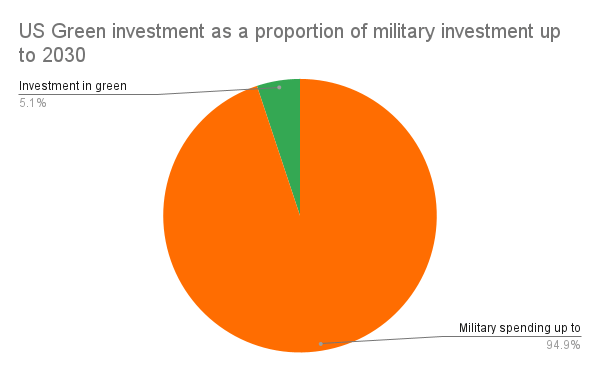
On current government spending, the US is putting fourteen times as much into its military as it is into domestic green transmission, and is encouraging its allies to increase theirs too; which they are doing.
The economic context of this is that, because globalisation now favours China not the US, the US is “decoupling” from it and pressing its subordinate allies to do the same, while screwing them over at the same time.
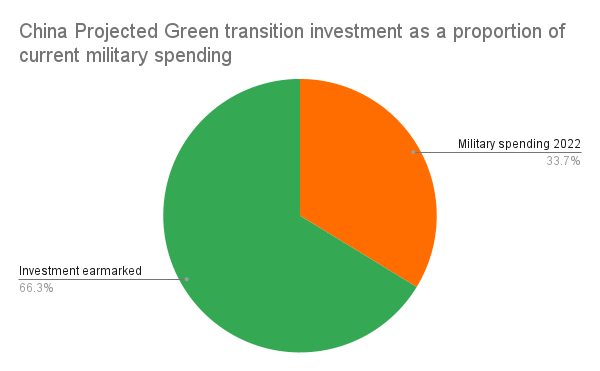
China, by contrast, is spending more than twice as much on green transition as on its military. More precise look at these figures here.
China’s is the right priority for every country because of the scale of the problem. Reports that the 1.5C limit is fast getting beyond reach should be a klaxon going off in all our heads. Not an invitation to fatalism, which will be fatal, but to redouble efforts to accelerate the scale and speed of transition to limit the damage as much as possible.
The consequence of not doing so will be severe. In 2007 a joint report from the Centre for Strategic and International Studies and the Centre for a New American Security entitled “The Age of Consequences: The Foreign Policy Implications of Global Climate Change” made this prediction for the impact of the kind of climate breakdown we could be heading into.
“Governments with resources will be forced to engage in long, nightmarish episodes of triage; deciding what and who can be salvaged from engulfment by a disordered environment. The choices will need to be made primarily among the poorest, not just abroad but at home.”
That’s what we have to avoid, and the Labour movement has to take a lead in making sure we do. Not least because if we don’t the widespread anxiety about the future will give rise to wilder and wilder versions of the tsunami of irrationality we are already seeing, with severe consequences as climate crises bite and people seek false solutions. We should note that the capitalist class, which emerged historically– in its own head at least – as champions of reason and enlightenment – are going down promoting collective insanity; Q Anon and on…The only question is whether they take us with down them.
Socialist solutions are needed because, as the FT noted recently “The Free Market will solve the Climate Crisis – but not in time”. This is even recognised in the Skidmore Review of the government’s Net Zero “Strategy” which notes that the state has to provide clear goals, legislative frameworks and sufficient investment for any transition to be viable. The US Inflation Reduction Act has taken the same approach, which has now prompted the EU to follow suit, streamlining investment procedures, resetting regulations and priming green pumps.
This is better than letting the market follow its financial nose while hoping for the best, but its still within a framework in which it is the job of the state to provide the conditions for private sector profitability – with that profitability being the determinant of whether a transition takes place or not.
This won’t be good enough – which brings us back to China.
In the context of the second phase of the Wars for the New American Century, and the great decoupling that goes with it, China will not get a good press in this country; and the dominance of a set of negative narratives relentlessly repeated means that relatively few people, even on the Left, will give it the benefit of the doubt.
This sometimes takes the form of extreme cognitive dissonance. A recent Labour Party Foreign Policy Group Report said that China’s success in poverty reduction for 850 million people in the last half century was “perhaps the single most significant contribution to human wellbeing in world history.” but then goes on to argue for technological, commercial and academic disengagement from, and military preparedness to confront, the country, people and Party that produced “perhaps the single most significant contribution to human wellbeing in world history.” A similar view is common in the climate movement.
So, on climate, does China get it? Beyond Xi Jinping’s speeches about the need to build an ecological society and for global cooperation to achieve it – a concern that predates him becoming General Secretary – there’s what China does domestically, how it acts internationally, and how the two intertwine. I want to look at two key areas.
Energy Transition.
China is still heavily dependent on coal to generate power, but we should note that since 2011 the quantity of coal used every year has levelled off, while the economy has been growing dramatically.
Overall, China’s investment in wind and solar has been on such a large scale that it has made them a cheaper source of energy than fossil fuels, which is a crucial global life line.
The current (14th) Five Year Plan envisages a better connected grid with renewables at its core and coal relegated to a back up role.
The International Energy Agency and others project that China’s 2030 target for renewable power installation could be met by 2025, which indicates the sort of exponential growth that will be needed for China’s overall emissions to start dropping before the end of the decade.
The IEA assessment is also that the speed and scale of this drop will, exceed Western precedents.
At the same time, the decision to cease any funding for coal fired power stations as part of the Belt and Road initiative is estimated by the IEA to have the same beneficial effect as the whole of the EU actually getting to Net Zero by 2050. So, a massive deal.
That means that the energy development paradigm for those parts of the Global South where China is hegemonic will be via renewables. The “dash for gas” in Africa being pushed by the EU, and Tony Blair Institute among others, at the last COP is depressing contrast. They are selling this as a “transition fuel” for the continent, but its actually for export to Europe.
The city of Shenzen in Southern China replaced its entire 16,000 strong bus fleet with electric vehicles in 2016. London, with 8,000 buses, is going to take until sometime in the 2030s, and TFL is very good by UK standards.
In 2021 China produced 57% of the world’s electric vehicles and 77% of the batteries needed to power them. We should note in passing that the only gigafactory making EV batteries in the UK is part owned by a Chinese company. The debacle of build it from scratch startup company BritishVolt illustrates the difficulties of the UK model; which can’t compete with the level of subsidy that continental scale economies like the US and EU can put up, while its increasingly Sinophobic Foreign Policy posture will inhibit any inward investment from China, where this technology is best established.
The rapid development of China’s High Speed Rail Network has saved it from dependence on internal medium haul flights – of the sort that the US relies on and which were largely responsible for US carbon emissions rising again last year.
This is also and essential paradigm for Global South transport development through the Belt and Road initiative, which runs on rails.
So, Socialists in the climate movement have a number of tasks
To challenge disinformation about China in the movement and, as the saying goes, “seek truth from facts”.
Oppose the war drive and military spending, campaigning for financial and technological transfer to the Global South instead.
Oppose economic decoupling as detrimental to climate progress (a very clear example of which is that the trade sanctions imposed on Chinese solar panel imports by the US this year has led to a 23% drop in domestic installations – which is bad for emissions and bad for jobs) and seek win win global solutions on the context of the most rapid possible green transition.
Following on from the theme of the Tiny Tipping Points Blog, showing how China is exceeding the US and UK in key aspects of life even while having a far lower level of average wealth, in rankings produced by the 2021 Hologic Global Women’s Health Index
China appears at 14th on the list, with an overall score of 63, alongside Japan, Sweden, the Netherlands and New Zealand.
The USA is 23rd, with an overall score of 61, alongside Lithuania, Malaysia, Hong Kong, Belgium, Australia, France and Saudi Arabia.
The UK is down at 30th, with an overall score of 60, alongside Poland, Ireland, Slovenia, Kosovo and Kazakhstan.
This survey was carried out by Gallup during 2020 with “66,0000 women and girls (aged 15 and older) in 122 countries and territories and over 140 different languages to assess the multiple dimensions that contribute to women’s health.”
Every month. Dmitriy Kovalevich writes an update on the situation in Ukraine for the New Cold War website. What follows is a digest of some of his observations that jar most strongly with the unquestioned and unquestionable narrative that we are get from the media here and are therefore most likely to provoke thought and questioning.
The full Report is here and is well worth reading to get the detail behind each of these points.
Donetsk city and region remains even now under intense fire by the artillery and mortars of the Kyiv regime, generously supplied by Western countries.
Since the Ukraine coup of 2014, pressure on the Russian government to act in defense of Donbass has come from the millions of Ukrainians who have moved to Russia for safety as well as large part of the Russian population as a whole.
The basis for pro-Russian sympathies and influence in Ukraine comes not so much from any ethnic feelings (notwithstanding the fierce, right-wing and anti-Russia ethnic nationalism promoted by the governments of Ukraine) as the desire for greater social equality for the poorest in society. A significant role is played here by the social and economic conditions in Russia, which are far superior to those in Ukraine. The Russian Federation has much higher social assistance, pensions and salaries as well as low prices for electricity and heating. Ukraine, on the other hand, has been stubbornly following the recommendations of the IMF in recent years to subsidize and enrich local and foreign capitalist investors through the privatizations of state industries while cutting social spending.
In a random encounter with the Le Monde’s visiting correspondent, an elder resident of the city (Kherson) explains, “When the Russians were here, we had everything we needed and we were not afraid to walk in the street. Now we are just trying to survive!” Another says, “The Ukrainian soldiers are good for nothing, they don’t help us and only attract more shells.”
Ukrainian left-wing journalist Oleg…Yasinsky says Ukraine has become a model that is being tested for use in Western countries themselves. Social discussion and debate at the top levels of government and civil society are suppressed, while police, economic and cultural repression is waged against all dissenters.
Much of the humanitarian aid provided to Ukraine by the United Nations other international organizations ends up stolen. According to local journalists and aid volunteers, on average, about half of humanitarian aid arriving in Ukraine immediately ‘disappears’.
In December, Ukraine’s parliament passed a controversial media law allowing Kyiv authorities to shut down or block any media outlet without explanation and without a court decision.
Statistica reports that as of early October 2022, nearly three million Ukrainians have moved to Russia. (The pre-war population of Ukraine is estimated at 42 million).
The search by the Kyiv regime, targeting Ukrainians, for “collaborators and Russian agents” has been significantly expanded and strengthened of late. In addition, under this pretext, personal vendettas are being waged. Businesses with alleged ‘Russian links’ are being squeezed out in the Kherson/Kharkov region. Extortion is demanded to ‘remove’ criminal accusations against individuals for ‘collaboration’ with Russia. Arrests are even made for correspondence with relatives deemed to be suspect. The Ukrainian Telegram channel ‘Resident’ writes that the SBU has arrested some 4,000 civilians for the purpose of prisoner exchanges with Russia.
…the minister of finance of Ukraine, Serhiy Marchenko, argued that Ukraine finances only one third of its budget expenditures from its own revenues; the remaining two-thirds are provided by foreign sponsors and creditors. In other words, Kyiv is conducting hostilities clearly beyond its means, and the functioning of the Ukrainian state is now dependent on the generosity of Western partners. This amounts to a loss of sovereignty, making all of Ukraine into a sort-of private military company.
Billions of dollars have been shelled out by Western taxpayers to assist the Kyiv regime’s war, but Ukrainians will be left indebted for generations to come. Funds that could otherwise serve to make social improvements and lessen the assaults on the planet’s natural environment, in Ukraine and in the West, are being wasted.
The World Bank predicts that by the end of 2023, 55% of the population of Ukraine will live below the poverty line.
The only area where Ukrainians now consistently receive a respectable salary is the armed forces…
Western countries may rightly fear that in the event of an end to the military conflict in Ukraine, some one million unemployed male Ukrainians with experience in military operations will seek to emigrate to the West, looking for work. Many will be suffering the psychological disorders associated with war, and in the West they will find radical, right-wing Ukrainian paramilitary groups urging them to join.
In the period between Xmas and New Year the vibe in the local supermarket has changed even more rapidly than in recent years. The decs were all down – not even waiting until 12th night – and relentlessly upbeat music was playing. Even “Things can only get better” with no apparent sense of irony. Nevertheless, it works. Even as I am critiquing it in my head, I find myself bopping along to “Happy” with my shopping trolley. I look around and the only other person in the shop still wearing a mask is doing the same.
Watching the New Year Concert by the Vienna Phil, probably the whitest orchestra in the world, which is self consciously put on every New Year’s Day as reassurance that in a world of change, nothing changes. Three parts a static version of Last Night of the Proms to 2 parts Jules Holland’s Hootenanny. Even if the pieces shift round a bit from year to year, its all the same sort of music, and even though they actually finally let some girls from the Vienna Girls Choir sing with the boys this year – there were only a reassuring few, because you’ve got to take such wild experiments slowly and steadily so as not to scare the (Lipizzaner) horses. And the Blue Danube and the Radetsky March will always be played as encores, and in that order, with the emphatic last two beats of the Radetsky march ending on an emphatic “so there!” Thus, it was, and ever shall be. But not so of course. At the time they were written, those two beats were meant to affirm that, rise as the Italians might, Austria would stay in charge in Northern Italy – and the Habsburgs in the Hofburg – forever; and it didn’t turn out like that.
Its happy, frothy, beautiful music, sometimes accompanied by film of happy, frothy, beautiful – and impossibly clean – people doing swooping dances in classical surroundings dressed in impeccable clothes, or simulating a picnic with food that is visually delicious (this isn’t just food, this is Vienna Philharmonic food) but oddly fossilised, lacking in touch, smell, giving off a sense that the lush red strawberries were 3D printed, not grown in dirt, and with no sound other than the music – an impersonation of feeling in a replica heritage of a culture that died when the Empire did.
As Eric Hobsbawm pointed out, no one wrote Waltzes or Polkas in Vienna after the First World War. All the same, since 2014 at the 100th anniversary of the outbreak of the First World War, I have not been able to listen to the opening drum tattoo of the Radetsky March, calling all Kaisertreu men to arms with a jaunty innocence that it might all be over by Xmas, without welling up.
Although China has a nominal per capita income of just under a third of the US level in 2022 in PPP terms; since 2020 it has began to overhaul the US as a society in some key respects.
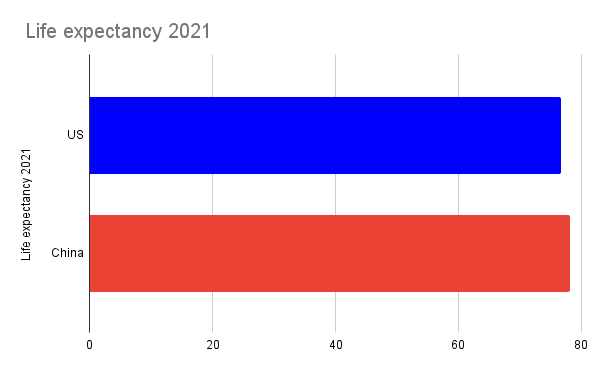
Life expectancy in China now exceeds that of the US by 20 months; at 78.2 years to the American 76.6. This might be dented this year by the current rise in COVID infections, but current indications are that the Zero Covid policy kept the population safe during the most lethal period, so the impact of opening up now will be qualitatively less than it was in the West.
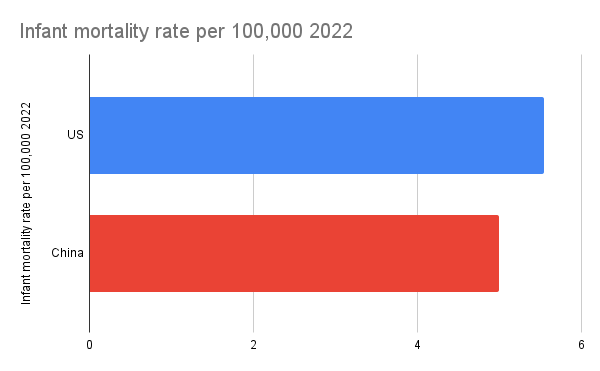
In China, infant mortality has declined to 5 per 100,000, now below the US level of 5.5 and the maternal death rate at birth is now substantially lower, at 16 per 100,000, compared to 24 per 100,000 for the US.
While this is improving but uneven in both countries, the rate of improvement is greater in China.
In the worst performing US State, Mississippi, infant mortality declined slightly from 10.1 per 100,000 in 2009 to 8.7 per 100,000 in 2019.
This compares unfavourably with Xinjiang, one of China’s least developed and poorest regions, where infant mortality dropped dramatically from 26.58 per 1,000 in 2010 to 6.75 per 1,000 in 2020.
At the same time, the maternal death rate more than halved from 43.41 per 100,000 in 2010 to 17.89 per 100,000 in 2020 – less than a third the Louisiana rate.
NB the figure for Louisiana is for 2021, that for Xinjiang is for 2020.
Beneath the brute figures of sheer size of economies – China’s has been larger in PPP terms since 2014 and is likely to be bigger in exchange rate terms by the late 2020’s – China’s largest firms are beginning to outperform those of the USA, with Chinese companies in the Fortune 500 Global list earning $11.71 Trillion last year, compared to $11.34 trillion for the US companies listed. 87 out of the 145 Chinese companies listed are majority, or wholly, state owned.
This is underpinned by increasingly ground breaking scientific research, with the Chinese share of the most cited Scientific papers (top 1%) having grown to 27.2%, surpassing the USA’s 24.9%.
The US model of development, dependent as it is on dominating and exploiting the rest of the planet, producing consumption patterns with an elephantine carbon footprint, is neither a viable path for other countries to follow – because no other country can dominate the way that it does – nor, as we can see above, does it produce the best possible outcomes for its population from the resources it commands. It is already an outmoded model of modernity.
Faced with a collapsing climate, the most powerful country on the planet is spending colossal sums of money on keeping the war in Ukraine going rather than seeking a peace, while only committing to a tenth of its $11 billion pledge to the Global South for funding to avert climate breakdown.
These figures show a set of priorities that spell disaster for humanity unless reversed.
On the way up to Northwick Park hospital on Friday, we passed through Kenton. As the rest of Brent North has become tougher and more workaday. Kenton has retained a tidy “my pink half of the drainpipe” quality where people are well off enough to keep keeping up appearances, keep their houses fixed and front drives clear for shiny cars that all conspire to keep the property prices up. Passing so many handsome detached houses, its still possible to image them populated by the sort of Tory granddames immortalised in Betjeman’s Metroland film (1973); all hatchet faces and horrible hats. Kenton is the one ward that has consistently retained three Conservative Councillors when the Party has been all but wiped out in the rest of the borough since 2010.
One sign of change is that the old Kenton Conservative Club, Churchill Hall, a hideous prefab mausoleum painted 8th Army orange – the venue for generations of young Conservatives to bond over games of ping ping, tea dances and pints of bitter (and twisted) – has been demolished; even as a wave of communalism among better off members of the local Gujerati community gives them an revival of a kind, incorporating “favoured” ethnic minorities in the way the Empire always did, and Anthropology Departments set up to theorise, but now as an aspect of domestic politics creating a kind of equal opportunities xenophobia. Suella Braverman, after all, grew up in Harrow and Wembley.
Going in to A&E in Northwick Park is always a bit daunting. Hearing a radio report recently about how many hospitals were now beginning to slip below the 4 hour limit for dealing with new arrivals, it struck me that 4 hours would have been a fast turnaround for our most recent visits. The staff are always lovely when they get to you, incredibly overworked and kind, the pressure they are under almost unbearable. In a last flicker of COVID precautions, masks now being worn by a minority, I am not allowed in with my daughter.
Walking up the corridor, I am passed by two medics of visibly different grades animatedly discussing ballots; giving a sense that the NHS staff are engaging in a mass collective struggle to save it and make ends meet.
An elderly woman being pushed, backwards, in a wheelchair, clutches a bottle of Lucozade – the convalescent strategies of the 1950s still alive and well it seems.
A bloke walking and talking on a mobile mutters “You don’t understand. You can’t eat an orange in one go”.
In another legacy of Covid precautions the Costa uses paper cups, but the harassed Barista trying desperately to work her way through a queue that keeps growing is too preoccupied to engage in a discussion about it.
The woman selling hand made jewellery along the back of the Costa tells me that the bright, glittery crystal hearts are very popular. Not surprising. They are shaped like love and look like hope. Not medicine, but what you’d want from it.
Waiting over in A&E, my daughter reports that the “Mission Impossible” theme has just been played, raising a few smiles around her. Reminds me of a physio appointment I once had during which the music in the background suddenly launched into the Volga boatman’s song – “Yo-Oh – HEAVE Ho”. I asked the Physiotherapist if it was a departmental theme tune.
Outside the main entrance to the hospital, someone has chained up this extraordinary small motorbike. A retro version of the electric bikes that are becoming more common, and alongside one of them. What the future looks like for petrol heads?
On Saturday, with S properly medicated and beginning to recover, I am sent in search of a wood yard with cutting facilities, which takes me deep into the Harrow part of Kenton to a dour and no nonsense establishment full of shiny drill bits lined up in order of girth, saw blades ordered by type and size, nuts, bolts, DIY power tools, some covered in dust to show that life is too short for cosmetic cleansing and a long counter, staffed shoulder to shoulder with serious looking men trying to keep warm in black fleece hoodies. While I am waiting for the 2 cuts on S’s plank of MDF that the colossal B&Q in Cricklewood couldn’t handle – “the cutting’s not available” – a bloke buying a lot of timber tries to get a bit of edging thrown in for free as a sweetener. He hits a brick wall. “Yes, but you’ll have to pay for that”. He tries to haggle a bit, but knows its a lost cause. The spirit of Mr Flint is alive and well in HA3. This is also apparent when I get my two cuts at £1 a cut. The bloke in charge of keeping tabs on orders hand writes a receipt for £2, writes PAID on it and circles it, handing it to me with an understated but definite flourish.
Walking back towards Honeypot Lane, one of the more hopeful sounding local thoroughfares, I realise that I have been to this area before. In the run up to the December 2019 General Election there was a mass canvas of these streets. A big detachment of the huge urban militia that Labour was able to field at the time spread out across the stony ground of these neat little bungalows seeking to squeeze a bit of red blood out of Tory stones by trying to drive more hope than an aging local electorate could cope with. This bit of suburbia clings on to Major’s conception of it.
I walk past the bungalow with the stone lions on every buttress where the elderly gentleman I spoke to barked at me “Do I LOOK like a Labour voter?” I said that we came in all, shapes and sizes, but it was downhill all the way from there. Actually, he looked a bit like me. Old, white, bald. But he didn’t feel like a Labour voter; and I expect still wouldn’t, however many Union Jacks the leadership stands behind them.
“Fifty years from now Britain will still be the country of long shadows on county grounds, warm beer, invincible green suburbs, dog lovers and pools fillers and – as George Orwell said – “old maids bicycling to Holy Communion through the morning mist” and if we get our way – Shakespeare still read even in school.” ~ John Major Speech at Conservative Party Conference 1993
Visions of the future as an eternal version of the past never wear well, especially in a period of late capitalism defined by the maxim “move fast and break things.” As Karl Marx remarked when capitalism was taking off beyond its North European cradle All that is solid, melts into air.
Thirty years on and some of Majors eternal bucolic vision is already looking a bit far gone.
Thanks to Major himself, the Football Pools were overwhelmed by the National Lottery that he introduced and were pretty much dead by the time he was turfed out of office just four years later.
There may still be some long shadows on county cricket grounds, but a lot more attention is paid to 20:20 and even when Major was speaking, cricket as such had long been supplanted by Football as a totemic national sport. A visions of crowds of the hoi polloi chanting obscene -if original – songs on terraces, while munching on meat pies and drinking Bovril, conjures an image of a different kind of country than that of chaps in whites languidly striking leather with willow in arcadian surroundings. Whish poses a question beyond “who do you think you are?”, which is “WHERE do you think you are?”
“Warm beer”? Although there are still around 40,000 pubs in the UK, they are currently closing at a rate of 50 a month, or 600 a year. At that rate, the last “Last Orders” would be called some time in 2088.
In a country now turning its back on formal Christianity at an increasing rate, “Old Maids” (ouch) cycling to Holy Communion through the morning mist” – which, for me, conjures up an image of Margaret Rutherford playing Miss Marple – are a rare sight. Major might not have understood that many of the single women Orwell was referring to were bereaved by the mass slaughter of young men in the First World War, which left a legacy of many single women in one generation and a deep reluctance to suffer such extreme loses ever again. You could still see this in an odd sort of way as late as the first years of this century in the ceremonial welcomes given by rows of silent people to the coffins of dead soldiers flown back from Afghanistan and Iraq being driven through Wootton Bassett during Blair’s auxiliary role in the opening stage of the Wars for the New American Century. Respect, but there’s a limit…
That phrase “Shakespeare still read even in school” indicates both the Tory suspicion of teachers as dubiously progressive thinking people who can’t be trusted with “the national heritage” as they want us all to imagine it, but also how poorly he understood just how subversive Shakespeare can be. Shakespeare will be read and watched and performed because he was a brilliant, funny, moving poet of a playwright who asks hard questions about power and humanity even in the midst of a seeming puff to mindless patriotism. The opening of Henry V, which for people on the right and far right is nothing more than a mash up of “once more unto the breach” and “we happy few” and sticking it to the French with arrows at Agincourt, is of a cabal of cynical Archbishops faking up a “legitimate claim” to the French throne to sell to the new young King; to divert his attention from helping himself to their land holdings. The version of this I saw at the Globe a few years ago had the discussion taking place with the plump, crimson clad prelates sitting on portable toilets, just to underline the point. I think the Tories like the heritage, but may not watch the plays themselves much.
As for the Conservative Party itself, it is now looking as endangered as it ever has and could well not exist in its present form by the time Major’s 50 years are up (2043). “Tis a consummation devoutly to be wished” (Hamlet) or as Richard II put it, talking of his dying uncle, John of Gaunt, “Pray God we may make haste…and come too late”.
There is no way to dress this up. If you look at the figures for investment in military spending as a ratio of investment in domestic green transition it becomes obvious what each country’s priorities are.
The agreed US military budget for 2023 is $858 billion. The investment in green transition earmarked by the Inflation Reduction Act is $369 billion between now and 2030. So, 858 multiplied by 8 years gives a total spend of $6864 billion by 2030. Divide that by the 369 billion to be invested in green transition and you get a ratio of 18.6:1. So, for every dollar spent on green transition in the United States, $18.60 is spent on the armed forces.
China’s military budget for 2022 was $229 billion, according to Jane’s. The investment earmarked for green transition – for a carbon peak before 2030 and neutrality by 2060 – is $450 – 570 billion a year, according to China Briefing. That gives a ratio of between just under 2:1 and 2.5:1, so on average more than twice as much being invested in green transition as on the military.
So, the US, eighteen times as much on the military. China, twice as much on greening. It’s quite obvious from this which country’s investment is more beneficial to the world making a viable transition to sustainability.
These calculations assume flat military budgets. An additional reason that none of us can afford the new cold war that the US is determined to pursue is that China will be forced to devote more resources to defence, which will slow the transition. A reduced US military budget, on the other hand, would allow both countries to transition quicker and allow greater cooperation to that end.



 Urban ramblings