Emotive Plagues instead of Analysis on Ukraine – A Reply to Présumey and Bekier.

The most recent apologia for a pro war stance on Labour Hub from Vincent Présumey and Stefan Bekier claims to be dispelling myths, but is transparently erecting many of its own. The most glaring is this statement slipped in towards the end. “This all-out war since February 2022 was in no way caused by NATO expansion or any aggression towards Russia on its part.” There is no attempt to justify this statement. It is simply an assertion. The most obvious rejoinder to it is that it does not look that way in Russia.

If an assessment of this war and the historical background to it has any prospect of being taken seriously, it is necessary to have some analysis of Russian motivation that goes beyond trivialised prolefeed notions that its all a manifestation of a belated mid life crisis on Vladimir Putin’s part or that Russia is inherently, timelessly imperialist, but one of the strangest things about the wall to wall coverage in the media here since Feb 24th last year has been how little of it has seriously examined why the Russians sent their troops over the border, and this piece is no exception.

Here is a list of why they did, from their point of view; which can largely be summarised as the massive increase in Ukrainian military spending and NATO military aid, training and technical assistance from 2014 to 2021.

  • The signing of a new military doctrine (2015) which explicitly named Russia as Ukraine’s enemy (in violation of the Ukrainian constitution).
  • The number of soldiers increased from 140k in 2014 to 250k in 2015, and then by 2020 with 900K reserves). Even without the reserves, this is three times bigger than the British Army and about half the size of that of the US! It is also, again, even without reserves, significantly larger than the force the Russians invaded with (around 150K).
  • The growth of the Ukrainian nationalist national guard from 15k in 2014 to 60k men in 2019. These included overtly fascist elements.
  • The ongoing war in the Donbass in which 14,000 people were killed, including over 3,000 civilians in the Donetsk Rebel Republics.
  • The ongoing flow of far right volunteers to fight in the Donbass.
  • US military aid alone amounting to almost $3 billion dollars by the end of 2021. This has, of course, been dwarfed since, with a level of expenditure comparable to what they were putting into Vietnam in the late 60s.
  • The presence of NATO advisers in military units along the frontlines in the Donbass, sometimes as contractors from western military security companies.
  • The presence of a large contingent of US intelligence officers in the headquarters of the SBU (Ukrainian intelligence service) in Kiev (according to former SBU chief).
  • Statements from senior Ukrainian figures (including a former Foreign Minister and the head of the armed forces) that discussed a future war with Russia, the targeting of Russian cities and power stations, and the annexation of Russian territory in the Kuban.
  • In that context, Ukrainian claims that they had developed and would begin producing long-range cruise missiles (2019). Not hard to see who they would be aimed at.
  • Statements by a senior Ukrainian politician that the Russian population of the Donbass and Crimea should be put in concentration camps following their ‘liberation’ by Ukraine.
  • Statements by various officials during 2021 that Ukraine would seek to acquire nuclear weapons, which substantiated a long-term far right desire for Ukraine to become a nuclear armed power.
  • Increasing verbal expressions of support for a future Ukrainian membership of NATO by senior western politicians.
  • The cutting of military-to-military relations between NATO and Russia in late 2021.
  • Recent admissions by Hollande and Merkel that they used the Minsk 1 and 2 agreements to buy time for the Ukrainian military to grow.
  • The cutting off of water supplies to Crimea and the Donbass, which affected the civilian population.
  • The January-February 2022 incursions by Ukrainian special forces into Russia and the shelling of border posts near the Donbass.
  • The massing of Ukrainian forces around the Donbass, which Russia interpreted as preparation for an invasion of the rebel provinces of Donetsk and Lugansk.
  • Border incursions by NATO ships in the Black Sea during late 2021.
  • The use of Ukrainian territory for flights by US reconnaissance drones and aircraft.

    And this is without considering the political context within Ukraine since 2014:
  • The post 2014 purging of the state, and the promotion of fascist nationalists within its institutions.
  • The glorification of Nazi Germany and its collaborators in Ukraine, and the justification of their war against the peoples of the USSR, by both the state (in education especially) and the media.
  • The effective banning of socialist symbols and imagery through the twin effects of a ‘de-communisation’ law and a law on extremist symbolism which clearly defined socialist symbols, left Nazi symbols undefined, and which was exacerbated by selective application only to Soviet symbols such as the red star and flag, the hammer and sickle and so on.
  • Allowing nationalists and fascists to create a widespread network of social organisations, youth movements and businesses which propagated fascist ideology targeting Russians, Russian-ness (what they call the ‘internal occupation’) and manifestations of ‘Sovietism’.
  • Legal and social repression of the use of the Russian language, including in the education and state systems.
  • The imprisonment and judicial harassment of opposition activists and critical academics, the assassination of critical journalists and social leaders.
  • The adoption of laws that equated dissent with ‘separatism’ and ‘sedition’, which meant that even calls for peace and a negotiated solution to the Donbass crisis became criminalised.
  • And the total refusal of NATO to even consider negotiating about any of this in the period between November 2021 and February 24th, during which Russian attempts to propose a mutual security arrangement that would have demilitarised the crisis were turned down flat, mobilisations were treated as bluff and concessions seen as signs of weakness.

This is not simply rationally calculated on the Russian side. but emotionally felt. If you were to walk down the Arbat in Moscow, you would pass poster sized black and white portrait photographs of the hundreds of children killed by Ukrainian shelling in Donetsk since 2014. This might be considered as emotionally manipulative as the coverage we have on the BBC, though it lacks Orla Guerin’s mordant voiceovers, but it makes the point that, in any war, no one has a monopoly on suffering. Coverage that downplays that of the other side, or attempts to ignore their motivation leads to decisions based on outrage and lack of understanding.

On the Left, those that support the escalation of this war rely a lot on emotive propaganda of this sort. The point of which is to emotionally short circuit awkward questions, rule out of consideration any awkward facts, with a fierce emotional response that has to feed on itself more and more as the war drags on, digging so deep into a trench that it becomes impossible to see beyond it. This necessarily leads to some weird rewriting of history to justify it and a realignment alongside the traditional Atlanticist right in the Labour Movement in their bloc with the British ruling class and their “Special Relationship” with the USA. Ukraine Solidarity is calling a conference next weekend with the aim of generating a “new internationalism” which will gather together the currents that prioritise targeting enemies of the United States.

The Presumey and Bekier piece also contains a number of very strange historical assertions that simply don’t bear scrutiny.

  • That 19th Century cultural figures like Gogol and Tchaikovsky were Ukrainian because they were born on current Ukrainian territory. I may be wrong here, but I don’t think that Gogol or Tchaikovsky considered themselves to be Ukrainian; or indeed, Trotsky, Khrushchev or Brezhnev, all of who were born in Ukraine, would have either. Identity is more complex than birthplace, and this kind of claim is crude, misleading and ahistorical.
  • The “specific Ukrainian and peasant revolution in 1917-1918” occurred within two broad developments; an attempt to set up Soviet Republics in the Industrial South and East and an attempt to set up a nationalist regime under Petliura in the rural West. In the Civil War that followed the Russian Revolution, the Petliura forces distinguished themselves by carrying out even more antisemitic pogroms that the Whites, who were hardly restrained on that front. That political division from 1917 to 1921 reflected the split between urban/industrial and Russian speaking on the one hand and rural and Ukrainian speaking on the other, and has been broadly replicated in voting patterns within modern Ukraine since 1991.
  • The existence within Ukrainian nationalism of left wing currents is taken to imply that the movement itself was overall leftish or progressive and still is. This does not look reality in the face. All national movements are diverse, but the question is, which current is dominant/hegemonic and why, (which relates to where such movements get their external support from), Given that Ukrainian nationalism’s core was in Western Ukraine, gaining sustenance initially from the Habsburgs, then later the Nazis is why even Presumey and Bekier have to concede points like “The majority of the ‘Banderist’ forces (in fact split into several armed factions) actively engaged in anti-Semitic genocide” and “Ukrainian peasants, while they were oppressed for centuries, undoubtedly had their own victims: the Jews, and a substantial part of the population had been favourably disposed towards, and even participated in, the Shoah” and today “a part of the oppressed Ukrainian youth has internalized the stigma and turned it around, taking up Banderite or Fascist emblems and flags.” While this is not original sin, there is no doubt that it is an accurate description of what the dominant current in Ukrainian nationalism has been, and still is.
  • The 1991 independence referendum is taken as still an accurate reflection about which state the peoples in the Donbass and Crimea want to be part of, without reflecting that at that time it was considered feasible to have a binational state with equal rights peacefully coexisting with Russia on the one side and the EU/USA on the other. Rather a lot has happened since then, and it no longer is.
  • The description of the 2014 crisis presents the Maidan movement as purely popular and anti oligarchic, with ne’r a whiff of Western intervention misses both the role of the US and EU and the reaction against it in other parts of Ukraine, which was equally popular. Putting “colour revolution” in inverted commas for the earlier movement of 2004 is of a piece with this and the statement about NATO having no role in the crisis. The most powerful actor in these crises is painted over, ignored, looked at and not noticed. Its as if it wasn’t (and isn’t) there. The movement against the results of the Maidan in the South and East is presented as though it had no popular support. This is an equally serious evasion of reality that makes a mockery of the fact that over 3,000 civilians have been killed by Ukrainian army shelling and thousands of Donbass residents have been actively fighting the Ukrainian Army since 2014 in the Donbass militias. They have a memorial garden in Donetsk City to all the children that have been killed. And these kids are just as dead as any killed in Western Ukraine. They won’t get the full Fergal Keane treatment on the BBC, but they are just as dead. While Donetsk holds these graves…So, any attempt to get a peace settlement has to take their rights into account as much as those of people in Western Ukraine. There is a distinct sense that Presumey and Bekier don’t think they should and that “pro Russian” forces and currents deserve everything they get for being “pro Russian”. It being OK to ban Parties, close down media outlets and even take reprisals against individuals because they are “pro Russian”. In taking this position they concede that “pro Russian” forces are sufficiently present to require such repression, which ought to make them wonder why.
  • This is also expressed in their attempt to downplay the Odessa massacre – nearly 50 people burnt to death – with a piece of nit picking about what the name of the building they were burnt to death in was, and that the people killed were “pro Russian” not just “trade unionists” as if that makes it OK somehow. They were still burnt to death. At the hands of a right wing nationalist mob.
  • If anyone thinks the Azov battalion have been sanitised, have a look at some of their films. The influence of the far right is not demonstrated in their showing in elections but by what role they play in the state. This assertion “the ethnic or culturally exclusive conception of the nation, expressed by the extreme right-wing currents claiming to be more or less Banderist, has in fact been in retreat since the Maïdan surge of social self-activity in favour of a democratic, inclusive and civic conception” is the direct opposite of the truth. Consider these points from Freedom House, quite a right wing source, from 2018. After Ukraine’s 2014 Euromaidan Revolution and Russia’s subsequent aggression, extreme nationalist views and groups, along with their preachers and propagandists, have been granted significant legitimacy by the wider society. Extremist groups are, however, aggressively trying to impose their agenda on Ukrainian society, including by using force against those with opposite political and cultural views. They are a real physical threat to left-wing, feminist, liberal, and LGBT activists, human rights defenders, as well as ethnic and religious minorities. In the last few months, extremist groups have become increasingly active. The most disturbing element of their recent show of force is that so far it has gone fully unpunished by the authorities. Their activities challenge the legitimacy of the state, undermine its democratic institutions, and discredit the country’s law enforcement agencies.
  • The notion that Ukraine since 2014 has been primarily characterised by ” the self-organisation of civil society” misses both this and the overarching pattern of privatisation in both industry and agriculture that has gained pace since then; and which the agreement signed between President Zelensky and Blackrock will copper bottom it if Ukraine “wins”. Negotiations with the EU on a path to Ukrainian membership have been marked by complaints from the EU that Ukraine is diverging from EU standards on labour rights and environmental standards and corruption is rife and deep rooted, with twice as many Ukrainian Oligarchs named in the Panama papers as the next most corrupt country (Russia). President Zelensky was one of the people named. This was leading to a structural crisis in which 600,000 people, mostly men, were emigrating every year, both to find better prospects and avoid being conscripted and the economy was close to collapse according to the Finance Minister speaking in January last year.
  • As “the essence of montage is conflict” these two sentences coming one after the other create a dissonance that the authors seem unaware of. There is an oligarchic faction behind Zelenskiy – that of Kolomoiski, of Dnipro, which financed his studios – but he will emancipate himself from it. He began by trying to move towards the implementation of the Minsk agreements, before backing down. Funny kind of “emancipation”. As with an earlier statement about the supporters of the Orange Revolution being deceived by the politicians it had put in power, this is noted without examination, the better to move quickly on. That Zelensky was elected on peace ticket accounts for his landslide win over Poroshenko. But the way that he was rapidly brought to heel by both the far right and the US and carried on with the war as before is passed over in silence.

Their summary – that the Russian intervention is a “genocide” – that to Russia “Ukrainians can only be Russians or dead” is the complete nonsense of people made delirious by their own rhetoric. The Russian war aims are for a demilitarised Ukraine that is outside NATO and without far right influence, was initially for autonomy for the Donbass but is now for its incorporation within the Russian Federation. That is still a reasonable basis for a peace settlement that could begin to ratchet down tensions and allow people to live, if not together, at least side by side.

Not settling on this sort of basis begs a number of questions, which no one from Ukraine Solidarity ever addresses. As Russia has military superiority and the supply of NATO arms at the current rate isn’t stopping them making slow but definite military progress, at terrible cost in casualties on the Ukrainian side, and with increasing damage to infrastructure like power stations and railways, USC has called for a specific escalation of arms supplies. So, as they think the reconquest of the part of Ukraine that does not want to be part of a nationalist Ukraine is a justifiable objective, they should answer these four questions;

  1. How much additional weaponry would be needed to do it?
  2. How would this be paid for, and what else would be sacrificed to do so?
  3. Do support escalating beyond nuclear thresholds, which the Americans have already broadly concluded it would be crossed if there were an attempt to reconquer Crimea?
  4. What would be the impact of the prolonged war that such an extension of military supply would entrench be on what’s left of Ukraine and the people who live there?

Give a little to NATO, and you end up capitulating a lot.

Breath taking hypocrisy from one of Yesterday’s Men.

Boris told such dreadful lies

It made one stare and stretch one’s eyes.

The (Right) Honourable Member for Uxbridge, who can occasionally be spotted sprawled in an entitled somnolent slump across several green benches in the House of Commons, like a haystack made of melting blubber*, is trying to restore his broken political fortunes by opposing clean air in Outer London. 

Even though 85% of cars in outer London already meet ULEZ standards, Johnson is trying to whip up a “they are coming for your cars” reaction among suburban drivers on a par with the NRA’s campaigns against gun controls. “You will take my steering wheel out of my cold dead hands…”

He says that the ULEZ expansion scheduled for the end of August is unnecessary because Outer London does not have a problem with polluted air.

There is a skill taught in Public Schools called “oiling”. Future masters of the universe are taught to speak complete self-serving BS with such insouciance and self confidence that, even if they’ve just made it up, most people will believe them. Johnson has been found out so many times that people now see though him for the most part; which is why those in the Conservative Party who think he would restore their fortunes if hoisted back into Downing Street are such desperate fantasists, but its a useful exercise to show just how wrong he is.

You can test this on the addresspollution.org site on which Imperial College analyses air quality in each post code. Checking three postcodes at random in Johnson’s own Uxbridge constituency reveals one (UB8 1GW) at the 98th national percentile (only two points off being as bad as you can get) and breaching 3 WHO limits. Another (UB8 2DL) is in the 93rd percentile, another (UB10 9LD) is in the 91st, but both also breaching 3 WHO limits. Another (UB8 2DL) is in the 93rd percentile, also breaching 3 WHO limits.

The health consequences of breaching these limits are listed on the site as follows.

Pollutant one: PM2.5

At this address, the annual average of the pollutant PM2.5 is 12.73mcg/m3. The World Health Organization limit is 5mcg/m3.

This study shows 19.9% of strokes were attributed to exposure (for a year or more) of PM2.5 concentrations exceeding 10mcg/m3.

PM2.5 can also cause asthma, jeopardize lung functions and promote cancer.

Pollutant two: PM10

The reading for PM10 at this address is 20.59mcg/m3. The limit is 15mcg/m3.

Exposure (for a year or more) to 20mcg/m3 leads to increased risk of total, cardiovascular and diabetes mortality.

PM10 can cause wheezing, bronchitis and reduce lung development.

Pollutant three: NO2

The reading for N02 at this address is 39.88mcg/m3. The limit is 10mcg/m3.

Exposure (for a year or more) to 40mcg leads to a 11% increased risk of disease related mortality.

There is also strong evidence to suggest it leads to respiratory symptoms including irritation, coughing, shallow breathing and difficulty breathing.

A comparison with Inner London is instructive. NW1 3UD is on the Euston Road. It is in the 99th percentile, NW3 3RE is in the 94th and NW5 4LS in the 92nd; all in the same range as Uxbridge. All breaching the same three WHO limits and all with the same adverse health effects.

So, Outer London does have a polluted air problem and, if Johnson were serious about the need to support people hit by a cost of living crisis exacerbated by governments he has led or supported, and the difficulties faced by people forced to commute into London in old bangers because they have been driven out of the city by the soaring house prices and rents that he was content to let rip as Mayor, he should join Sadiq Khan in demanding that the government match fund the scrappage scheme to support them, in the way they have been prepared to do in Bristol, Bath, Birmingham and Sheffield.

But, I’m not holding my breath…

*If anyone finds this offensive, please be reassured that this is in the same post modernist jokey spirit as Boris Johnson’s Daily Telegraph columns and can’t possibly be taken seriously.

14 Questions for John McDonnell (and others) on Ukraine

John McDonnell’s article for Labour Hub The Ukrainian Question for Socialists has so many missing dimensions its hard to know where to start. It is a story with a middle, but no explanation of the beginning, nor any projection of where the course of action he supports might end.

John’s judgement on the war is oddly flat, missing whole dimensions of the conflict and lacking any sense of causation beyond a kind of moralism, the 21st century equivalent of WW1 “German War Guilt”. The assessment of the conflict as Five Wars in One in the most recent New Left Review Editorial gives a fuller picture, every aspect of which has to be grasped to understand the dynamics of it.

  1. There is a civil conflict within Ukraine itself.
  2. The Russian intervention after February 2014, which NLR defines as having “a double character”, interventionist against Ukraine, and defensive against NATO at the same time, leading to
  3. A Ukrainian war of national self defence combined with
  4. What former CIA chief Leon Panetta describes as a “proxy war” against Russia carried out by the US using Ukrainian soldiers on the ground, but also imposing global sanctions that have had a terrible blowback on food prices in the Global South and energy prices in Europe. NLR describes this as “unambiguously imperialist” in that “it aims at regime change… (in Russia) …and the assertion of American hegemony over the Eurasian continent”.
  5. “The prospect of a Sino-American conflict, the real focus of the last three administrations in Washington, is the final lock determining the Ukraine war’s dynamic”.

John only looks at 3 and half of 2. Does he recognise that he’s missing the determining forces driving this process?

In the context of a “civil war in Ukraine itself”, John’s article acknowledges fighting since 2014, but does not acknowledge that there is any popular legitimacy in the pro Russian side of the civil war. This disorients him from the off, as important facts have to be denied to maintain his posture.

The Guardian last week quoted a Ukrainian junior officer fighting around Vuhledar on the southern Donetsk front complaining that troops recruited locally didn’t want to fight. Most Ukrainian troops are conscripted. Some are unwilling. Aleksey Arestovich, an adviser to the office of the Ukrainian president, said in January that many Ukrainian soldiers fighting in Soledar simply fled and there were “a substantial number” of refuseniks who declared they “cannot fight any longer in this terrible war”. Arestovich said, “We have people who refused to dig trenches, and when they were led into ready-made trenches, they just stood still. Many said the enemy (Russian soldiers) were too close and it was better to move several miles back from the front lines.” This has meant that that month President Zelenskyy in January signed into force a punitive law introducing harsher punishment for deserters and wayward soldiers, even stripping them of their right to appeal.

At the same time Ukrainian dissident Dmitriy Kovalevich reports that refugees and residents in the south of Ukraine …are attending protest rallies organized by the wives and mothers of servicemen.

Perhaps more significantly, the soldier in Donetsk went on to note that “about half” of the local population was “pro Russian” anyway. Does John acknowledge this?

NLR describes the uprisings that led to the formation of the Donbass People’s Republics in 2014 like this.

  • After the Maidan events “opposition to the new government was broad. In late February, some 3,500 elected officials gathered at an anti-Maidan conference in Kharkiv. The following day, the Kiev parliament repealed protections for Russian as a regional language. The anti-Maidan uprisings in Eastern Ukraine copied the Kiev model of occupying central squares and taking over government buildings. The security forces were also divided; in some areas the local police made no effort to stop the anti-Maidan protestors. In cities like Kharkiv or Odessa, Kiev’s authority prevailed. In hardscrabble towns like Donetsk and Luhansk, popular militias made up of miners, truck drivers, security guards and the local unemployed stormed the regional-administration offices and declared peoples republics…”

In Odessa, Kiev’s authority “prevailed” through far right thugs trained in from the capital for a football match burning down the local trade union HQ with anti-Maidan protestors inside it, killing nearly 50 people. Is John unaware of this?

This division in the country is widely recognised inside it. NLR notes a student in Kiev remarking of workers rebelling in the Donbass, “They can’t help it. They’re all Sovoks over there”. Sovoks being a term applied to people nostalgic for the Soviet Union. “All Sovoks over there“. Does John think that these people should be occupied against their will?

In the context of this civil war since 2014, has John not noticed the steady stream of fighters from the European and North American far right who have signed up to fight in the Donbass, and get tooled up for future fights at home once they’ve gained the combat experience? While John mentions people in Ukraine that he knows and identifies with who are not like this, there are a lot of people fighting on the Ukraine side who are; some of them local, some from all over in a kind of fascist foreign legion.

John also does not note what happens when the Ukrainian army reoccupies an area and carries out “cleansing” operations against “saboteurs and collaborators”. Some of the dead bodies are posted on Instagram. Is that ok?

The same applies to Crimea. I don’t think there’s anyone even amongst the most gung ho Ukraine Solidarity Campaign supporters who argue that the population of Crimea is clamouring to be reconquered by Ukraine.

And there is a recognition now being freely expressed by the United States that, given the concentration of Russian armed forces, including nuclear weapons, on the peninsular, pushing to retake it could trip over the threshold into nuclear war, so best not try. Would John agree with that assessment, that surrendering territory will be necessary to avoid of tripping nuclear thresholds?

If so, would he be prepared to concede that this is a principle that may have to be applied more broadly; and that there is no level of escalation that is capable of reconquering the Donbass without pushing through nuclear red lines; so that has to be ruled out too?

In the first month of the war, President Zelensky called for a NATO enforced No Fly Zone. Arguing for Ukraine to be able to “defend” itself with all possible means would imply support for that. As this is an obvious invitation to Armageddon, it hasn’t been taken up, so far. Am I wrong to presume that John would be against that?

I hope so, but he doesn’t mention it, so its hard to say. The problem is that that’s where we are heading. The latest USC statement – signed by John – lists lots of additional sets of equipment that could be supplied by the British Army, including fighter jets. Where does this end?

Its important to be clear on this, because starting from the need to pull back from escalation to World War 3 requires the Labour movement to push for peace and a negotiated settlement, rather than going along with the step by step escalation in munitions. And pressure for that has to start with the Left.

There is a domestic dimension to this too. The UK government and Labour front bench support an increase in military expenditure at a time of collapsing public services and impoverishment of the working population. That means “hard choices” to build up the military at the expense of the population in a country that already spends more on it than any other country in the world apart from the USA, China and India. In fact the per capita burden on the UK population is already double what it is for Russian citizens and five times that on the Chinese. Does John support that?

To have an idea of how this could end short of escalation to mutually assured destruction, you need to go back to why it started in the first place and how it could have been avoided. John does not examine this at all. He just gives the invasion a pair of labels – “illegal” and “imperialist” – and leaves it at that. Any closer examination can’t help but look at NATO, and whether the Russians have any legitimate security concerns about it. I wonder if John thinks they do? He doesn’t say.

Just taking the months in the run up to 24th Feb,

  • the Russians were asking for NATO to rule out Ukrainian membership and for mutual security guarantees that could defuse the crisis – and implementation of the Minsk accords that would have gone some way to restoring a peaceful modus operandi; with autonomy within Ukraine for the Donbass Republics.
  • It also would have allowed Europe to sustain its supply of relatively cheap Russian natural gas, instead of being forced to buy expensive LNG from the USA and Qatar.
  • Just to spell out the obvious, NATO outspends Russia on its military by a factor of 19 to 1 – and that’s before the current proposed increases.
  • NATO is the core alliance of global imperialism centred on the USA.
  • “The West” is the same place as “The Global North”. It has armed forces to maintain its system of global dominance and exploitation.
  • Russia has never been included in this core because doing so would set up the potential for a Russo German bloc that would edge the USA out of its dominance in Europe.
  • So, Russia is not at the table (despite asking to be let in on numerous occasions). And, as they say, if you’re not at the table, you’re on the menu.
  • What this might look like is Dick Cheney’s 1991 plan to balkanise Russia into three more easily manageable countries, the European part, Siberia and the Far East.
  • A less drastic bottom line might be the replacement of Putin with a more compliant oligarch who knew his place in the US world order. more like Yeltsin.
  • The Russians are acutely aware of this. Which is why they feel under threat. And why the Ukrainian oligarchy being so eager to sign itself up as a US henchman in NATO feels like an existential threat.
  • The refusal of NATO to even discuss their proposals, couldn’t help but confirm the impression in Moscow that NATO was preparing for war.

Does John think that these concerns on the part of the Russians should have been negotiated about then and, more to the point, should addressing them be an essential aspect of any attempt to secure peace?

We should be clear here that framing the war as simply one of national defence in which NATO is just helping out, implies that the tail is wagging the dog. The power in this situation is in Washington not Kyiv. The Americans are now beginning to argue about the risks, costs and advantages of a long war versus a short one with a diplomatic off ramp. This is all within the framework of US national interests of course – which the UK political establishment will go along with; whatever it is.

The phrase “proxy war” was coined by Leon Panetta long before anyone in Stop the War started using it. But whatever its origin, it is a very accurate description of what’s happening. All the finance for the war and to sustain the Ukrainian state is coming from NATO powers. All the training for the army, targeting for missiles and artillery systems, is coming from NATO too. The USA will be perfectly happy to destroy Ukraine in order to save it. Does John not realise that that is what his position is supporting?

John’s call for a new Marshall Plan to rebuild Ukraine is the opposite of what’s on the cards. Since 2014 Ukraine has become increasingly neo liberal, with “Sovok” holdovers in state property sold off to multi national capital, including Monsanto in agriculture and negotiations around EU convergence noting that Ukraine is moving away from EU standards on regulations and labour standards. Were it to be fast tracked into EU membership it would act as a Trojan Horse to undermine them in the rest of the continent. The plan for reconstruction agreed at Geneva last Autumn sets Ukraine up to be asset stripped, with Blackrock presiding over the dismemberment. Fighting for a “victory” for the Kyiv government, is fighting for that.

The views of the Social Movement will count for nothing in that context. Does John really think that because there are small groups of left wingers who wanted to be part of the Maidan -but were marginalised and driven off by the right sector – and have opposed the neo liberal dystopia that Ukraine has become – but failed to make any headway – and are hoping that, in the event of a military victory by the world’s most powerful imperialisms, they will be in a position to move the country towards “socialism” that this is remotely realistic?

20 minute neighbourhoods ; an “international socialist conspiracy”… by Sainsburys?

It takes a particular kind of weird right wing mind set to cast a need to drive long distances breathing in pollution from the exhaust pipes of the cars in front just to get to the shops, or a playground, or your kid’s school as a kind of “freedom”.

Cars have become the main form of travel in the UK in the last 60 years, which is now leading to serious problems.

Take London. London’s 2023 population is just over 9 million people, on a land area unchanged since it was 8.3 million back in 1950 and it is projected by the GLA to grow to 10.3 million by 2050 in a period in which London’s green space is due to expand from 40% to 50% of the metropolitan area. All those people have to live and work somewhere, and they have to get about, and they have to have ready access to all the things they need to make life bearable at least and enjoyable at best.

Unless London is to break through the greenbelt and sprawl across the Home Counties like a Northern European version of LA, that means higher density populations living closer to the amenities they need, cutting down on the need to make unnecessary journeys and public transport hubs so that longer distance travel is facilitated without car use. That does not imply, far right conspiracy theorists please note, people being walled into neighbourhoods or forbidden to travel out of them. it means facilitating it so they don’t have to: thereby reducing personal costs and stress as well as pollution amongst other things. If those extra million and a half people all had cars, as about half of Londoners currently do, there would be nowhere to put them and no prospect of them being able to get from A-B, let alone Z. We should note that LA itself, the model city for low density urban sprawl slung together by freeways – which, right wing conspiracy theorists please take note, acted as barriers slicing communities into fragments that were hard to get out of, especially without a car, leading to all sorts of other malign effects – had to start investing in its now very popular and extensive metro system because the morning gridlock in the early 1990s was beginning to merge with the evening gridlock.

There are a lot of examples of this in North West London. There has been a huge development of solid looking new flats on the site of the old Hendon Police College. Over 1600 of them with a school in the middle; which no one needs to drive to to drop their kids off. There are some parking bays, but this whole new town has not been built on the assumption that everyone will own a car or have to use one to get out to work. This is because there is one road alongside of the site – and no option for another – this would simply clog up if everyone tried to travel by car during rush hour. On the other hand, the Northern Line is within walking distance; as it is to a comparable number of new flats that have been built around Colindale Station, complete with amenities, shops, cafes, restaurants etc.

There are similar developments all alongside the Edgware Road. If everyone living in all these new flats owned and used a car, even the mighty A5 would just get clogged in a stationary stream of fuming metal. No one would be able to get anywhere in rush hour, and the already grim levels of pollution would be even more character building than they currently are.

One of the most striking of these is the local Sainsbury Megastore. Built about 20 years ago as a classic suburban big box supermarket with a car park for 462 vehicles – on the presumption that a lot of shoppers would drive in and load up for a big weekly shop – this is now being redeveloped so that the car park will shrink by over half, and most of its space will be occupied by flats. 1300 of them. Car parking space will only be available for around a quarter of these. The Hendon Thameslink station is within a five minute walk and the Northern Line within ten minutes by bus. About a quarter of residents are projected to use the tube, others may work locally or from home or use the bus or cycle. Improvements for pedestrian and cycle access to the Thameslink station are part of the planning with input from TFL The loss of car parking space for the supermarket will be more than compensated for by having 1300 homes alongside or, in some cases, literally on top of the store. It obviously won’t be compulsory for residents to use it, and other supermarkets are available for anyone who wants to head up the Edgware Road because they really like Asda or Morrisons, but most people will probably just pop down to the nearest.

This is one aspect of a 20 minute neighbourhood. If this is an “international socialist conspiracy” it has a fairly hard nosed capitalist instigator.

One caveat we should note is that the initial plans by the developers had a somewhat higher number of car parking spaces both for residents and supermarket, on the presumption that the better off people who will buy the posher flats will assume they will be entitled to a car, so providing spaces is a way of maximising the returns they get on sales. This had to be pushed back by the GLA and Barnet Council as the level of traffic generated would be outside the limits set by the London Plan to allow what traffic there is to keep flowing. The usual conflict between private gain and social needs playing out here.

Here be Monsters?

Anyone who thinks that “respect” and “tolerance” are “Fundamental British Values” hasn’t spent a lot of time online. The review of Prevent by William Shawcross published on February 7th reflects the government’s alarm that referrals for right wing and racist views were beginning to outnumber referrals for Islamism by 2021. As well they might. Jihadist attacks have dropped off sharply. There have been none in the UK since 2019 and the ISIS Caliphate no longer casts any kind of bogus attraction to a community that has overwhelmingly grasped how malign it was, whereas there was a far right/Incel mass shooting of five people in Plymouth in 2021. Nevertheless, the Review has ruled out the growing concerns about the increasingly aggressive misogyny in Secondary schools, directed by boys influenced by the Incel movement against girls students and women teachers alike; even though it has increasingly gone beyond verbal abuse to violent attacks, killing 53 people across the world and injuring many more. By this definition, racism and misogyny are not worthy or referral, even though they are currently leading to the largest number of violent incidents and Prevent is supposed to be about stopping people being “radicalised” so that they commit such acts.

What’s quite overt about this is that racist views – by definition contrary to “tolerance” and “respect” – are considered by Shawcross and the government to be “mainstream right wing views” that are acceptable. Given that racist paranoia about “small boats” is one of the main knee jerk reactions the government is trying to hammer on to divert attention from its deplorable record in sustaining our living standards, not least by cutting the immigration of necessary workers, unless racism is taken out of the list of Prevent concerns, the government itself would have to be referred for grooming it.

Its hardly surprising that they should want to define themselves out of a situation in which, if Suella Braverman were in a classroom, she might find herself referred for the incendiary language that fuelled the people who firebombed refugee hostels in Knowsley and Dover. Braverman herself, who always comes across as someone living on the edge of nervous anger from having to control so many explosive contradictions in her own head with a rigid framework of far right paranoia, doesn’t seem to have twigged that the next step on from “Stop them coming” is “Send them back”. And, however much she tries to save herself by channeling pure gammon, the people she is winding up to violence won’t exempt her from the flights to Rwanda she says she dreams about.

The paradox of the government’s move is that it exposes Prevent as a divisive and “partisan” tool employed for limited political purposes, with some views demonised and others given official sanction, whether they contradict the FBVs or not. They are dropping the curtain and stand revealed. Here be monsters indeed.

Its a right of passage towards old age when someone young offers you a seat on the tube or a bus, which started happening a few years ago. When someone visibly middle aged does the same thing, as happened yesterday, you know you’re getting past it in a big way. What must I look like? And today, someone stopped their car to allow me across the road. OK, I was pulling a shopping trolley and wearing a mask, but I must be exuding a new level of decrepitude to bring forth such gratuitous courtesy.

This is the bust of late Rolling Stones drummer Charlie Watts that’s been on display in Kingsbury Library for the last couple of months. Watts, who definitely got old before he died in 2021, grew up locally in a now demolished row of houses off Fryent Way and went to Tyler’s Croft, the Secondary Modern School off Roe Green Park that became part of Kingsbury High School when Comprehensivisation went through well after he’d left; and my kids went to well after that. He is one of two famous alumni. The other being James Hanratty; the last man in England ever to be hanged. I see that the new Deputy Chair of the Conservative Party, Lee Anderson, would like to hang more people in the future on the invincible grounds that “nobody has ever committed a crime after being executed”. As an extra bonus, that includes all those innocent of the crime they were executed for.

The 183 bus route, run between Pinner and Golders Green in a striking display of cross border state ownership by the RATP (Régie Autonome des Transports Parisiens) has now been electrified. It feels like riding inside the future. The buses arrive swiftly, swoosh to a halt, then accelerate off again smoothly; without picking up any of the bad vibrations, rumbling, juddering, boggler, boggling you get with a diesel engine. Smells better too. At present it will take TFL, which is very good by UK standards and at least publicly owned, about another ten years to electrify all 8,000 of its buses. Shenzen, in Southern China, did all 16,000 of theirs in 2016.

Which makes the current wave of Sinophobia doubly sad and dangerous. We have things to learn from each other but, instead, we get stories designed to make us fear. A feature of the recent past is how quickly stories that first show up on really whacked out far right sites – the sort of places that combine racism and imperial nostalgia with adverts for hemorrhoid cream, and feature Nigel Farage as an embodiment of all of them – find themselves on the front pages of our mainstream press within a week or two. This one, complete with weird capitalisation, “China finds SHOCKING WAY to spy on you – and they’re already in your KITCHEN!” was replicated in the slew of headlines this week implying that use, in anything, of technology made by Chinese companies would allow surveillance by the CPC. This is weird. If Xi Jinping wants to know what’s in my fridge – and this is terribly important information for the 15th Five Year Plan – he will have to nudge Eric Schmidt, Mark Zuckerberg and Jeff Bezos out of the way, because they already know (and are using it to try to sell me stuff that I don’t realise I “need”). US based tech companies are also, of course, completely tied in the the National Security Agency, so, if Joe Biden wanted to know what’s in my fridge he could probably find out without too much trouble. If you want to be really paranoid about tech surveillance, read Surveillance Capitalism by Shoshana Zuboff. This is a bit repetitious, but reveals some quite alarming stuff, like the way interactive toys are sending messages about what a child says, and how they say it, back to the manufacturer and that devices like Alexa don’t just tabulate requests, but tones of voice…

Although I retired from teaching three and a half years ago, I still get classroom anxiety dreams. This morning’s was a classic. I was being driven in to school by a friend and everything was really relaxed until I got there – even though it was during morning break, so seriously late – and realised I was due into class in a minute and not only had no plan, but no idea what we were supposed to be teaching that week. Feeling far less panicked than I would have been if that had actually been the case I wandered into the classroom, getting a reproachful look from a younger version of BB, my old head teacher, who’d been covering, and asked what we were supposed to be doing. “Stories”. That’s ok. Everything is a story. Best to start with a question. As the kids drifted in chatting and sitting on the mat, I asked them “Where do you find a monster?” while thinking that wherever we find them, they are already in our heads…

Then I woke up and it was all a dream. THE END.

Shifting Sources of power generation in the OECD

The annual figures produced by the IEA on the OECD countries are a useful gauge of shifting sources of power generation. The OECD is made up of all the world’s richest countries; all of North America plus Columbia and Chile in South America, most of Europe, Japan, Korea, Australia and Turkiye.

Overall, between November 2021 and November 2022, fossil fuels still accounted for over half of all power generated, with renewables now up to just over a third and nuclear down to a sixth.

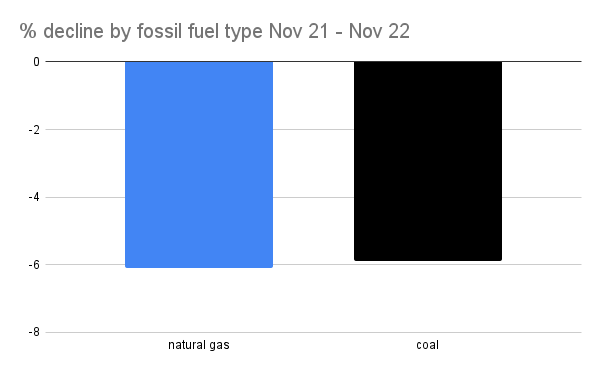
But, between November 2021 and November 2022 there has been a growth in the use of renewable sources of energy and a decline in the use of fossil fuels and nuclear.

Within fossil fuels coal and natural gas have both declined by about the same amount.

Within renewables there has been a dramatic increase in solar and a smaller but steady increase in wind.

The International Energy Agency has projected that 90% of new energy generation will be renewable by 2025. With the IPCC warning that 1.5C is slipping beyond our grasp unless we accelerate this trend sharply there should be no holding back on getting to 100% and eating into those big residual fossil fuel slices.

Four caveats

  1. These figures are just for the generation of electricity. This is a vital area, but fossil fuels are also in use for domestic heating and cooking (78% of homes in UK have gas central heating) transport and manufacturing. Energy generation has made faster progress towards sustainability than other sectors. Transport emissions in the UK, for example, have made no progress for over a decade.
  2. These are figures from the OECD. OECD countries are primarily those with high per capita climate footprints and the huge legacy of having generated the overwhelming majority of the carbon emissions that have led to the temperature rises we have seen to date. This is therefore not a full picture of the Global sources of energy use as it misses out most of the Global South. China has a large legacy use of fossil fuels but is investing in renewables on a significantly greater scale than the OECD.
  3. The OECD also has the capital and technical wherewithal to invest in renewable energy; but are denying this for the most part to the Global South, which is being impacted harder and deeper. On average African countries are already losing 5-15% of GDP a year due to adverse climate impacts, so having to run harder and harder to stand still. Global South countries are charged far higher rates of interest by banks if they want to borrow to invest in energy transition than Global North countries, which makes it hard for them to do so without being caught in a debt trap.
  4. The Global South, for the most part, has a very high proportion of traditional renewable energy (Hydroelectric dams) so the transfer of capital and technical expertise is vital for them to develop without reliance on fossil fuels. The decision by China to stop all coal power funding as part of Belt and Road is a huge positive step. The decision by the EU to classify gas as a transition fuel and encourage a “dash for gas” in Africa (to make up for the loss of Russian supply) is a step backwards.

Ukraine Dissident Digest 2: Casualties of a “Kamikazi State”.

Dmitriy Kovalevich’s monthly updates provide a strikingly different insight into the war in Ukraine from the received opinion/agreed narrative that the Western press sticks to. The italicised set of very revealing excerpts below might come as a shock to anyone just used to listening to the BBC or reading The Guardian. Reading it is like opening a closed book. The whole report can (and should) be read on the New Cold War site here.

Kirril Mochanov’s notion of Ukraine as a “Kamikazi state” reminds me of a comment in John Keegan’s History of the First World War; noting that the scale of the defeats suffered by the Austro Hungarian Empire by 1915 were so severe that past imperial practice would have led to swift peace negotiations and an attempt to salvage a truncated country with territorial concessions. Instead, locked into an alliance with the more powerful German Empire, the Austro Hungarians kept fighting until the end, by which time there was nothing left to salvage. This puts the relationship between the Ukrainian Oligarchy and the West the right way round, with those who are paying the piper calling the tune; and the Ukrainian people forced to do a dance of death on their behalf.

The first month of 2023 in Ukraine was marked by the defeat of Ukrainian troops near Soledar, …Ukraine suffered heavy losses in fighting around the city in January. It is continuing with the capture and forced conscription of young men on the streets of its towns and cities to compensate for its large military losses in Bakhmut.

Aleksey Arestovich, an adviser to the office of the Ukrainian president, said in January that many Ukrainian soldiers could not withstand the Russian onslaught against Soledar and fled. According to him, during the entire defense of the city there were “a substantial number” of refuseniks who declared they “cannot fight any longer in this terrible war”. Arestovich said, “We have people who refused to dig trenches, and when they were led into ready-made trenches, they just stood still. Many said the enemy (Russian soldiers) were too close and it was better to move several miles back from the front lines.”

The battle for Soledar also showed the eroding motivation of military personnel in Ukraine. Many of those being forcibly mobilized are showing no desire to fight. In mid-January, the Ukrainian media published a video in which Sgt. Igor Bondarenko, deputy platoon commander of the 60th brigade, berates his subordinate Ukrainian soldiers who had taken refuge in a residential building and were unwilling to fight. The video was filmed for the purpose of reporting to a higher command, which demands that military recruits be driven into battle by all necessary means.

The German magazine Der Spiegel, referring to German intelligence information, reported at the end of January that in and around Bakhmut alone, Ukraine was seeing hundreds of its soldiers killed every day. The Ukrainian Telegram channel ‘XUA-photo of the war’ has broadcast terrible film footage demonstrating the extent of deaths among the Armed Forces of Ukraine in the area. It comments, “Of course, the full scale of this tragedy needs to be documented in the future. On the front lines of Bakhmut-Soledar, the Ukrainian military command has displayed complete failure. There are huge numbers of deaths among the manpower of the Armed Forces of Ukraine.”

Pentagon chief Lloyd Austin told a meeting of NATO-country war ministers at the U.S. Air Force base in Ramstein, Germany at the end of January that a crucial moment in the fighting in Ukraine had arrived and Russia was gathering strength.

Russian military experts are once again noticing that Western media and politicians are constantly talking about “crucial moments” and “imminent turning points” in Ukraine...and…They see the West actively pressuring Kyiv to send more military recruits to the slaughter in order to achieve a ‘tipping point’ as quickly as possible. In contrast, Russian tactics involved orderly entries or exits from selected territories designed to wear down the Ukrainian army and economy while maintaining main forces in reserve in case of a major conflict with NATO in the future.

Against the backdrop of its serious losses, military conscription has intensified throughout Ukraine. Sometimes, it resembles the straightforward kidnapping of men of military age. Military commissars are increasingly trying to hand out summonses in the most unlikely and inappropriate places (albeit fully permitted legally), such as entrances to shops, in parking lots or at gas stations. Sometimes they resort to roadblocks.

Other subscribers from Odessa comment that men are brought to the military enlistment offices by ambulances and ‘Nova Poshta’ (delivery service) vehicles. Military commissars often go about their work in civilian clothes. Not everyone surrenders without a fight. “Near Kulikovo field (a neighborhood in central Odessa) in the courtyard of a nine-story building, two unknown people put up serious physical resistance to two “messengers of death” (as military conscription officers are called), as a result of which the young civilian men prevailed and the losing ‘military’ side lost their package of documents and money,” writes ‘Typical Odessa’.

The director of the Institute for the Study of the Consequences of Military Actions in Ukraine, Russian political scientist Kirill Molchanov, calls Ukraine a “kamikaze state”. He emphasizes that there exists another Ukraine, which is represented by refugees and residents in the south of Ukraine who are attending protest rallies organized by the wives and mothers of servicemen. According to him, these are the people who voted for Zelensky in 2019 because of his promise to end the nationalist dictatorship and the war in Donbass of his predecessor, Petro Poroshenko. (Poroshenko was elected in May 2014 as the suppression of opposition to the coup of February 2014 was already well advanced.) Molchanov argues that, “In order to get away from the Western-imposed role of Ukraine as a kamikaze state, a platform is needed to find consensus and develop a common vision for Ukrainians who disagree with Kyiv’s current course.”

The former commander of Polish Land Forces, reserve Colonel-General Waldemar Skrzypczak, …argued… for the mobilization of those Ukrainians residing in Western countries who managed to escape military service in Ukraine. When asked by a journalist that Ukrainians in the West probably do not want to fight, the general replied that their opinions do not matter. “Ah, so now we are going to ask them if they want to be soldiers or not? It is necessary to mobilize, draft into the army – and that’s all,” said the Polish general …and… the head of the IMF told the assembled faithful in Davos in January that the conflict in Ukraine is global, not regional. For the sake of this, hundreds of Ukrainians are dying every day in and around Bakhmut, and such losses are being replaced by forceful kidnappings on the streets of Ukraine.

The Balloon Goes Up!

Is it a bird? Is it a plane?

Amid all the fuss about the Chinese balloon floating over Montana – we should not forget that the US has 339 military surveillance satellites operating around the world; watching everyone and everything all the time.

They launched four of them in 2020 and, as Space Magazine reported at the time “It’s unclear exactly what the spacecraft will be doing up there.” Though I think we can work it out.

If every other country reacted to that like the US has to this balloon, no future summit would ever be able to take place.

Paranoia about Chinese technology is becoming another theme being pushed hard in the Western Press and on right wing sites. Here’s a headline from one of them. China finds SHOCKING WAY to spy on you – and they’re already in your KITCHEN! (their caps) Of course, if there’s someone from Chinese intelligence who wants to sit in your fridge to note the contents, he or she would have to nudge Jeff Bezos, Mark Zuckerberg and Eric Schmidt out of the way first. “Alexa! note down everything I’m saying”.

The US has also been developing balloon surveillance capacity of its own. Last May Politico reported that

Over the past two years, the Pentagon has spent about $3.8 million on balloon projects, and plans to spend $27.1 million in fiscal year 2023 to continue work on multiple efforts, according to budget documents.

And that

For years, DoD has conducted tests using high-altitude balloons and solar-powered drones to collect data, provide ground forces with communication and mitigate satellite problems. The Pentagon is quietly transitioning the balloon projects to the military services to collect data and transmit information to aircraft, POLITICO discovered in DoD budget justification documents.

Projecting just a little perhaps?

Socialist Solutions to the Climate Crisis – China

This is a slightly tweaked version of the talk I gave at the Socialist Solutions to the Climate Crisis meeting at the Marx Memorial Library alongside Dan Kovalic from the University of Pittsburg, Lauren Collins from the Cuba Solidarity Campaign and the Nicaraguan Ambassador Giselle Morales-Echaverry and chaired by Ben Chakko from the Morning Star. A film of the whole meeting can be viewed here.

What China does to tackle the climate crisis will have a huge impact on whether humanity succumbs to it or not.

This is partly because it

  • is already the world’s largest economy in Purchase Power Parity terms
  • has a population greater than that of Europe, North America, South America and Australasia combined; a four continent country
  • is a developing country that has developed very successfully
  • is now exceeding the US in the number of patents for new inventions filed every year
  • is a country run, not by the private sector interests that make the USA the best democracy money can buy, but by a Communist Party with 90 million members; whose project is to build Socialism with Chinese characteristics.

This is in a context in which the US – as the self proclaimed “indispensable nation” and “global leader” – the country for which the rules in the “rules based international order” are written – is failing spectacularly to lead the world in confronting its greatest existential challenge – the breakdown of the climactic conditions in which human society can continue to exist – and prioritising war instead.

  • On current government spending, the US is putting fourteen times as much into its military as it is into domestic green transmission, and is encouraging its allies to increase theirs too; which they are doing.
  • The economic context of this is that, because globalisation now favours China not the US, the US is “decoupling” from it and pressing its subordinate allies to do the same, while screwing them over at the same time.
  • China, by contrast, is spending more than twice as much on green transition as on its military. More precise look at these figures here.

China’s is the right priority for every country because of the scale of the problem. Reports that the 1.5C limit is fast getting beyond reach should be a klaxon going off in all our heads. Not an invitation to fatalism, which will be fatal, but to redouble efforts to accelerate the scale and speed of transition to limit the damage as much as possible.

The consequence of not doing so will be severe. In 2007 a joint report from the Centre for Strategic and International Studies and the Centre for a New American Security entitled “The Age of Consequences: The Foreign Policy Implications of Global Climate Change” made this prediction for the impact of the kind of climate breakdown we could be heading into.

Governments with resources will be forced to engage in long, nightmarish episodes of triage; deciding what and who can be salvaged from engulfment by a disordered environment. The choices will need to be made primarily among the poorest, not just abroad but at home.”

That’s what we have to avoid, and the Labour movement has to take a lead in making sure we do. Not least because if we don’t the widespread anxiety about the future will give rise to wilder and wilder versions of the tsunami of irrationality we are already seeing, with severe consequences as climate crises bite and people seek false solutions. We should note that the capitalist class, which emerged historically– in its own head at least – as champions of reason and enlightenment – are going down promoting collective insanity; Q Anon and on…The only question is whether they take us with down them.

Socialist solutions are needed because, as the FT noted recently “The Free Market will solve the Climate Crisis – but not in time”. This is even recognised in the Skidmore Review of the government’s Net Zero “Strategy” which notes that the state has to provide clear goals, legislative frameworks and sufficient investment for any transition to be viable. The US Inflation Reduction Act has taken the same approach, which has now prompted the EU to follow suit, streamlining investment procedures, resetting regulations and priming green pumps.

This is better than letting the market follow its financial nose while hoping for the best, but its still within a framework in which it is the job of the state to provide the conditions for private sector profitability – with that profitability being the determinant of whether a transition takes place or not.

This won’t be good enough – which brings us back to China.

In the context of the second phase of the Wars for the New American Century, and the great decoupling that goes with it, China will not get a good press in this country; and the dominance of a set of negative narratives relentlessly repeated means that relatively few people, even on the Left, will give it the benefit of the doubt.

This sometimes takes the form of extreme cognitive dissonance. A recent Labour Party Foreign Policy Group Report said that China’s success in poverty reduction for 850 million people in the last half century was perhaps the single most significant contribution to human wellbeing in world history. but then goes on to argue for technological, commercial and academic disengagement from, and military preparedness to confront, the country, people and Party that produced perhaps the single most significant contribution to human wellbeing in world history. A similar view is common in the climate movement.

So, on climate, does China get it? Beyond Xi Jinping’s speeches about the need to build an ecological society and for global cooperation to achieve it – a concern that predates him becoming General Secretary – there’s what China does domestically, how it acts internationally, and how the two intertwine. I want to look at two key areas.

  1. Energy Transition.
  • China is still heavily dependent on coal to generate power, but we should note that since 2011 the quantity of coal used every year has levelled off, while the economy has been growing dramatically.
  • Last year China accounted for nearly half the world’s investment in low carbon energy, with four times the investment put in by the USA.
  • Overall, China’s investment in wind and solar has been on such a large scale that it has made them a cheaper source of energy than fossil fuels, which is a crucial global life line.
  • The current (14th) Five Year Plan envisages a better connected grid with renewables at its core and coal relegated to a back up role.
  • The International Energy Agency and others project that China’s 2030 target for renewable power installation could be met by 2025, which indicates the sort of exponential growth that will be needed for China’s overall emissions to start dropping before the end of the decade.
  • The IEA assessment is also that the speed and scale of this drop will, exceed Western precedents.

At the same time, the decision to cease any funding for coal fired power stations as part of the Belt and Road initiative is estimated by the IEA to have the same beneficial effect as the whole of the EU actually getting to Net Zero by 2050. So, a massive deal.

That means that the energy development paradigm for those parts of the Global South where China is hegemonic will be via renewables. The “dash for gas” in Africa being pushed by the EU, and Tony Blair Institute among others, at the last COP is depressing contrast. They are selling this as a “transition fuel” for the continent, but its actually for export to Europe.

2. Transport

  • In 2019, of 425,000 electric buses in the world, 2,500 of them were not in China.
  • The city of Shenzen in Southern China replaced its entire 16,000 strong bus fleet with electric vehicles in 2016. London, with 8,000 buses, is going to take until sometime in the 2030s, and TFL is very good by UK standards.
  • In 2021 China produced 57% of the world’s electric vehicles and 77% of the batteries needed to power them. We should note in passing that the only gigafactory making EV batteries in the UK is part owned by a Chinese company. The debacle of build it from scratch startup company BritishVolt illustrates the difficulties of the UK model; which can’t compete with the level of subsidy that continental scale economies like the US and EU can put up, while its increasingly Sinophobic Foreign Policy posture will inhibit any inward investment from China, where this technology is best established.
  • The rapid development of China’s High Speed Rail Network has saved it from dependence on internal medium haul flights – of the sort that the US relies on and which were largely responsible for US carbon emissions rising again last year.
  • This is also and essential paradigm for Global South transport development through the Belt and Road initiative, which runs on rails.

So, Socialists in the climate movement have a number of tasks

  1. To challenge disinformation about China in the movement and, as the saying goes, “seek truth from facts”.
  2. Oppose the war drive and military spending, campaigning for financial and technological transfer to the Global South instead.
  3. Oppose economic decoupling as detrimental to climate progress (a very clear example of which is that the trade sanctions imposed on Chinese solar panel imports by the US this year has led to a 23% drop in domestic installations – which is bad for emissions and bad for jobs) and seek win win global solutions on the context of the most rapid possible green transition.

Women’s Health in China compared to US and UK

Photo: Xinhua

Following on from the theme of the Tiny Tipping Points Blog, showing how China is exceeding the US and UK in key aspects of life even while having a far lower level of average wealth, in rankings produced by the 2021 Hologic Global Women’s Health Index

  • China appears at 14th on the list, with an overall score of 63, alongside Japan, Sweden, the Netherlands and New Zealand.
  • The USA is 23rd, with an overall score of 61, alongside Lithuania, Malaysia, Hong Kong, Belgium, Australia, France and Saudi Arabia.
  • The UK is down at 30th, with an overall score of 60, alongside Poland, Ireland, Slovenia, Kosovo and Kazakhstan.

This survey was carried out by Gallup during 2020 with “66,0000 women and girls (aged 15 and older) in 122 countries and territories and over 140 different languages to assess the multiple dimensions that contribute to women’s health.”

The full report can be read here.