Postcards from The Big One

I don’t know what they were expecting, but there were dozens of armed police at Westminster tube station on Friday morning; sub machine guns casually displayed like a militia that had just staged a coup. Perhaps its a sign of harsher days to come, if the government gets away with its restrictions on protests, closing down dissent and nibbling away at the right to vote, and the state becomes fully rhinocerised to cope with the fall out from economic stagnation and environmental collapse.

It seemed an unlikely response to a protest that has been flagged up as completely peaceful for months, with not even any non violent direct action that might cause someone to be arrested; and those of us heading for it looked at them with bemusement. But, if they were there for a tip off about something else, there was nothing in their demeanor to indicate that they expected trouble. They were quite relaxed, as though standing around a tube station entrance with a machine gun was as normal as leaving your copy of the Metro on the seat on the tube. Perhaps they are just getting us used to it.

It certainly didn’t seem to be a response to the shrill panic in headlines from the Sun and Daily Mail this week – when will someone get a grip on the eco fanatics?– presumably by putting us all under martial law and locking us up, so their readers can watch the snooker without being disturbed by any thought that the world is beginning to burn around them. Displacement anxiety on their part, in a way.

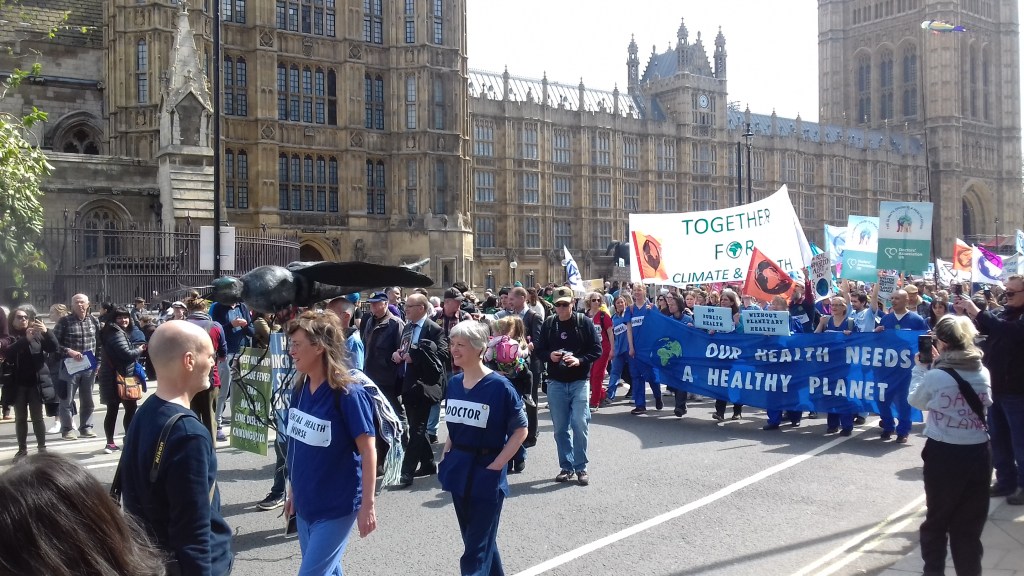
Sometimes there is a protest in central London that overwhelms and redefines it for a while. On the first day of The Big One, it was almost like that. You could hear the drums in the underpass. “Oh God! Those drums! We’ll all be murdered in our beds”, as they used to say on colonial verandas (and possibly still do in Daily Mail editorial meetings). Out of the tunnel and into the reassuring grey of the sort of London Spring characteristic of the epoch we are losing, and the streets are seeded with business like protest organisers in high viz jackets with XR stickers, in an odd balance with lots of tourists, doing the things that tourists do, moving in herds led by guides holding up umbrellas so they don’t get lost, taking photos of each other leaning on the doors of the iconic Gilbert Scott red phone boxes no one uses anymore (with the Houses of Parliament as a backdrop for the perfect evidence of having been here and seen that) school trips in chatty crocodiles up and down the paving stones, in and out of the Abbey.

As the day goes on, the number of protestors increases, so they begin to define the streets much more. The drums have dominated the soundscape from the off, but now there are contingents of people from here or there wandering like pilgrims between ministries, sometimes with drummers, sometimes not. And in the distance those strange silent processions of priestesses proceeding silently in bright scarlet or eery green robes, saying nothing, moving slowly, bearing witness.

By mid day, the cafe in St James Park is mostly occupied by what the Mail calls the “Eco mob”; for the most part middle aged, thoughtful, quite middle class people, more women than men, politely drinking coffee or holding the door open for each other in the long queue for the loo. The mound outside is occupied by the Bristol Climate Choir; about a hundred of them. Polite, peaceful, determined, not singing yet. A couple of curious coots cautiously duck their heads at them, trying to work them out – and probably closer to understanding them than the Daily Mail is.

At the Department For Education to make a speech for the XR Educators picket (see separate Blog). It is drizzling steadily. The road remained open; so anyone speaking, delivering a model lesson to show what the curriculum could be like, or performing -they had dancing later -had to pause from time to time as a vehicle went past. On one occasion – symbolically enough – a Clapham Omnibus, possibly occupied by average people who we will need to convince; though 70% of them already want more action on climate, so they are more on board than the government is. The rain is dismal but the mood determined.

Photo Graham Petersen This is opposite the DFE. The building behind houses the Adam Smith Institute. The last time there was an XR picket of the DFE, the Adam Smith Institute, an offshored annex of Tufton Street, played loud music through the windows to try to drown it out. This was a mix tape of tracks extolling the joys of driving cars or taking trips in aircraft. “I like driving in my car”, “Buy me a ticket for an aeroplane” and so on. Like the Institute itself, an ideological support for the short lived fever dream of the Truss government, their music choices were out of date and out of time. This time, they were silent; which is just as well; and entirely appropriate.

The pickets at other Ministries a little down the road and round the corner, were bigger. And they had drums. Impossible to walk along and not want to dance to them. The crowd outside the Department of Energy was spilling over the pavement. Outside the Home Office there was a “die in” of climate refugees. Alongside the Ministry of Transport a big crowd arrived from South Yorkshire shouting “We’re from South Yorkshire and we want better buses!” Pretty plain and direct. No need for rhymes. They also had a song about how miserable it is to wait for a bus that doesn’t turn up. Especially when its raining. The tragedy of this, for anyone who can remember back forty years or so, is that in the early 80s Sheffield was an inspirational public transport success story. The fares were low. The timetable regular. The buses reliable. People came from all over the world to study it. The GLC based its Fairs Fare campaign to boost public transport in London on it. Then the Thatcher government forcibly deregulated the system, with the usual nonsense about how the private sector will be more efficient; and it all went to shit.

The crowd outside DEFRA blocked the side street completely. A quiet picket, largely made up of Quakers, strings all the way along the pavement outside the Foreign Office, bearing witness to all its accumulated sins; perhaps symbolised by the statue of Sir Robert Clive at the end of the road; founder of the Indian Empire and a man who reduced Bengal, the most prosperous province in the Mughal Empire, to famine within a decade of conquering it. Clive, who gave a strong impression of being able to brass out what he’d done and revelled in the staggering wealth he accumulated, nevertheless committed suicide at the age of 49 by stabbing himself in the throat with a penknife. So, perhaps it got to him after all. Our current masters have better insulated consciences.

Some of the Ministries are quite strange. Digital Culture, Media and Sport, which had a small picket outside; with a few Equity banners. The seeming polar opposites of Digital Culture and Sport glued awkwardly together by Media. And why just digital culture? What about the rest of it? Perhaps it could be renamed the Ministry of Propaganda and Commercially Lucrative Distractions. Time was that Equity was run by a right wing faction headed by Sir Laurence Olivier, challenged by a WRP bloc led by Vanessa and Corrin Redgrave. Meetings must have been really performative.

The statue of Field Marshall Viscount Allenbrooke turns its back on the Nurses not Nukes banner and its nose up at the teach in going on outside the Ministry of Defence (even though he was such a keen bird watcher).

The Ministry of Defence is playing host to an open air seminar being chaired by CND. One of the most dangerous aspects of our current crisis is the deployment of investment that could be going into green transition into building up the military instead. The United States is spending 14 times as much on its military as it is allocating to investment in transition under the Inflation Reduction Act. According to the Campaign Against the Arms Trade, in the UK, there is 30 times as much Research and Development on weapons systems as there is on renewable energy. That could be why the patents for the turbines in wind turbines are held by Danish and German/Spanish firms. And this goes on. In the last budget, £5 billion extra for the Ministry of Defence. For insulation? Nothing.

There is an unacknowledged militarism that runs through the UK, which is by some way the most bellicose nation over the Ukraine war in NATO; and in central London there is a war memorial or statue of a Field Marshal or Admiral every few yards if you have eyes to see them. A few years ago, I was showing two teachers from Limpopo Province in South Africa around Trafalgar Square. One of them looked from Nelson on his column to the busts of Beattie, Jellicoe and Cunningham ranged along the Northern wall and muttered “Hmm. Nation of warriors”. I’d not seen it like that before, somehow just taking it for granted as normative; but after he’d said it, it was impossible to miss how the military side of all that imperial history is celebrated and sanctified in bronze.

The speakers are pointing out that the US and its allies – essentially the core of the Global North – are increasing military spending at a dizzying rate; with the US itself hitting a record level, and sharp increases in France Germany and Japan. Japan is doubling its military spending and working together with Italy and the UK to develop a next generation fighter aircraft. One of the speakers uses a strange formula to describe this. That Japan’s increase is “in response to the rising tensions in the world”. Given that, even before these increases, the US and its direct allies are already responsible for two thirds of global military spending, it would be more accurate to describe them as the source of it. And the trajectory is quite clear. As Meehan Crist wrote in March last year, “One of the worst outcomes of the war in Ukraine would be an increasingly militarised response to climate breakdown, in which Western armies, their budgets ballooning in the name of “national security” seek to control not only the outcome of conflicts but the flow of energy, water, food, key minerals and other natural resources. One does not have to work particularly hard to imagine how barbarous that future would be”.

Not hard to imagine, because that’s the world we’ve already got, but a bit more so.

The Saturday was bigger, younger and sunnier in all respects. Stunts get publicity. Mass events build movements.

My speech to the trade union hub can be read – and partly seen – here.

“We are the majority”. Speech to the XR picket of the DFE.

I convene the NEU Climate Change Network and edit the Greener Jobs Alliance Newsletter, which brings together trade unionists active on climate breakdown with climate activists serious about working in and through the unions. Please look us up and check us out.

I’m here as a warm up for XR Youth, who will be talking about what schools are for in a few minutes, so lets think about that.

Michael Gove’s favourite Marxist, Antonio Gramsci, said that every society reproduces itself through its education system.

But, if the society we have is unsustainable, schools have to anticipate a sustainable society and transform themselves as part of the process of constructing it. That necessarily challenges the existing social, political and economic order.

In assessing the Department for Education we should measure their performance against the legal obligation under Article 12 of the Paris Agreement; which states

Parties (that’s governments) will cooperate…to enhance climate education, training, public awareness, public participation and public access to information recognising the importance of these steps with respect to enhancing actions under this agreement.

That means that the whole of society – not just schools and universities, but all media, all government at national, regional and local level – should be participating in a mutually reinforcing education and action movement to prevent climate change and respond to its impacts.

Hands up if you think they are doing that… (there were no hands).

I think that Just Stop Oil people on the media are spot on in turning the question “are you bringing the public with you?” back onto media interviewers. Why are they not dealing with it? We have to be here, partly because they are not doing their job.

Photo Graham Petersen Portrait of the author as an old man.

Looking at what the DFE is doing in its Net Zero Plan, there are two fundamental flaws

  1. There is no plan to review the entire curriculum and no integrated skills programme. Some institutions are doing amazing work. Some primary schools integrate their whole curriculum around climate and sustainability. Manchester Met University has a climate module built into every course. But in a climate emergency that should be the norm; and its criminally negligent that it isn’t.
  2. There is no plan – and no budget – to retrofit the entire schools estate to Zero Carbon by 2030. Small pockets of money are made available to be bid for, which allows for partial works in penny packets here and there; but its left to individual schools and Local Authorities to find their own way. Again, some places are taking a lead, Newcastle City Council aims to retrofit all its schools by 2030. Hats off to them, but again, this should be normative and treated with urgency.

Even the good things they are doing, the National Nature Park, which aims to link up all school, college and University grounds into one greening space, and the requirement for all schools to have a Sustainability Lead by the end of this year – have no budget.

By contrast, in the last Budget, the Ministry of Defence got an extra £5 billion, companies were handed £9 billion in investment tax relief for investments they were going to make anyway.

Anticipating this critique, and responding to the school students strike movement, the DFE published, at the same time as their Net Zero Strategy, its guide to teaching “controversial subjects” with “impartiality”. This is a more subtle version of what Ron DiSantis doing in Florida. DiSantis bans books to do with racism, gay rights. What we have here is a requirement to teach “controversial subjects” like world poverty, racism, the legacy of Empire and climate breakdown in a “balanced” manner.

Which is mind boggling. How do you teach about racism in a “balanced” way? On the one hand, Martin Luther King…on the other hand Adolf Hitler? What are you “balancing”?

Let’s be clear about this. Hands up if you think that the impartiality guidance means that you have to teach climate denial in the interests of balance? – (No hands up. Cries of “No!”)

You’re right. We won that one. This is what the guidance says. “Schools do not need to present misinformation, such as unsubstantiated claims that anthropogenic climate change is not occurring to provide balance”.

Its a pity that that message hasn’t got through to the rest of the government. A spokesperson for the Department for Business and Trade said recently “There are various think tanks in Westminster that have sceptical views about climate change, and Ministers meet those people all the time”. One of them is right behind us, right here, the Adam Smith Institute.

And that guidance was just for the facts in the Science and Geography curriculum. Climate breakdown becomes “a political issue” when discussing what we do about it. So, you can see why a governing Party that

  • abstained on the Parliamentary motion to declare a climate emergency
  • contains within in the organised core of Parliamentary climate change denial in the form of the Net Zero Scrutiny Group, which includes current Ministers
  • was taken to court because its Net Zero plans did not meet its targets, and lost

would be sensitive about this and want teachers and students to be inhibited about discussing it. Am I being “partisan” in pointing this out?

There are two aspects to this.

  1. Mainstream Parties, those represented in Parliament, will have different approaches to climate breakdown. The guidance prohibits “partisan” support for any of these. So, you couldn’t walk into a classroom waving the Labour or Green Party Manifestoes over your head and calling for support for them. But, you wouldn’t do that anyway. No one would. And the guidance doesn’t stop you teaching the facts about what different Parties say in relation to the crisis and discussing them through. It also does not prohibit the expression of a personal point of view, as long as you identify it as such and make it clear that other views are available.
  2. “Extremism”. The definition of views that are not expressed within the mainstream parties, particularly when linked to campaigns of Non Violent Direct Action, as “extremist”. As all the mainstream responses are inadequate, this dovetails with overall government attempts to close down the space for protest and dissent and, on this issue, shoot the messenger.

What this doesn’t take into account is that we are the majority. Two out of three people want more action to prevent climate breakdown. It has been a top four voter concern for well over a year and will become more so as the crisis intensifies. At the risk of being “partisan”, is this top voter concern one of Rishi Sunak’s top five priorities? Who is it that’s out of step here?

So, because we are the majority, we should not allow the Thought Police into our heads. We need a full, open, exploratory discussion in schools and society – because no one has all the answers, we’re making this up as we go along and its not all under control. The people in charge do not have a grip, and too often have a vested interest in not getting one.

So, getting colleagues, management, parents, governors, students all on board is crucial.

I’ll leave you with a quote from UN Secretary General Antonio Gutierrez, to put all this “extremist” stuff in context and might make a good start for a Philosophy for Children session.

“The truly dangerous radicals are the countries that are increasing the production of fossil fuels. Investing in new fossil fuel infrastructure is moral and economic madness”.

Maths Questions for Ministers

As Rishi Sunak has now decided that extra Maths teaching up to 18 is the “silver bullet” to solve all the UK’s problems of low productivity, in search of a more positive attitude towards numeracy, here are a few questions for him

Rishi Sunak.

  1. If the 11% decrease in the number of teacher training applications in 2023 continues at the same rate, estimate how many years it will be before there are no applications at all; and what year will that be? Answer: Roughly 10 and we will be at zero applications by 2033.
  2. If teachers had a 13% real-terms drop in pay between 2010 and 2022, while average earnings across the economy have gone up 2% in real terms over the same period, and your pay offers for teachers remain well below the rate of inflation in 2023; how is this going to reverse the trend in question 1? Answer. it isn’t.
  3. If 12% of Maths classes in Secondary Schools are being taught by a teacher without a Maths degree, and almost half of Secondary schools are using non specialist teachers for Maths classes, and 13% of new Maths teachers quit within 5 years, but you want all students to take additional Maths classes through to age 18; how does all this add up? Answer. it doesn’t.

Kemi Badenoch

If the Trans Pacific partnership benefits the UK economy by 0.8% but the negative impact of Brexit is 4%

  1. What is the effect of doing both? Show your working. Answer. -4 + 0.08 = -3.92%.
  2. Express your answer showing how many trade deals on the scale of the Trans-Pacific Partnership would be needed to make up for the impact of Brexit. Answer: 4/0.08 = 50.

Ben Wallace

If the UK spends $1020 per head on its armed forces, while Germany spends $674, Russia spends $455 and China spends $204 per head

  1. How much greater is the burden of military spending for a UK citizen over a German citizen? Show your working. Answer 1020/674 = 1.5 times.
  2. How much greater is the burden of military spending for a UK citizen over a Russian citizen? Answer 1020/455 = 2.24 times
  3. How much greater is the burden of military spending for a UK citizen over a Chinese citizen? Answer 1020/204 = 5 times

Grant Shapps

If the IPCC states that the number of new fossil fuel projects that can be explored or licenced if we are to prevent climate tipping points is 0,

  1. What is the number of new fossil fuel projects the UK government should be allowed to licence for exploration Answer: 0
  2. Applied Maths: explain the discrepancy between the 0 and the number that you are licencing and quantify what you think the impact of that will be. Answer: It won’t be good…

From Yorkshire to Buddha

On the Metropolitan line, heading North by North West, a small boy dressed in a blue puffa jacket emblazoned with yellow lightning flashes – to show he is a live wire – determinedly pulls himself up on the bar above the seats where his parents are sitting and languidly swings himself along with the same seemingly effortless grace you’d expect from an orang utan. His parents ignore him and no one else pays him any mind. The loneliness of the short distance gymnast.

In Chili Masala at the bottom of the hill, waiting for a take out while being serenaded by film music on the flat screen on the wall, all yearning, echoey lyrics and shots of beautiful young people staring longingly at each other on dancefloors and across roofs: or doing formation dances on the tops of steam trains – as you do. Rather more surreal, a grim faced man in black standing in front of a brand new bright yellow JCB parked in an industrial wasteland straight out of Tarkovsky’s “Stalker” sets about a small army of disposable henchmen, also in black but wearing V for Vendetta masks with a base ball bat and small axe and a choreographed balletic grace. On the wall, a solid home made open fronted MDF box, with the words HAND SANITIS shakily scrawled in sharpie. Empty now of course. I still have a few sachets of Clinell wipes in my back pocket that I tempted to post in it to make it seem a bit less sad.

In the window of one of the flats on the way to the doctors, someone has stuck up one if those centre spread St Georges flag pull outs the Sun does during football tournaments and left it there long afterwards; no more inclined to take it down than I am to remove the Clinell wipes from my back pocket. Over time the ink has faded from the letters not inside the red cross, so it now reads “t’s coming om”.

The Strike Wave gets its Second Wind.

On a cold, bright day in April, on the Euston Road at about midday on Thursday, a solid phalanx of junior doctors picketing the Jade Green eminence of University College Hospital, arrayed up the steps like a choir in orange BMA hats; and all still singing after standing there for over four hours.

This lot shall not be moved.

And now they are being reinforced by RCN members who voted against the miserable pay deal the government offered; even though their union leadership got cold feet and recommended they accept it, in a desperate hope to get something from the struggle without going for broke.

I have to say that I am proud of my own union, the NEU, which recommended rejection of a similarly insulting “offer” (a one off £1000 now plus a 4.5% percentage rise for September below half the inflation rate that would have had to be paid out of existing school budgets). NEU members voted 98% reject on a 66% turnout. The other teacher’s union, the NASUWT, also voted to reject by 87%, and so have the Heads unions, ASCL, by 87% and NAHT by 90%. These unions will now be reballoting for action and so will the NEU, to get a mandate to continue action into the Autumn and Winter if need be.

Suddenly the ground is shifting under Rishi Sunak’s attempts to defuse struggles with minimal offers; and the delusion of stability generated by abandoning Brexiteer brinkmanship over the Northern Ireland Protocol is now looking shaky. The local elections are just a few weeks away. If the Conservatives get the hammering they deserve, Sunak could be on the skids. This would be a real problem for the Tories – as he was brought in after a succession Prime Minsters who were becoming increasingly, visibly, deranged – from May to Johnson to Truss – as a competent bean counting technician to steady the ship; rather like the way Italy sometimes deploys a technocrat; or a company on the slide brings in a consultant from PWC.

If they haemorrhage votes in May, and the already frantic recriminations among Tory backbenchers go into overdrive – as they scrabble around for a way, any way, to hold onto their seats – turns into open factional fighting, the ruling class might have to turn to Starmer as the only viable option to maintain their interests; a role he is very keen to carry out.

This is shown by all the moves that signal his reliability for them, from banning Jeremy Corbyn as a Labour candidate, to an aversion to supporting picket lines, to attacks on law and order and military spending from the right; all the way to a preparedness to use racism in recent personalised attack ads that made even David Blunkett’s stomach turn. This is reassurance for them and a warning to us. But it also means that Starmer is not only dampening down expectations, he is also damping down the Labour vote; as people unhappy with the changes he has made since 2019 walk out of the open door he has challenged us to exit by, and the poll lead steadily slips. While the standing of the Party is held up by hostility to the Tories, his personal ratings are floating like a lead balloon.

Given all this, the best conditions in which a Starmer government could come to office would therefore be if the Tories had visibly been brought down by popular resistance in the ongoing strike wave; which would make it much harder for Starmer to carry out the “hard choices” he has lined up; and face him with a mobilised and increasingly politically conscious movement with a government’s scalp on its belt.

It feels significant that a song often heard on the Doctor’s pickets has the same tune as “Oh Jeremy Corbyn”; so the ghost of the Left’s last surge is haunting the soundtrack of the latest one.

I dreamed I saw Joe Hill last night

Alive as you and me

I said, but Joe you’re ten years dead

I never died said he…

When they say there is no money…

Health Secretary Steve Barclay says the Junior Doctor’s claim to restore their salary levels to where they were in 2008 are “unaffordable” he does so in a tone of voice that is almost bewildered in its puzzlement that anyone could possibly think that their work should be valued as highly as it was 15 years ago. No one in the media seems to have the gumption to ask Barclay, or other Minsters saying the same thing, what has gone so badly wrong on the Tories watch that so many people are so much worse off now than they were before they came to power.

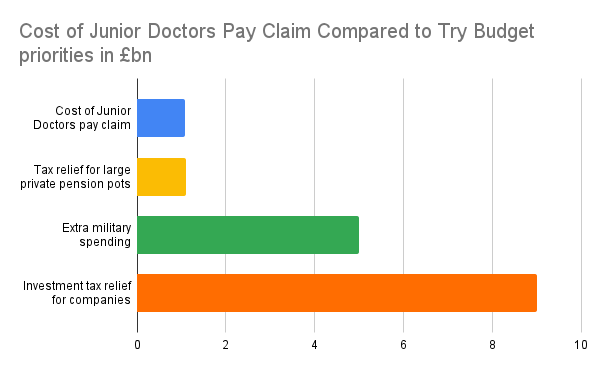
All the same, Barclay’s claim should be examined in relation to the cost of the Junior Doctors claim in full would cost £1.08 billion.

This is just under the £1.1 billion the Chancellor handed out with no apparent stress at all as tax relief for the most lucrative private pension pots. A straight hand out to the top 1%.

Its is just over a fifth of the £5 billion he handed out to the Ministry of Defence for extra military spending; which we’d better hope is wasted, because if its used its deadly.

And a ninth of the £9 billion in Tax relief to companies making investments; which is also a straight hand out with no effect, as incentive loop holes like this never lead to additional investment, just to the companies in receipt of them paying for the investment they were going to make anyway courtesy of foregone investment in more useful things by the state.

So, there is money, but they are spending it on the wrong people. Visually, that looks like this.

Scooters – to E or not to E?

News that Paris is to ban rented e-scooters from September after a public consultation in which there was a very low turn out, but in which most of those who did turn out were very antagonistic to e-scooters, poses a number of questions.

3 people have been killed in e-scooter accidents and 459 injured in 2022.

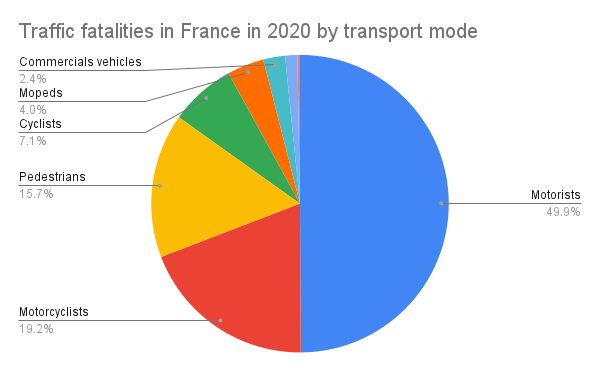
To put this is perspective, the French government’s road traffic safety annual report noted that across the whole of France “In 2020, there were 45,121 injury accidents in metropolitan France. 2,541 people were killed within 30 days of their accident, including 391 pedestrians, 7 users of personal mobility devices (such as electric scooters), 178 cyclists, 100 moped riders, 479 motorcyclists, 1,243 motorists, 59 users of commercial vehicles, 33 users of heavy goods vehicles.

It should be noted that e-scooters are a sub set of PMVs, but that, in nay case, this is by far the smallest source of fatal traffic accidents. That looks like this on a graph. The PMV segment is the little sliver at just before “12 o clock”. Though these figures are from 2020, Its unlikely that these proportion s have changed qualitatively since then.

The report goes on to note that, across France as a whole in 2020 “The number of users killed on e-scooters and other motorised personal mobility devices (PMD) is stable in 2020, but the number of people injured increases by 40%, also reflecting an increase in use since the end of the first lockdown. This number is still 5 times lower than the number of people injured on bicycles in urban areas.”

If fatalities and injuries are the issue, banning motor vehicles would have far more impact on reducing them. In fact, if the increased popularity of e-scooters in Paris has, as the Guardian reports, cut out one in five journeys that would otherwise have been carried out by car, motorbike or moped, then it is reasonable to extrapolate that, given the much higher fatality rate in collisions involving these vehicles, there have been fewer deaths as a result of e-scooters being available for hire.

As a new form of urban transport, better regulation would be a better way to go. As one opponent admitted “its better than it was”. Technical adjustments to limit potential speed and stricter enforcement of pavement surfing bans and “zipping in and out of traffic” alongside expansion of bike routes. Clear rules for users displayed on the handlebars and in tourist guides. Teaching in schools on the same lines as cycling proficiency classes. All that would have an effect worth having if we want to reduce the overall impact of motorised traffic.

So, on these figures, cars are 36 times more lethal than PMVs.

Part of the problem perhaps is that we expect cars to kill us. The background stress of car centred cities, all that noise, motion and potential threat swishing by us constantly, which we only notice when its suddenly not there in a place we expect it to be. Several thousand fatalities a year has become taken for granted. Wallpaper. It should not be. And the problems posed by other modes of transport should be considered in a proportionate way.

Debates about modes of urban transport in Paris – and even in other cities where cars are driven with less panache – should take in all modes of transport at the same time, so we can properly rebalance the ways we get around.

Peace in Ukraine?

In a recent interview, President Zelensky said that unless Ukraine can hold Bakhmut, he will come under immense pressure, at home and abroad, to negotiate a peace with Russia. It is possible to interpret this in four ways.

1 Zelensky is trying to stiffen the resolve of the troops in Bakhmut, whose morale is low, after conceding inch after inch of ground and terrible losses, fully aware that they are virtually surrounded and after hearing for weeks and weeks about a relief counter offensive that never arrives.

2 He is putting pressure on NATO to up its military supplies, warning them that there is a limit beyond which the Ukrainian armed forces and people will no longer fight on their behalf.

3 He is giving himself an opening to go for such negotiations if Bakhmut does fall, to cut his country’s losses in all respects – as arguing for such negotiations in public hitherto has be tantamount to treason and people have been assassinated for doing so. It is of some significance in this context that, while the USA dismissed the Chinese Peace Plan outright, Zelensky didn’t.

4 He is doing all three at once.

A negotiated peace then is no longer unthinkable. Even his more recent statement that Ukraine would be willing to discuss the status of Crimea if the offensive that has been flagged up for the end of this month and start of May manages to get through to the Black Sea, underlines that negotiation over territory is not off the table. Obviously he does not talk about what will happen if the offensive is a debacle, but this would be a much bigger deal than simply losing control of Bakhmut, which is slowly happening.

Its evident that NATO has no end game beyond crossing its fingers and hoping for the best. Its military industrial complex isn’t designed around wars of attrition with an “almost peer” military.

  • It is designed to produce immensely expensive and complex weaponry requiring months of training to use and squads of maintenance crew to keep going. These are very profitable for its manufacturers and very effective in short wars in which any resistance is qualitatively outgunned. Not so much in this war, in which the capacity to mass produce shells is more decisive. So, all they can do is shovel in enough aid to keep the war going, but not enough to turn the tide.
  • With the sanctions only adopted by direct allies and having blown back hard on Europe primarily, their presumption that the economic war would do the job has failed.
  • The alternative, of decisive direct intervention would be World War 3 and we’d all die.

So, in the meantime, hundreds of men, mostly Ukrainians, are dying every day with no prospect of “winning”. While a reader of the Guardian here might well believe that the Russians have lost 200,000 troops, because they paper they (still) trust says so, the BBC Russian Service calculated just 10,002 killed by December last year, the Russians themselves say they have lost 14,000 and the Israeli Security Agency Mossad calculated 18,840 last month. With the US reckoning on at least 100,000 Ukrainian soldiers killed that’s a loss ratio of at least 5 to 1 that’s completely unsustainable. Something has to give. And in the interests of not throwing away more and more lives in a hopeless fight, the sooner the better.

The outlines of a possible peace are quite clear and very like the initial Russian call before last February. Demilitarisation of Ukraine – demobilisation of the army and redeployment in reconstruction – no membership of NATO, recognition that the areas that have seceded from Ukraine don’t want to be part of it and have as much right to join the Russian Federation as the West of Ukraine does to stay out of it and mutual security guarantees between Russia and NATO, to allow both sides to de-escalate and put scheduled expansions of military budgets to more constructive use. This will open a period of intense struggle in Ukraine and NATO countries, because the war will be seen to have been futile, the far right will cry betrayal and “stab in the back” resentments at NATO might well lead to all sorts of unpredictable blowbacks, and the reconstruction deal that Zelensky has agreed with Blackrock looks like creating a neo liberal dystopia. One motivation for trying to prolong the war on their part.

Those, in USC and elsewhere, who argue for the NATO/Kyiv war aim of restoring sovereignty over all of Ukraine’s pre 2014 borders and for “Russian troops out” are ignoring a political reality within pre 2014 Ukraine, which is that there has been a civil war there since the population of the Donbass rebelled against the overthrow of a government that they had voted for. There is no doubt that the Maidan movement in Kyiv had popular support in that part of Ukraine. It was also taken advantage of by the US and EU. And hegemonised by the far right. USC people tend to emphasise the first point and turn their eyes away from the latter two, but all three are true and have to be taken into account.

The rebellion against that in Donbass has been described like this in New Left Review. After the Maidan events “opposition to the new government was broad. In late February, some 3,500 elected officials gathered at an anti-Maidan conference in Kharkiv. The following day, the Kiev parliament repealed protections for Russian as a regional language. The anti-Maidan uprisings in Eastern Ukraine copied the Kiev model of occupying central squares and taking over government buildings. The security forces were also divided; in some areas the local police made no effort to stop the anti-Maidan protestors. In cities like Kharkiv or Odessa, Kiev’s authority prevailed. In hardscrabble towns like Donetsk and Luhansk, popular militias made up of miners, truck drivers, security guards and the local unemployed stormed the regional-administration offices and declared peoples republics…” In effect a parallel movement. Arguing for Ukraine’s right to self determination while denying it to the people of the Donbass is wilfully inconsistent.

The initial, rather cautious, Russian intervention that summer was to prevent this uprising being completely crushed by the Ukrainian army. The ensuing civil war killed over 14,000 people, mostly in the Donbass Republics, over 3,000 of them civilians.

They have a memorial garden in Donetsk City to all the children that have been killed by Ukrainian shelling. And these kids are just as dead as any killed in Western Ukraine. They won’t get the full Fergal Keane treatment on the BBC, but they are just as dead. While Donetsk holds these graves…

The Donbass militia, which is locally recruited and has done a lot of the front line fighting even after last February, is 44,000 strong. They see themselves as Russian, and, since the referendums last autumn (far from perfect though they were) see their land as part of Russia. Calling for them to “withdraw” is calling for them to leave their homes, dismiss their own right to self-determination and become refugees, alongside the 3 million or so others who have fled to Russia during the conflict – about a third of the total (and the largest single destination country). This would also apply to a large number of non-combatants. Given that the Ukrainian armed forces “cleanse” captured areas of “saboteurs and collaborators” and one senior politician has called for the local “Sovoks” to be put in concentration camps after “liberation”, a very large proportion of the local population would have to abandon their homes to keep safe. USC is actually calling for ethnic cleansing.

If you doubt that, here are some statements by leading spokespeople in Kyiv in an ongoing discussion about how Ukraine should reintegrate the territories lost after the Maidan. There are various perspectives on this, from the genocidal to the more precisely targeted. The solutions range from wholesale killing, driving out the local population in whole or in part, to filtration measures for the population to identify ‘agents’ and ‘proponents of the ‘Russki Mir’ ie pro Russians, more selective punishment for anyone associated with military resistance overarched by ‘cultural’ measures, re-education, re-naming everything, forbidding use of Russian and so on.

  • July 2014 – MIkhail Koval (Ukrainian Minister of Defence) states that special filtration measures are needed to ‘identify those linked to separatism’
  • August 2014 – Bogdan Butkevich (journalist) speaking on live TV states that Ukraine should free itself from ‘excess people’ in the Donbass and that ‘some people need to simply be killed’
  • In 2018 the Ministry of Interior under Avakov proposed a law on deoccupation and reintegration and a law on collaborators. These were passed in February that year. The laws effectively suspended citizenship to suspected ‘collaborators’ and denied them political rights, and provided almost unlimited powers to the military in the ‘liberated territories’
  • In 2019 Oleg Radik (journalist) wrote that ‘when we go in there, there’ll be 40 years of purges and anti-terror, a ban on the use of Russian by state officials. Close all the higher education institutions, let them study in Lvov.’
  • November 2020 the Prime Minister Denis Shmigal proposes Bill No.4 327 which allows the SBU to identify people to be {forcibly} interned by the military.
  • In March 2021 Alexei Reznikov (vice Prime Minister for the Temporarily Occupied Territories) discusses the removal (Otseleniya) of Russians in Crimea (some 500k people).
  • In August 2021 President Zelenskii told Donbass residents who think they’re Russian ‘to go to Russia’.


Daily life in wartime Ukraine – Ukraine Dissident Digest 3.

Every Month Ukrainian dissident blogger Dmitriy Kovalevich writes a summary of developments for the New Cold War website. The extracts here deal with everyday life and media and present a very different view from the one you will see on the BBC or read in the papers here.

The full version, entitled One year of the tragic proxy war being waged by NATO in Ukraine, which also covers the ‘Official’ deaths of the peace agreements of 2014 and 2015, Russian military strategy, a ‘Ukraine offensive’? and the Tense situation brewing over Moldova can be read here at newcoldwar.org.

The situation in agriculture and utilities

As the sowing season looms in Ukraine’s countryside, agricultural enterprises in all regions are complaining about the shortage of tractor drivers and other machine operators because so many workers have been taken for military service. Due to shortages of workers, fuel and fertilizers, Ukrainian experts predict a 40 per cent drop in wheat and corn yields this year, even if fighting were to suddenly stop.

Similar shortages of skilled workers are being experienced by the country’s utility companies. Hundreds of electricians, mechanics, cleaners and other vital workers have been taken into military service and there is no one to replace them.

The utilities are experiencing an acute shortage of skilled workers because their employees are being conscripted into in the AFU, they are hiding in their homes to evade military service, or they have succeeded in fleeing the country. Current law in Ukraine prohibits any male of the age of military service from leaving the country, and this is strictly enforced along the country’s borders.

Most Ukrainian towns outside of the front lines in the southeast of the country have not been hit particularly hard so far by military hostilities. On the other hand, there is a gradual degradation of infrastructure throughout the country and there is an ever-present danger of its collapse. 

“All business in Ukraine is close to being paralyzed,” writes the Ukrainian telegram channel ‘The Skeptic’. “Entrepreneurs are suffering huge losses. Several factors contribute to this, one of which is the shortage of male employees. Men are being taken from the streets by military conscription units and immediately shipped off to the front lines.”

The channel emphasizes that no economic recovery is taking place in real life. The prospect of recovery is only ‘announced’ by Ukrainian authorities from time to time when they decide it is a good moment to again plea to the West for more money. 

Daily life in wartime Ukraine

Thanks to a relatively warm winter, the energy situation for ordinary Ukrainians has improved in February. In most regions, shutting off of electricity has diminished and hot water supply has reappeared.   

Another issue is that despite relatively low gas and electricity prices (frozen during the current period of martial law), Ukrainians have nonetheless accumulated significant debts owed to utilities. Russia has cancelled such debts in regions that have come under its control and is promising more of the same to other regions that may come under its control in the future. 

The price of gas and electricity has been raised for businesses and industrial enterprises, which has led to the closure of many enterprises and, consequently, mass layoffs of workers. 

Beginning in February of this year, businesses are required to submit lists of their employees to the military enlistment offices. Male employees then receive notification to appear for military service. To get around the loss of key workers, many companies do not list them as employed.

Significant part of workers in Ukraine since the years of privatizations during the 1990s work unofficially – working part-time or off-site—and are paid in cash. Officially, they are unemployed. This allows a business owner to avoid paying salary-delated taxes and allows workers to avoid paying income taxes. But it also means that workers do not have such rights as joining a trade union, paid vacations or paying into a company’s pension plan. Ukraine’s government has for many years tried to reduce such ‘shadow employment’, but it has returned with a vengeance due to the fear of military conscription. 

However, with this form of ’employment’ causes big problems for workers in receiving salaries. An employee can be listed as employed and is therefore subject to army recruitment, or he works without a formal contract and risks not receiving a paycheque or a fair paycheque.

For businesses and industrial enterprises, the prices of gas and electricity have risen, leading to the closure of many enterprises and, consequently, to the dismissal of employees. 

Similar problems are experienced by the utility companies. They are experiencing acute shortages of workers due to military conscription or because workers are hiding in their homes to avoid conscription or have fled the country. The hundreds of electricians, mechanics, cleaners and loaders needed to replace them are simply not available.

Most Ukrainian towns, outside the front lines in the southeast of the country, have so far not been hit particularly hard by the military conflict. On the other hand, there is a gradual degradation of infrastructure.

Continued media censorship

One year later, all media in Ukraine with a different point of view from the official line remain closed. All television channels are required to broadcast the ‘United News’, telemarathon-style broadcasts where only the official position of the office of the Ukrainian president is aired. For the past year, not a single attempt to reflect upon or explain the conflict has been broadcast in the permitted media.

Official Ukrainian propaganda involves almost exclusively the airing of hysterical emotions by Ukrainian citizens. The country’s opponents are termed “psychopaths” and the causes of the conflict are reduced exclusively to the desires of a single “tyrant”, namely, the president of Russia. The study and practice of political economy in once-renowned schools of political economy in Ukraine has been replaced in such institutions by straight-up, pro-government propaganda. 

Ukrainian propaganda for domestic consumption is focused exclusively on the emotional whipping up of its audience. This has led to a sharp fall in viewers and in trust for the television channels because their ‘reporting’ is, frankly, bringing much of the civilian population into states of nervous breakdown. This media promotes hatred of all things Russian. But most Ukrainians speak Russian fluently and many have Russian relatives. Thanks to strict censorship in the media following adoption last year of the Zelensky regime’s ‘Law On the Media’, the share of Ukrainians using television as their main source of news has fallen by 12 per cent. The images and messages on television differ too much from real life.

Nordstream 2 – “the silence shouts in your ear” (Graham Greene)

I wrote this yesterday evening after listening to PM. Whatever your views on the Ukraine war, the way the blowing up of Nordstream 2 is being reported is so transparently manipulative that they must know they are doing it. The almost complete silence on Seymour Hersch’s story in particular is almost deafening.

The Ministry of Truth? User:Canley, CC BY-SA 3.0 http://creativecommons.org/licenses/by-sa/3.0/, via Wikimedia Commons

During the discussion with Frank Gardner about the blowing up of the Nordstream pipeline and the current information from Germany that they are investigating a “pro Ukrainian group” for carrying it out, Gardner complained that the Russians were calling for an international investigation that they should be part of. Given that it was their pipeline, that doesn’t seem so odd.

He went on to say that the Russians were considered the main suspects for some time, without clarifying that they were considered to be this by the West, and that this would be -as “false flag” operations go – a spectacular example of cutting off their nose to spite their face given

1) that cutting Germany off from cheap Russian gas has been a strategic objective of the US for some time (and stated as such)

2) that blowing it up helps undermine peace movements in Germany seeking and end to the bloodshed and a deal that could get their cheap gas back (blow up the pipeline, no prospect of gas)

3) thereby removing a significant piece of Russian diplomatic leverage. this is about as plausible as the stories that the Russians were shelling their own troops at the Zaporizhzhiya power station which were repeated – or at best muddied – by your programme too.

Even more striking was that at no point did Gardner, or Evan Davies, refer to the Seymour Hersch story based on leaks from US Special Services that they carried out the attack. Hersch has a long record of getting embarrassing stories for the US bang to rights – from the My Lai massacre to Abu Ghraib. I appreciate that you guys are under heavy manners to keep to the agreed script, but it makes me wonder if Vietnam was happening now, you’d close down the My Lai story too.

Probably…

This is the key sentence in what the BBC write when you complain to them about a News item, so it doesn’t hurt to do it.


We’ll normally include your complaint in our overnight report to producers and management. This will circulate your and all complaints with other reaction we receive today (but with any personal details removed) so it will then be available for the right team to read tomorrow morning.