1963: Between Eternity and Congress House

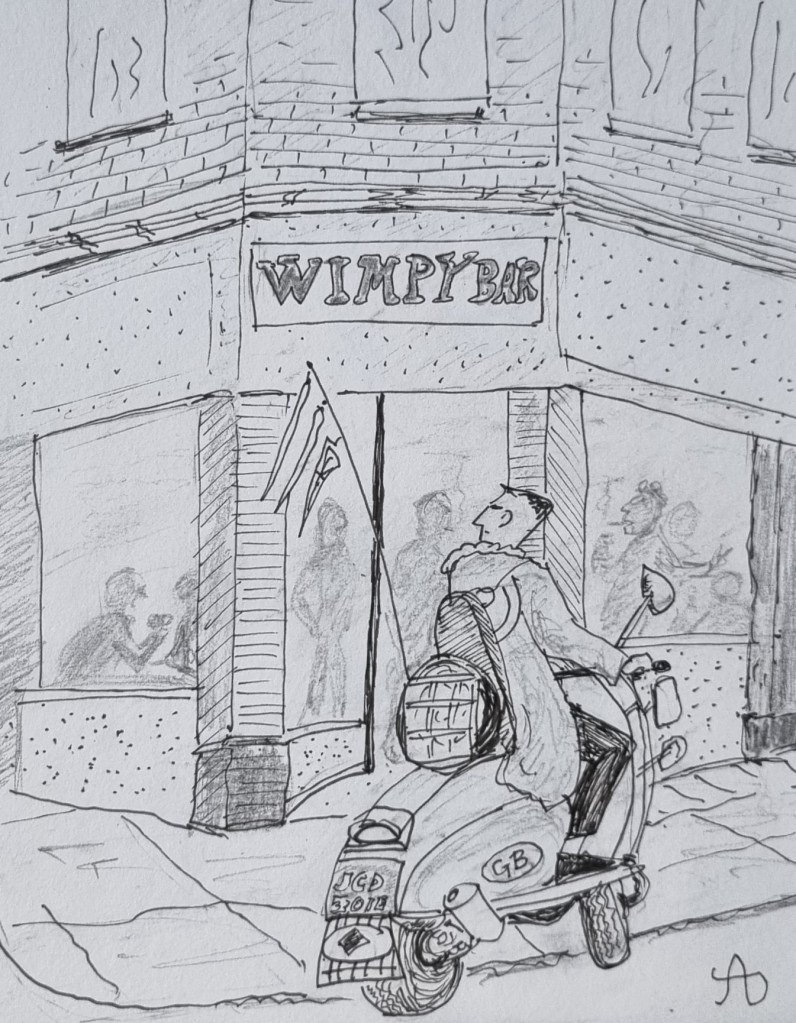
Squadrons of Mods in sharp suits on Italian motor scooters

Lambrettas and Vespas,

With little Union Jacks and floppy plastic tails hanging limply from their aerials

Disrespectfully patriotic RAF roundels on the backs of their parkas

Parked in a pack between the War Memorial and the Wimpy Bar

That little slice of American Modernity

– formica table tops

-frothy coffee

-table ketchup in real plastic tomatoes

wedged in between the dusty deserted grandeur of the Queens Hotel to the Right

and the Coop Department store on the Left.

September 2014

Bit of a false memory when I wrote this. I couldn’t recall what the Wimpy Bar looked like above ground floor level. Looking at the space I imagined it was in was even more puzzling, as there didn’t seem to be room for it. Scouring the internet turned up a photo that showed it was wedged between the Coop and the Queens Hotel, it was wedged into the Queens at the corner of its northern most end.

“Congress House” was the name of the Coop Department store. The Selfridges of South East Essex. It looked like the future in 1963. Sold everything from furniture to clothes to electrical equipment and hyperreal pottery shrunken heads of exotic types of person you might encounter on a holiday from a farther away place than Westcliffe on Sea. A great place to play hide and seek in after school. It even had lifts. There was a competition for the name. They chose the same one as the TUC HQ, which showed what a Labour sort of place this was.

1957 – Brand New Tile

This is actually 1959, but it gets us all in. Dad, Me, Mum and Chris. Photo from Edie Clark collection.

When my parents became the second tenants

of one of the first homes fit for heroes to live in

some time in 1957,

they had to take it as they found it

aged beyond its years

1 cracked, stone floored scullery

1 indoor coal cupboard

1 outside toilet

a pantry under the stairs

bare floorboards, splintery and grey

round, brown bakelite switches, hard, chunky, glowing like dulled conkers

black iron fire places

and, here and there, rusty nails driven into bare walls to hang up pots, pans, hats or coats.

My Dad set to work, digging up weeds, planting potatoes and runner beans – bright scarlet flowers amid leaves waving like wings

building cupboards

planing, sawing, sanding, plastering, painting, papering

smells of blowtorch burning acrid, sweet paint and hot sawdust, damp earth and cut grass, squelchy paste and crisp, dry paper.

My Mum cranked the mangle handle in the steaming scullery

pulling boiled sheets from fat iron pans with wooden tongs

smelling of lavender and soap

washing, scrubbing, polishing grimy surfaces

putting out washed milk bottles that gleamed like a Grenadier Guardsman’s boots

and fresh, fresh laundry flying high on lines stretched between old ship’s masts, newly painted burgundian Green.

I was 3.

My part in this spring offensive

rejuvenating the prematurely decrepit

was to polish a tile

singular and special for being deep crimson red

cracked and broken, but with a leathery glow as though it was made of melted down cricket balls, red boot toe caps, the heart of a winter hearth

just inside the front door, alone as a relic of happiness

that I could make gleam and smile

if I polished it hard enough on my hands and knees

just like Mum.

When the time came too soon

to neatly nail hardboard over the grooved wooden doors and paint them slickly over with easily cleaned pastel gloss

replace the bakelite relics with neat, flat squares of snappy grey plastic – switched on with a whispering click, not an emphatic clunk

and entomb my tile under clean, new lino

it felt like burying an emotion under a wipe clean surface

and the spirit of Barry Bucknell bestrode the world like a collosus.

August 2005

Any old iron? Any old iron?

Any, any, any old iron?

You look sweet

Talk about a treat

You look dapper from your napper to your feet

Dressed in style

In your brand new tile

And your father’s old green tie on…

Well I wouldn’t give you tuppence for your old watch chain

Old iron, old iron…

Popular song of the time.

“Capitalism won’t solve the energy transition fast enough”

These are the notes for a recent speech at my local Constituency Labour Party. The title and the quote at the beginning is from Jason Hickel, who is the Energy editor at the Financial Times; so has something of a horses mouth quality to it.

There’s too much to do and, given the urgency and the need to get the solutions right, this isn’t a task for your favourite ESG focussed portfolio manager, or the tech bros. The sheer scale of the physical infrastructure that must be revamped, demolished or replaced is almost beyond comprehension. Governments, not Blackrock, will have to lead this new Marshall Plan. And keep doing it. The Western nations that did so much of the damage will have to finance the transition in the developing world – it is astonishing that this is still debated. Massive deficit funding will be necessary.(my emphasis)

For all the clean tech advances and renewable deployment in recent decades, fossil fuels share of global energy use was 86% in 2000, and 82% last year.”

The scale of the challenge

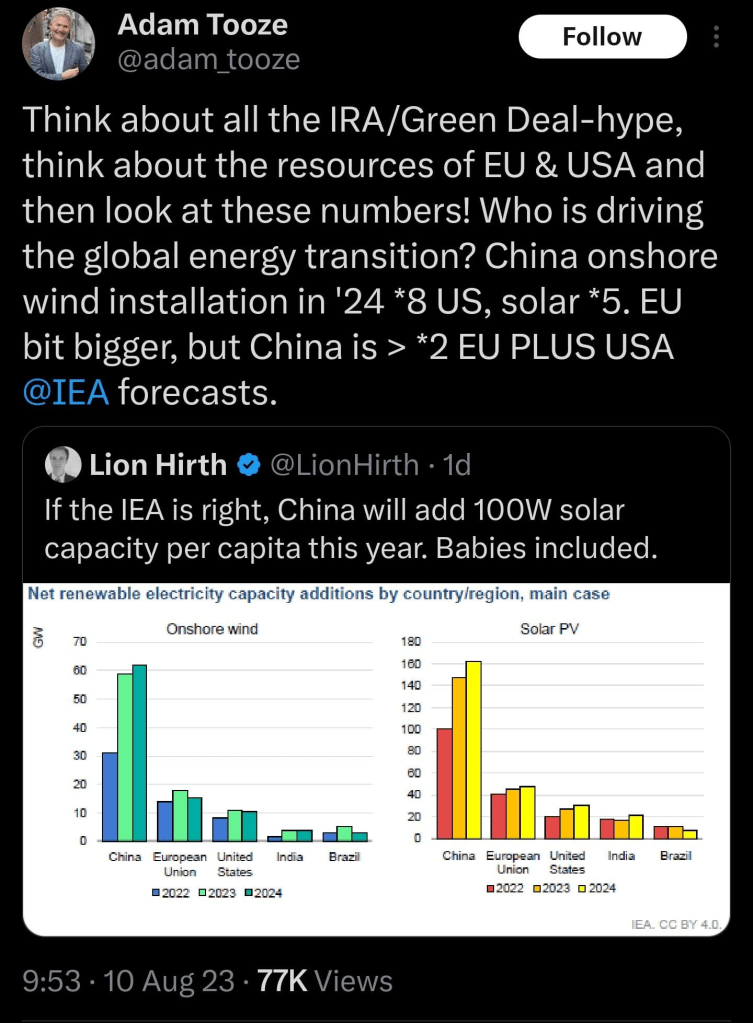
According to Adam Tooze we need to be investing $4 Trillion per year in energy transition. 

Others have argued as much as $6.5 Trillion per year

As the world economy is roughly $100 Trillion a year, between 4 and 6% of it needs to be invested in the transition.

A large sum, but to put it in context, last year (2022) subsidies for fossil fuels amounted to $7 Trillion and Fossil fuel profits were $4Trillion.

This is an opportunity – because there’s your magic money tree…but also a problem, because fossil fuels are so entrenched in everyday life and political power.

Fossil fuel companies have known about the effect of greenhouse gases for 60 years, and have reacted in the same way as the tobacco and asbestos companies did over the links between their products and cancer.

Even now, Shell is arguing that – to be compatible with their interests – Net Zero will only be achievable some time in the 22nd century (so between 50 and 100 years too late).

This entrenchment in political power is seen in Sunak’s latest announcements and more structurally in the high level of climate denial in the US Congress – where Senators and Congresspeople are bought up by FF companies. Showing once again that the USA is the best democracy money can buy.

This leads to a mind boggling level of cognitive dissonance. In 2019 the US military produced a report which stated that the impact of climate breakdown would lead not only to states collapsing around the world, but also that extreme weather events in the US itself would lead to infrastructure and civil society collapsing to a degree that they would expect to be called in to fulfil para state roles, before collapsing themselves from the overstretch that would impose. At the same time, they projected a need to be ready to intervene as the Arctic ice melts, to make sure that the US gets its customary lion’s share of the fossil fuel resources revealed under the ice; thereby helping fuel the collapse that they predict.

Which brings us to a related problem. The ratio of military to green transition spending. In the US, for every $1 allocated to green transition via the Inflation Reduction Act, they are currently spending $18 on their military. And this will get worse as the US and its allies, already responsible for two thirds of global military spending, are sharply increasing it.

The figures on this for China might surprise you. For every $1 they spend on their military, they spend $2 on green transition.

This means two things

  1. A shift from military to green transition spending is an urgent task for the climate and labour movement globally – and therefore the Atlanticist foreign policy framework of the current Labour leadership is as wrong as it can be – and will be thrown into complete crisis should Donald Trump be re-elected next year (which is highly possible).
  2. Countries that see themselves as Socialist are more part of the solution than they are given credit for. The one relatively developed country that the UN considers operates on sustainable lines is… Cuba.

Going back to Tooze to underline this point.

$4Trillion per year needed for energy transition.

Last year, $1.7 Trillion invested in renewable energy, but $1 Trillion was invested in fossil fuels. So, the net gain of 700 billion amounts to about 20% of what we need to be doing. Another way of looking at this is that we need to be doing five times as much as we are at the moment.

According to Tooze, China is the only country investing at anything like the scale and pace we need.

This is underlined by the International Energy Agency that reports that last year China invested 70% more in the transition than the USA and EU put together. And next year the projections are that their investment will be double that of the US and EU combined.

Specifically, in 2024, China is projected to account for 

50% of global solar installations

60% of new onshore wind

70% of new offshore wind.

Labour’s projected £28 billion a year would get us up to US or EU levels; so about half of where we need to be.

This week the IEA put out an updated road map to Net Zero and keeping under a 1.%C increase.

Their essential point is that this is still possible, but only if advance (rich) countries in particular up their targets and ambitions – the opposite of what Sunak has done this week – with an enhanced target of 2045 for Net Zero. No new oil and gas is a bottom line.

To have any chance of getting to that £28 billion, what we need is Just transition bodies with union and community involvement at every level in every sector – so plans for investment – and community mobilisation around them – can be made. This transition can’t happen as a “trickle down” process. It has to be forced up, and the unions in particular will need to take the lead on this, not react defensively.

A Place to Live….

A look at two housing developments in Thurrock from the last 100 years, and one for the next 100, which show how the places that get built for us to live in reflect and reproduce the dominant ideas, and the relationship of class forces, in society at the time they are developed.

1920s:Homes fit for for Heroes

In the immediate aftermath of World War 1, and with the Russian Revolution haunting their imaginations like a nightmare, the powers that be in Britain embarked on a period of mass affordable social housing for rent run through local authorities to maintain decent standards and accountability. Council houses. Until widely denigrated in the 1970s in the run up to “Right to Buy” a solid, affordable and secure place to live, generating an income from the council that paid off the initial loan taken out to build them, pay for maintenance and improvements, and provide a steady income once the loans were paid off.

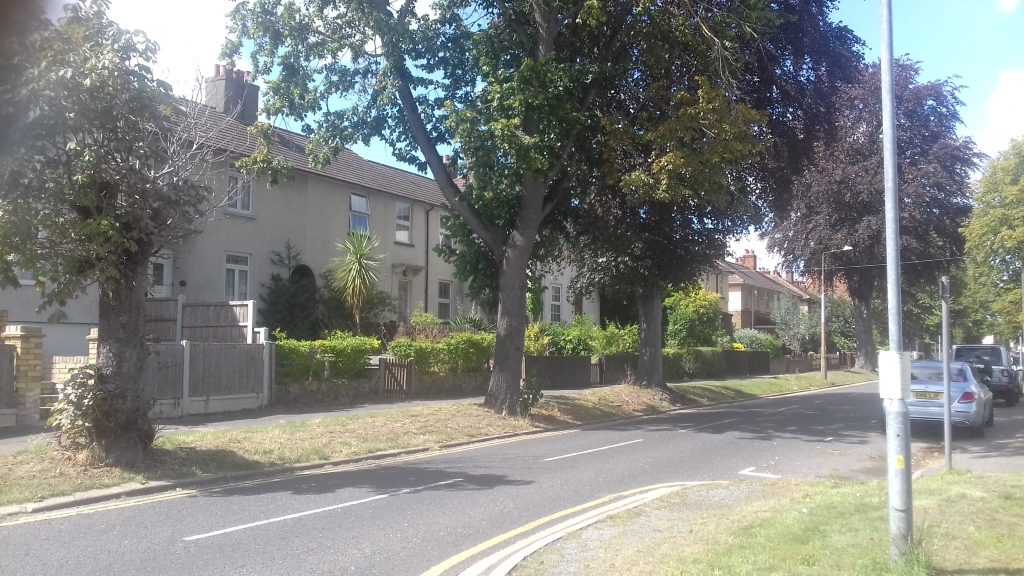
The Grays estate of over 1,000 homes pictured above was built in the mid 1920s and was one of those. I have to declare an interest at this point. I grew up on this estate. One of my great uncles knocked in the posts that laid out the road plan. My Dad was born on it in 1930, my mum moved to it as a toddler; and they still live there now at the age of 93.

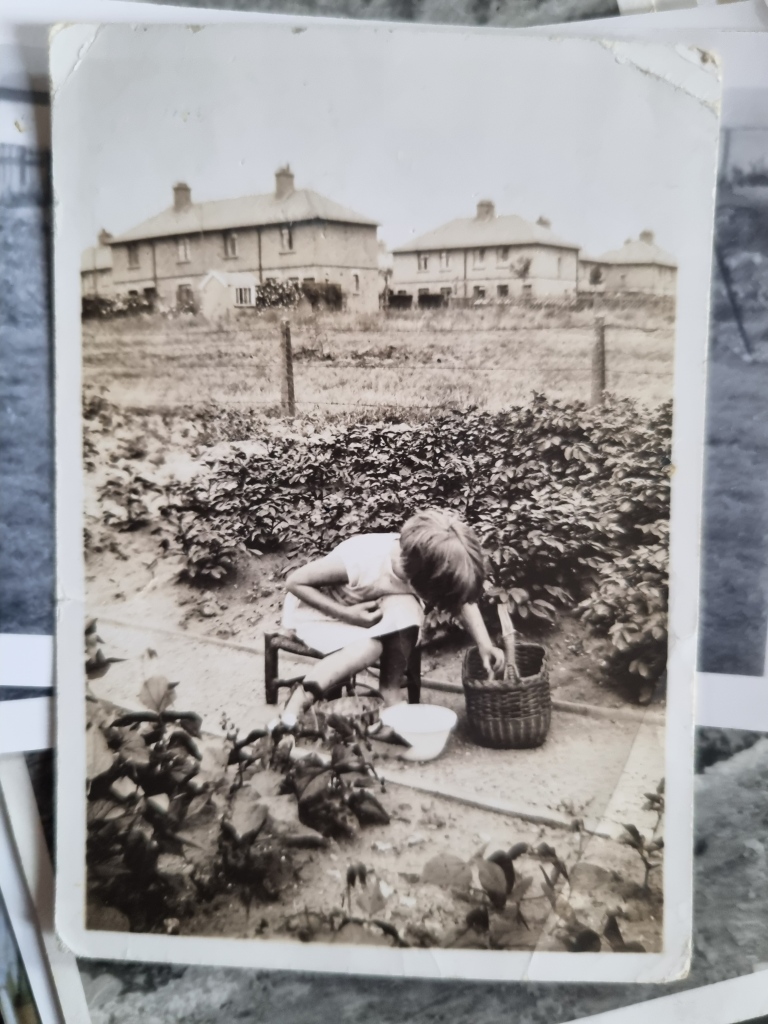
These were standard designed “family homes” with three bedrooms – a big one, a middle sized one and a little one, a bit like the Three Bears. There was an outside toilet for each house – not shared like they would have been in a tenement, a small front garden and a more substantial allotment out the back for people to grow vegetables, like nearly everyone did at first, and, in some cases, keep chickens, as some still did as late as the 1960s. Early on, nearly every one had substantial posts for washing lines, many acquired one way or another via the docks; many of them, like ours, former ships masts. Nearly everyone did washing on a Monday and there was almost a competition to get the washing up on the lines first; almost like flying a flag.

My Mum as a child shelling peas in the back garden of her parents house, circa 1936 or 7.

Smack in the middle of the estate was a recreation field with a small set of children’s play equipment in the North Eastern corner. Until after WW2 the influence of Sabbatarianism meant that every Sunday a Council employee would clank through the field wreathed in chains “like Marley’s ghost”, as my dad put it, and chain up the swings and merry go round; so the Sabbath would not be defiled by the satanic influence of children having fun. And, although there was one off licence in a small parade of shops, grocers, chippie, Co-op, post office, there was no pub. This may have been because the Old High Street down by the river – and easily in staggering distance -was full of them, but it gave the place a sober character; no one reeling home singing after closing time.

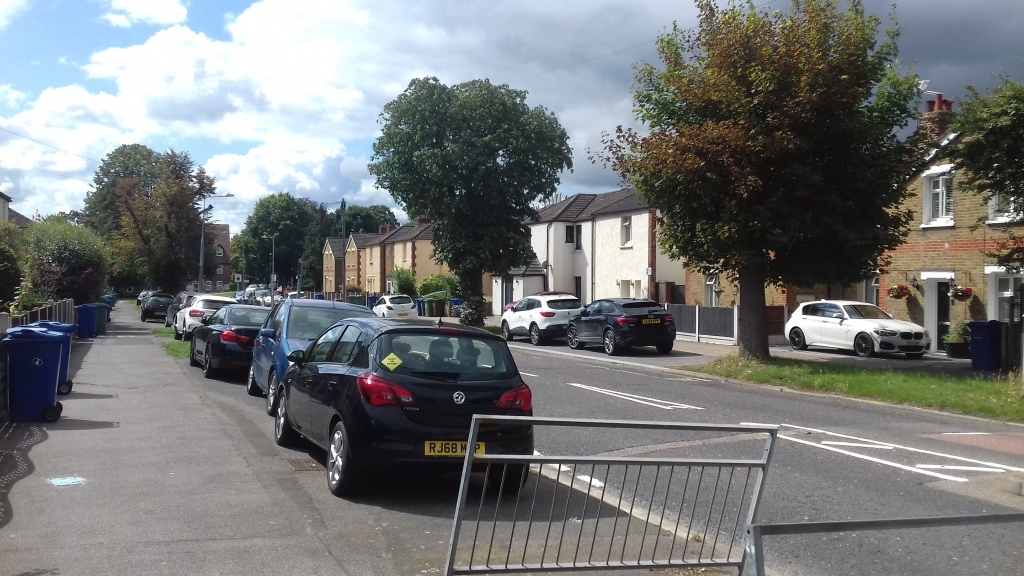
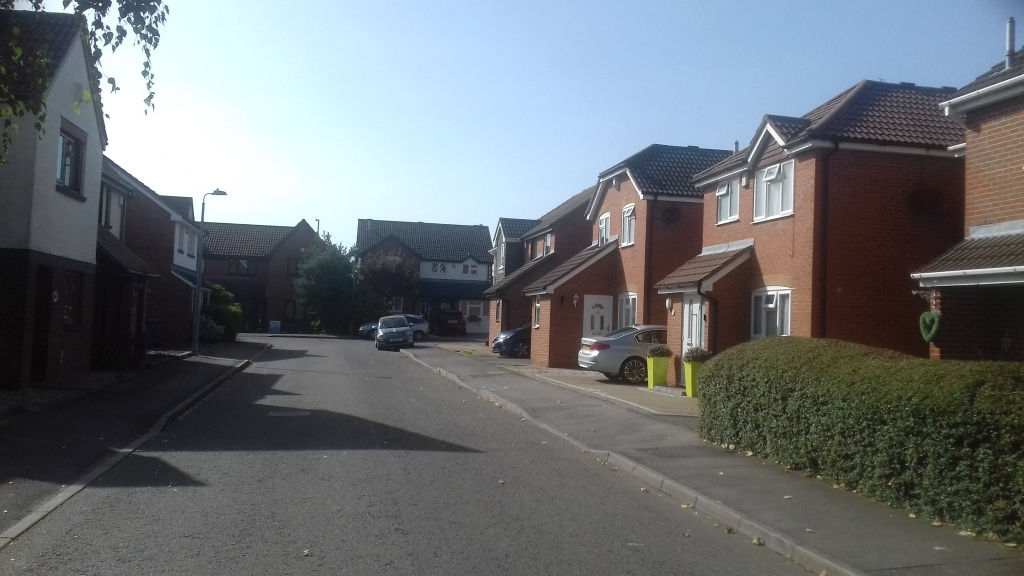
Built long before mass car ownership, the streets gave access to van or horse and cart delivery for the coal merchants – as heating was from coal fires – and groceries. Each road was bordered by a grass verge planted with trees at regular intervals, with every other tree a flowering variety like Horse Chestnut. This arrangement is still intact in places, as in the picture above. In the picture below more than half of the trees have been cut down, and the grass verges have been paved over in the last 30 or 40 years to provide parking bays for cars; which makes the streets feel more bare, less nurturing. This goes along with privet hedges being grubbed out and either replaced with fences or left open so paved over front gardens can provide space to park even more cars.

This coincided with the impact of Right to Buy. In 1979, the Council had upgraded the whole estate, remodelling both floors in each house to build in (two) inside toilets, open up the kitchens and take out the pantry storage spaces that had been superseded by most people having fridges by then. This was done by decanting tenants into other, similar houses while the work took place, block by block, on a standard model using economies of scale. It was a triumph of social provision. Paradoxically, this made the upgraded houses a very desirable purchase when the Thatcher government went on its “Property Owning Democracy” drive in the early 80s. As houses were sold off, with no right for the Council to use the proceeds to replace the stock, little marks of difference started to appear. Different front doors or windows. The occasional column. Some stone cladding. A little lion on a gatepost.

This did not have the desired political effect. The ward this estate is in has always – always– returned Labour councillors; and still does, by some margin. Not that it was ever politically homogenous. Even in the sixties, when the whole area was industrial working class and the Labour vote was weighed as much as counted, there were clearly identifiable Tories here and there – having the Daily Express delivered, wearing blazers with silver buttons, putting Pirate Radio Station stickers in their car rear windows (while looking like the sort of people who wouldn’t listen to them in a million years). During the 2017 election, when Thurrock was a three way marginal between Labour, Conservative and UKIP, a walk through this estate turned up so many Labour posters and garden stakes that it looked like a shoo in for Polly Billington. In the end, she came second, 500 votes behind the Conservative and a little ahead of the Kipper. Close run thing, but indicative the widely polarised political character of different localities in the same Constituency.

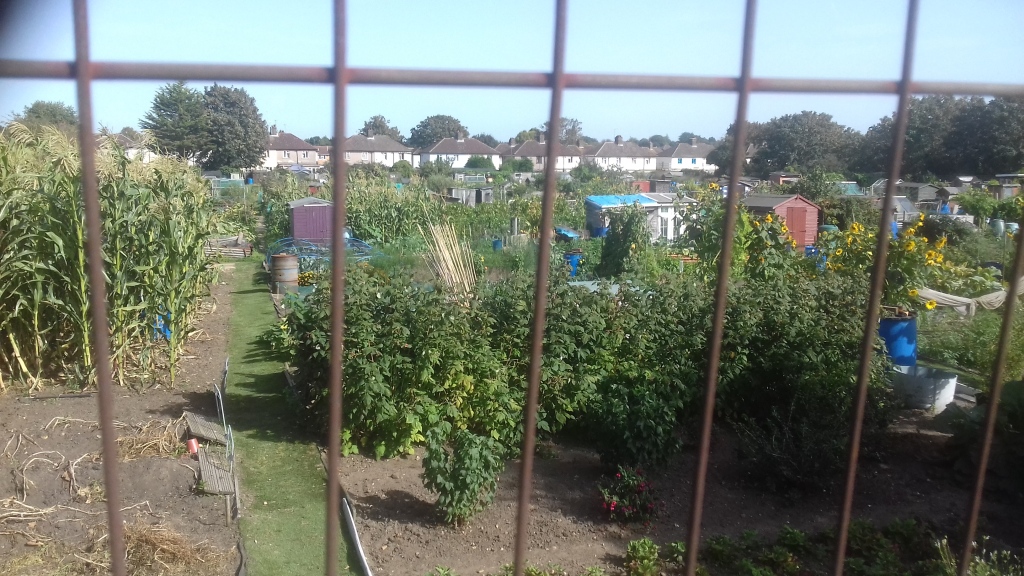
This estate was, and is, also buttressed by allotments that are still well used. This is a view from Hogg Lane, with Chafford Hundred, the alternative universe viewed below, behind and out of sight on the other side.

A final point to note is that a substantial minority of the houses have been enveloped with insulation and look oddly fatter and, being painted white, almost continental. Its not clear how many of these are remaining social housing and how many are those that have been bought. But it is clear here as well as in most other streets you can walk down in the UK that most people with limited wealth at the lower end of the “home owning democracy” can’t afford to make the changes that are socially necessary as individuals; meaning they have higher carbon emissions than they need have, and the higher bills to go with it. An eloquent demonstration of the limits of the market, and transition by piecemeal consumer choice. A wholesale retrofit doing all the houses in one go, with all the benefits of economies of scale on the same model as the 1979 refurb, would be more effective; and is another example of what neo-liberalism has cost us.

1980s: Chafford Hundred, by contrast, is almost an embodiment of what might be called Late Thatcherism. This is a huge development of 5,600 houses built on the land above the old worked out chalk pits on a derelict farm, between Hogg Lane in Grays and Lakeside by the Dartford Crossing; and is a classic piece of late 1980s urban redevelopment, named after an ancient Anglo Saxon County division that once extended from Brentwood to the river, Ongar to Childerditch. It sounds reassuringly retro with undertones of chaffinches and chaff from wheat fields. Almost rural and bucolic. An Essex echo of dreamy little towns in the Chilterns.

But, what’s in a name?

The architecture is box pastiche – standard boxes with historic local style flourishes to give “character” and instant “heritage” – all jammed together a bit too closely for privacy and ease, but too separate for community – snaking around curving roads that lead nowhere but to each other. There is no real centre to it. It feels like an American suburb shrunk to meaner English dimensions.

Little boxes on the hillside, Little boxes made of ticky-tacky, Little boxes, Little boxes, Little boxes all the same…

A few little shops and a doctors surgery with everything retail sucked into the enormous commercial gravitational field of the Lakeside Shopping Centre, on the far side of a foot bridge over the railway line.

There’s only one tiny park for the kids, unless they want to trek off down the pits, which have been remodelled as nature reserves, so the developer – a consortium of Blue Circle, Tunnel Holdings (the old cement firms that worked out the pits) and West Thurrock Estates – could cram on as many units as possible for sale.

Its saving grace is that is has a railway station that connects it to London (Fenchurch Street) and Southend, and everywhere en route. As a result many of the people who live there commute in to work in the City. More a place to be stored in when not working than a place to live. In the property crash of the early 90’s house prices halved and more than half the homes were repossessed; which must have been a shattering experience at the time.

Politically, Chafford was represented solidly by Tories, with Conservative councillors winning every election from 2004 to 2021, displacing the Lib Dems, who won in 2002. In May this year – after the Council’s Conservative leadership had managed to bankrupt Thurrock with unwise commercial investments – Labour won a seat there for the first time.

2020’s New Town Centre?

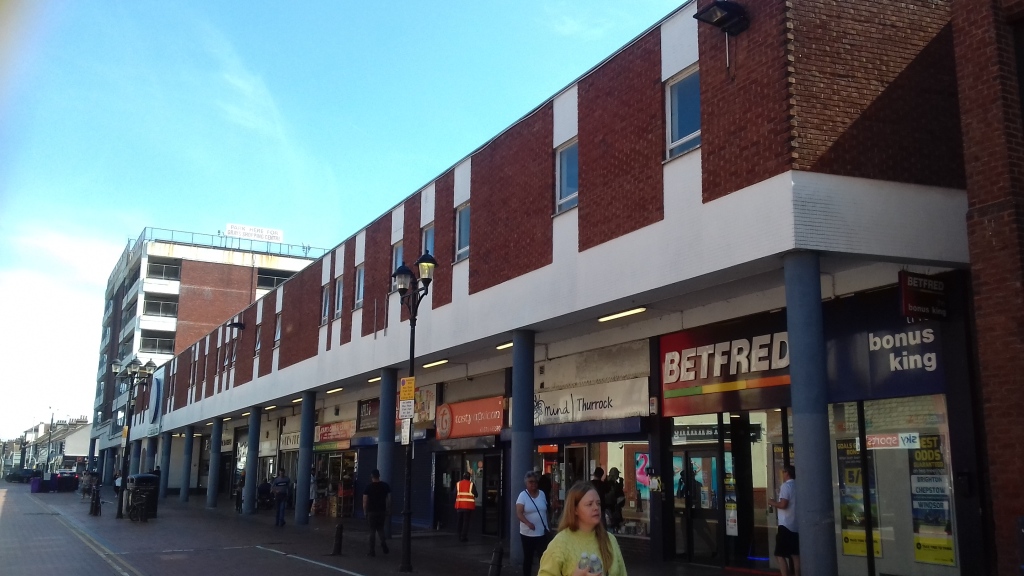
In the 1970s there was an attempt to boost the High Street, which at that time still had a Woolworths and Marks and Spencer, by building a small shopping mall with attached multi story car park to the rear of it. At a time when the car was still considered the future and places like Leeds were carving themselves up with urban motorways, the idea was that people would drive in, have a place to park in the multi story, and load up.

This was never fully realised even early on, the multi storey being decidedly underused, but when the Lakeside shopping centre opened 5 miles up the road by the Dartford crossing at the end of the eighties, everything shrivelled. Lakeside had big flagship stores, a wider range of everything and was not much harder to get to. Everything in the town centre moved downmarket. The vibe in the centre now, if you walk through it, is decidedly sparse. Even the Wilko has now gone.

This was the future once…

So the owners, like the owners of retail space elsewhere, are looking to realise capital and build in a customer base by building high above the shop. The ongoing income from retail however, is dwarfed by the enhanced value of the real estate. Similar schemes in North West London include the Edgware Road Sainsbury development at the Hyde – that is proceeding apace -and the Broadwalk Centre in Edgware, which is generating some opposition from people used to living in a sleepy greenish suburb, suddenly about to be overshadowed by 20 storey towers.

The Grays Plan is not quite so gargantuan, but envisages, modern high rise blocks around a square. You can see an idealised version in their video here, complete with weird holograms of oddly shaped people doing strange things.

Their description of their plan has the same slightly corporate unreality as the holograms in their video.

Key features of our proposals:

  • Enhance and revitalise the town centre and public square 
  • Re-invigorate the retail and leisure offer
  • Boost the night-time and leisure economy within the town
  • Create space for community use and independent-focused retail
  • Create a vibrant and safe public realm with open spaces and increase biodiversity in the heart of town
  • Bring forward new homes in an accessible and sustainable central location
  • Improve pedestrian connectivity across the town
  • Introduce design-led, landscaped spaces for the whole community 
  • Facilitate pedestrian linkages with the Thameside neighbourhood 
  • Support the creation of new jobs and opportunities

All this is currently being discussed and I think the apposite questions are these. So, I have sent them in, and await a reply.

  1. How many people, roughly, do you envisage will be living in the development?
  2. What proportion of the development will be social housing for affordable rent? If there are any, will these be of the same quality as the rest of the development and integrated into it?
  3. Related to that, what proportion of the apartments will be for sale at what sort of prices?
  4. Will there be a residence requirement to avoid people buying higher end flats as an investment and leaving them empty (as is far too common in London).
  5. What does the proposed “space for community use” consist of? Will the public square be public or will it be privately owned?
  6. How will the development increase the biodiversity of the town centre?
  7. Will the apartments be zero emission ?
  8. I note that you say that, given the proximity to good public transport links, many people will have no need of a car but, if enough of the flats are high end, most of the people who live in them would probably want one, especially for leisure use. Would you consider building a car share club into the development to minimise the amount of space needed for car parking – and help pull the residents together into a community?

The developers will probably want as many expensive flats as they can get, which will build in a well heeled consumer base above the remaining retail space on the ground floor and maximise their revenues from sales. But this will be in a tension with the pressing housing need in a fast growing borough, with people spilling into it from London in a very steady stream* looking for somewhere more affordable to buy or rent. How this tension works out will determine what this development becomes.

*The ONS used to produce a migration flow maps for local authorities – sadly discontinued after 2020, which showed that when people leave Thurrock they go all over the place, but nearly everyone who moves into it does so from London.

No ifs, no buts…why the trade union movement should stand for peace in Ukraine – a reply to Gary Smith

However one views Russia’s invasion, to support pursuit of the war by Kyiv until victory, until all lost territory has been regained, and to call for Russia’s strategic defeat—the current position of that regime, supported by the US and NATO—is to support a profoundly criminal policy, since the goal is unrealisable. Its pursuit will not change the outcome of the war but will continue to destroy Ukraine. David Mandel

Gary Smith’s argument on Labour List, written under the pressure of a critique from Stop the War’s Andrew Murray, starts with the resounding phrase “Solidarity should know no borders”.

One border that he doesn’t acknowledge is the one that has run in blood across the Donbass since the Ukrainian Air Force bombed Donetsk City in May 2014. This followed a popular insurrection in the East of the country against the Maidan coup, because it overthrew a President they had voted for, with the help of the US and EU with an increasingly influential role being played by the local far right.

Gary Smith simplistically sees this as a “Russian occupation”. His attempt to explain away local support undermines his entire stance, however. He is AGAINST a local referendum in Crimea and Donbass, to determine whether the people who live there wish to revert to Ukraine or remain in the Russian Federation, on the grounds that there has been an exchange of population since 2014. What he doesn’t acknowledge is that some of the people who have moved into the Russian zone since the start of the war have been refugees from Western Ukraine. Russian speaking people who felt under threat or out of sympathy with the Ukrainian nationalist form of the oligarchic regime in Kyiv. Early in the war, there were convoys of cars trying to get out of Western Ukraine to get to the Russian zone. Some of them were shelled. He also doesn’t note that a third of the refugees from the war overall have fled to Russia itself, which is the largest single destination country.

He uncritically repeats lurid propaganda that a policy of evacuating civilians from war zones -as the Russians have done – amounts to “abduction”. It seems odd to argue that children in an orphanage, for instance, should be left in a zone that is being shelled and fought over by both sides. Better to get them out, surely? He does not note that when Russia evacuated Kherson last Autumn, a majority of people chose to leave, but those hostile to them stayed; and were allowed to do so; which would not be the case if they were being “abducted”. Hopefully he does not agree that keeping them in situ to act as human shields for military installations – as Amnesty International noted the Ukrainians were doing – is somehow acceptable because its them doing it.

Overall however, opposing a referendum – giving the people a choice – shows that he knows that the reversion to Ukraine would lose in these areas. There are good reasons for that. Even if you think the referenda held by the Russians last Autumn in Donbass, and in Crimea in 2014 had no significance, people in Donbass have been fighting the Ukrainian army since 2014. 50,000 of them are in the Donbass militia. Dontesk city has been shelled almost every day for nearly ten years. There is no love lost on either side of this border. It is also stated in terms by the head of Ukraine’s Military Intelligence, Kyrillo Budanov, that the people in Donbass and Crimea have a “completely different view of the world” and will have to be “re educated” or “physically eliminated”. This is not, in his view, a liberation of a population oppressed by a Russian occupation, but a reconquest against the resistance of people who support it. Budanov is a serious man. We should take him at his word.

So Gary Smith’s view, and that of the GMB Motion, is that the determination of Ukraine’s future should be left in the hands of some of the pre 2014 population, but definitely not all of it. Self determination for the West. Forcible occupation and ethnic cleansing for the East. Not a position the TUC should support if we think that “solidarity has no borders”.

Gary Smith’s case relies on two gigantic false premises.

1 That it is a Russian war aim to conquer the whole of Ukraine and eliminate the Ukrainian nation. It isn’t. Occupation of the whole of Ukraine would be like “swallowing a porcupine” for Russia, as John Mearsheimer put it. Why would they want to do that?

Russian war aims have been quite clear from before the war started, and negotiating about them seriously in the Winter of 2021-2 could have averted the conflict.

  • They were initially to remove the military threat to the Donbass and allow it autonomy within Ukraine. 14,000 people had died in the conflict since 2014, most of them on the Donbass side of the line. Initially Russia didn’t even recognise the Donbass Republics, despite local pressure and pressure in the Duma from The Communist Party of the Russian Federation – the main opposition Party – to do so. The demands from Donbass itself to be absorbed into the Russian Federation were only accepted and implemented after 6 months of fighting and the failure of initial peace negotiations in May 2022 that are widely acknowledged to have been torpedoed by the US and UK.
  • Recognition of Crimea as part of the Russian Federation. This is overwhelmingly supported by the people who live in Crimea. For background see here.
  • A commitment from Ukraine not to join NATO. NATO is presented in the West/Global North as a defensive alliance, because NATO is the military expression of the Global North. Being a member if NATO is being part of a bloc of wealthy imperialist countries responsible between them for 62% of global military spending and whose core members, including the UK, are responsible for 4.5 million deaths in the war on terror over the last twenty years. It does not defend “democracy” it is an organisation to defend the Pax Americana, which is anything but peaceful for anyone on the receiving end of it. Every year, NATO conducts “war games” in Eastern Europe practising for a war with Russia. Locking in Ukraine, with a large army, swollen by Western finance and honed by Western training, spiced up by far right volunteers who see the Donbass as the front line of the war between (white) Europe and (untermensch) Asia would make such a war inevitable. The refusal of NATO to even negotiate on the Russian proposals for mutual security guarantees in the winter of 2021 -2, convinced them that this was the case.
  • A removal of far right (Banderite) influence on the Ukrainian state. This influence has been played down in the West for the last eighteen months, but it is pervasive. This goes a lot deeper than Azov battalion insignia. The wholesale glorification of Stepan Bandera, a man whose organisation provided a strong contingent of concentration camp guards, fought with the Nazis and killed 100,000 Polish villagers, as well as countless numbers of Jews, and the embedding of far right organisations and their mode of thought across the entire state is no trivial matter and reflects a wider rehabilitation of the far right increasingly pervasive in the Global North.

Supporters of the GMB motion should reflect on what, if anything, is wrong with any of these positions.

Is it desirable to glorify a Fascist movement as part of an attempt to build up national consciousness?

Is it desirable to be part of the world’s premier predatory imperialist alliance?

Should the people who live in Donbass and Crimea be forced to live in a state that is hostile to them and wants to ethnically cleanse them?

If your answer to any of these questions is “no”, then the GMB Motion can’t be supported.

2. Gary Smith does not acknowledge the role of NATO in general and the United States in particular in fomenting this conflict. The geo-political aim of the US since the fall of the Soviet Union in 1991 has been to “dominate the post Soviet space”. That means Eastern Europe, former Soviet Republics and, ultimately, Russia too. This goes along with breaking any relationship between countries in the EU and Russia that might threaten US dominance in Europe as a whole. That’s why they never agreed to any notion that Russia could join NATO – because the centre of military and economic gravity on the continent would be between Russia and Germany, and that would be hard for them to control. Blowing up the Nordstream pipeline is symbolic of this.

The United States is funding this war, and supplying the military equipment, satellite intelligence and propaganda mobilisation needed to keep it going. You’d have to have to have been paying no attention at all to the US record across the world in the last 150 years to have any delusion that this has anything to do with the rights or otherwise of Ukrainians. Senator Mitt Romney put it as cynically as you might expect “Supporting Ukraine weakens an adversary, enhances our national security advantage, and requires no shedding of American blood”.

On the principle that “he who pays the piper calls the tune” it would also be naive to assume that Kyiv has any weight at all in strategic decisions. A concern with “imperialism” that ignores the role and influence of the world’s dominant imperialism – and its local dominance inside Ukraine itself -is an attempt to blow smoke in our eyes.

The best traditions of international solidarity in the trade union movement are to stand up against the wars and exploitation visited upon the world by our own ruling class. The worst tradition is that of knowing our place, tugging our forelock, and going along with the foreign policy objectives of our own imperialism and its senior partner in Washington, in the hope that, loyalty will be rewarded with some crumbs from their table, like well paid manufacturing jobs in BAE systems perhaps.

The current course of the Kyiv government is to subject their people to self immolation at the behest of the US. This summary of how grim things are getting is from Dimitriy Kovalevich.

In Western media, the current conflict in Ukraine is often presented as a war between Western-style ‘freedom and democracy’ and Russian-style ‘authoritarianism and dictatorship’. We are told, furthermore, that such ‘freedom and democracy’ are represented by the governing regime in Kiev.

But this is a regime that has banned all men between the ages of 18 and 60 as well as women in certain professions from leaving the country. There is no free internal movement of citizens. The main exceptions to the prohibition on leaving the country are those unfit for military service, those fathers who have three or more minor children (all below the age of 16), and persons caring for people with disabilities. (The latter exemption only applies if there is no other family member to provide care.)

The regime, which came to power in a violent coup in February 2014, has long ago banned all left-wing political parties in the country, and since last year it has banned street protests and strikes. Also last year, it passed a law severely restricting the rights of trade unions. Ukraine was supposed to hold a legislative election this fall, but this has been postponed. (Elections are to take place in the Russian-controlled territories of Ukraine on September 8-10). For neoliberal capitalism, there can never be too many restrictions against freedom, nor can there ever be too much exploitation.

In early August, deputies of the Ukraine president’s ‘Servant of the People’ party in the national legislature (‘Rada’) introduced a bill that provides for the conscription of forced labor of all those who have not been conscripted to the armed forces. Formally free citizens who already cannot legally leave the country due to wartime restrictions will now also be subjected to forced labor.

There is also already a serious shortage of trained personnel in Ukraine. Hundreds of thousands of factory workers, skilled tradespeople, railway workers, drivers, and other equipment operators in agricultural industries, and on and on have been conscripted into the army. Many of them have died or been seriously injured in the futile attempts of Ukraine’s leaders and their Western patrons to storm the well fortified defensive lines of the Russian armed forces.

In addition, some eight million people have simply left the country during the past year and a half. Most of those have no wish or plans to return in any foreseeable future. Every day, Ukrainian border guards catch dozens of ‘conscription refugees’ at Ukraine’s borders. Sometimes, border officials use tracking drones generously provided by the governments of the European Union and the United States. The unfortunates who are caught quickly find themselves in the trenches along the hundreds of kilometers of front lines separating Ukrainian and Russian armies.

‘Help wanted’ signs can be seen in Ukraine on many delivery trucks, at bus stops, and in front of supermarkets. Orderlies and drivers, construction workers and packers read the signs, are “urgently needed for work”.

Although Ukraine is the poorest country on the European continent, many people are not eager to rush into a job. Since the beginning of the year, company managers are obliged to hire employees only after receiving formal approval from the local military conscription office. Thus, a man who applies for an advertised job as a driver may well instead find himself in the trenches, facing minefields and deadly Russian defensive positions. Meanwhile, his former employer will be back on the hustings looking for a replacement driver.

Another factor weighing on the labor market in Ukraine is wage reductions of up to 50 per cent. Teachers are facing salary cuts as the 2023 national budget for public education in Ukraine has been downgraded from an initial 154 billion hryvnias to 131 billion  hryvnias (US$3.5 billion). That is less than the 2022 expenditure. In addition, most school districts rely on supplementary funding from local governments, and these funds, too, are being squeezed. As the Ukrainian news outlet Apostrophe explained in a report in late 2022, citing a teacher in Kiev named Oksana: “In Kyiv, the situation is more or less the same, although the allowances have been partially removed. But the situation elsewhere in Ukraine is really worse. In many cities and villages, teachers are receiving ‘survival’ salaries only, losing from 15 per cent all the way to 50 per cent of their income, depending on the state of local budgets.”

The report explains, “Educators receive money not only from the Ministry of Education and Culture but also from local budgets. But local budgets during the war have also shrunk significantly. According to a study by the Kyiv School of Economics, every fourth community under [Russian] occupation [control] has collected 50 percent less revenue compared to pre-war plans. Another two-thirds of communities outside the combat zone reported a decrease in income. It is clear that in such a situation when it is necessary to urgently address humanitarian issues, local authorities cannot pay pre-war salaries to teachers.”

This takes place as inflation is around 30 percent annually. Wages in Ukraine today barely cover the cost of basic food. For these reasons and more, many workers retreat into the shadows and choose to work illegally, many in multiple jobs if possible.

Last year, Ukrainian authorities tried to solve their labor shortage problems by tapping into the large pool of the unemployed. The unemployed who were officially registered were sent into military zones to clear rubble, cut down trees, build shelters, etc. This is hard physical work, often located near the front lines. This initiative was labeled an ‘Army of Reconstruction’, but many people responded by simply stopping to register as unemployed. After all, unemployment benefits have also been cut in Ukraine. Today, the average benefit hovers around the equivalent of US$27 per month. The maximum benefit rate is $180 per month, but this is only good for three months.

Food prices in Ukraine are already higher than in Russia and EU countries, from where most food supplies in Ukraine come.

Simply put, Ukraine is gradually introducing a system of slave labor – people must work to meet basic food needs, but they work for steadily shrinking salaries and benefits. Western media is silent about all this ...

The new draft law on the mobilization of workers is intended to “ensure the functioning of the national economy under martial law”, in the words of those drafting the law. It is noteworthy that in early August, Ukraine began to talk about a likely ban against military conscripts leaving the country for three years following an eventual end to military hostilities and martial law. Just such a proposal was recently made by Vadym Denysenko (and here), head of the Ukrainian Institute for the Future and a former advisor to the head of the Ukrainian Ministry of Internal Affairs. Denysenko said, “I am sure that even after the war it will be necessary to extend the ban on men traveling abroad for at least another three years. Otherwise, we simply will not survive as a nation.”

Earlier, Denysenko’s Ukrainian Institute for the Future published data on population numbers in Ukraine. Since the start of the Russian special military operation in Ukraine 18 months ago, some 8.6 million citizens have left the country and not returned. Of the 29 million citizens remaining in the country, no more than 9.5 million are working. State-financed jobs excluded, there are some six to seven million workers earning salaries. Ukraine began its path to post-Soviet ‘independence’ in 1991, with a population of 52 million. The population numbers have been steadily declining ever since due to mass emigration.

At the same time, the fertility rate of the country has fallen below one. To ensure stabilisation and a small increase of the population, the fertility rate should be more than 2. But the Institute says the average fertility rate is 0.7 children per couple. It also cites analysts who project that the number of pensioners in Ukraine in the coming years will be double the number of working-age citizens.

Vadym Denysenko is partly right in the sense that millions of Ukrainian men would no doubt rush abroad were borders to be opened. The wives and children of many of them have already been living abroad for year and a half. Many would leave in search of better wages and in order to escape the mousetrap that Ukraine has become.

Denysenko’s proposal is not at all appreciated in Ukraine. It is viewed as a return to slavery and serfdom. Of particular note is that his Ukrainian Institute for the Future is a neoliberal think tank funded by right-wing think tanks in the West, including the Atlantic Council and the National Endowment for Democracy in the United States.

This idea of prohibiting Ukrainian citizens from leaving the country even after the end of hostilities stems, in part, from the fact that Ukraine is now heavily indebted to Western governments and financial institutions. Repayment with interest can only be guaranteed through the merciless exploitation of the Ukrainian population. To achieve that, it is necessary that the population be denied the option of running away from something rightly perceived as something resembling slavery or medieval serfdom.

In July 2023, the foreign exchange reserves of the National Bank of Ukraine grew by 6.9% to $41.7 billion, the highest monthly increase since 1991. However, the largest share of the increase came not from economic growth and increased export revenues but from international assistance to the tune of $4.7 billion. Most of that comes in the form of loans from the European Union, the United States, Japan, the IMF, and the World Bank, to be repaid in the future.

Bloomberg News reported on July 24 that Ukraine needs to bring back 2.8 million of its women citizens from abroad in order to have a chance at economic recovery following the end of military hostilities. According to one expert Bloomberg interviewed, if only half of the women return, this would cost Ukraine 10% of its GDP by 2032, on the order of $20 billion per year. Such losses will far outweigh the EU’s proposed four-year aid package to Ukraine in the amount of $14 billion per year.

According to a recent estimate by the Ukrainian Ministry of Economy, Ukraine will need to attract an additional 4.5 million workers to the labor market over the next ten years. But at current wage levels, people are more likely to leave the country than to stay and work.

Ukrainian journalist Diana Panchenko wrote on her blog earlier this month, “At the end of the war, a huge number of people will still leave. Ukrainians will be scattered all over the world, like the Roma people, for example.” She has been forced to flee Ukraine due to her writings critical of the government. She also noted in her blog post that, according to UN statistics, most Ukrainians who have left the country have settled in Russia. “It is not customary to talk about this in Kyiv, and the reason for that is clear.”

Answering a reader asking when the refugees could return to Ukraine, the journalist replied that, in her opinion, it would not be soon, the war could last a long time. Clearly, this will not help boost population growth. And how will it all end? Few in Ukraine can openly say this, but, according to Panchenko, “Ukraine has already lost – we have no economy and, even worse, we have no sovereignty. Today, we simply depend on what the West says. We have lost our identity.”

At the end of July, Ukrainians were also apprised of a stunning proposal that the working week may be increased to 60 hours, consisting of six days of work at ten hours per day or five days at 12 hours. At least, that is the idea published by the Eastern interregional office of the State Service of Ukraine on Labor Issues. The duration of weekly, uninterrupted rest would be reduced to 24 hours, that is, Ukrainians will have only Sunday as a day of rest from work. This idea would first be implemented in enterprises working in critical infrastructure or “defense”. The increase in the work week is said to be required by the shortage of workers and the need to constantly repair energy infrastructure.

As it stands presently, employers often exploit Ukrainian workers beyond the norms that would be established by this law. Recently, this same State Service of Ukraine on Labor Issues was approached by an employee whose employer set the rest period for the preceding month as only one day every three weeks and the duration of the shift as 12 hours. The employer claims that such a schedule will be in effect until the end of the year because, during martial law, the number of overtime hours required to work can be unlimited.

Thus, for the average Ukrainian, the Western values of freedom and democracy are turning into an unprecedented neoliberal experiment to abolish all labor rights and implement something resembling slavery. Measures to force Ukrainians to ‘fight or work’ are presented as a triumph of oft-spoken “European values”.

In the future that Ukrainian politicians and their Western advisors and think tanks are preparing, many Ukrainians will work up to 12 hours a day with few days off, earning less than a minimum subsistence salary. They won’t dare flee their country because the consequences of being caught could easily become deadly.

A prolonged war will make all of this worse. A fig leaf conscience clearing clause in a TUC Motion claiming to oppose this will have no weight at all in the situation. The only thing that could make a difference is for the war to end. And the path to that is not through a military victory for NATO with Ukrainians doing the fighting and dying, Even if you think this might be desirable, it isn’t possible so the attempt to pursue it becomes an act of futile cruelty.

As David Mandel puts it

the most condemnable policy is surely to keep the war going when there is no hope that continued fighting will improve the outcome for Ukrainian workers and related popular groups. That is precisely the policy of the US, NATO and Kyiv. Biden stated clearly that he would not pressure the Ukrainian government—in private or public—to make any territorial concessions.

One need not be a military expert to see that there is not the slightest prospect that Ukraine can regain its lost territory, or possibly even avoid losing more, through continued military action, unless, of course, NATO forces directly enter the war—a move that would threaten the world with nuclear Armageddon. This was evident to objective observers from the very first moment of the war, even to the New York Times, which a month into the war admitted that the US goal was to pull Russia into a quagmire.

Continued pursuit of war will bring only more death and destruction to the people of Ukraine. At one point, that was admitted even by the US Chairman of the Joint Chiefs of Staff Mark Milley, who called for a negotiated settlement and was duly instructed to shut up. And if anyone still nurtured illusions, the current Ukrainian “counteroffensive,” whose inevitable failure was obvious to any objective observer, should have finally dispelled them.

However one views Russia’s invasion, to support pursuit of the war by Kyiv until victory, until all lost territory has been regained, and to call for Russia’s strategic defeat—the current position of that regime, supported by the US and NATO—is to support a profoundly criminal policy, since the goal is unrealisable. Its pursuit will not change the outcome of the war but will continue to destroy Ukraine. Territorial compromise is inevitable, if the war is not to go on forever, a prospect that some elements in Washington and Kyiv, in particular the latter’s neo-Nazi elements, who have gained much influence thanks to the war, are apparently prepared to contemplate.
War and Peace: Points of Information for TUC delegates on the GMB Motion on Ukraine.

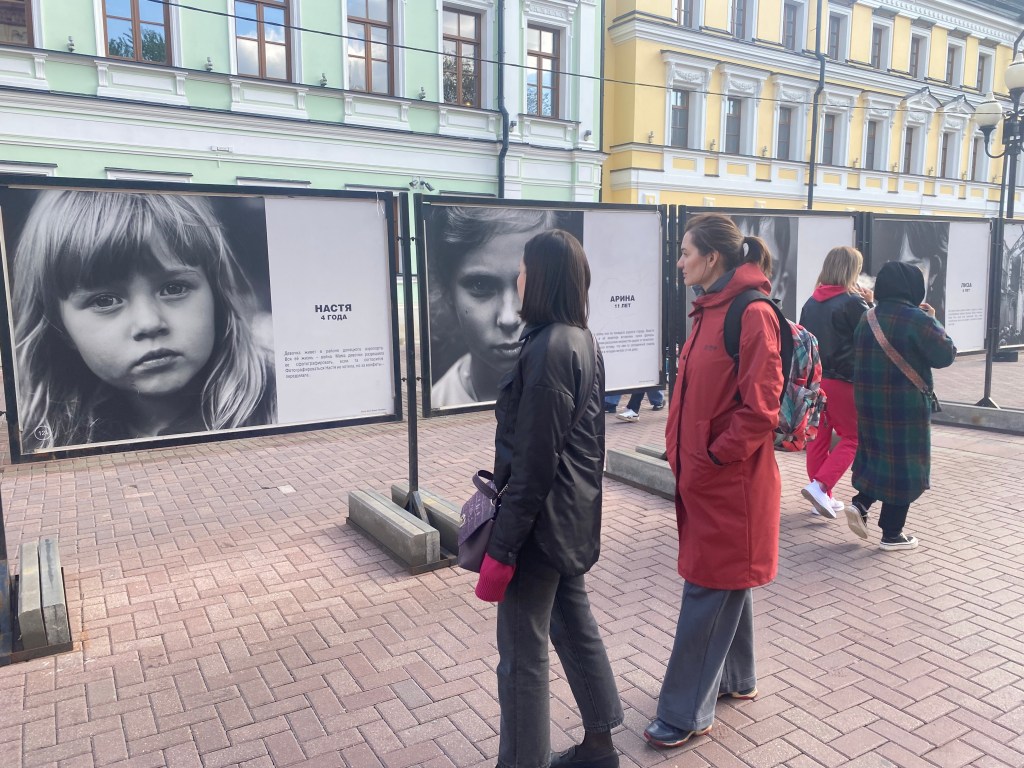
These are pictures of children killed by the almost daily Ukrainian Army shelling of Donetsk City since 2014 on display in the Arbat in Moscow. There are more than 300 of these children. They are not reported here. The GMB Motion writes them out of history. Photo: Dan Kovalik

When you think through what it says, it becomes clear that support for the GMB Motion to the TUC on the Ukraine war means support for two things that contradict everything the trade union movement stands for.

1. The ethnic cleansing of the Donbass and Crimea

2. An unlimited commitment to a war without end and/or an escalation which could lead to a nuclear confrontation that will kill all of us.

To be precise about it:

1 Ethnic Cleansing

The Motion’s point 1 calling for the immediate withdrawal of Russian forces from all Ukrainian territories occupied since 2014 is not compatible with point 3, calling for a peaceful end to the conflict that secures the territorial integrity of Ukraine and carries the support of the Ukrainian people. This is because it eliminates the people of the Donbass and Crimea from the narrative. As we can see from the image above, this is because there has not been one undivided “Ukrainian people” since 2014.

There has been a civil war.

The success of the Maidan movement in 2014 in overthrowing President Yanukovych, backed by the US, EU, finished off any chance of sustaining the binational state in Ukraine balanced between Russia and “the West” that had been viable until then. The people of the Donbass and Crimea rebelled against the overthrow of a President they had voted for. The decision by the new regime in Kyiv to repress them by force was prevented in Crimea by a popularly supported Russian annexation, but the bombing of Donetsk City by the Ukrainian Air Force in May 2014 began a civil war that had already cost 12,000 lives before the Russian intervention in February 2022.

This eye witness account of that day from the Donetsk Anti Fascist site is from EIena Hovhannisyan, a biology teacher:

“At that time we kept up with the news from Sloviansk and Kramatorsk. We already knew how people had been martyred in Odessa, Mariupol and Krasnoarmeisk.

I had forebodings of near disaster. It was already hovering over us, but we did not think how tragic, long, brutal, hopeless the events would be. Sometimes it seemed that it was just a bad dream, that I would wake up and everything would be like before. But no. It is an illusion that the war will not touch you. It will touch everyone, sooner or later. We were simply the first to be in the epicentre.

And May 26th I will always remember. The warm, sunny weather and the roar of planes in the sky. From the balcony on the side of the airport black smoke could be seen, you could hear explosions constantly. The first shelling, deaths, destruction, grief and pain. Since that day, there would be no peace in Donetsk for another nine years. But we didn’t know it then.

And that day was endless, filled with horror and pain. The phones were literally ringing off the hook – everyone was trying to find out what happened to their loved ones, whether they were alive or not. In the evening my son arrived from work; his office was a couple of blocks from the station. He told about the horror in the city, about the dead woman vendor from the station market, about the very young guy who worked as a valet. He was killed by shrapnel from a missile fired by a Ukrainian helicopter.

People were falling, screaming, crying, calling for help. Passers-by tried to save the wounded, car alarms howled. The railway station area in any city is the most crowded place. In Donetsk on Privokzalnoye there are markets, shops, banks, the area was teeming with life. They say helicopters flew so low that you could see the pilots in the cockpit. And these pilots also saw that they hit peaceful people.

This was not done by some Hitlerites, but by Ukrainians, with whom we lived in the same country. May 26 was the day that turned everything upside down. There is no and will not be our forgiveness for Ukraine. And there will be no return. (My emphasis).

Were Kyiv a regime that was a target for the US rather than an auxiliary, does anyone doubt that this action would have been universally condemned in our media as that of “a regime that bombs its own people”?

As a result, 50,000 people from Donetsk and Luhansk have been fighting the Ukrainian Armed Forces in the Donbass militia since then. They see themselves as Russians, not Ukrainians. The demand of the Donbass Republics from 2014 onwards was to be incorporated into the Russian Federation, on the same lines as Crimea was in 2014. And that has now happened.

So, for the people who live there, the Russian troops are not occupiers, they are their army. The restoration of the 2014 borders would be over their dead bodies, or see them made refugees. Delegates should note that a third of the people who have fled the fighting have fled to Russia (the largest single destination of any country).

The threat of ethnic cleansing in Crimea and Donbass is not a claim by RT or a “Putin talking point”. It is what the Ukrainian leadership say themselves.

In this interview with Kyrylo Budanov, Ukraine’s head of military Intelligence, is quite clear about what would happen if Ukraine’s war aims were achieved (starting 36:57 minutes in). He is quite blunt that “victory” in the sense of military reoccupation would only be the start of a “difficult” “multi year process” of “reintegrating” territories with a population that is actually hostile and does not want to be reoccupied. Three million people with, as he puts it “a completely different view of the world”.

Budanov states that people with an “altered psyche” who can be “re educated” should be; without specifying what should be done with those that can’t, though “physical elimination” is a phrase he uses “for people with blood on their hands”; so, anyone who fought in the militia. He says that this will have to be done with a carrot and a stick, as the two only work together; and with a “firm hand”. This will be “hard work”.

Many words can be used to describe this scenario. “Liberation” for those 3 million people is not one of them. If you believe in self determination, you can’t support this.

If the people who live in the Crimea and Donbass are to be counted as part of “the Ukrainian people”, their wishes have to be taken into account in any settlement. The imposition of the 2014 territorial borders on them, as this motion advocates, is incompatible with a “peaceful end to the conflict” capable of carrying the support of ALL of the people of pre 2014 Ukraine.

So, the Motion should be rejected on this basis alone.

2. War without end – or to an end for all of us?

Even if you discount those people and their rights, committing to continue or escalate the war until they are crushed, if it is to be taken as meaning what it says, also has to take into account the costs of doing so. There are two levels to this.

1 Crimea

Actually trying to reconquer Crimea, as opposed to engaging in rhetoric about it, is seen by US military thinkers as being likely to cross Russia’s nuclear red lines.

So, support for this motion as it is written means being prepared to risk doing that .Supporters of the Motion should think through what that means.

The danger here is not simply what the Russians would do in this scenario, but what the Americans think they might do; and therefore what action they would take themselves.

If they suspect the Russians might launch nuclear weapons, there is no limit to how rapidly this could escalate. That’s the case even if the minimum gesture were initially deployed – like the sort of very high altitude explosion above the battlefield that NATO envisaged using as an initial warning shot above a conventional Warsaw Pact break through into central Europe during the Cold War. Even in that sort of case, is hard to imagine that NATO response would be to back off. Games of military chicken tend to escalate, especially with no time to find a mutually face saving climb down, and, with the only acceptable political leaders people who are “prepared to press that red button” we would all be standing on very thin ice indeed at that point.

And, if the the threshold were to be crossed, you have to recognise that US nuclear war fighting doctrine is based on an all out “first strike” to prevent retaliation. Which means acting fast, which makes anyone in its sights doubly nervous. As the Russians have over 3,000 nuclear missiles dispersed all across their territory, such a first strike would have to be huge, widespread and comprehensive. It would also have to smash cities, to knock out control and command centres. As long ago as the early 1960s, the Pentagon’s estimate of the impact of such a strike would be that it would immediately kill upwards of 600 million people, many of them “collateral damage” in nearby countries.

That’s bad enough, but studies done in the 1980s showed that a strike on that scale would cause a “nuclear winter”, as debris from city wide firestorms would be flung too high into the atmosphere to be rained out, thereby blocking sunlight and causing a catastrophic drop in global temperatures by up to 10C; devastating plant life and therefore harvests for years. It would therefore be suicidal for all of human civilisation; even if they got away with it and there were no direct retaliation. This is explored in depth here.

So, there are two reasons why Crimea should not be forced back into Ukraine and therefore the Motion should be rejected.

1 The people who live there don’t want it to happen.

2 The attempt to do so could lead to a nuclear war that will kill most, if not all, of us.

2 Donbass

The first reason also applies to the Donbass. The second may not. But, even if it doesn’t, the costs in men and material of trying to reconquer it are and will be appalling.

The current Ukrainian offensive is effectively stalled. Thousands of men have been killed to regain villages in no man’s land that barely approach the main Russian defences. A large proportion of the “game changing” NATO supplies of Leopard tanks and Bradley armoured vehicles have been destroyed in the attempt.

At the moment, the Kyiv government is launching a further mass conscription drive. Men from 18 to 60 have not been allowed to leave the country, and they can be called up at any time. Many are actively reluctant and are having to be effectively press ganged to fight. Kyiv has just banned 16 – 18 year olds form leaving the country too, indicating that they too may be called up. A truly horrific prospect.

Even with mass conscription on this scale, the prospect of “winning” is nil. The prospect of thousands and thousands more men dying is certain.

That is what supporting a continuation of the war amounts to.

Another reason for the Motion to be rejected.

We need a peace deal instead that will save lives and respect the people on both sides of the Ukrainian divide, allow them to put their shattered lives back together; and both sides of the European divide too, as there can be no “just and enduring peace” without a mutual security arrangement that allows everyone to live without feeling threatened, and that has to include the Russians.

Smaller points

The Motion tries to make an analogy with support for the Spanish Republic in the 1930s without noting

a) that the internationalists who went to fight with the Republican side in Spain were from the trade union movement and the Left. Whereas a significant proportion of the people who have volunteered to fight in Ukraine since 2014 have been from the far right.

They look like this. Photo taken in November 2014 in front of Azov Battalion HQ in Mariupol featuring Oleg Pyenya, a volunteer who posted it on his VK page, who can also be seen here in front of another Nazi flag.

A further difference with Spain in the 1930s is that at that time the British government maintained an arms embargo against the Republic, which mostly received support from the Soviet Union. Today, the British government is very keen to supply Kyiv with arms, with BAE systems opening an office in Kyiv as it has, as the Guardian puts it “benefited from increased defence spending as a result of the conflict”. The United States moreover is spending almost as much on this war as it did when fighting directly for itself in Vietnam – which makes it the major protagonist, just using the Ukrainians to do the fighting.

NATO is not explicitly mentioned in the Motion, but no Motion concerned about “imperialist aggression” deserves support if it actively encourages its intervention, as this one does.

NATO is the military core of global imperialism, responsible for 62% of global arms spending (outspending the Russians by 19 to 1) and the deaths of 4.5 million people in the last 20 years of “war on terror”. It is not a defensive human rights organisation. Its refusal to even negotiate about mutual security arrangements with Russia led directly to the war, perhaps because it has a strategic aim to partition Russia into controllable fragments at the end of it.

b) The Motion argues that trade unions in Russia are banned; whereas there are 23 million trade union members there. The main Federation was considered an acceptable affiliate of the ITUC until it suspended itself in February 2022. The Motion also, however, notes that trade unions in Ukraine do not have “full …labour rights”. In fact, since 2014, Ukraine’s labour standards have diverged from compliance with the norms that would be required for EU membership; as more and more of the economy has been privatised, laws have been passed under the tutelage of the IMF and land has been bought up by Western agribusinesses like Monsanto. The reconstruction Plan for post war Ukraine hands the task over to Blackrock, which will sell the country wholesale into a neo liberal dystopia.

For all these reasons the GMB Motion should be rejected.

A reconquest of Donetsk or Crimea by Kyiv backed by NATO, or NATO with Ukrainians doing the fighting, would require massive ethnic cleansing because the people who live there don’t want to be part of Ukraine.

Attempting to do it will cause hundreds of thousands more deaths or a risk of nuclear war.

The TUC should not cheer this on.

Where the main enemy is.

William I Robinson’s conclusion to his essay The Unbearable Manicheanism of the “anti imperialist” Left implicitly contradicts the rest of his argument.

He writes The U.S. may be the top dog and the most dangerous criminal among competing cartels of criminal states.  We must condemn Washington for instigating a New Cold War and for prodding Russia through aggressive NATO expansion into invading Ukraine.  

Quite so. This point makes it an odd post to be recommended by the editor of Labour Hub, which in lockstep with the hegemonic ruling class narrative in the UK, has spent the last 18 months arguing doggedly that NATO expansion had nothing to do with causing the war. No prods or provocations acknowledged.

But the wider point, that the US “may be the top dog and the most dangerous criminal among competing cartels of criminal states” means that the Tricontinental Institute, Code Pink, The International Manifesto Group and No Cold War among others critiqued in his article, have got it right; that the US is the core of the imperial system that needs to be opposed in the global struggle for socialism; because that “may be” is a way of saying “is” without quite saying “is”.

The way Robinson poses it in the rest of his article however is that we are almost in a multipolar world already, and the USA is just first among equals. This is far from the case. Its capacity to subordinate the rest of the developed world to its economic, political and military needs makes it the lynch pin of the global imperial system. The EU, Japan, UK, and even smaller wealthy countries like Australia and New Zealand, are tied to it as auxiliaries prepared to sacrifice their own economies for its needs, and integrate their militaries into US global leadership. This integration of all the major developed imperial powers, subordinates the weaker to the US, but allows them together to dominate the rest of the world. Between them, direct US allies account for 67% of global military spending; and the US alone accounts for more than half of that. “Top dog” indeed.

And the US has almost 800 overseas military bases in over 80 countries, as we can see here. China, by contrast, has one (8 fewer than Turkey).

What a Global Empire looks like

This is not a matter of show. The war on terror, from 2001 to the debacle of the flight from Afghanistan, killed 4.5 million people; and did so without establishing a single viable, functioning, let alone democratic, state anywhere they intervened. It has been argued that the creation of chaos in countries like Syria and Libya has been seen in Washington as preferable to allowing regimes they disapprove of to function effectively.

This is underpinned by the Death Star level planet destroying weight of the US nuclear arsenal, the biggest of big sticks, which has hitherto allowed them to speak as softly or loudly as they like. And this is not simply for “deterrence”, or to threaten non nuclear states. The US nuclear “first strike” doctrine envisages an exterminist attack on China or Russia. This would be suicidal, as the scale of such an attack would generate a nuclear winter, but the top brass are as deeply into denial about this as they are about their equally fatal failure to rise to the level of the challenge of climate breakdown, and their planning is regularly updated.

Direct military intervention, by their own forces or using proxies, as they are trying to do with ECOWAS in the current crisis of Mali, Burkina Faso and Niger trying to get out from under France Afrique in the Sahel, are only the sharpest form of intervention. Sanctions are also devastating and are imposed “against countries that violate the interests of the United States” as Wikipedia puts it with disarming frankness. At any one point, this is a significant slice of, primarily, the Global South, as we can see here.

These sanctions are designed to cripple economies but also kill people in large numbers. Half a million children in Iraq in the 1990s, over 40,000 in Venezuela in the last decade, to pick just two examples.

This is sustains the (“rules based”) world economic order, which keeps the Global South underdeveloped through the normal functioning of the international trade system, US dominance of finance, low prices for Global South commodities and high prices for loan capital, including from international institutions like the IMF and World Bank, that have imposed the “Washington consensus” privatising development agenda that is anything but developmental. The utter failure of the US allied countries in the Global North to provide the – completely token – $100 billion a year contribution to the Global South to enable fossil fuel free development, at the same time as the US alone has stumped up more than $120 billion to fuel the Ukraine war, is emblematic of how this rotten system works. As Vijay Prasad has pointed out “one in three lightbulbs in France are powered by uranium from Niger, at the same time as 42 percent of the African country’s population lived below the poverty line” and fewer than 20% have access to electricity.

At the outset of World War 1, Karl Leibknecht argued rather bravely in the Reichstag that “the main enemy is at home”. In the light of the above assessment of the structure of global imperialism, we have to recognise that the main enemy, while the Pax Americana exists and the struggle for full spectrum dominance and a “New American Century” is driven onwards, is always in Washington.

Footnotes. Short points on the rest of Robinson’s article

“Manicheanism” is a Persian theology from 300 BC that poses the world as the site of a cosmic struggle between good and evil; which are posed as moral absolutes.

Cold War thinking is Manichean. “Win, win” global cooperation is not. Demonisation of rivals, or just people who think differently, as “evil” is a characteristic of Manichean thinking.

It makes a rational assessment of the motives of opposing forces very difficult, because all analysis is shrouded in a red mist of moral repugnance; which is itself all too often a form of projection. This is evident in most establishment media coverage of the Ukraine war, in which all atrocities are attributed to the Russians, while butter wouldn’t melt in the mouths of the Azov battalion.

This is often given added vehemence by sections of the Left who back this line, partly because they they need to stoke a lot of moral outrage to drown out the awareness in the backs of their minds that doing so is becoming an auxiliary of “the top dog”.

Its the same the whole world over?

The core of Robinson’s argument is that, while “the 2022 Russian invasion of Ukraine and the West’s radical political, military and economic response to it may signal the coup de grace of a decadent post-WWII inter-state order” and “the emerging global capitalist pluralism may offer greater maneuvering room for popular struggles around the world “ nevertheless, “the crisis of hegemony in the international order takes place within this single, integrated global economy.” Essentially all states are capitalist and much of a muchness. No state is any different from any other. All are converging on nationalist revivalism and this is the primary context for the “escalating economic turbulence and political chaos” we are heading for.

The paradox of this argument is that the Manichean zero sum calculations made by the US Foreign Policy establishment, that confrontation, decoupling and, in extremis, war with China is necessary to stop its rise, is not reflected in a Manichean mirror image in China’s stance. Their approach is to maintain globalisation, for global cooperation to find “win win” solutions and “a common home for humanity”. The former is leading us towards Armageddon and sections of the Left are being swept up with it. The latter is the basis of a way out.

Because China, and other states that see themselves as Socialist, dance to a different drum. Robinson acknowledges China’s “rapid industrialization, technological progress, and advanced infrastructure” and that “China has not followed the neo-liberal route to transnational capitalist integration.  The state plays a key role in the financial system, in regulating private capital, in massive public expenditure, especially in infrastructure, and in planning“. And that’s the point. “The state plays a key role” The key role in fact. And it is a state run by a Communist Party with 90 million members. It is not run by the private sector. It hasn’t been since China “stood up” in 1949. That’s the difference.

Four ways this shows.

  1. Poverty Reduction Robinson acknowledges that China “has lifted millions out of extreme poverty” then moves swiftly on. Let’s be more precise about this. 850 million people lifted out of poverty in the last 40 years. To make that relatable, because statistics don’t have an emotional impact, think of one friend and what it would mean for their life to be lifted out of extreme poverty. Then imagine a city the size of London full of friends like that. Then imagine 100 of those cities full of friends like that. That’s the scale of China’s achievement. Another way of looking at it is to imagine the whole population of Europe (740 million people) living in extreme poverty in 1993, and being lifted out of it by now. Plus an additional 100 million people. This is not normal for developing countries subject to imperialist domination. It has been a state driven mission.
  2. Wages As you can see from this graph, wages in China have consistently grown faster than in the rest of the world. This is one reason that the rule of the CPC is popular and most people in China see their country as a democracy, in the sense of it being run in the interests of the mass of the population. Fewer than half of respondents in the United States thought the same about their country, because they know full well it isn’t.

3. Belt and Road Initiative The overall impact of this is genuinely developmental and far more “greening” than Robinson makes out. As argued here, “Research indicates that the BRI has significantly promoted the carbon intensity reduction of countries along the route”, and, though this is uneven, a recent study by CGS analysing “17 environmental, economic, and social indicators” in Africa found “consistent improvements across 12 indicators through 2050 across 1.5°C scenarios” thanks to to BRI impacts. Even the World Bank projects that “BRI transport projects could reduce travel times along economic corridors by 12%, increase trade between 2.7% and 9.7%, increase income by up to 3.4% and lift 7.6 million people from extreme poverty.

4. Climate Breakdown The investment that China is putting into the energy transition is projected by the IEA to be double that of the US and EU put together next year, as you can see here.

They are also spending twice as much on energy transition as they are on their military. The US is spending 18 times as much on its military as on the energy transition. Which sums up their relative priorities.

The Left in the Global North – which has never overthrown its own ruling class and lives in a relatively comfortable niche of permanent opposition made bearable by the higher standards of living made possible by global exploitation- tends to be dismissive of the struggles of people in developing countries who have. This niche has been tolerated hitherto here, but, with US dominance increasingly under challenge, both economic concessions and democratic spaces are being inexorably squeezed, and dissent increasingly categorised at treasonous.

Currents on the Left who, to prove their independence of mind, find themselves habitually parroting the same attack lines on the same targets as the State Department (and at the same time) should reflect that perhaps their opposition to “campism” has led them to pitch their tents in the wrong camp.

The West vs Russia – was it all inevitable?

This look at Mike Phipp’s review of Gilbert Achar’s The New Cold War- The United States, Russia and China from Kosovo to Ukraine, is because it represents an archetype of the thinking among sections of the Left that have fallen into becoming cheerleaders for NATO; despite their recognition that, as the author approvingly quotes Achar it continues to push, global relations in the worst possible direction, (my emphasis) at a time when the world should be focused on fighting the greatest threats that humanity has ever faced short of a nuclear Armageddon—climate change and pandemics—as well as the socioeconomic consequences of global economic crises related to these same threats.” So should we all.

The title of the review is a belated acknowledgement by the author that this is not a war between Russia and Ukraine, but a war between Russia and “the West”. “The West” can be described in many ways. “Global North” is another label for it. The most developed, advanced, dominant countries in the world, united militarily in NATO with the United States at its core is another. And it is, indeed, pushing global relations in the worst possible direction. The tragedy of the position taken by the author is that the logic of it provides them with left cover to do so.

With the collapse of the Soviet Union in the early 1990, the way that pushing global relations in the worst possible direction manifested itself was a drive by the United States to “dominate the post Soviet space”. This is thoroughly documented, but the author ignores it because it is such a blatant move by the dominant global imperial power to extend its dominion eastwards; with the ultimate aim of control of Russia itself, “a gas station masquerading as a country” as Senator Lindsay Graham put it. Understanding this makes supporting NATO’s war aims under the guise of supporting Ukraine’s national self determination an unsustainable posture; therefore the only possible position is disavowal. Look right at it, and not see. Or try to talk it away…

So, let’s look and see.

Dominating the post Soviet space meant not only moving to absorb Eastern European members of the former Warsaw Pact into the USA’s political, military and economic orbit, but also breaking the USSR down into its constituent republics, and seeking to control the leadership in Russia while this took place.

By 1992, precursors to the neo cons, often with direct fossil fuel interests like Dick Cheney, argued for partitioning Russia into smaller parts immediately, the better to dominate it and, “get the gas”. This is now back on the agenda, both in Ukraine and the US. The more cautious heads, who won out in 1991, felt that this would lead to uncontrollable political and economic chaos that would be more trouble than it was worth, particularly with several thousand nuclear weapons in the mix. They went for holding the country together under the control of a biddable President (Yeltsin) while shock therapy shattered its economy and reduced it to its knees as a competitive power.

Politically, in Eastern Europe, this also meant disinterring old nationalist identities from the shadows that, in their rejection of a common Soviet past, celebrated collaborators with the Nazis as national heroes, particularly in Ukraine and the Baltic States.

Economically, as the author puts it, “The IMF-blessed economic reforms plundered the former USSR, wrecking the economy and impoverishing the mass of people” throughout the nineties. GDP declined 3% in 1990, 5% in 1991, 14.5% in 1992, 8.7% in 1993 and 12.7% in 1994 and didn’t recover sustained growth until 1999. Between 1988 to 1999 per capita income in Russia dropped from $3,777 pa to just $1,331 pa.

This also involved overt anti democratic action, backed by “the West”. Again, as the author puts it ” when the Russian parliament became a centre of opposition to the policy, the then President Boris Yeltsin dissolved it and ordered the military to shell the building in 1993″ killing 147 people and wounding 437, according to Yeltsin’s own officials. The anniversary of this event on October 4th passes in silence in the West every year. Hardly surprising as the US at the time praised Yeltsin’s “superb handling” of the situation.

It is evident that Western shock therapy could not be carried through without repression. The author puts this mildly. “There’s no doubt that the economic policies imposed on Russia by the West contributed significantly to this process.” Indeed.

But he then makes an arbitrary detachment of the military dimension of US policy “It’s less evident, in my view, that US-led military policies played the same role”, on the basis that “they did not impact on the life of ordinary people in Russia in anything like the same way as the economic destruction.” As if the military, economic and political dimensions of a single policy can be divided from each other. As if the economic destruction could have been guaranteed without the military threat of the US in the full flush of its unipolar moment. This serves a purpose because, if NATO expansion is conceded to be a real, and very widely understood, threat in Russia, the whole house of cards resting on the oft repeated phrase “unprovoked invasion” collapses.

Instead, the author spins his argument around speculation about how the rise of Vladimir Putin – as an embodiment of nationalist self assertion – might have been avoided. This implies that – far from being inherently locked into a push for its own dominance, the US could have applied a different policy, one that built up and integrated Russian into a “common European home” perhaps and, instead of shock therapy, applied a Marshal Plan to the “post Soviet space”. The implication of this is that he shares Gorbachev’s delusions about the nature of US imperialism. That it is possible that it could genuinely lead the world in the interests of anything other than its venal ruling class. As though the Marshal Plan itself were an act of selfless generosity, rather than a hard nosed intervention by the US to prevent Europe going Communist – reviving flattened European competitors to revive as the price paid – allowing Western European Social Democracy half a century of delusion that its welfare states were a tribute to its own strength and wisdom rather than the temporary price paid to stave off the red threat.

This gets quite surreal when discussing Putin’s proposal to join NATO in 2001. Nowhere does the author consider why the US turned this down. The clue is in Putin’s own statement, that Europe (my emphasis) will reinforce its reputation of a strong and truly independent centre of world politics soundly and for a long time if it succeeds in bringing together its own potential and that of Russia, including its human, territorial and natural resources and its economic, cultural and defence potential.” A strengthened European pole inside NATO with Russia as a hefty and unshiftably consolidated component part is the last thing the US wanted then, and now, as it would put its own hegemony in Europe at risk.

But, not letting the Russians in, and continuing to expand NATO at the same time, while fomenting or taking advantage of political crises in Russia’s “near abroad” in Georgia and Ukraine particularly meant that Russia, with the 20 million dead from World War 2 seared into living memory, was bound to feel under threat. Because it was, in fact, threatened. It takes an extraordinary level of dulled empathy to ignore this; or treat it as some sort of irrational paranoia on their part – or attribute it to a personality defect on the part of President Putin – all of which have become articles of faith among these currents.

In presenting the “colour revolutions” in Georgia and Ukraine as “attempts to break free” the author swallows the US narrative whole. Becoming imperial junior partners of the United States is not the same thing as to “break free”.

His argument that local actors have agency – which they do – is presented as in itself a sufficient refutation of any notion that these movements were “Western orchestrated” or “designed to encircle Russia militarily”; as if all three can’t be true at the same time.

This is odd, because the author comes close to acknowledging the point when he states, “Equally, from the standpoint of the opportunities available to self-interested Western capitalism, any military or diplomatic arrangement with Russia which left the latter’s hegemony over these states intact would be less than satisfactory, especially given the exploitable, mineral-rich nature of some of them. If opportunities for a grand US-Russia rapprochement were missed, it was not accidental. (my emphasis)”. Quite so.

There is reckoned to be $12 trillion worth of rare earths and related minerals, most of it in the rebellious region of the Donbass; which “self interested Western capitalism” would like under its control, regardless of the rights or views of the people who live there.

The Maidan movement in Ukraine had popular support in Western Ukraine. The hegemonic political current within this is passed over without comment, the better not to acknowledge the strength of the far right. To do so is embarrassing, so best not. The US and EU were also active participants in the process, and the aim to pull Ukraine decisively into the Western orbit economically and politically, and to begin to pull it in militarily, had been part of the agenda since 1991. Not to acknowledge this is disavowal again.

What is even stranger about this is that the argument is completely inverted when it comes to Eastern Ukraine and Crimea. When people there rebelled against the overthrow of a government they had, for the most part, voted for, their “local agency” is dismissed by the author’s camp as completely invalid, and reduced to them being simply Russian agents.

This is where the author’s central argument, that “for socialists, the central starting point is the human and social rights of the peoples in the states involved, which could not be sacrificed to great power bloc considerations” exposes itself as utter tosh. The human and social rights of the people of the Donbass, who rebelled against Kyiv in 2014 and have been shelled and bombed by the UAF daily ever since, and mobilised in tens of thousands into the Donbass militia, are ignored completely, of no account, dismissed, written out of history. Some people, it seems, are more equal than others.

Its also evident that Ukraine itself is part of the “post Soviet space” that the US and its allies were, and are, seeking to dominate. The impact since separation in 1991 has also been to wreck the economy. As Renfrey Clarke has noted “World Bank figures show that in constant dollars, Ukraine’s 2021 Gross Domestic Product was down from the 1990 level by 38 per cent. If we use the most charitable measure, per capita GDP at Purchasing Price Parity, the decline was still 21 per cent. That last figure compares with a corresponding increase for the world as a whole of 75 per cent.”

Even before the war, Ukraine had the worst death rate in Europe and was losing 600,000 young people to emigration every year. The country has been asset stripped at an increasing pace, especially since 2014, with Western agri-businesses buying up land, and the post war reconstruction deal aimed to be run by Blackrock seeking to recoup the debts Ukraine has run up to the West by acting as its henchman/military frontier state/ willing sacrificial victim. This is grotesque any way you want to look at it, and will be crippling, whatever the residual assets and territory controlled by Kyiv.

Self determination, it won’t be.

Writing to the Blacktops

Writing about the Greenpeace activists who scaled Rishi Sunak’s mansion in North Yorkshire to drape it with black cloth, the Daily Mail headline was:

HOW ON EARTH COULD THIS BE ALLOWED TO HAPPEN?

As eco protestors scale the roof of the Prime Minister’s family home, which is a humiliating symbol of our supine tolerance of a tiny self obsessed bunch of zealots who disrupt everyday life with impunity.’

So I wrote them the following:

With fires, floods and famines already devastating our planet, the real “tiny, self obsessed bunch of zealots” who will make “everyday life” not just disrupted but unsustainable within the lifetimes of children currently in our schools, are the owners of fossil fuel companies; and the think tanks, politicians and newspapers that they buy to defend their profits. People who went on holiday to Rhodes this year will have had their “everyday life” disrupted violently by the impact of climate breakdown. Its time to end the impunity of the tiny minority who are causing it.

And the Daily Express, with characteristic understatement, HEADS MUST ROLL! JUST HOW DID THIS HAPPEN?

So I wrote them this.

Given the increasingly frenzied tone of your articles and headlines on anything related to climate breakdown, and people trying to alert us to the severity of it, I must confess to wondering if your “Heads must roll!” headline was intended to be solely metaphoric.

May I suggest that a suitable set of people who’s head should roll is anyone in government, business or media who downplays the seriousness of the crisis – just ask anyone who went on holiday to Rhodes this year – or slows down the pace of the measures needed to tackle it, putting our children’s futures at risk for short term financial or political gain?

The Express article went on to quote an unnamed Tory MP as saying “I’d say shoot them!” which indicates a state of mind that is a long way from sweet reason.

I remember this when it was all fields… What kind of housing and where?

Recent contrasting visions of housing development from Michael Gove and Lisa Nandy pose some questions about what kind of homes we want to live in, where we build them, in what kind of communities, with what level of facilities, what standards they are built to (in terms of carbon emissions/sustainability size/dimensions and quality) who builds them and how (and what their motivation is) who owns them and is responsible for upkeep?

There is a consensus between both major Parties that “home ownership” is an aspiration and a good thing in itself. This presumes

  • an atomised pattern of housing that is presumed to be for individuals or families acting as consumers first, members of a community second*.
  • that those individuals or families are in a position to afford to buy and them maintain them: which is increasingly not the case. Go for a walk around an average suburb and you find a lot of houses in a bad state of repair, with owners unable even to “keep up appearances”.

A market not simply determined by demand exceeding supply – but also massively distorted by the intervention of finance capital seeking assets, and doing so by bumping up land prices to an astronomical extent – requires house prices to stay high, but mortgages to be sufficiently affordable not to cause a crisis. What happened in new developments like Chafford Hundred in Essex during the property crisis in the early 90s, when a slump in prices combined with increases in interest rates and half the properties in the area were repossessed, is a stark warning of what can happen when the market fails – as it must when prices get overheated, as they now are. The attempt by the Bank of England to cut inflation by raising interest rates, thereby paradoxically raising the price of staying in your house if you have a mortgage, is heading in that direction.

This points to a paradox. With a growing population unable to find somewhere affordable to live, with two thirds of childless single adults aged between 20 and 34 still living with their parents, a trend that rose by a third between 2010 and 2020, its generally agreed that the UK is 4.3 million homes short. Hence the pressure on both potential governments to have a plan to build a lot more of them. But, if a lot more of them are built, there is a downward pressure on prices. And a lot of property investment relies on them staying high.

This is putting the market above people’s needs and wants.

Ask almost anyone what they want and its a place to live that’s affordable, spacious enough to spread out in without feeling squeezed, solidly built so there are not a lot of costs in maintaining it, well insulated so energy bills can be kept low, with access to green spaces (if not a garden, then a local park, grass verges and street trees, maybe allotments) and amenities within walking distance and decent transport links. If construction is determined by the market and the demands of developers, the homes that meet and exceed these standards will be for the people who can afford them the most; places like the Welborne development in Hampshire. Homes for the rest of us, for sale or rent, will be poky, crammed together, built with corners cut and materials skimped on.

Gove’s announcement, counterposing dense brownfield urban development to “concreting over the green belt” aims to hit two targets at once.

  • Defuse the nimby reaction in leafy Tory rural seats that put paid to previous Tory housing growth targets after they lost the Chesham and Amersham by election to the Liberal Democrats in 2021.
  • Allow population growth to be housed by keeping it urban; so that existing city facilities don’t have to be replicated in new developments, thereby cutting costs.

If done properly, this should implement 15/20 minute neighbourhoods, which is easier to do in cities; and this should be a cross Party consensus. A dense local population provides demand for shops and services and keeps them viable. There are so many cafes and bakeries in Paris because there are seven storeys of apartments built above them full of people who will be popping in and out for a baguette or expresso. This also, however, has to be combined with integrated town planning that takes account of transport needs – ensuring public transport links and pedestrian/cyclist priority to inhibit space gobbling cars – and green spaces; so the dense population has air to breath and space to share and regenerate its soul.

Gove’s approach is a bit more Wild West and desperate than that.

Part of it is a “make do and mend” set of proposals on buildings conversion that relax the criteria for permitted development rights. As this would be market led and carried out in the interests of developers and landlords, it is likely to see a rash of glorified living cupboards being shoved into old office developments by inserting ticky tacky partition walls. This would be a triumph for the same entrepreneurial spirit that has already led to people living in partly converted garages and family homes carved up into tiny flatlets, but with more of an official nod and a wink.

This could be a further step towards shanty towns, or new suburban slums, accelerating the downward slide we are already seeing in many areas. The absence of space and proper cooking facilities in Homes in Multiple Occupation is a boon for fast food outlets; but also leads to a tsunami of litter and infestations of rats and foxes happy to fatten up on the half eaten chicken wings that alienated people dump in the streets.

We should also bear in mind, when listening to Gove wax lyrical about beautiful architecture uplifting the human spirit, that Conservative MPs voted down Labour proposals that private rented homes should be “fit for human habitation”. Presumably they think that people who can’t afford to live anywhere other than an unventilated room with a bed and Belling in it should just see the black mould on their walls as a motivation to make better lifestyle choices; or, perhaps, that anyone living in places unfit for human habitation do not deserve to be classified as human.

This was not received well.

The Local Government Association noted that “expanding permitted development rights risks creating poor quality residential environments that negatively impact people’s health and wellbeing, as well as a lack of affordable housing or suitable infrastructure.”

Shelter said that “Converting takeaways and shops into homes and restricting building to city centres won’t help. It could risk creating poor quality, unsafe homes that cause more harm than good” and instead the government “should put its money where its mouth is and get on with building a new generation of social homes.”

Moreover, property consultancy Knight Frank’s said the plans are “unlikely to have meaningful impact on housing supply”.

The exception to an insistence on city brownfield sites is “Garden Villages”. Gove rhapsodises about Welborne as an example of these. Semi rural middle class enclaves which look as though they are designed to cement a population of Conservative voters into Blue Wall seats.

Welborne, is a 6,000 home development between Southampton and Portsmouth, that will be built over 30 years with a £2billion price tag. It has self consciously retro architecture, with a limited range of design styles that is almost regimental. Look at the images of how they imagine it on their website and there’s something eery about it. A replica of an imagined past; with the same monstrous quality as if a contemporary composer were to write in exactly the same style as Haydn. No matter how good it was, it would still sound wrong; out of time and out of place. About half of the houses have chimneys as a motif (hopefully not for wood burners, which would be worse) and there is no sign of solar panels. It looks like a Homes fit for Heroes Council estate but with more generous proportions, steeper roofs and semi bowed windows – for that Georgian gentrification look – and wider grass verges; each house defended from the others by a dense wall of privet. It presents itself as a place for people who are so nostalgic for the past that they want to live in a replica of it, but with lots of mod cons. Presumably it will be possible to twitch the curtains by remote control.

Needless to say the proportion of homes that will be classified as “affordable” will start out at 10% (rising to “up to 30%”, which seems unlikely). So, 90% of the homes will be unaffordable for people on average incomes, which will define the sociology of the place and determine its character from the off. They might as well have a sign reading “No Riff Raff” on the approach roads.

And it will be roads. Connections to anywhere else will be via a new Junction on the M27 that is a confirmed part of the development. The possibility of a rail link is at a more exploratory stage, though essential if a vision of green streets designed to facilitate walking and cycling internally is not to be fatally undermined by a need to have a car to get anywhere else. The images on the site have nice mature tree lined streets with relatively few parking bays. How this would stand up to the pressure of frustrated, and well heeled, car owners demanding a place to park can only be imagined.

This is at conception stage. Garden villages that have actually been built have been described as “Amazon deserts”. Sparsely served with amenities, so nowhere to go or meet people locally, socially isolating, dependent on cars to get anywhere that has anything worth getting or doing. Places to store people when they are not working, or while they are, if doing so remotely. Exactly the opposite of what we need.

Lisa Nandy, for Labour, proposes to

  • Restore centrally determined local housing targets and make it mandatory for LAs to have housing plans.
  • Organise new construction through Local Development Corporations.
  • Build on the green belt -and make it easier to reclassify agricultural land to build on it.
  • Shift balance in renting so social housing is more common than private renting.
  • make house building central to Labour’s investment plans.

This poses a number of questions.

What standards will these homes be built to?

Building anything now that is not zero carbon emissions is storing up an expensive retrofit job for the future. If these homes are not part of the proposed £28 billion annual green transition investment they become part of the problem. Apply proper standards and they are part of the solution.

  • Will they have solar panels and heat pumps fitted as standard?
  • Will they be designed to be properly insulated to keep cool in summer and warm in winter without too much use of energy?
  • What specification will there be for design(s) to minimise construction waste and recycle unused material from one site to another?
  • What specification will there be for minimum spaces/facilities per person, so that total numbers are not inflated by building lots of small units.
  • Will any sophisticated control technology be designed to be as simple as possible to operate?

Will they be built in communities?

  • What local commercial, social and community facilities will be required to make any development viable on the 15 minute model?
  • Will the transport infrastructure require affordable, regular and reliable public transport links to larger centres with streets designed around people not parking spaces?
  • Will there be car clubs so the flexibility of occasional car use does not require the – personal and social -burden of owning one?

How will they be built and who will build them?

  • If Councils have the responsibility to develop the local housing plans to meet the local housing targets, will there be a mandated target that most of them will be social housing at the highest standards (as above) at genuinely affordable rents? The imperative to squeeze out the deplorably neglectful and chaotic private rented sector clashes here with Nandy and Starmer’s obsession with the “dream of home ownership”. The notion that inequality is best dealt with by means of “aspirational social mobility” up a structure that remains increasingly unequal, rather than actually reducing inequality was never viable, but in the Anthropocene is an absurdity. Building a massive new wave of Council Housing at genuinely affordable rents would be the best solution to meet people’s needs. This is crucial, alongside scrapping “right to buy” because housing associations have become developers rather than social landlords and council estates contain a mix of tenures because of it. Many of the houses or flats where tenants have exercised the right to buy are now owned by developers or large-scale private landlords who invariably charge much higher rents than councils. This will only stop when renting socially is restored as a good thing in itself, and no longer denigrated as just safety net for people who can’t afford to buy. Affordable social renting also allows geographical mobility. There are streets, even towns, where people are stuck with deteriorating properties and no work to pay for improving them, unable to afford to go anywhere else or to sell house that as no-one wants. To deal with a similar situation in the 1970s Housing Improvement Areas were introduced and the local state stepped in, took over these streets through Compulsory Purchase Orders, improved them and then rented them.
  • This relates to who will build these homes. The best way to do it would be Local Authority Direct Labour Organisations, with a unionised workforce on decent terms and conditions, proper training through FE College hubs (including a climate module to develop a sense of mission) and an option for workers building new Council Homes to take up a tenancy after working for six months. When this was done in New Towns like Stevenage, it had a knock on effect of greater civic engagement after it was built. This is in contrast to the sense of resentment that comes off luxury housing construction sites; where workers are putting up places to live (or invest in as an absentee owner) that are so far beyond their wages that it can’t help generate a profound alienation. If this work is contracted out to developers, as it is at the moment, their imperative to maximise profit will determine everything else; and all other goals will be subordinated. Developers prioritise the latter. they are building profits first and homes a long way second.
  • Which relates to the question of who will be on the Local Development Corporations and who will have the whip hand? Will there be community and trade union representation or will it primarily give developers quasi state powers? It has to be said that Gove aims to develop outer East London using an LDC to override the powers of the London Mayor and any local accountability at all, building Docklands 2 down through Thamesmead, a linear riverside development (on a flood plain) that when first envisaged in the late 80s was referred to as Heselgrad.
  • There is an additional problem with leaving developers in the driving seat, which is that if the private housing market begins to collapse, as it is now, developers will stall developments as they fear they won’t be able to sell; then any ‘affordable’ social rented property that is part of it will also be stalled because they are tied together.
  • We should note that the current definition of ‘affordable’ requires a minimum income of about £80,000, especially if through shared ownership, more than double the average UK income of £38,000 pa. Council rents, are the only level that is genuinely ‘affordable’.

What parts of the green belt will be built on; and is it necessary?

  • Nandy usually refers to brownfield sites within the green belt, disused garages and so on, but by making it easier to reclassify agricultural land, its clear enough that a wider range of places is envisaged. So this poses all the questions above about standards, community facilities and public transport links.
  • However, there are over 35,000 empty properties just in London and 100,000 around the country that could be CPO’d by local authorities, and this could limit the extent of any need to build on the Green Belt. In London in particular, many of the luxury flat developments built in the last decade or so along the Thames are empty because they are bought by finance capital as investments. In Kensington and Chelsea one in eight homes is long term unoccupied and one in three in the City of London. It is scandalous that they are lying empty when it takes hundreds of thousands of pounds and 80 tonnes of CO2 to construct a new house. So, CPO first, new build second would save time, money and resources; in the case of London about a year’s worth of new builds.

Will Labour stand up to the developers?

  • Developers will want new build first, subsidies, the minimum of demands and the maximum profit.
  • In recent years, they have pushed back hard against net zero standards on grounds of cost – and the Cameron government caved in to them. They are now campaigning hard against a demand from Natural England that they take into account the impact of new developments on water tables, and look like they are going to get away that too.
  • They will do so again. Building homes to the standards we need will cut into their bottom line, or cost more. They will argue that targets can only be met if standards are relaxed. In the same way that Harold Macmillan built a record number of houses in the late 50s by relaxing the standard size expectation for each unit. Architectural shrinkflation.

The signs in this are not good. Labour’s overall approach to business was summarised by an unnamed executive in a long report in the Evening Standard (25/7/23) as “the plan is clearly ‘don’t force us into loads of new rules by your behaviour. Sort it out yourselves, make some money, then we’ll take the tax to pay health and education’.”

In building its a starting point that there will have to be “loads of new rules” if we don’t want to replicate what we’ve had up to now.

*With 36% of households being single individuals in Scotland and 30% in England and Wales the scope for the exploration of more shared accommodation to cut costs (all round) and loneliness should be much more on the agenda than it is.