If this Motion were to be marked as a History essay, it would be unlikely to get high marks for balanced or objective judgement.
More important, it is a motion to pursue the war not to end it.
All of the horrific consequences of the war, which it simplistically, ascribes to one side in the same way that our self serving media do, are arguments to end it as rapidly as possible, not cheer it on, particularly given the dangers of nuclear escalation.
Whatever views members have about the causes of the war, we can surely unite in wanting it to end.
Most people do.
1 A Majority of people in Ukraine now support negotiations to end the war. “More than half of Ukrainians polled by Gallup (52%) agree that: “Ukraine should seek to negotiate an ending to the war as soon as possible”, while only 38% want the country to “continue fighting until it wins the war”. This is a remarkable shift compared to a year ago, when 63% wanted to continue fighting and 27% were in favour of negotiations.” From The Conversation. The motion supports the minority view in Ukraine.
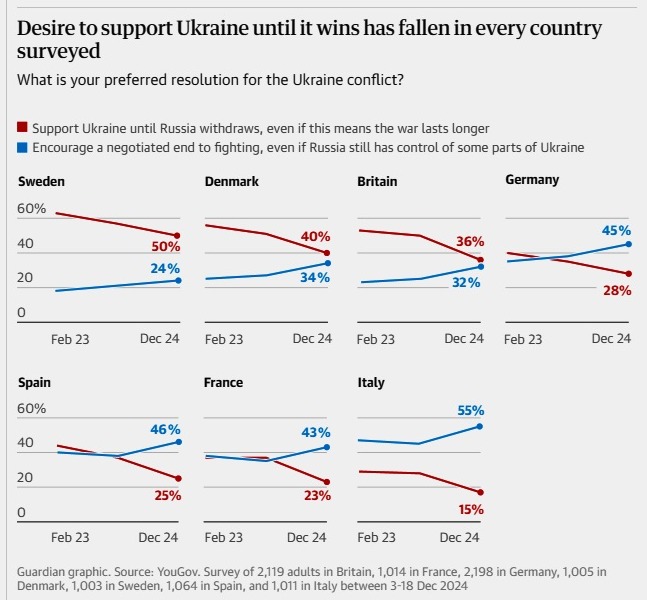
2 Majorities in Poland and Italy (both 55%) support a negotiated settlement over supporting Ukraine for as long as it takes to restore the 1991 borders. Almost twice as many also support negotiations over those who argue for fighting on in Germany (45% -28%) and France (43% – 23%) twice as many in Spain (46% -23%) even more than that in Italy (55% – 15%). Even in the UK, with its stifling pro-war consensus in Parliament and media, support for negotiations is now almost level pegging with support for fighting on (32% -36%). The trend in all countries is towards negotiation not endless war. By the time of NEU conference at Easter, on current trends, there will be a majority for negotiations here too. This is partly because only one in ten Europeans now believe that Ukraine can “win”; or that to do so would require an economically, militarily and humanly unsustainable level of military escalation; including crossing nuclear red lines.
3 Supporters of the motion should be asked if they support the £3 billion a year from the UK, “as long as it takes”, and the sharp increases in military spending now being posed as needed to counter the Russians, if not now, then in a suicidal land war in Europe within the decade. Trump is demanding 5%. Neil Kinnock says 4% would be “reasonable”. Kim Darroch says “more than 3%” would be needed. 5% of GDP on “defence” in the UK would require an additional £60 -70 billion a year. This cannot be done without cuts in every other area. Mark Rutte, of NATO, suggests this could come from “health and pensions”, but we can be sure that everything else, including schools – with 76% of primary schools and 94% of secondary schools already being threatened with cuts this year, even before this starts – and investment in climate transition, would be in the firing line too.
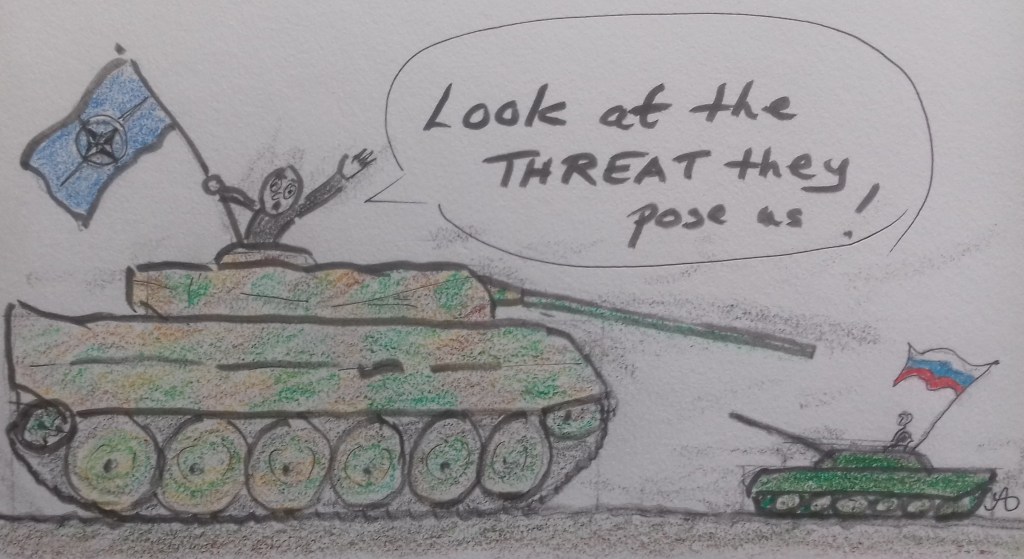
This infographic shows the comparative existing balance of military spending between NATO and the Russian Federation. For every £1 spent by the Russians, NATO spends £11. Even the European NATO powers outspend them by a ratio of £7 for every £1. Proposals to double that can’t realistically be described as “defensive”. We should not support it.
The USC Motion point by point.
- Self determination has to apply to all peoples in Ukraine, including the large Russian speaking minority in the East of the country and Crimea. The USC position is based on the delusion that there is one united Ukrainian people, which writes the Russians in the East of the country out of history as if they don’t exist and never have. They did, do, and have been asserting their independence since 2014. Any position on the war that does not recognise this is a denial of reality and principle.
- and 3. All children deserve a peaceful education on both sides of the front line. Hopefully we can all agree on that. The USC does not acknowledge that the Donbass has been shelled daily since 2014. Schools and colleges have been hit. Children have been killed. Their lives matter as much as those in the West.
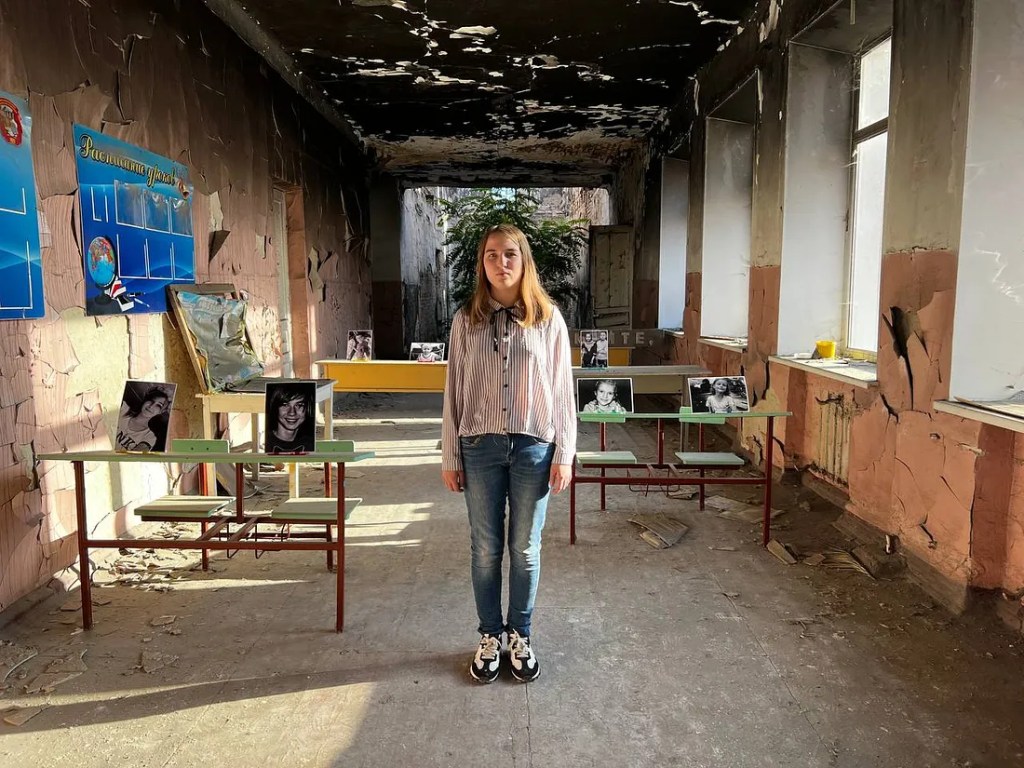
Faina Savenkova in the ruins of school №7 in Lugansk. It was not a warehouse or a military facility. Ordinary children studied in this school. But Ukraine destroyed it during its shelling of the city in 2014.
4. Calling for “Russia” to withdraw from “Ukrainian territory” does not recognise the unresolved national question in Ukraine and, as a result, is a call for the Russian speaking population of the Donbass and Crimea to become refugees en masse. Ukrainian military intelligence is quite clear that the people in these areas have “a completely different mindset” (Kyrillo Budanov, head of Ukranian Military Intelligence) requiring wholesale reeducation and anyone “with blood on their hands” would have to be “physically eliminated” (Budanov again). This could well mean all 55,000 members of the Donbass Militia. Hopefully, we can all oppose that.
5. This point is a cover for NATO to step up the war. When funding, munitions, weaponry, special forces and special advisers, “volunteers”, military technicians and satellite data are core to the war effort this makes it clear that this is not support for Ukraine from NATO, it is the Ukrainian government sacrificing its people on behalf of NATO. A neat formula expressing this relationship is President Zelensky’s comment that his aim is to build “a big Israel in Eastern Europe” – that’s to say, a powerful, technically proficient, military frontier state for the US, guaranteeing its interests in “a bad neighbourhood”. The price being paid by the Ukrainian working class for this ambition is appalling. The fulfillment of this ambition would not be a good development for the working class in Ukraine, or anywhere else.
6. At the moment the Russians are still able to grow their army with volunteers. By contrast, the early surge of volunteers in Ukraine has long subsided and there is now forced conscription with press gangs roaming the streets widespread draft resistance – with films of men being dragged off the streets into military minibuses and putting up a hell of a fight to stay free. In the Autumn there were demonstrations of relatives demanding to know the whereabouts of their sons, brothers, husbands who have disappeared at the front. UAF losses have been horrific, particularly since the start of the Kursk offensive. As a result, Western “supporters” of Ukraine like Senator Lindsay Graham, have been calling for conscription to be extended down from 27 to 18 years old to supply more bodies to feed into the war. President Zelensky has been resisting this so far, for the same reason that the call up age was so high in the first place. With a steep demographic decline since the break up of the USSR, resulting from a low birth rate combined with high emigration, the number of men in their twenties is about half that of men in their forties; so national survival depends to a large degree on not letting them get killed in large numbers. Hopefully we can all oppose that.
7. In the event of peace, the “Western backers” will call their loans in and asset strip the country and no one should have any delusions about that. Having sacrificed their sons for the West, the Ukrainian people will have their resources annexed by it for the privilege.
i) Opposing the Russian intervention without considering what came before is like opposing October 7th without considering 70 years of Israeli occupation. There had been a civil war in Ukraine since 2014, when the overthrow of an elected Russian leaning President by a mass movement in the West of the country, – supported organisationally and politically by the US and EU – led to a rebellion by people in Crimea, the South and the East of the country by Russian speakers who objected to the overthrow of a government they had voted for. This was crushed in Odessa, led to direct Russian intervention and annexation in Crimea and to a war in the Donbass, after the new government in Kyiv sent in the army and strafed Donetsk city with helicopter gunships. This war cost 14,000 lives up to 2022, mostly on the Donbass side of the front line.
Attempts to resolve this war through an agreement (at Minsk) to allow autonomy within Ukraine for the Donbass Republics were conceded by Angela Merkel to be an attempt to “buy time” while NATO trained up the Ukrainian Armed Forces so they’d be strong enough to retake the Donbass by force. At this point, the Russian stance was for the Minsk agreement to be implemented. They didn’t even recognise the Donbass Republics. This came to a head in the Winter of 2021 -22 when the formal process of starting Ukraine’s application to join NATO began.
The Russians had made it clear at least since the US backed Orange Revolution of 2004 -5 (hard to deny that this was a colour revolution, since the name is on the tin) that Ukraine being in NATO was as much of an existential threat to them as the US had seen Soviet missiles in Cuba in 1962. At that point the US had been prepared to risk nuclear war to get them out. The Russians were saying consistently that this was a similar red line for them. So, in the winter of 2021 -2 they put forward a mutual security treaty as a way to avoid the clash that, without it, they conceived was inevitable, if not now, then later when Ukraine was fully integrated and NATO felt able to chance its arm. NATOs refused even to negotiate on this, either because they thought the Russians were bluffing, or that if they weren’t the sanctions they had up their sleeve would be enough to bring them to their knees in short order. They were wrong about both. But, either way, an alliance interested in peace would have negotiated.
Deliberately pushing across the red lines of a nuclear armed state warning of an existential crisis for it is a level of reckless brinkmanship that puts us all at risk and our movement should be challenging that not supporting it.
ii) See point 2 above.
iii) and iv) All civilian deaths on both sides of the line are to be deplored, as are war crimes committed by soldiers of either side. Trying to present only one side as culpable of this, as this motion does, is reminiscent of editions of John Bull in 1915 banging the drum for recruitment in WW1 on stories of “German beastliness”, and it is dangerously similar to the far-right framing of the Azov battalion (or Benjamin Netanyahu) who see themselves in a struggle for Western civilisation against hordes of eastern Untermensch. In Vietnam, the US forces referred to the Vietnamese as “Gooks”. In Ukraine they refer to the Russians as “Orcs”. There is a continuity in this with the Ukrainian nationalists from WW2 led by Stepan Bandera, who are now celebrated in Kyiv, who fought with and for the Nazis, recruited guards for the concentration camps and massacred Polish villagers. The longer the war goes on, the more atrocities there will be.
v) The environmental damage is done by the war itself, not just by one side in it. Some of the most productive agricultural fields in the world are mined by both sides. The Nordstream gas pipeline was blown up by the US . The Zaporozhe nuclear power station was shelled by the Ukrainians for months, as was the Kakhovka dam. All these are good reasons for the war to end, not be pursued.
vi) It is the war and resulting sanctions that is disrupting the supply of food and fertilizer from Russia and Ukraine to the rest of the world. Another reason to end it.
vii) What the USC describe as “Russian occupied areas” are Russian speaking areas that rebelled against Ukrainian nationalism in 2014 and are now part of the Russian Federation; so it is entirely logical that schools there follow the Russian curriculum, not that of the state they rebelled agsinst.
viii) Evacuating children in orphanages and children’s homes from war zones is a necessary precaution to keep them safe. Perhaps the USC thinks it would have been better had the Russians left them in the firing line?
- Supporting the trade unions that support the oligarchy that support the war is in contradiction to
- supporting campaigns for working class interests, which requires the workers movement not to subordinate itself to its own oligarchy.
- 1.2 million of the refugees from the war fled to Russia – which is more than any other single country.
- Dissidents are also arrested in Ukraine, some have been murdered.
- All refugees should be treated with respect and care wherever they come from and whatever the reason.
The instructions for the Executive do not support a campaign to end the war and the suffering attendant on it.
All the links they propose are with organisations in the West of Ukraine that support the continuation of the war, and therefore the sacrifice and suppression of the working class. We should reach out to teachers in the Donbass too and should campaign for a ceasefire and peace talks without preconditions.
The NEU already has guidance for supporting refugee children that we should be pressing employers to use for all refugee children.
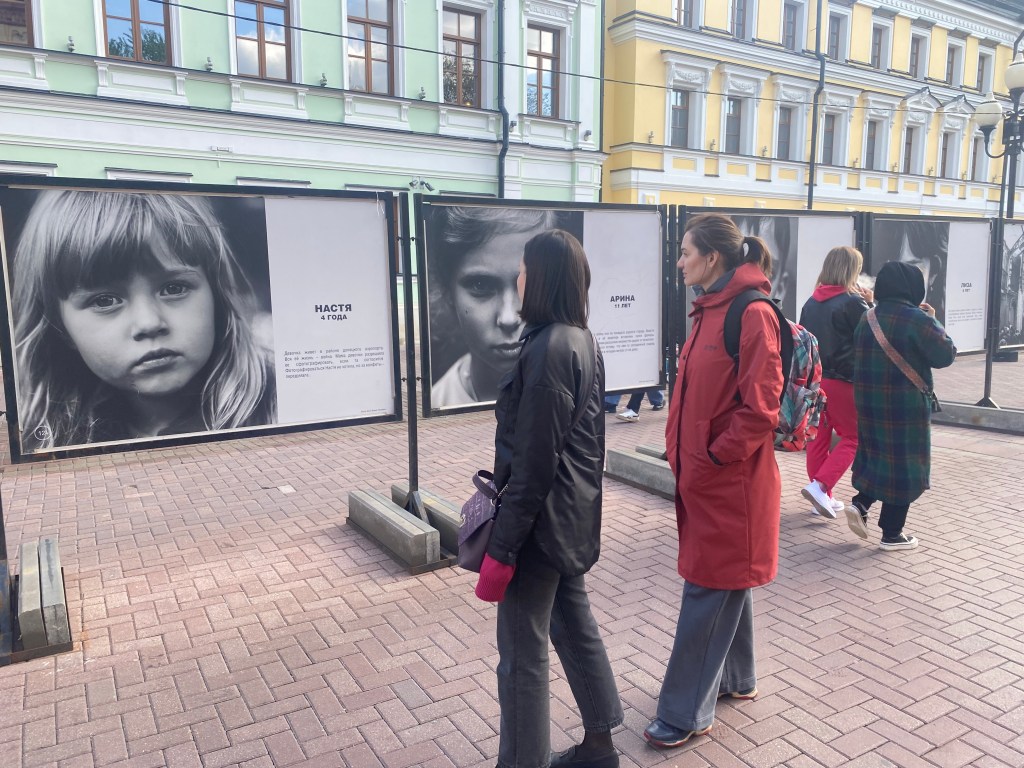
Photos of children killed in the Donbass by Ukrainian shelling from 2014 onwards on display on the Arbat in Moscow. There are more than 300 of them. Photo Dan Kovalic
 Urban ramblings