Before anyone gets any impression that the Selby by election represents a mass move endorsement of Labour’s current attempt to drift into office on the back of Conservative unpopularity, all of the by elections on July 20th should provide food for thought.
Selby has been presented as the clearest evidence of a potential landslide, and much made of the swing from Tory to Labour. When you look at actual voters, however, its clear that there is no massive surge of Labour support, with a slight increase on the votes achieved in the bleak midwinter of 2019, but a drop from the high watermark of Corbynism in 2017. This indicates that Labour was able to mobilise some of its core vote in this constituency, but not all of it.

The swing is accounted for by the collapse of the Tory vote, from 33,995 in 2019 to 12,295 this week. A drop of almost two thirds.
A further indication that it is antipathy to the Tories that is driving these results rather than positive support for Labour is show by the votes in Somerset and Frome, where the Conservative vote also plummeted by two thirds, from 33,231 to 10,179.
Its quite clear that most of Labour’s previous voters in this constituency voted for the Lib Dems, whose 13,325 voters in 2017 were barely 3% ahead of Labour’s 10,998. The Labour vote is now less than a tenth of what it was then and is now a quarter of the vote achieved by the Greens, whose vote doubled.

In Uxbridge, the Labour vote was down about a quarter on both 2017 and 2019 from over 18,000 in both years to 13,470.
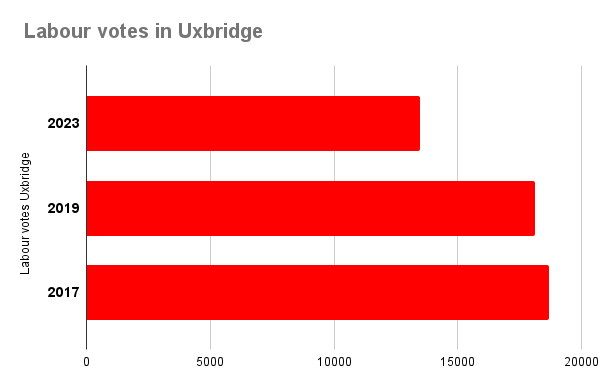
The Conservative vote, however, dropped by a “only” a half from 25,351 to 13,965. If this is the straw of comfort that the Conservatives are grasping at, it shows how desperate their situation is.
The notion, now being energetically pushed by the Labour leadership, that the Uxbridge result shows the need to back off from any policy that might scare off current Conservative voters is belied by the utter failure to motivate and mobilise Labour’s potential vote in these constituencies. The stances taken on issues like the two child cap on child benefit, that led to the moniker “Sir Kid Starver” circulating all across social media, will hardly have driven our people to the polls with any enthusiasm.
And, as for the ULEZ, this post from Open Democracy indicates that it was the failure to fight for it that was one of the factors that kept potential Labour supporters at home, the opposite of the conclusion that the Party leadership is so eager to draw. As they put it.
…Russell Warfield, a campaigner with the environmental group Possible says – is that there is a “hardened rump” of Conservative, anti-ULEZ, pro-car voters in the outer-London boroughs. And we already knew that: polling shows that, while a majority of Londoners back ULEZ expansion, most Tories oppose it.
Specific polling in a group of London boroughs where councils are taking legal action against Sadiq Khan over the scheme – including Hillingdon, which overlaps with Uxbridge and South Ruislip – found a majority of people in these areas who are deeply concerned about air pollution. (My emphasis)
Just as there is a block of anti-ULEZ people capable of being mobilised by the Tories, there is a group of pro-ULEZ people that Labour could have mobilised had they tried. But instead, the party’s candidate came out against the scheme, Starmer sat on the fence, and the potential Labour voters sat at home.
 Urban ramblings
2 thoughts on “Labour Votes in Uxbridge, Selby and Ainsty down on 2017”