
With the 80th anniversary of VE Day being treated as a celebration, affirming the “glorious past” that Reform’s Andrea Jenkyns would like us to be dragged back into, and a recent YouGov survey showing
1. That a majority of people in the Uk believe that the defeat of Nazi Germany was primarily because of the efforts of the UK, with significant support from the United States and a tiny contribution from the Soviet Union; the exact reverse of what actually occured and
2. that 70% of the people surveyed think it likely that there will be another World War within the next 50 years.
its important to put the historical record straight.
The disturbing aspect of the latter point is that this is being set up with a kind of fatal fatalism. With the current Labour government’s Defence Review premised on being in a “pre war period” and this being reported without any serious questions revealing either
1 That the UK and its allies have been in a state of more or less constant war for decades, so “pre war” is hardly an appropriate phrase.
2 A state of preparing for a war with “Russia, China, Iran, North Korea” – the countries listed as “the deadly quartet” by George Robertson in the Defence Review- or all four at once, is preparing for a nuclear war. With the USA having a “first strike strategy” designed to overwhelm it targets with a wholesale nuclear assault that would not only slaughter millions in a matter of hours, it would also cause a nuclear winter that would make human life untenable on this planet thereby finishing us all off even if “successful”. This is therefore an insane course of action that anyone remotely interested in human survival should be busting every nerve to oppose.
The story that is told of World War 2 in the UK is done through local optics and has a distinct moral arc. From early hesitancy, Chamberlain and Phoney War, to survival and stand alone defiance in the face of disaster, Dunkirk, Churchill, the Battle of Britain, the Blitz and the Battle of the Atlantic, through to the turn of the tide at El Alamein, Atlanticism affirmed by the USA arriving (late but welcome) like the cavalry in a Western, D-Day, a Bridge too far, late atrocities from Doodlebugs to Belsen until the final victory with Hitler dead in his bunker.*
This was a titanic struggle and left almost half a million UK dead between 1939 and 1945. Thats about 1 in every 100 people. Most families lost someone. Mine lost 2. None of that should be downplayed. But, unfortunately viewing this war through domestic lenses means that an overall objective perspective is usually lost and distorted. Its a bit like viewing the world through a virtual reality helmet that makes everything away from the foreground almost invisible.
When I read an account of the Battle of El Alamein in The Eagle in the 1960s, it was headlined as the turning point of the war. At the end of the article was a single reference to another battle that took place at the same time in Russia called Stalingrad. But that was it. It was referenced as a relatively obscure event. And this sums up how most people here see the Eastern Front. Shrouded in mist. Probably nothing like as significant as the events “we” were involved in.
This graph shows the numbers involved in the two battles. It is quite clear which was the more decisive event.

The casualties in both battles underlines the complete imbalance between the scale of the struggles. El Alamein was an important defeat for the Axis, but Stalingrad was crushing and decisive.

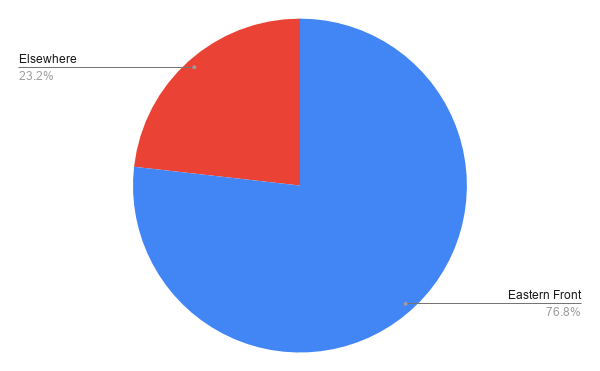
And this is not an aberration or an isolated example. The German armed forces were predominantly deployed on the Eastern Front. This graph shows the deployment in 1942 when 139 of 181 Divisions were concentrated on the Russians; (2) but this was the characteristic pattern from the initial attempt at an overwhelming Blitz in Operation Barbarossa in 1941, through Stalingrad in 1942, the greatest tank battle in world history at Kursk in 1943, right through the huge Soviet offensive of Operation Bagration in 1944, at the same time as D Day, that crushed 28 out of 34 Nazi divisions, effectively destroying Army Group Centre, and on to the final Gotterdammerung of 1945.
This is reflected in the the overall casualty figures for each country; which can be quite startling when you first look at them. (3)
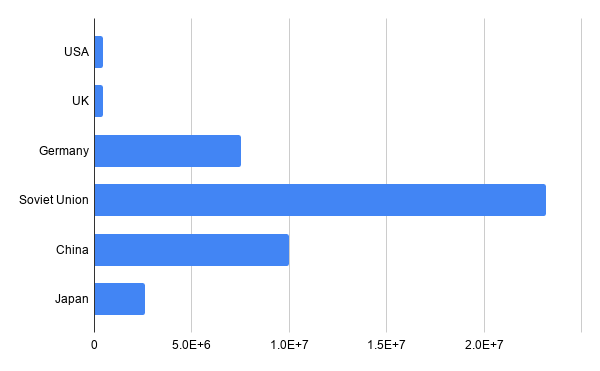
The scale of the loss of life in the Soviet Union stands out. UK losses were 1 in every 100 people. Soviet losses were 1 in every 7. Think about the scale of that for a moment. We should reflect on what that means about what that war was, where most of it was fought; and adjust our historical memory accordingly. For the Nazis, the war in the West was a war between colonising powers, the war in the East was a war of extermination against Untermensch. A very good way to get a fuller grasp of this and the sheer scale of the Soviet resistance to it, is to read Vasily Grossman’s epic novel Stalingrad (the Twentieth Century’s answer to War and Peace). It was the Red Army who broke the back of the Wehrmacht and therefore of the Nazi regime; and we should give respect where it is due.
*This narrative is bolstered by annual commemorations and a huge output of books, films, TV series, from documentaries to comedies. I wrote the first version this with the BBC News D Day output in full flight behind me. At one time The Great Escape was shown so often at Xmas that a greetings card was produced showing a motor cyclist in the distance with mountains behind him and the legend “This year Steve McQueen will make it over the wire.” So World War 2 – even as it fades from living memory – remains a dominant touchstone of popular national culture and people are encouraged to identify themselves within the glow of its myths. And this is very potent. The Washington Post reported a few years ago that surveys of opinion in the UK showed that most people believed that World War 2 was the defining and most crucial moment in British history. The same article pointed out that surveys of opinion everywhere else in the world showed the view that this was the British Empire. The disjunct is revealing and characteristic. In every national crisis the media reach for World War 2 metaphors and play the Vera Lynne records, dust off the Churchill quotes, and we are invited to keep calm and know our place. This enables the ruling class to make any number of screw ups safe in the knowledge that anyone seeking to point out awkward truths can be painted as someone who is trying to “politicise a crisis” or, in extremis, is a “traitor”. As long as we go along with it, this locks us into an interpretation of ourselves which cements us into roles and stances defined by the social relations appropriate to late Empire, and thereby makes facing uncomfortable realities more difficult and moving beyond our limitations impossible, and gets us ready for more wars as a continuation of the same national epic. When the Queen ended her pep talk on Coronavirus with the words “We’ll meet again” perhaps the most appropriate response is “We can’t keep meeting like this.” And remembering the Bear in the room is one step in helping us to do that.
- Figures from here. https://en.wikipedia.org/wiki/Battle_of_Stalingrad https://en.wikipedia.org/wiki/Second_Battle_of_El_Alamein
- Figures from here. https://ww2-weapons.com/deployment-german-forces-1942/https://ww2-weapons.com/deployment-german-forces-1942/
- Figures from here. https://war.wikia.org/wiki/World_War_II_casualties
 Urban ramblings